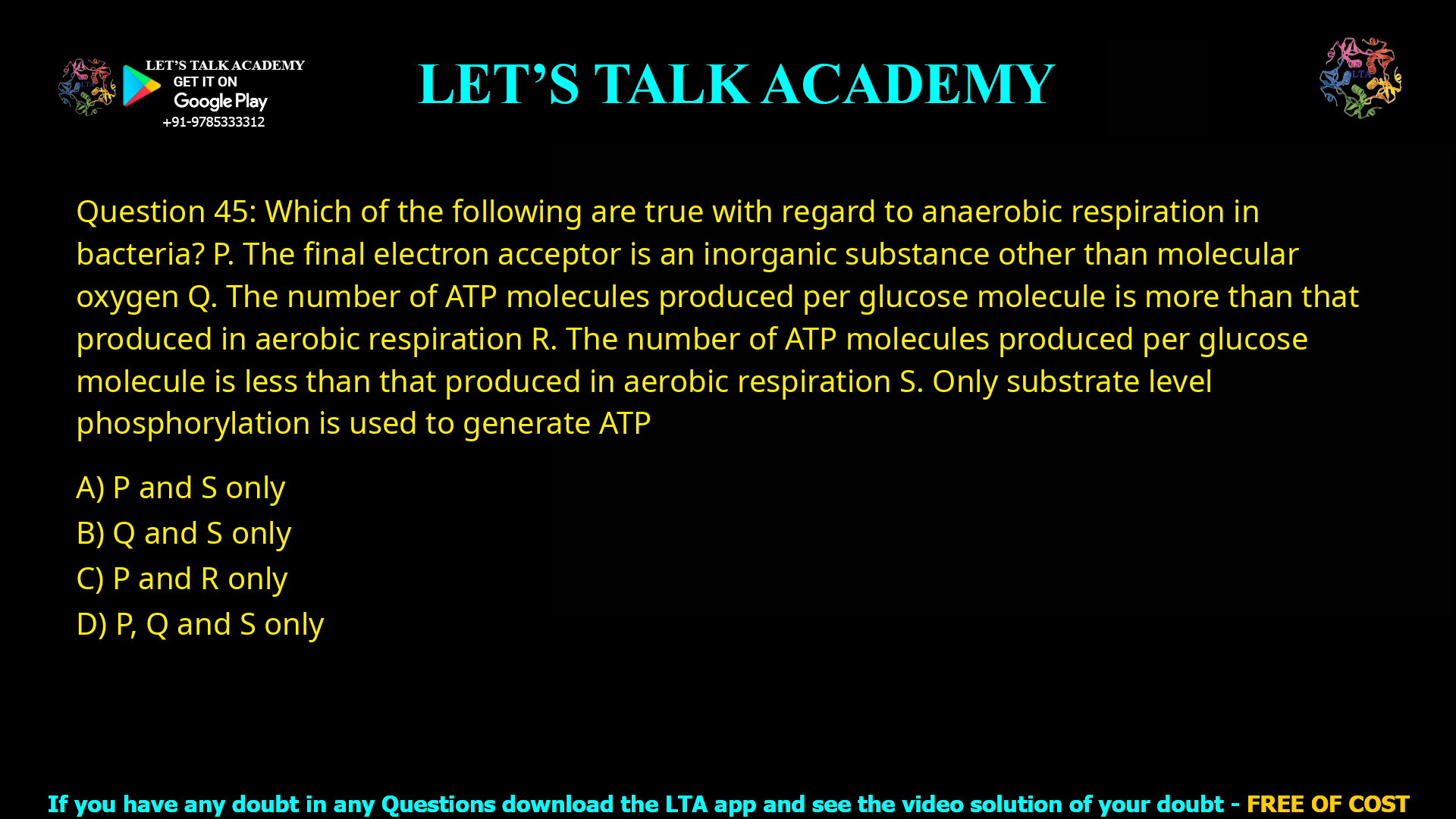
Q.45 Which of the following are true with regard to anaerobic respiration in bacteria?
P. The final electron acceptor is an inorganic substance other than molecular oxygen
Q. The number of ATP molecules produced per glucose molecule is more than that produced
in aerobic respiration
R. The number of ATP molecules produced per glucose molecule is less than that produced
in aerobic respiration
S. Only substrate level phosphorylation is used to generate ATP
(A) P and S only (B) Q and S only
(C) P and R only (D) P, Q and S only
Anaerobic respiration in bacteria uses inorganic molecules like nitrate or sulfate as final electron acceptors instead of oxygen, yielding less ATP than aerobic processes. The correct answer to the given multiple-choice question is (C) P and R only.
Correct Answer
Option (C) P and R only identifies the accurate statements about anaerobic respiration in bacteria.
Option Analysis
P: True
Anaerobic respiration relies on inorganic substances such as nitrate (NO₃⁻), sulfate (SO₄²⁻), or ferric iron (Fe³⁺) as the final electron acceptor, excluding molecular oxygen (O₂).
Q: False
Anaerobic respiration produces fewer ATP molecules per glucose (typically 2-38, depending on the acceptor) compared to aerobic respiration’s consistent ~30-38 ATP via full oxidative phosphorylation.
R: True
Due to weaker electron acceptors with lower reduction potentials, anaerobic pathways generate less proton motive force, resulting in fewer ATP molecules than aerobic respiration.
S: False
Bacteria employ both substrate-level phosphorylation (e.g., in glycolysis) and oxidative phosphorylation via electron transport chains, unlike fermentation which uses only substrate-level.
Key Differences Table
| Aspect | Aerobic Respiration | Anaerobic Respiration |
|---|---|---|
| Final Electron Acceptor | O₂ (high reduction potential) | Inorganic (e.g., NO₃⁻, less potential) |
| ATP Yield per Glucose | ~30-38 ATP | Less (~2-38 ATP) |
| Phosphorylation Types | Substrate + oxidative | Substrate + oxidative |


