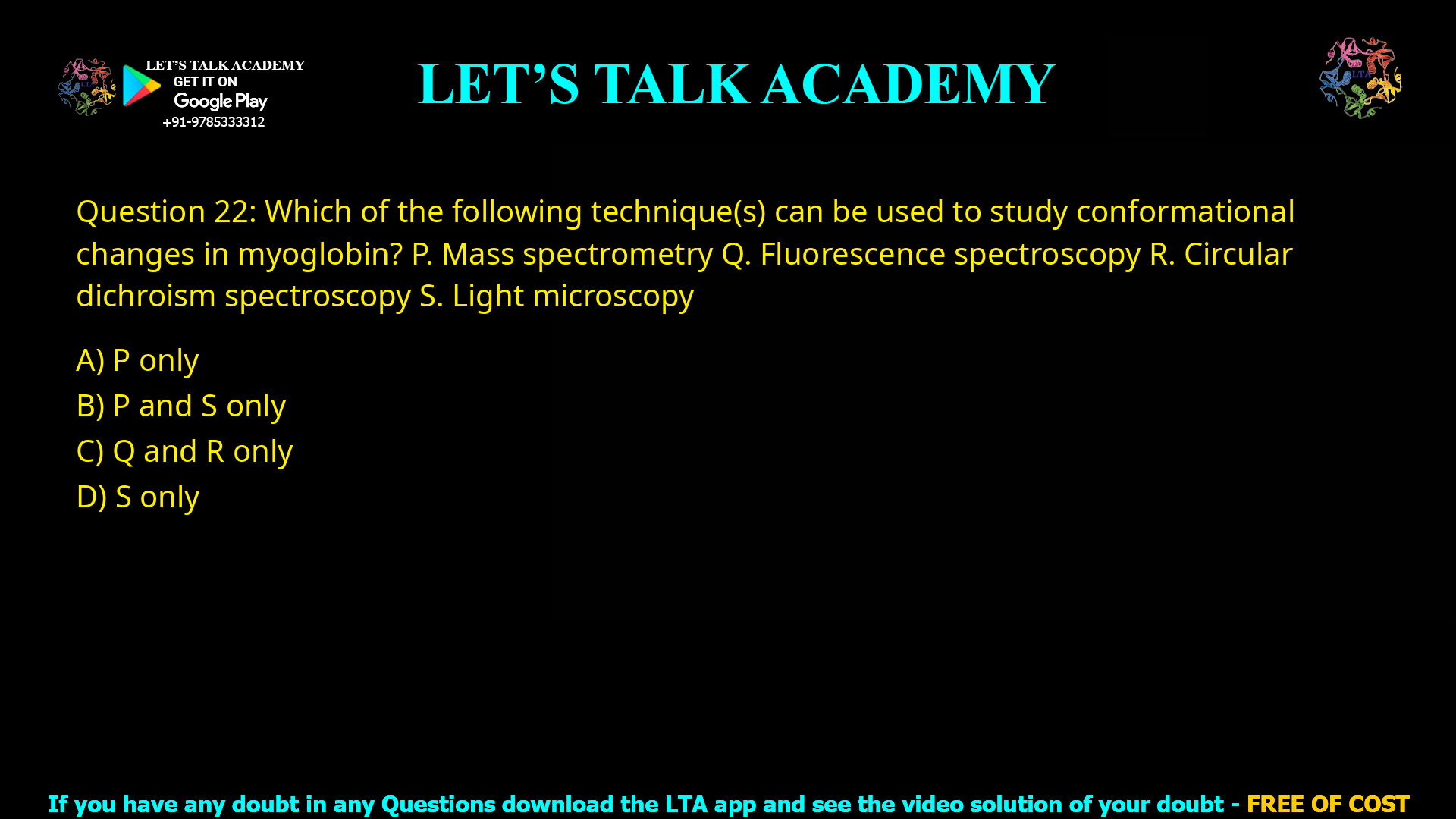
Q.22 Which of the following technique(s) can be used to study conformational changes in
myoglobin?
P. Mass spectrometry
Q. Fluorescence spectroscopy
R. Circular dichroism spectroscopy
S. Light microscopy
(A) P only (B) P and S only (C) Q and R only (D) S only
Conformational changes in myoglobin, a key oxygen-binding protein, involve shifts in its 3D structure that can be probed by specific biophysical techniques. Among the options—mass spectrometry (P), fluorescence spectroscopy (Q), circular dichroism spectroscopy (R), and light microscopy (S)—only Q and R effectively monitor these changes. The correct answer is (C) Q and R only.
Option Analysis
P. Mass spectrometry
Mass spectrometry (MS) excels at measuring molecular mass, identifying proteins, and detecting post-translational modifications or binding partners. However, standard MS does not directly report on conformational dynamics, as ionization often unfolds proteins, erasing native structure information. Specialized variants like hydrogen-deuterium exchange MS (HDX-MS) or ion mobility MS can indirectly infer conformation via solvent accessibility or collision cross-sections, but these are not implied by “mass spectrometry” alone in this context.
Q. Fluorescence spectroscopy
Fluorescence spectroscopy detects conformational changes by tracking shifts in intrinsic fluorophores like tryptophan residues in myoglobin. Unfolding alters the polarity around these residues, causing emission wavelength shifts (blue for buried, red for exposed) or quenching by nearby groups like the heme. Urea-induced unfolding studies confirm fluorescence tracks myoglobin’s two-state transition accurately.
R. Circular dichroism spectroscopy
Circular dichroism (CD) spectroscopy measures differential absorption of left- and right-circularly polarized light, revealing secondary structure content via far-UV signals (α-helix at ~222 nm dominates myoglobin’s spectrum). Conformational changes disrupt helices, altering CD spectra distinctly. This technique routinely monitors protein folding/unfolding, including myoglobin.
S. Light microscopy
Light microscopy visualizes cells or large structures at ~200 nm resolution but lacks atomic-level precision for single protein conformations like myoglobin (~4.5 nm size). It cannot resolve or track molecular dynamics in solution.
Why Q and R Excel for Myoglobin Studies
Myoglobin’s globular fold with 8 α-helices and a heme prosthetic group makes it ideal for spectroscopic methods sensitive to local (fluorescence) and global (CD) changes. Studies on photodissociation or denaturation use these to quantify kinetics, as infrared or fluorescence probes confirm picosecond-to-second dynamics. For researchers in molecular biology, combining Q and R provides complementary data: fluorescence for tertiary contacts, CD for secondary structure.
This selection aligns with GATE Biotechnology exam patterns, emphasizing technique applicability in protein biochemistry.


