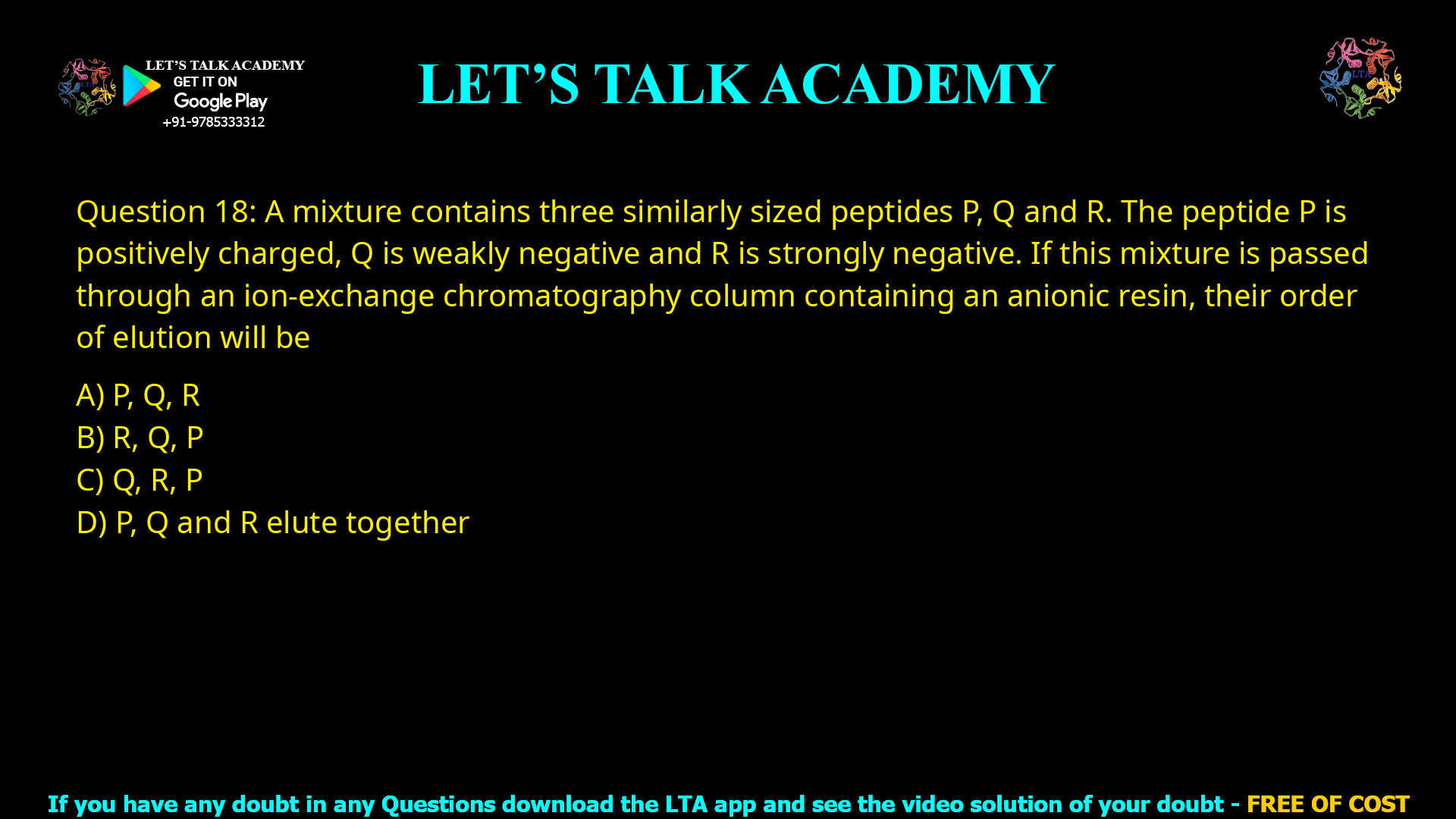
Q.18 A mixture contains three similarly sized peptides P, Q and R. The peptide P is positively
charged, Q is weakly negative and R is strongly negative. If this mixture is passed through
an ion-exchange chromatography column containing an anionic resin, their order of elution
will be
(A) P, Q, R (B) R, Q, P
(C) Q, R, P (D) P, Q and R elute together
Correct Answer: (A) P, Q, R
An anionic resin in ion-exchange chromatography has positively charged groups that bind negatively charged molecules, allowing positively charged ones to pass through unbound. Since peptides P, Q, and R are similarly sized, charge determines elution: P (positive) elutes first, followed by Q (weakly negative) and R (strongly negative).
Anionic Resin Basics
Anion-exchange chromatography uses a stationary phase with positive charges (e.g., diethylaminoethyl groups) to attract anions. Positively charged peptides like P do not bind and elute immediately in the flow-through. Negatively charged peptides Q and R bind based on charge strength; elution occurs via increasing salt gradient, where weaker binders (Q) release before stronger ones (R).
Option Analysis
-
(A) P, Q, R: Correct. P flows through unbound; Q’s weak negative charge causes minimal binding, eluting early; R’s strong negative charge binds tightly, requiring higher salt for elution.
-
(B) R, Q, P: Incorrect. Strongly negative R binds most firmly and elutes last, not first; positives do not bind ahead of negatives.
-
(C) Q, R, P: Incorrect. Q elutes before R due to weaker binding, but neither precedes unbound P.
-
(D) P, Q and R elute together: Incorrect. Differing charges cause sequential binding and elution, not co-elution, despite similar sizes.
Ion-exchange chromatography anionic resin peptide elution order is a key concept in biotechnology purification techniques, especially for separating charged biomolecules like peptides. This method leverages electrostatic interactions to isolate peptides based on net charge, crucial for research in molecular biology and protein analysis. In scenarios with similarly sized peptides—such as positively charged P, weakly negative Q, and strongly negative R—the elution sequence follows principles of binding affinity on an anionic resin.
How It Works
Anionic resins feature positively charged stationary phases that selectively bind anions. Positively charged peptides pass through without retention, while negative ones bind proportionally to charge density. A salt gradient (e.g., NaCl) disrupts these interactions, eluting weakly bound species first. This ensures precise separation in applications like enzyme purification or proteomics.
Practical Applications
-
Biotech Research: Separates peptides for downstream sequencing or structural studies.
-
Pharma Development: Purifies therapeutic peptides by charge.
-
Exam Prep: GATE Biotechnology questions test this for techniques like PCR follow-up analysis.
This approach highlights why charge trumps size in such columns, optimizing yields in lab workflows.


