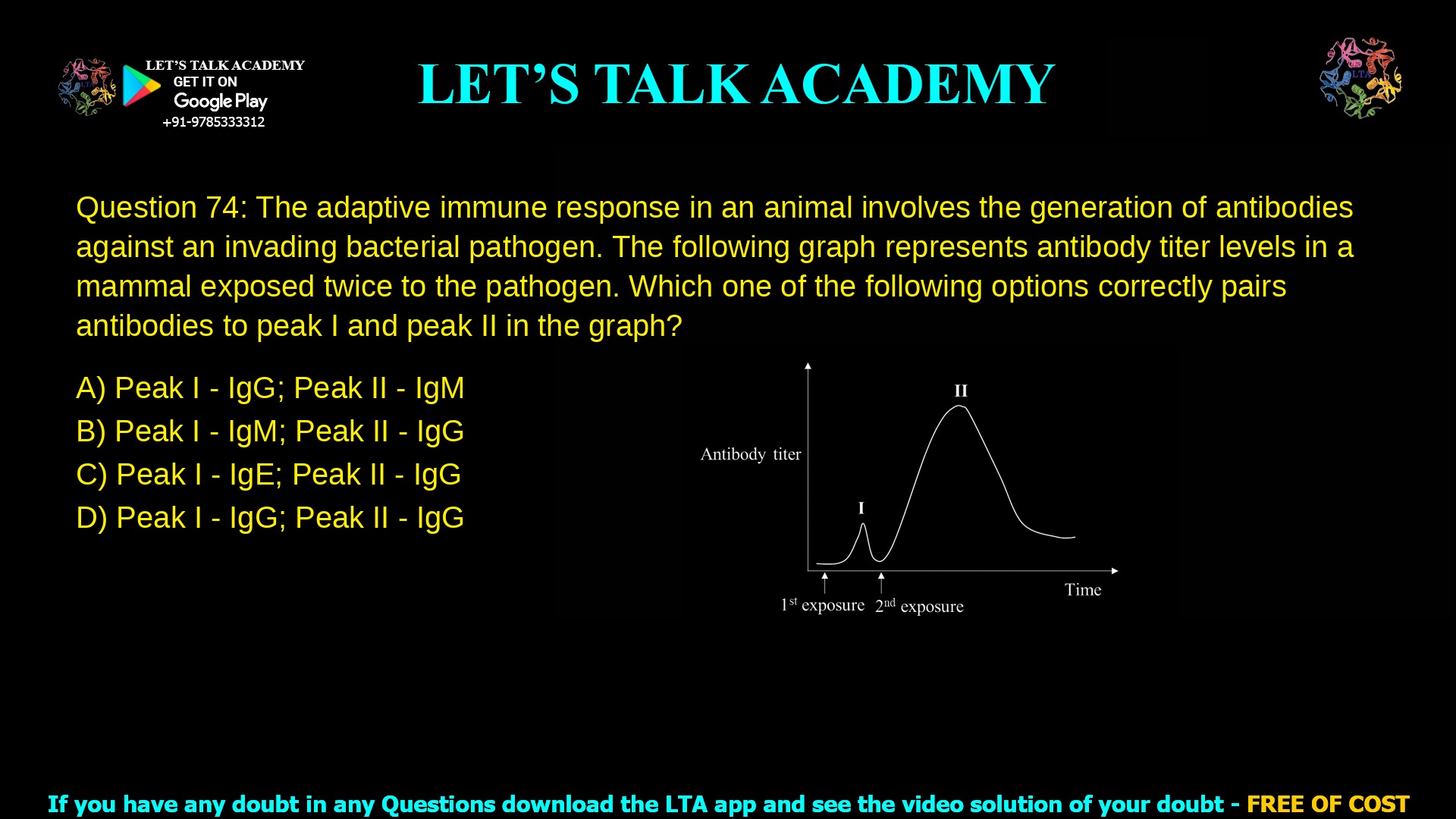
Q.74 The adaptive immune response in an animal involves the generation of
antibodies against an invading bacterial pathogen. The following graph
represents antibody titer levels in a mammal exposed twice to the pathogen.
Which one of the following options correctly pairs antibodies to peak I
and peak II in the graph?
(A) Peak I – IgG; Peak II – IgM
(B) Peak I – IgM; Peak II – IgG
(C) Peak I – IgE; Peak II – IgG
(D) Peak I – IgG; Peak II – IgG
The correct answer is (B) Peak I – IgM; Peak II – IgG.
Peak I represents the weaker, slower primary immune response dominated first by IgM, whereas Peak II represents the stronger, faster secondary response dominated by IgG.
Introduction
In adaptive immunity, antibody titers after first and second exposure to the same pathogen follow a characteristic pattern that distinguishes the primary and secondary immune responses. Understanding which immunoglobulin class (IgM or IgG) dominates each peak in such graphs is a frequent exam concept, including in GATE 2025 Life Sciences Question 74. This article uses the classic primary and secondary immune response IgM IgG graph to explain every option and clarify the correct answer.
Concept: Primary vs secondary antibody responses
-
During the primary immune response (first exposure), naïve B cells are activated and initially secrete mainly IgM; IgG appears later and at lower titer, so the first small peak is largely IgM.
-
On secondary exposure to the same antigen, memory B cells rapidly produce a much higher and faster response dominated by IgG, generating a taller second peak with greater antibody titer and longer duration.
In the given graph, Peak I (after 1st exposure) is small and delayed, while Peak II (after 2nd exposure) is large and rapid, matching the typical primary (IgM‑rich) and secondary (IgG‑rich) responses respectively.
Option‑wise explanation
Option (A): Peak I – IgG; Peak II – IgM
-
IgG is not the predominant antibody at the very beginning of a primary response; IgM is produced first and dominates early.
-
A secondary response being dominated by IgM contradicts immunology basics, because memory B cells have undergone class switching and mainly secrete IgG (or IgA/IgE depending on context).
Therefore, Option (A) reverses the physiological sequence and is incorrect.
Option (B): Peak I – IgM; Peak II – IgG ✅
-
IgM is the first antibody isotype secreted when an antigen is encountered, giving the smaller, slower primary peak (Peak I) in the graph.
-
On re‑exposure, IgG rises quickly to high titers due to memory B cells, explaining the large, sharp secondary peak (Peak II); this is the classic pattern shown in standard immunology graphs.
Thus, Option (B) correctly pairs the antibody classes with the primary and secondary peaks and is the right answer.
Option (C): Peak I – IgE; Peak II – IgG
-
IgE is largely associated with allergic reactions and defense against helminths, not with being the main antibody of a primary systemic response to a typical bacterial pathogen.
-
While IgG correctly matches the secondary peak, assigning IgE to Peak I ignores the well‑established predominance of IgM in primary responses, so this option is incorrect.
Option (D): Peak I – IgG; Peak II – IgG
-
Using IgG for both peaks fails to represent the early IgM‑rich phase of the primary response documented in textbooks and reviews.
-
Although IgG is indeed important in both responses, especially late in the primary and throughout the secondary, the first peak immediately after initial exposure cannot reasonably be labeled as purely IgG, making this option incorrect.
Key takeaway for exams
-
Remember: “First IgM, then IgG” in the primary response, and “Fast, high IgG” in the secondary response to the same antigen.
-
Whenever a graph shows a small first peak and a large second peak in antibody titers after repeated exposure, assign IgM to the primary (first) peak and IgG to the secondary (second) peak, leading to the correct pairing as in Option (B).


4 Comments
Ritika Jangir
January 8, 2026Done
Sonal Nagar
January 8, 2026Option 2
Payal Gaur
January 10, 2026Option B peak 1 IgM and peak 2 IgG
Bhanwar
January 26, 2026First IgM, then IgG