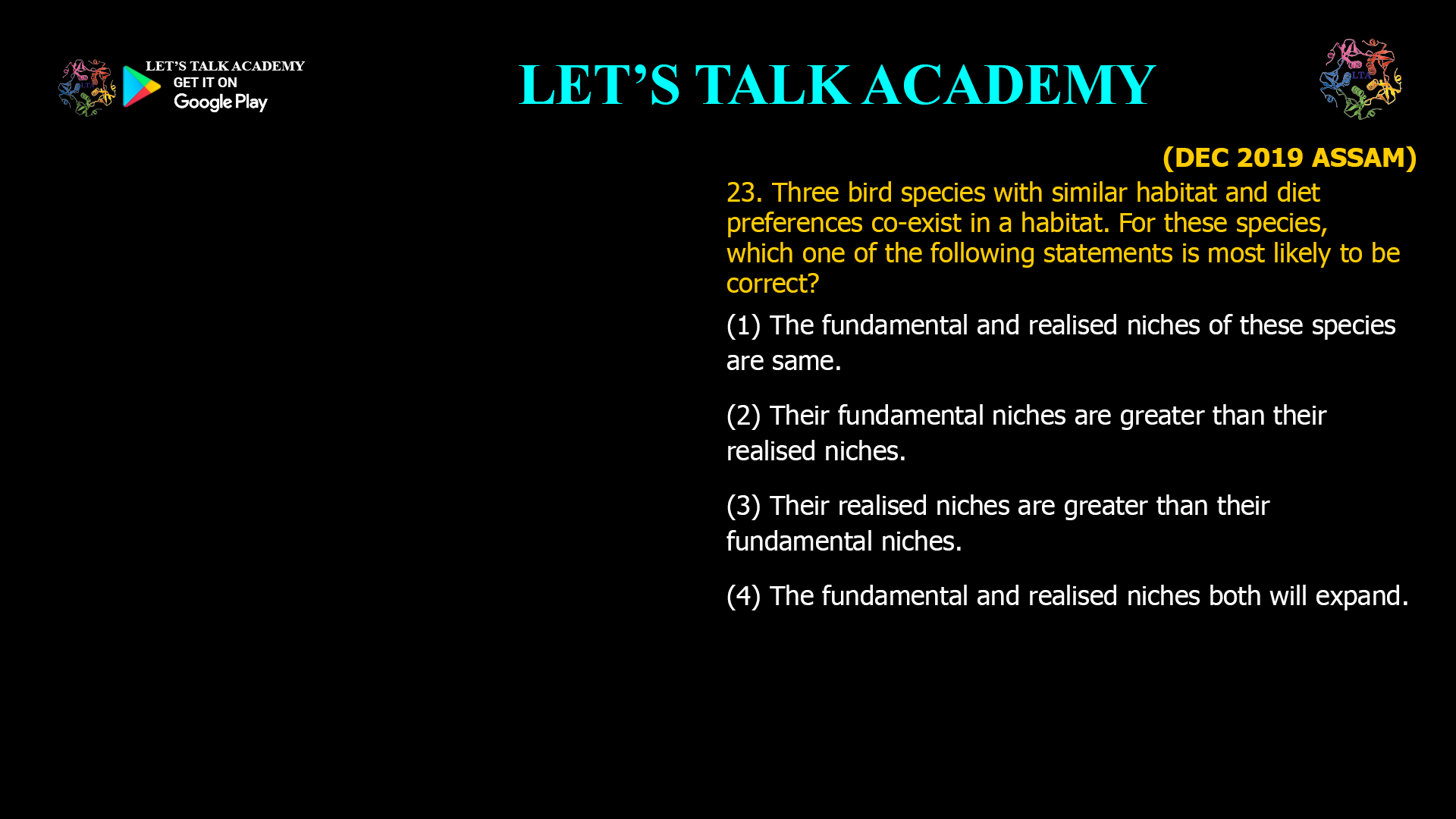
- Three bird species with similar habitat and diet preferences co-exist in a habitat. For these species, which one of the following statements is most likely to be correct?
(1) The fundamental and realised niches of these species are same.
(2) Their fundamental niches are greater than their realised niches.
(3) Their realised niches are greater than their fundamental niches.
(4) The fundamental and realised niches both will expand.
How Three Bird Species Coexist: Understanding Niche Dynamics and Competition
In the vibrant world of ecology, the coexistence of multiple species with similar needs is a fascinating puzzle. When three bird species share the same habitat and have comparable diet and habitat preferences, how do they manage to live together without one species outcompeting the others? The answer lies in the interplay between fundamental and realized niches and the subtle ways species partition resources. This article explores the ecological principles that allow such coexistence, the importance of niche differentiation, and what these dynamics mean for biodiversity and ecosystem health.
The Puzzle of Coexistence
At first glance, it seems unlikely that three bird species with similar requirements could coexist in the same area. According to the principle of competitive exclusion, two species with identical niches cannot indefinitely share the same environment—one will eventually outcompete the other. Yet, in nature, we often observe multiple species living side by side, even when their needs overlap. How is this possible?
Fundamental Niche vs. Realized Niche
To understand coexistence, it’s essential to distinguish between two key ecological concepts:
-
Fundamental Niche: The full range of environmental conditions and resources a species can theoretically use in the absence of competitors, predators, or other biotic constraints. This is the species’ “potential” niche—where it could thrive if left alone.
-
Realized Niche: The actual range of environmental conditions and resources a species occupies in the presence of competitors, predators, or other biotic factors. This is the species’ “real-world” niche—where it actually thrives, given the constraints of its environment.
When multiple species with similar needs coexist, each species’ realized niche is typically smaller than its fundamental niche due to competition.
Niche Partitioning: The Key to Coexistence
Niche partitioning is the process by which competing species use the environment and resources in different ways, allowing them to coexist. This can happen in several ways:
-
Spatial Partitioning: Species use different parts of the habitat. For example, one bird species may forage in the canopy, another in the understory, and a third on the ground.
-
Temporal Partitioning: Species are active at different times. Some birds may feed early in the morning, others at midday, and some in the evening.
-
Dietary Partitioning: Species specialize in different food items or sizes. One bird may eat large insects, another small insects, and a third seeds or fruit.
-
Behavioral Differences: Species may have different foraging techniques or social behaviors that reduce direct competition.
Through these mechanisms, each species carves out its own realized niche within the broader fundamental niche, minimizing competition and allowing coexistence.
How Competition Shapes Niches
Competition is a powerful force in shaping species distributions and behaviors. When three bird species with similar habitat and diet preferences live together, each species is forced to adapt or specialize to reduce competition. This leads to:
-
Reduced Overlap: Each species uses a slightly different subset of resources or occupies a different part of the habitat.
-
Smaller Realized Niches: The realized niche of each species is smaller than its fundamental niche because competition restricts access to some resources or areas.
-
Increased Specialization: Over time, species may evolve to become more specialized, further reducing competition and promoting coexistence.
Why Fundamental Niches Are Greater Than Realized Niches
Given these dynamics, it is clear that the fundamental niche of each bird species is larger than its realized niche when competitors are present. In the absence of competitors, each species could theoretically use a broader range of resources and occupy more of the habitat. However, when other species are present, competition forces each bird to stick to a narrower set of conditions and resources—its realized niche.
This principle holds true not just for birds, but for all organisms that share similar needs and compete for resources. It is a fundamental rule of ecology that helps explain the diversity and complexity of natural communities.
Real-World Examples of Niche Partitioning
Nature is full of examples where niche partitioning allows similar species to coexist:
-
Darwin’s Finches: On the Galápagos Islands, different finch species have evolved distinct beak shapes and sizes, allowing them to specialize on different types of seeds and avoid direct competition.
-
Warblers in North American Forests: Several warbler species coexist by foraging in different parts of the same tree—some in the canopy, others in the middle, and some near the ground.
-
African Savanna Herbivores: Grazers like zebras, wildebeests, and gazelles coexist by specializing on different grasses or parts of the grass, reducing competition for food.
These examples illustrate how niche partitioning enables species with similar needs to live together in harmony.
The Role of Evolution in Niche Dynamics
Over time, competition drives evolutionary changes that further reduce niche overlap. Species may evolve new behaviors, morphologies, or physiological traits that allow them to exploit different resources or habitats. This process, known as character displacement, is a key mechanism for maintaining biodiversity and preventing competitive exclusion.
The Importance of Niche Dynamics for Biodiversity
Understanding niche dynamics is crucial for conserving biodiversity. By recognizing how species partition resources and coexist, ecologists can better predict how communities will respond to environmental changes, such as habitat loss, climate change, or the introduction of invasive species.
-
Ecosystem Resilience: Communities with diverse niches are more resilient to disturbances because multiple species can perform similar ecological roles.
-
Conservation Strategies: Protecting a variety of habitats and resources ensures that species have the opportunity to partition niches and coexist.
-
Restoration Ecology: Restoring degraded habitats should aim to recreate the conditions that allow for niche partitioning and coexistence.
Misconceptions About Niche and Coexistence
There are several common misconceptions about niche and coexistence:
-
Identical Niches: Some people believe that species with identical niches can coexist indefinitely, but this is not supported by ecological theory or evidence.
-
Expanding Niches: It is sometimes thought that realized niches can be larger than fundamental niches, but this is not the case—realized niches are always equal to or smaller than fundamental niches.
-
Niche Expansion with Competition: Competition does not expand niches; it restricts them. Only facilitation or the removal of competitors can allow a species to expand its realized niche toward its fundamental niche.
Practical Implications for Birdwatchers and Conservationists
For birdwatchers and conservationists, understanding niche dynamics can enhance the appreciation and protection of avian diversity. By observing how different bird species use the habitat and resources, one can gain insights into the health and complexity of the ecosystem.
-
Habitat Management: Creating diverse habitats with multiple layers (canopy, understory, ground) supports more bird species by providing opportunities for niche partitioning.
-
Monitoring Populations: Tracking changes in bird populations can reveal shifts in niche dynamics, such as the arrival of a new competitor or the loss of a key resource.
-
Education and Outreach: Sharing knowledge about niche dynamics can inspire others to appreciate and protect biodiversity.
Summary Table: Niche Dynamics in Bird Coexistence
Concept Definition/Explanation Bird Example Fundamental Niche Full range a species could use without competitors All habitat layers and food types Realized Niche Actual range used with competitors present Specific habitat layer or food type Niche Partitioning Division of resources to reduce competition Foraging in different tree layers Character Displacement Evolutionary change to reduce niche overlap Different beak shapes or sizes Conclusion
The coexistence of three bird species with similar habitat and diet preferences is made possible by niche partitioning and the restriction of each species’ realized niche to a subset of its fundamental niche. Competition forces each species to specialize, reducing overlap and allowing all to thrive together. Understanding these dynamics is essential for appreciating the complexity of natural communities and for guiding conservation efforts to protect biodiversity in a changing world.
-


4 Comments
Kajal
November 2, 2025Niche partition
Ishika jain
November 13, 2025second option – fundamental niche > realized niche
Sakshi Kanwar
November 27, 2025Their fundamental niches are greater than their realised niches.
Muskan Yadav
December 13, 2025(2) Their fundamental niches are greater than their realised niches.