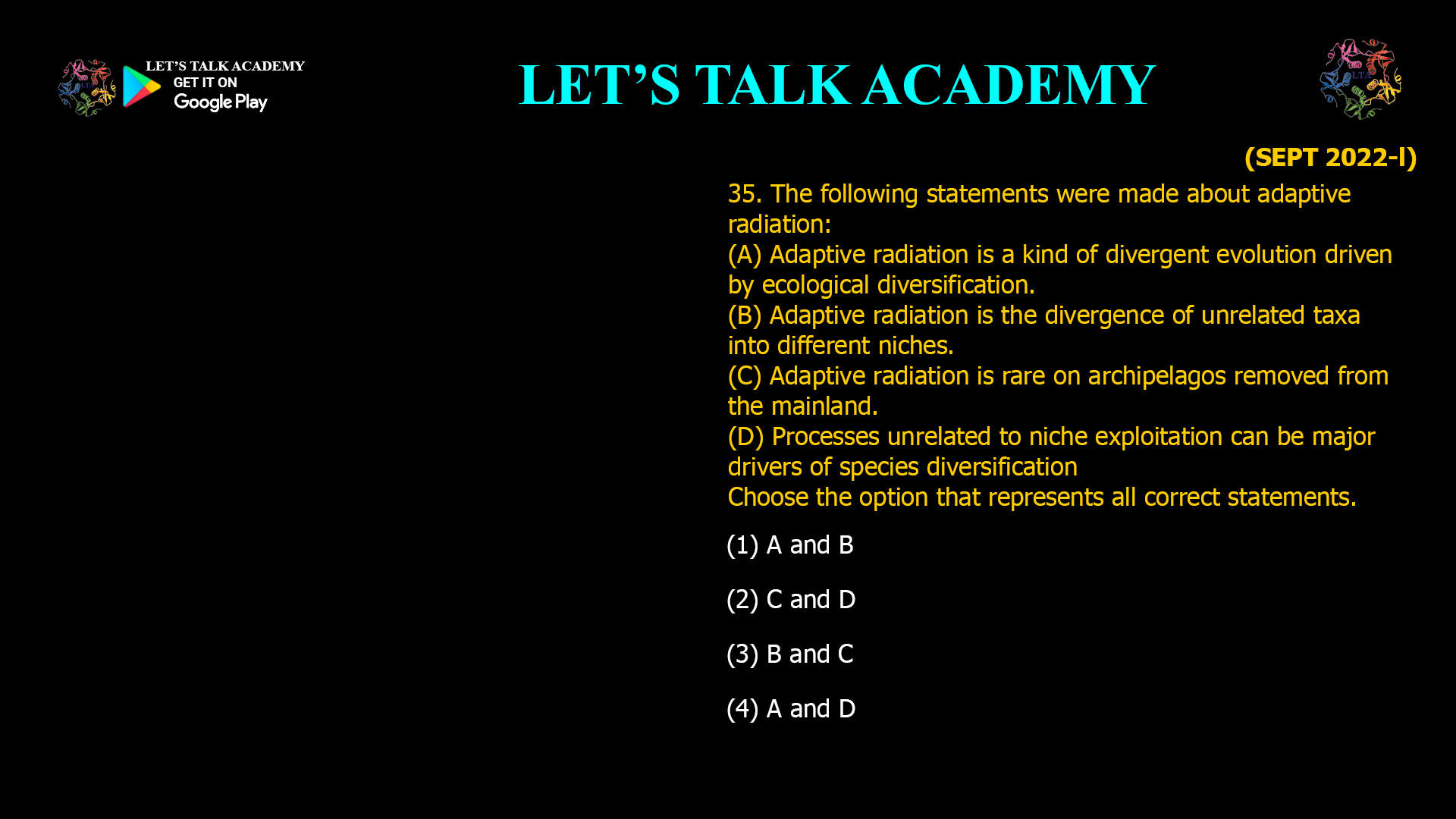
- The following statements were made about adaptive radiation:
(A) Adaptive radiation is a kind of divergent evolution driven by ecological diversification.
(B) Adaptive radiation is the divergence of unrelated taxa into different niches.
(C) Adaptive radiation is rare on archipelagos removed from the mainland.
(D) Processes unrelated to niche exploitation can be major drivers of species diversification
Choose the option that represents all correct statements.
(1) A and B (2) C and D
(3) B and C (4) A and D
Adaptive Radiation: Divergent Evolution and the Drivers of Species Diversification
Meta Description: Understand adaptive radiation as a form of divergent evolution driven by ecological diversification, and explore how both niche exploitation and other processes can drive species diversification.
Slug: adaptive-radiation-divergent-evolution-species-diversification
Introduction
Adaptive radiation is a fundamental concept in evolutionary biology, explaining how a single ancestral species can give rise to a multitude of new species, each adapted to a specific ecological niche. This process is not only central to understanding the origins of biodiversity but also highlights the dynamic interplay between environmental opportunities and evolutionary innovation.
What Is Adaptive Radiation?
Adaptive radiation is the rapid diversification of an ancestral species into a wide variety of forms, each adapted to exploit different ecological niches. Classic examples include Darwin’s finches in the Galápagos Islands and the diversification of Australian marsupials.
Key Features
-
Common ancestry: All species involved share a recent common ancestor.
-
Ecological diversification: Species adapt to exploit different resources or environments.
-
Rapid speciation: New species arise quickly in evolutionary time.
-
Phenotypic adaptation: Morphological and physiological traits evolve to match new niches.
Statement Analysis
(A) Adaptive radiation is a kind of divergent evolution driven by ecological diversification.
Correct. Adaptive radiation is a classic example of divergent evolution, where populations split and adapt to different ecological niches, leading to the formation of new species.
(B) Adaptive radiation is the divergence of unrelated taxa into different niches.
Incorrect. Adaptive radiation involves the diversification of related taxa from a common ancestor, not unrelated taxa.
(C) Adaptive radiation is rare on archipelagos removed from the mainland.
Incorrect. In fact, adaptive radiation is often most prominent on isolated archipelagos (such as the Galápagos or Hawaiian Islands), where new ecological opportunities drive rapid diversification.
(D) Processes unrelated to niche exploitation can be major drivers of species diversification.
Correct. While ecological opportunity and niche exploitation are major drivers, other processes—such as genetic drift, sexual selection, and evolutionary innovations—can also drive diversification, sometimes independently of niche exploitation.
Adaptive Radiation Beyond Niche Exploitation
While ecological diversification is central to adaptive radiation, other factors can contribute:
-
Sexual selection: Traits that improve mating success can lead to rapid divergence.
-
Genetic drift: In small, isolated populations, random genetic changes can accelerate speciation.
-
Evolutionary innovations: New traits (such as the evolution of feathers) can open up entirely new adaptive possibilities.
Conclusion
Adaptive radiation is a powerful evolutionary process, typically driven by ecological diversification and divergent evolution. However, species diversification can also be influenced by processes unrelated to niche exploitation, making adaptive radiation a multifaceted phenomenon that explains much of the world’s biodiversity.
Correct answer:
(4) A and D
SEO-Friendly Slugs:
-
adaptive-radiation-divergent-evolution-species-diversification
-
drivers-of-species-diversification-adaptive-radiation
-
adaptive-radiation-ecological-niches-evolution
-
examples-of-adaptive-radiation-in-nature
-
factors-influencing-adaptive-radiation
Adaptive radiation remains a cornerstone concept in understanding how life diversifies and adapts to ever-changing environments.


1 Comment
Manisha choudhary
October 3, 2025A and D statments are correct statement