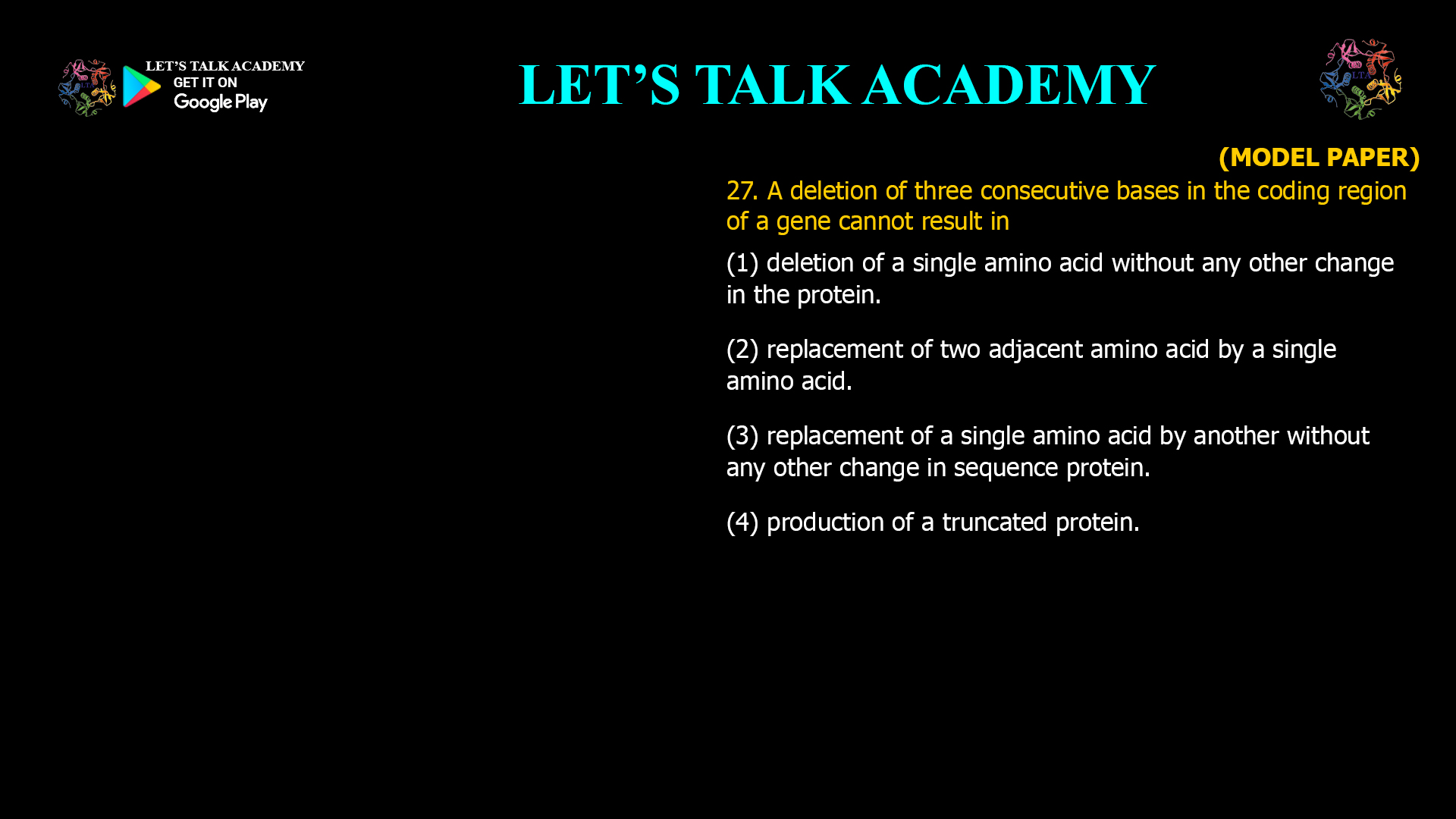
- A deletion of three consecutive bases in the coding region of a gene cannot result in
(1) deletion of a single amino acid without any other change in the protein.
(2) replacement of two adjacent amino acid by a single amino acid.
(3) replacement of a single amino acid by another without any other change in sequence protein.
(4) production ofa truncated protein.Effects of Three-Base Deletions in Coding Regions: What Cannot Occur?
A deletion of three consecutive bases (one codon) in the coding region of a gene is classified as an in-frame deletion because it removes one amino acid without altering the downstream reading frame. Understanding the consequences of such deletions is important for interpreting their effects on protein structure and function.
What Happens When Three Bases Are Deleted?
-
Deletion of a single amino acid without other changes:
Since three bases correspond to one codon, their deletion removes exactly one amino acid from the protein sequence without affecting the rest of the sequence. This is a common and expected outcome of in-frame deletions. -
Replacement of two adjacent amino acids by a single amino acid:
This would require a frameshift or more complex mutation, not a simple three-base deletion. A three-base deletion cannot directly cause two amino acids to be replaced by one. -
Replacement of a single amino acid by another without other changes:
This is typically caused by a point mutation (single nucleotide substitution), not a deletion. A three-base deletion removes an amino acid rather than substituting it. -
Production of a truncated protein:
Truncation generally results from frameshift mutations or introduction of premature stop codons. A three-base deletion, being in-frame, does not cause frameshifts and usually does not lead to truncation unless it removes a stop codon or affects splicing.
Correct Answer
(3) replacement of a single amino acid by another without any other change in the protein sequence
This cannot result from a deletion of three consecutive bases because deletions remove amino acids rather than substitute them.
Additional Insights
-
In-frame deletions maintain the reading frame and thus preserve the downstream amino acid sequence.
-
Frameshift mutations, caused by deletions or insertions not divisible by three, alter the reading frame and often result in truncated, nonfunctional proteins.
-
The phenotypic impact of in-frame deletions depends on the functional importance of the deleted amino acid.
Keywords for SEO Optimization
-
In-frame deletion effects
-
Three-base deletion consequences
-
Protein sequence changes by deletions
-
Frameshift vs in-frame mutations
-
Gene deletion mutation impact
-
Protein truncation causes
-
Codon deletion and amino acid replacement
-
Genetic mutation types
-
Molecular genetics of deletions
-
Protein synthesis and mutation effects
Conclusion
A deletion of three consecutive bases in a gene’s coding region typically results in the loss of a single amino acid without affecting the rest of the protein sequence. It cannot cause the replacement of one amino acid by another without other changes. This distinction is crucial for understanding mutation impacts on protein structure and function.
Correct answer: (3) replacement of a single amino acid by another without any other change in sequence protein.
-


5 Comments
Kajal
November 4, 2025Correct answer is (3) replacement of a single amino acid by another without any other change in sequence protein.
anjani sharma
November 4, 2025Answer 4
Deletion of three bases removes one codon (one amino acid) but doesn’t shift the reading frame, so it cannot create a premature stop codon or truncated protein.
Dipti Sharma
November 4, 2025replacement of a single amino acid by another without any other change in the protein sequence.
Heena Mahlawat
November 6, 2025Option 3
Mohd juber Ali
November 7, 2025deletions remove amino acids rather than substitute them. So replacement of a single amino acid by another without any other change in sequence protein can’t result ..