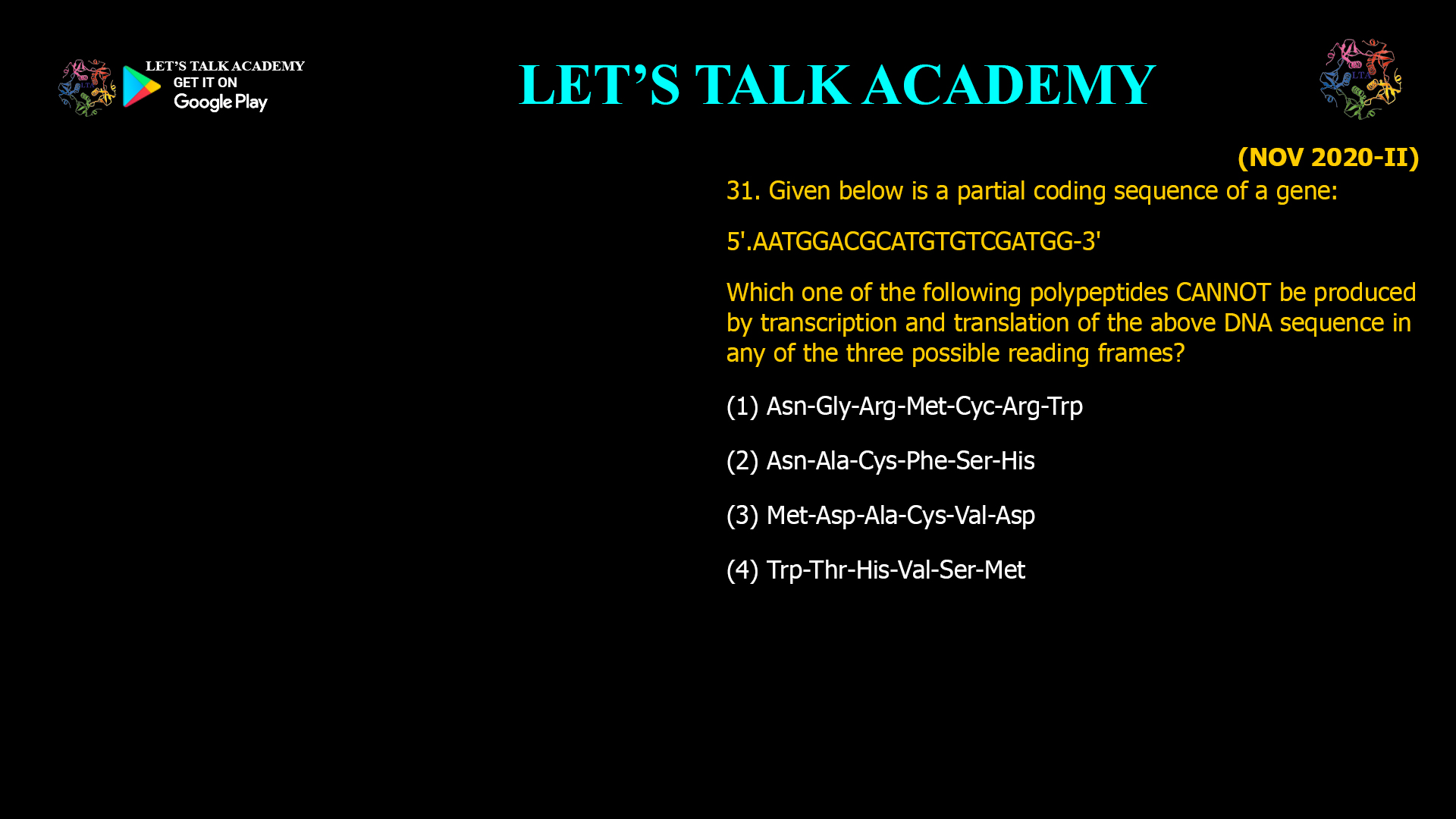
- Given below is a partial coding sequence of a gene:
5′.AATGGACGCATGTGTCGATGG-3′
Which one of the following polypeptides CANNOT be produced by transcription and translation of the above DNA sequence in any of the three possible reading frames?
(1) Asn-Gly-Arg-Met-Cyc-Arg-Trp
(2) Asn-Ala-Cys-Phe-Ser-His
(3) Met-Asp-Ala-Cys-Val-Asp
(4) Trp-Thr-His-Val-Ser-Met
Determining Which Polypeptide Cannot Be Produced from a Given DNA Sequence by Translation in Any Reading Frame
When analyzing a DNA sequence to predict possible polypeptides produced by transcription and translation, it is essential to consider all three possible reading frames on the coding strand. Each reading frame shifts the grouping of nucleotides into codons and thus affects the resulting amino acid sequence.
Given DNA Sequence (Coding Strand):
5’- AAT GGACGCATGTGTCGATGG -3’
Step 1: Identify the Three Possible Reading Frames
-
Frame 1: Starts at nucleotide 1
-
Frame 2: Starts at nucleotide 2
-
Frame 3: Starts at nucleotide 3
Step 2: Transcribe DNA to mRNA
Since the given sequence is the coding strand (5’ to 3’), the mRNA sequence will be the same as the coding strand with thymine (T) replaced by uracil (U):
5’- AAU GGACGCAUGUGUCGAUGG -3’
Step 3: Divide mRNA into Codons for Each Frame
Frame 1 (starting at nucleotide 1):
AAU | GGA | CGC | AUG | UGU | CGA | UGG
-
AAU = Asn
-
GGA = Gly
-
CGC = Arg
-
AUG = Met
-
UGU = Cys
-
CGA = Arg
-
UGG = Trp
Resulting peptide: Asn-Gly-Arg-Met-Cys-Arg-Trp
Frame 2 (starting at nucleotide 2):
A | AUG | GAC | GCA | UGU | GUC | GAU | GG…
-
AUG = Met
-
GAC = Asp
-
GCA = Ala
-
UGU = Cys
-
GUC = Val
-
GAU = Asp
Resulting peptide: Met-Asp-Ala-Cys-Val-Asp
Frame 3 (starting at nucleotide 3):
AA | UGG | ACG | CAU | GUG | UCG | AUG | G…
-
UGG = Trp
-
ACG = Thr
-
CAU = His
-
GUG = Val
-
UCG = Ser
-
AUG = Met
Resulting peptide: Trp-Thr-His-Val-Ser-Met
Step 4: Compare with Given Options
| Option | Peptide Sequence | Matches Which Frame? | Conclusion |
|---|---|---|---|
| (1) | Asn-Gly-Arg-Met-Cys-Arg-Trp | Frame 1 | Possible |
| (2) | Asn-Ala-Cys-Phe-Ser-His | None | Not possible |
| (3) | Met-Asp-Ala-Cys-Val-Asp | Frame 2 | Possible |
| (4) | Trp-Thr-His-Val-Ser-Met | Frame 3 | Possible |
Explanation
-
Option (2) includes amino acids Asn-Ala-Cys-Phe-Ser-His, which does not correspond to any of the three reading frames derived from the given DNA sequence.
-
The other three options match exactly the peptide sequences translated from one of the three reading frames.
Keywords for SEO Optimization
-
DNA translation reading frames
-
Protein prediction from DNA sequence
-
Open reading frame analysis
-
Codon to amino acid translation
-
Multiple reading frame translation
-
Molecular biology of gene expression
-
DNA to protein sequence conversion
-
Genetic code and reading frames
-
Peptide synthesis from DNA
-
Translation frame shift effects
Conclusion
Among the given options, the polypeptide sequence Asn-Ala-Cys-Phe-Ser-His (Option 2) cannot be produced by transcription and translation of the DNA sequence 5’-AATGGACGCATGTGTCGATGG-3’ in any of the three possible reading frames.
Correct answer: (2) Asn-Ala-Cys-Phe-Ser-His


5 Comments
Kirti Agarwal
November 1, 2025Opt 2
Pooja
November 3, 2025Option 2
Neha Yadav
November 3, 2025Option -2
Kajal
November 4, 2025The Correct answer is : (2) Asn-Ala-Cys-Phe-Ser-His
anjani sharma
November 4, 2025Asn-Ala-Cys-Phe-Ser-His, because this sequence cannot be formed in any of the three reading frames of the given DNA.