39. A group of palaeontologists digging in an area discovers a pre-historic human burialsite. The same group, while exploring a nearby area, discovered fossil remains of what appeared to be more than 100 million year old dinosaur bones. Which of the following combinations of modern radiometric dating techniques should they use to calculate the age of these fossils most accurately? (1) 14C dating for human remains and 235U dating for dinosaur remains (2) 87Rb dating for both human and dinosaur remains (3) 14C dating for both human and dinosaur remains (4) 129l dating for human remains and 129Xe for dinosaur remains

Choosing the Right Radiometric Dating Techniques for Human and Dinosaur Fossils

Given below are statements related to the two competing hypotheses on the origin of modern humans: the Out-of-Africa hypothesis and the multi-regional hypothesis. Which of the following statements is INCORRECT? (1) Both the hypotheses support that Homoerectus originated in Africa and expanded to Eurasia. (2) Mitochondrial DNA (mtDNA) and Y chromosome DNA evidence support the 'Out-of-Africa' hypothesis. (3) The principal conflict between the two hypotheses is that multi-regional hypothesis does not support African origin of Homo erectus. (4) The multi-regional hypothesis states that independent multiple origins occurred in the million years since Homo erectus came out of Africa.

Out-of-Africa vs. Multiregional Hypothesis: Understanding Human Origins and Common Misconceptions

Following is a diagrammatic representation of human evolutionary tree. In the above diagram A, B, C and D respectively represent: (1) Denisovan, Homo habilis, Homo erectus, Homo neanderthalensis (2) Homo habilis, Homo erectus, Homo neanderthalensis, Denisovan (3) Homo erectus, Homohabilis, Homo neanderthalensis, Denisovan (4) Homo erectus, Denisovan, Homo neanderthalensis, Homo habilis

Decoding the Human Evolutionary Tree: Identifying Denisovans, Homo habilis, Homo erectus, and Neanderthals

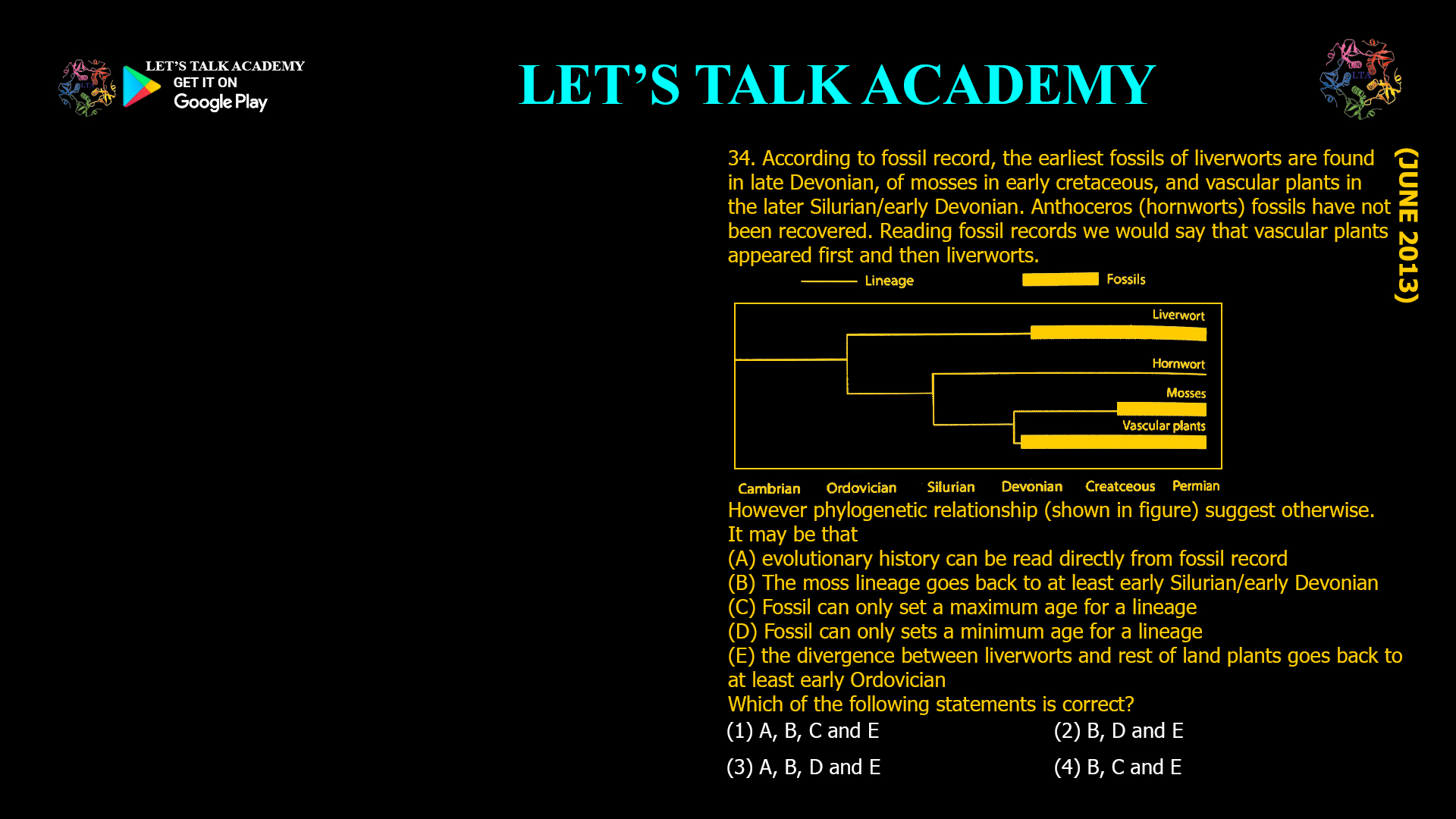
According to fossil record, the earliest fossils of liverworts are found in late Devonian, of mosses in early cretaceous, and vascular plants in the later Silurian/early Devonian. Anthoceros (hornworts) fossils have not been recovered. Reading fossil records we would say that vascular plants appeared first and then liverworts. However phylogenetic relationship (shown in figure) suggest otherwise. It may be that (A) evolutionary history can be read directly from fossil record (B) The moss lineage goes back to at least early Silurian/early Devonian (C) Fossil can only set a maximum age for a lineage (D) Fossil can only sets a minimum age for a lineage (E) the divergence between liverworts and rest of land plants goes back to at least early Ordovician Which of the following statements is correct? (1) A, B, C and E (2) B, D and E (3) A, B, D and E (4) B, C and E

Fossil Records vs. Phylogeny: Rethinking the Evolutionary Timeline of Early Land Plants

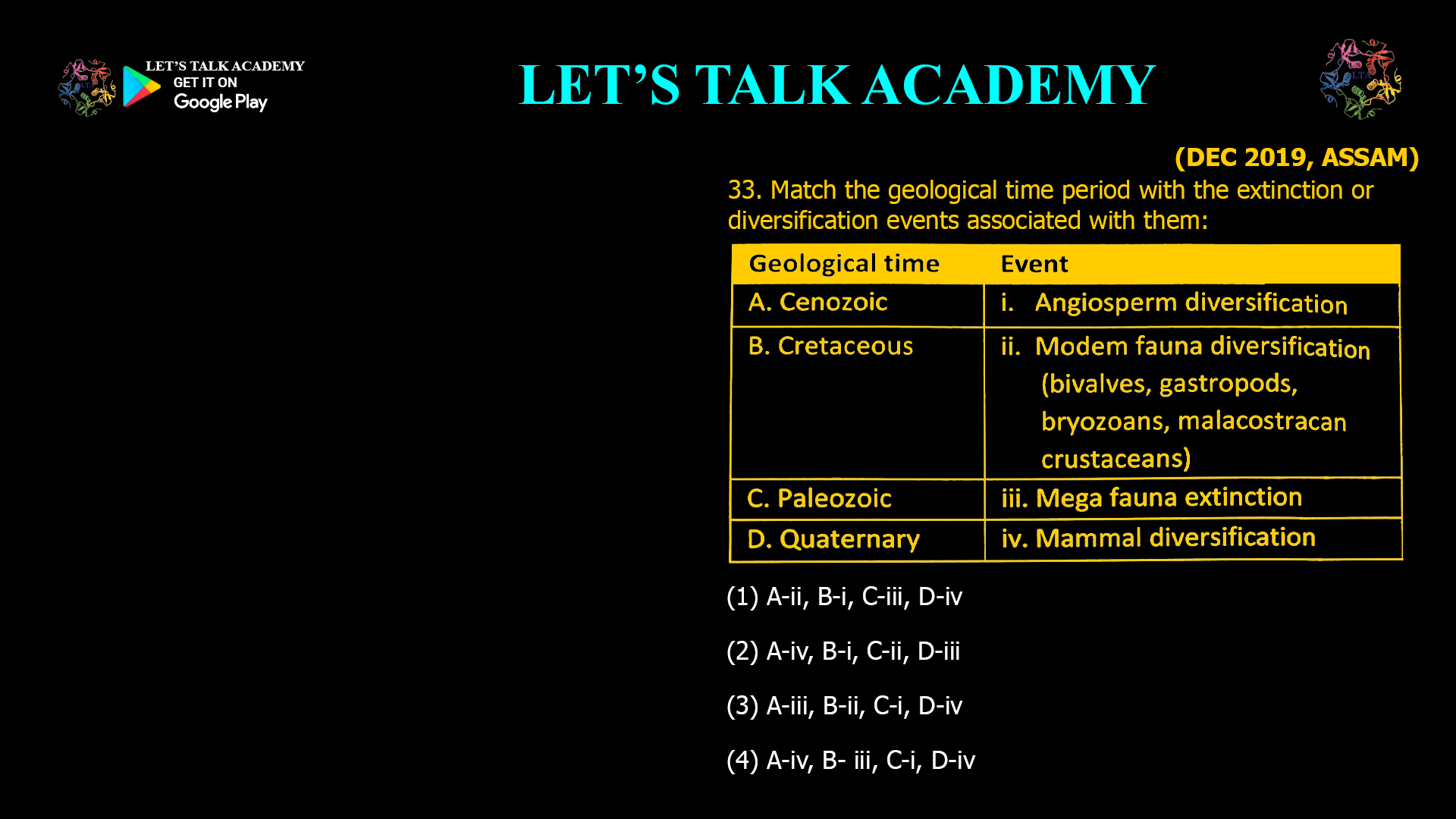
Match the geological time period with the extinction or diversification events associated with them: (1) A-ii, B-i, C-iii, D-iv (2) A-iv, B-i, C-ii, D-iii (3) A-iii, B-ii, C-i, D-iv (4) A-iv, B- iii, C-i, D-iv

Matching Geological Time Periods to Major Extinction and Diversification Events: A Guide to Earth’s Mass Extinctions

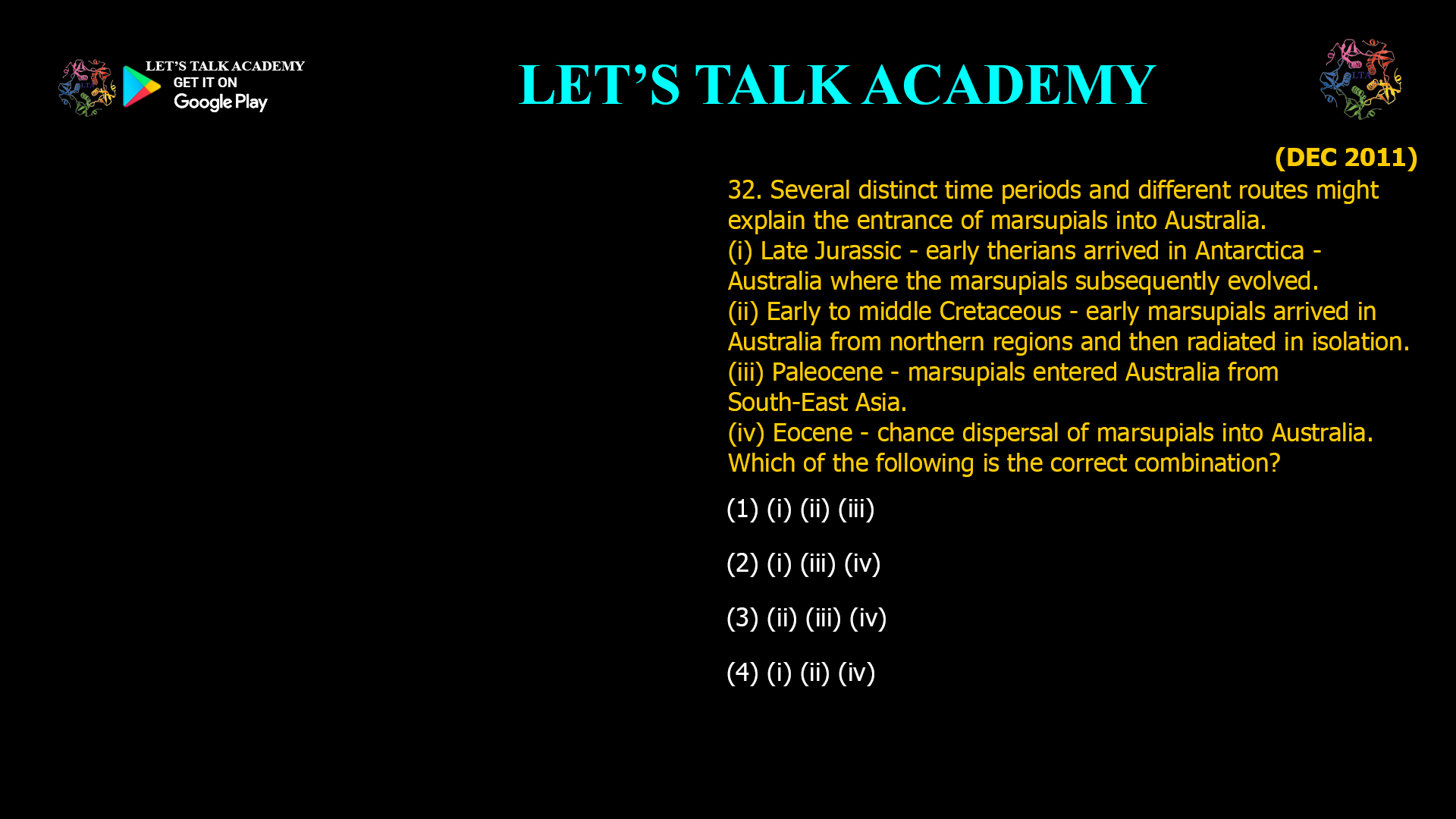
32. Several distinct time periods and different routes might explain the entrance of marsupials into Australia. (i) Late Jurassic - early therians arrived in Antarctica - Australia where the marsupials subsequently evolved. (ii) Early to middle Cretaceous - early marsupials arrived in Australia from northern regions and then radiated in isolation. (iii) Paleocene - marsupials entered Australia from South-East Asia. (iv) Eocene - chance dispersal of marsupials into Australia. Which of the following is the correct combination? (1) (i) (ii) (iii) (2) (i) (iii) (iv) (3) (ii) (iii) (iv) (4) (i) (ii) (iv)

Tracing the Arrival of Marsupials in Australia: Exploring Geological Timeframes and Migration Routes

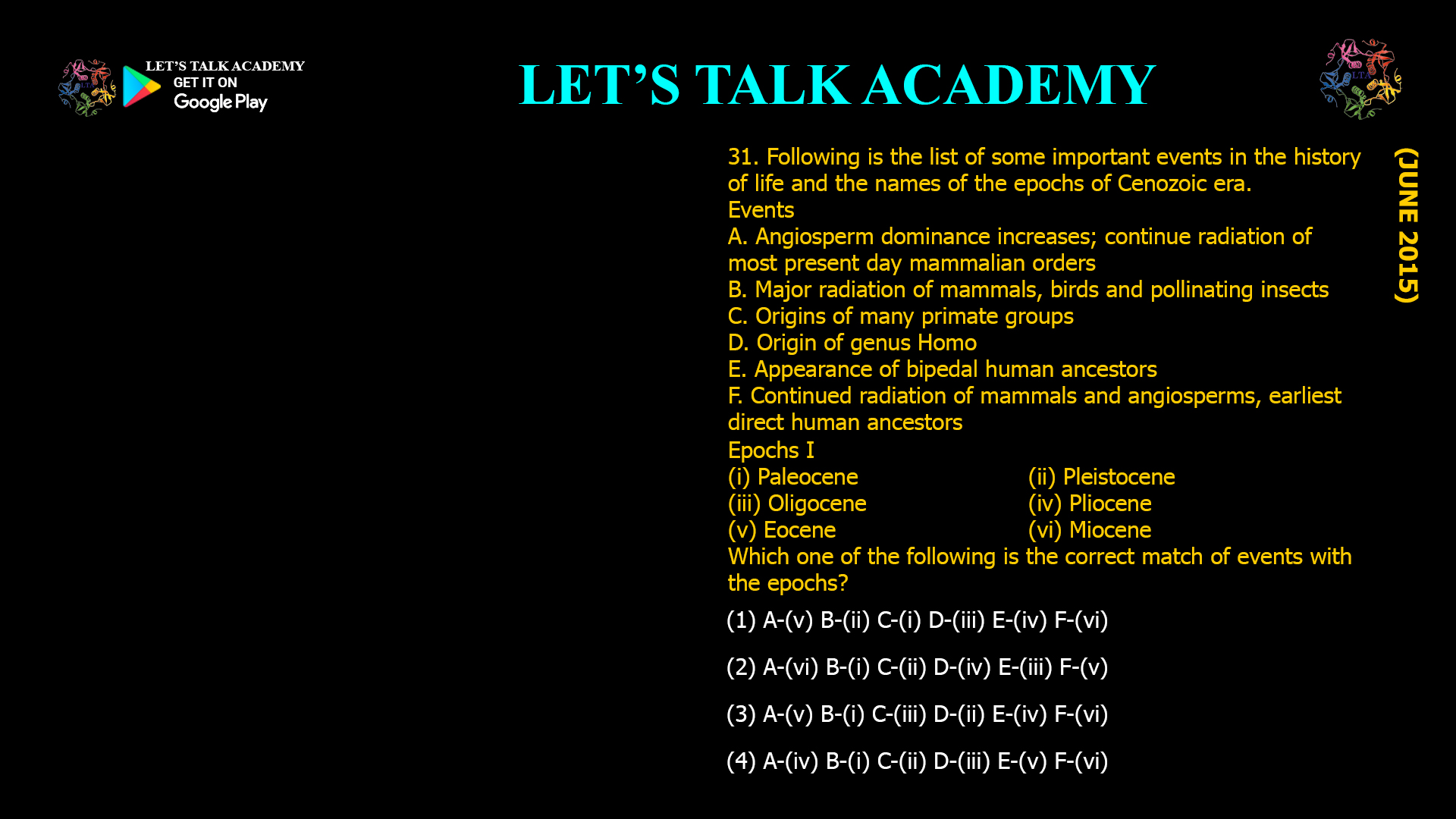
Following is the list of some important events in the history of life and the names of the epochs of Cenozoic era. Events A. Angiosperm dominance increases; continue radiation of most present day mammalian orders B. Major radiation of mammals, birds and pollinating insects C. Origins of many primate groups D. Origin of genus Homo E. Appearance of bipedal human ancestors F. Continued radiation of mammals and angiosperms, earliest direct human ancestors Epochs I (i) Paleocene (ii) Pleistocene (iii) Oligocene                                                 (iv) Pliocene (v) Eocene                                                     (vi) Miocene Which one of the following is the correct match of events with the epochs? (1) A-(v) B-(ii) C-(i) D-(iii) E-(iv) F-(vi) (2) A-(vi) B-(i) C-(ii) D-(iv) E-(iii) F-(v) (3) A-(v) B-(i) C-(iii) D-(ii) E-(iv) F-(vi) (4) A-(iv) B-(i) C-(ii) D-(iii) E-(v) F-(vi)

Epochs of the Cenozoic Era: Mapping Major Evolutionary Events to Their Geological Timeline

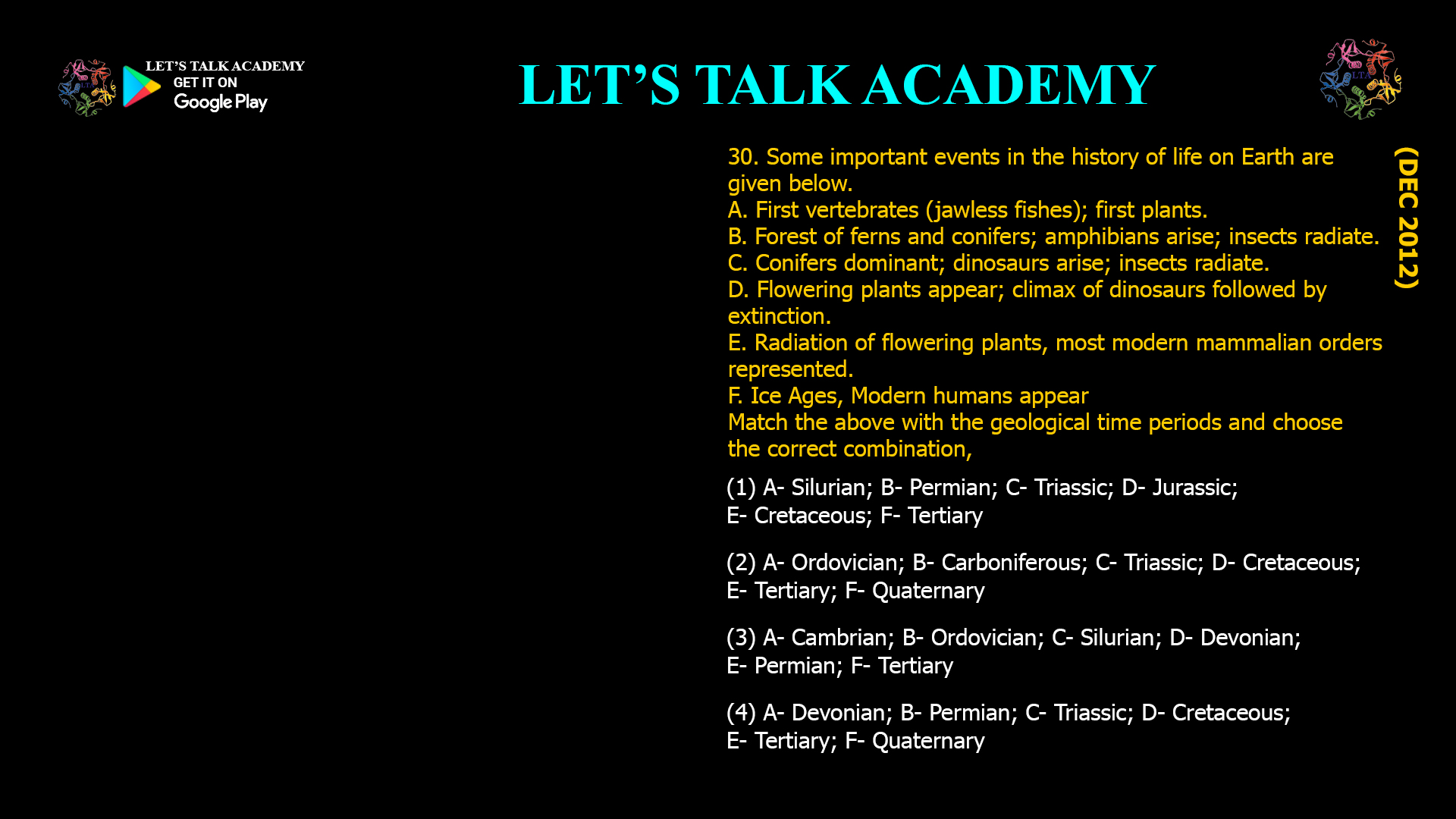
Some important events in the history of life on Earth are given below. A. First vertebrates (jawless fishes); first plants. B. Forest of ferns and conifers; amphibians arise; insects radiate. C. Conifers dominant; dinosaurs arise; insects radiate. D. Flowering plants appear; climax of dinosaurs followed by extinction. E. Radiation of flowering plants, most modern mammalian orders represented. F. Ice Ages, Modern humans appear Match the above with the geological time periods and choose the correct combination, (1) A- Silurian; B- Permian; C- Triassic; D- Jurassic; E- Cretaceous; F- Tertiary (2) A- Ordovician; B- Carboniferous; C- Triassic; D- Cretaceous; E- Tertiary; F- Quaternary (3) A- Cambrian; B- Ordovician; C- Silurian; D- Devonian; E- Permian; F- Tertiary (4) A- Devonian; B- Permian; C- Triassic; D- Cretaceous; E- Tertiary; F- Quaternary

Mapping Life’s Greatest Events: Matching Major Evolutionary Milestones to the Correct Geological Periods

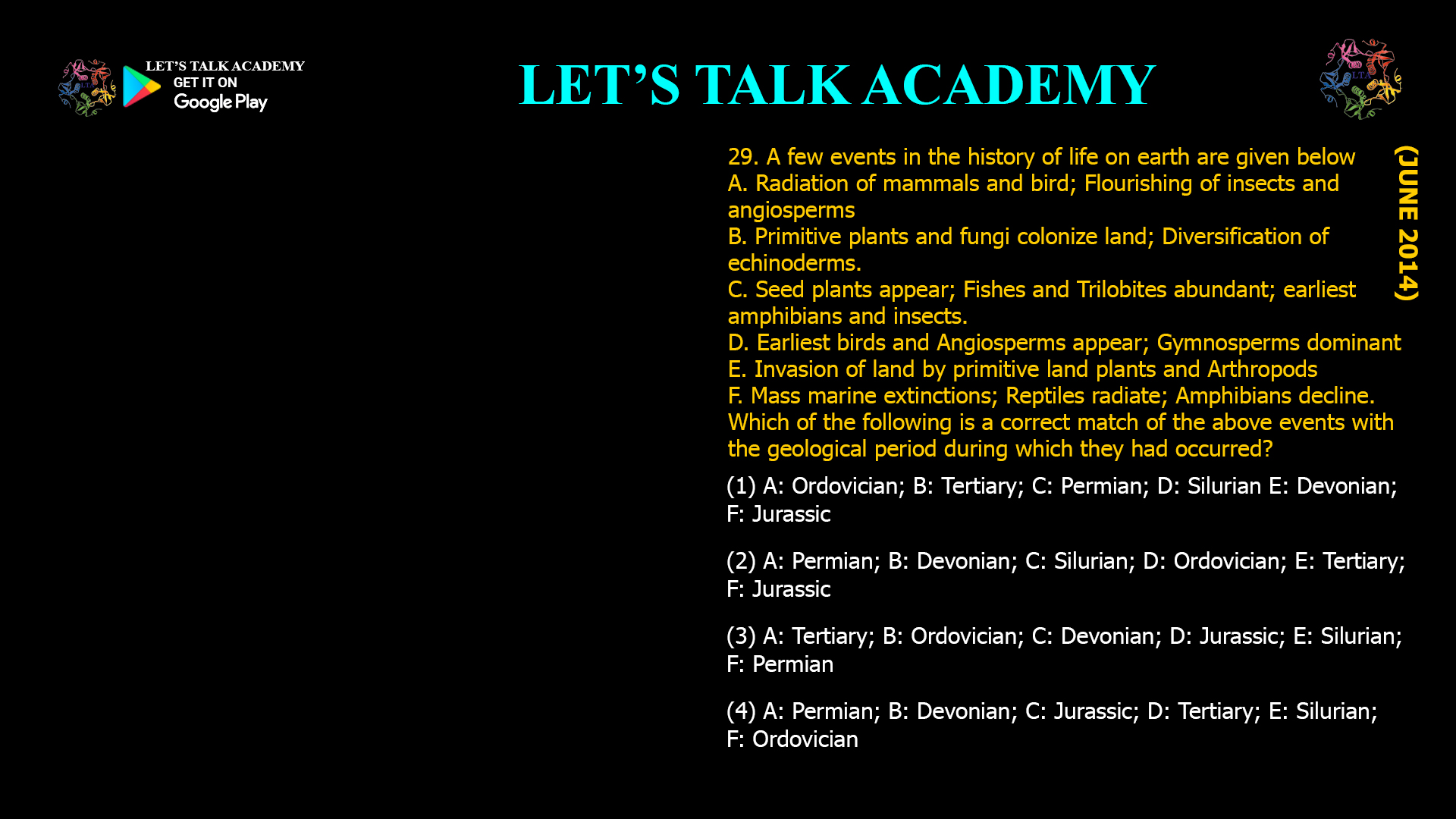
A few events in the history of life on earth are given below A. Radiation of mammals and bird; Flourishing of insects and angiosperms B. Primitive plants and fungi colonize land; Diversification of echinoderms. C. Seed plants appear; Fishes and Trilobites abundant; earliest amphibians and insects. D. Earliest birds and Angiosperms appear; Gymnosperms dominant E. Invasion of land by primitive land plants and Arthropods F. Mass marine extinctions; Reptiles radiate; Amphibians decline. Which of the following is a correct match of the above events with the geological period during which they had occurred? (1) A: Ordovician; B: Tertiary; C: Permian; D: Silurian E: Devonian; F: Jurassic (2) A: Permian; B: Devonian; C: Silurian; D: Ordovician; E: Tertiary; F: Jurassic (3) A: Tertiary; B: Ordovician; C: Devonian; D: Jurassic; E: Silurian; F: Permian (4) A: Permian; B: Devonian; C: Jurassic; D: Tertiary; E: Silurian; F: Ordovician

Key Events in the History of Life: Matching Major Biological Milestones to Their Geological Periods

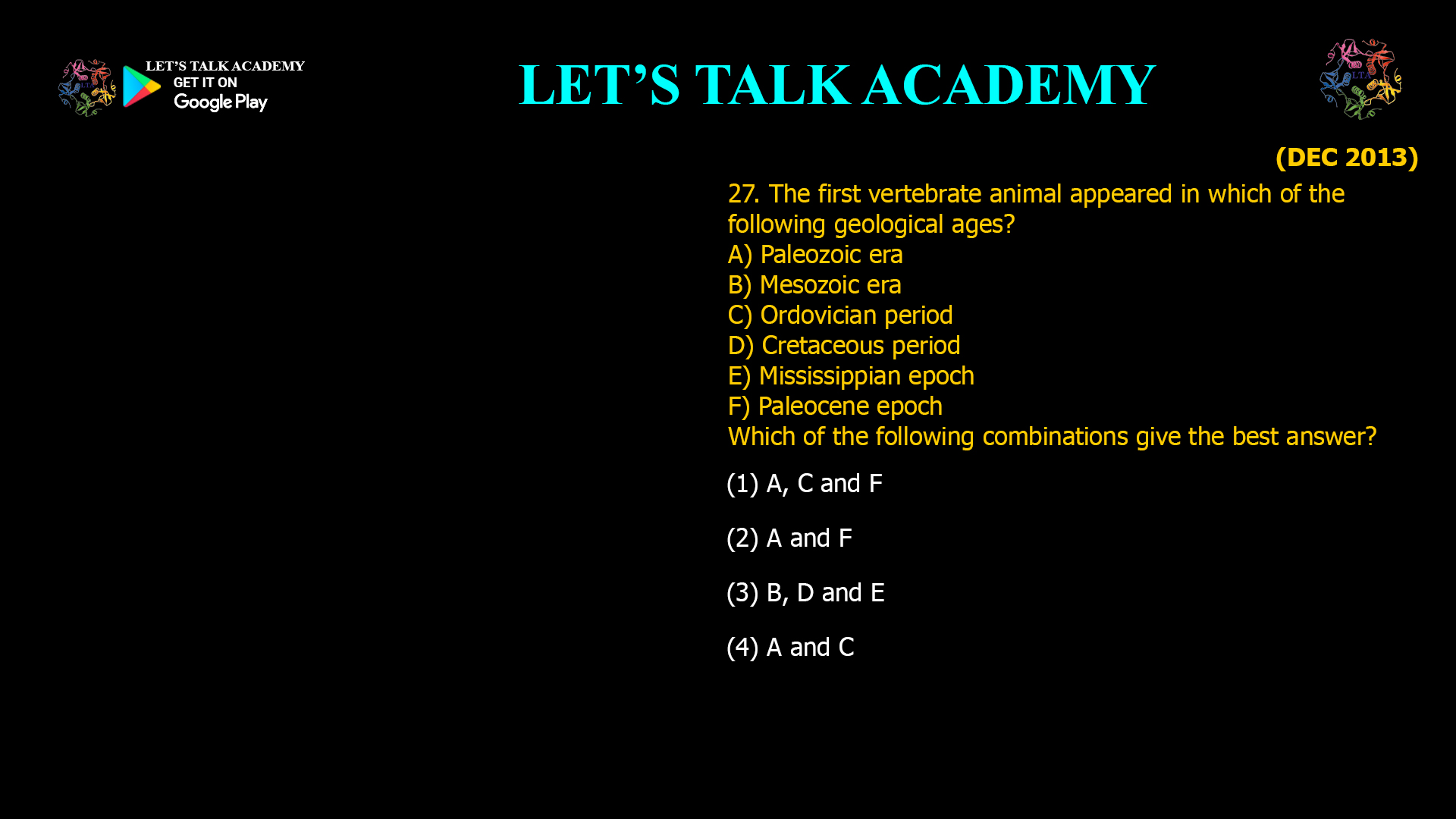
The first vertebrate animal appeared in which of the following geological ages? A) Paleozoic era B) Mesozoic era C) Ordovician period D) Cretaceous period E) Mississippian epoch F) Paleocene epoch Which of the following combinations give the best answer? (1) A, C and F (2) A and F (3) B, D and E (4) A and C

When Did the First Vertebrate Animals Appear? Unveiling the Paleozoic Origins

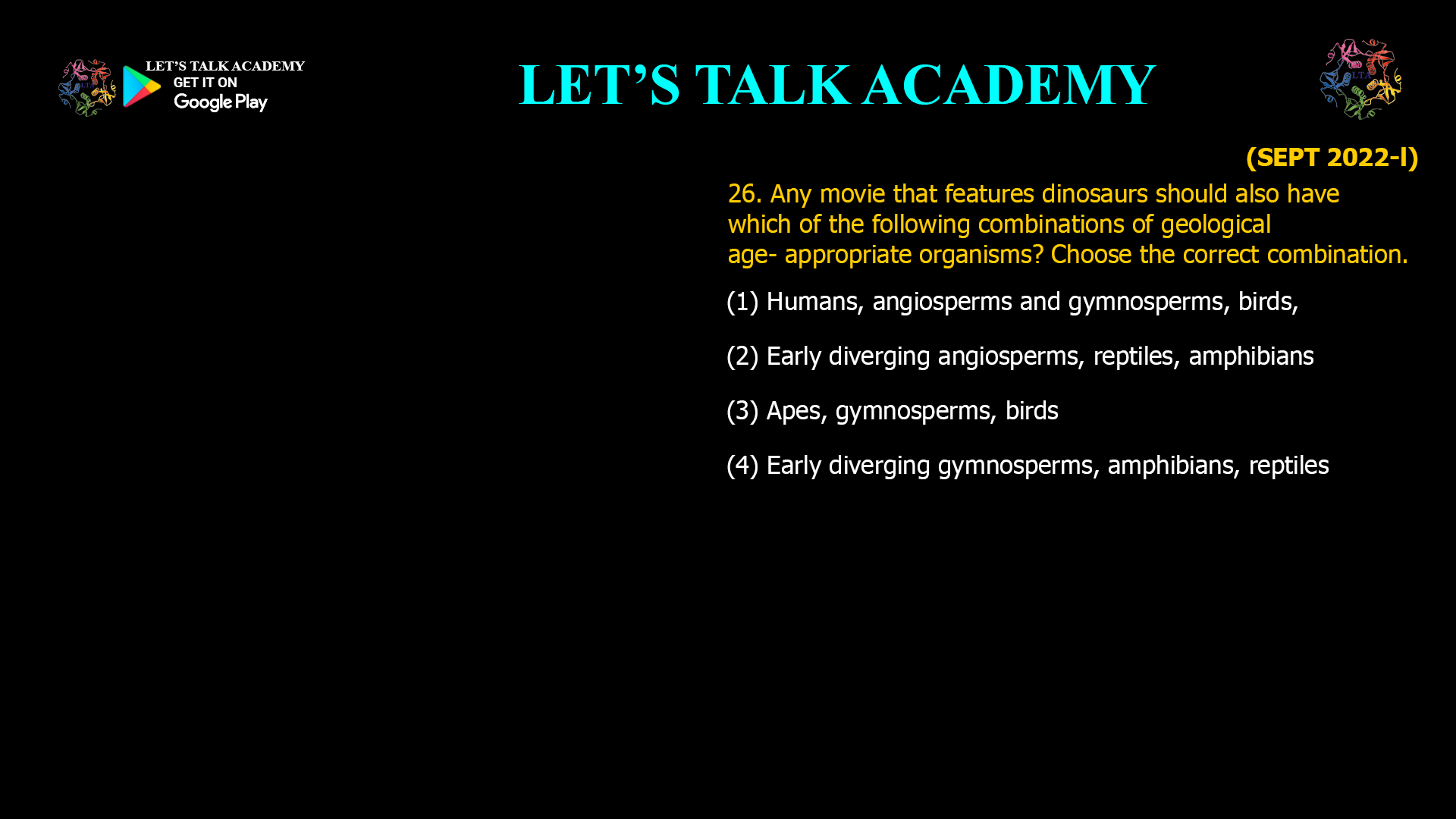
Any movie that features dinosaurs should also have which of the following combinations of geological age- appropriate organisms? Choose the correct combination. (1) Humans, angiosperms and gymnosperms, birds, (2) Early diverging angiosperms, reptiles, amphibians (3) Apes, gymnosperms, birds (4) Early diverging gymnosperms, amphibians, reptiles

The Essential Guide to Organisms That Coexisted with Dinosaurs: Authentic Mesozoic Companions for Accurate Dinosaur Movies

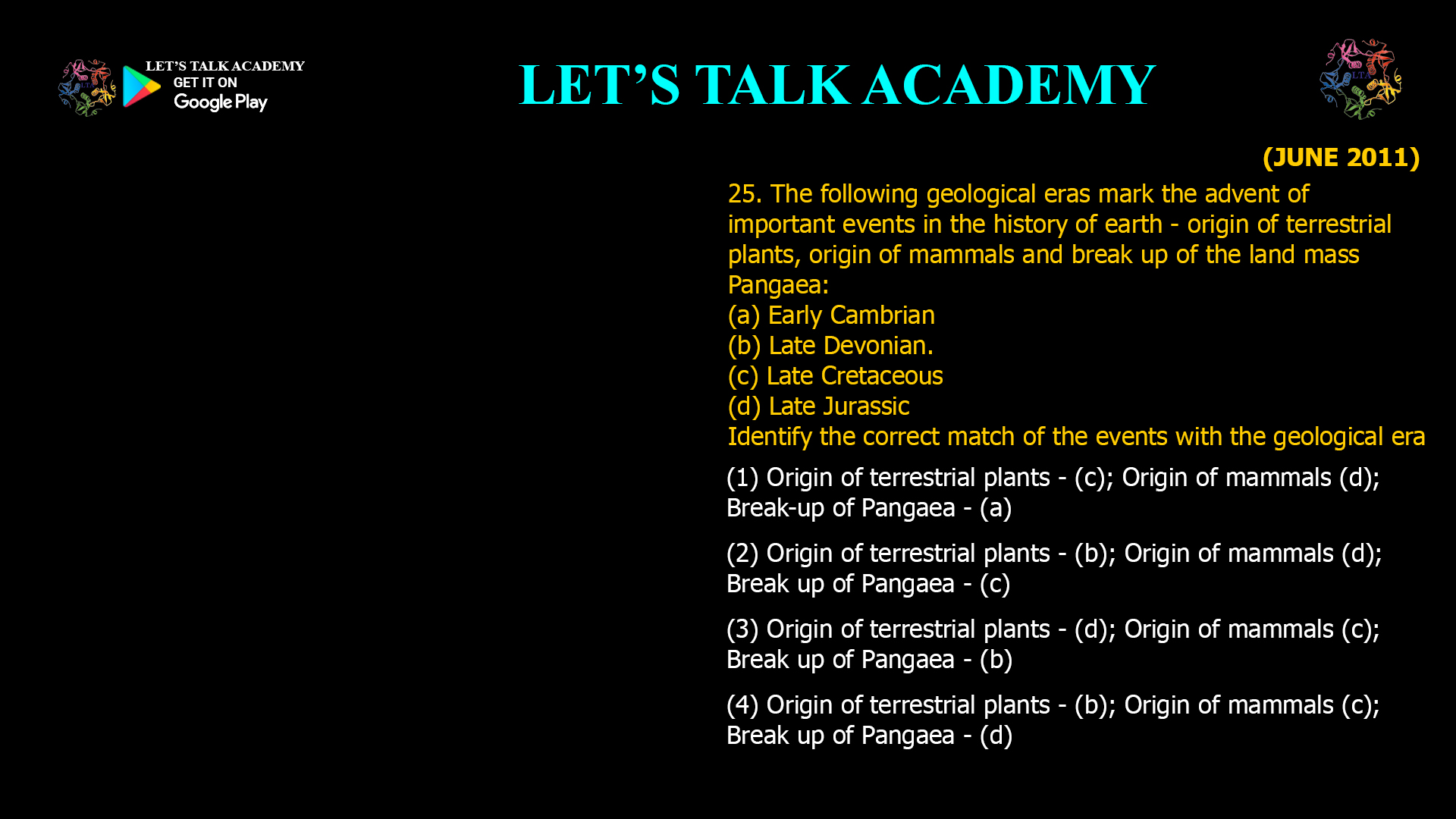
The following geological eras mark the advent of important events in the history of earth - origin of terrestrial plants, origin of mammals and break up of the land mass Pangaea: (a) Early Cambrian (b) Late Devonian. (c) Late Cretaceous (d) Late Jurassic Identify the correct match of the events with the geological era (1) Origin of terrestrial plants - (c); Origin of mammals (d); Break-up of Pangaea - (a) (2) Origin of terrestrial plants - (b); Origin of mammals (d); Break up of Pangaea - (c) (3) Origin of terrestrial plants - (d); Origin of mammals (c); Break up of Pangaea - (b) (4) Origin of terrestrial plants - (b); Origin of mammals (c); Break up of Pangaea - (d)

Matching Major Evolutionary Events to Geological Eras: Plants, Mammals, and the Breakup of Pangaea

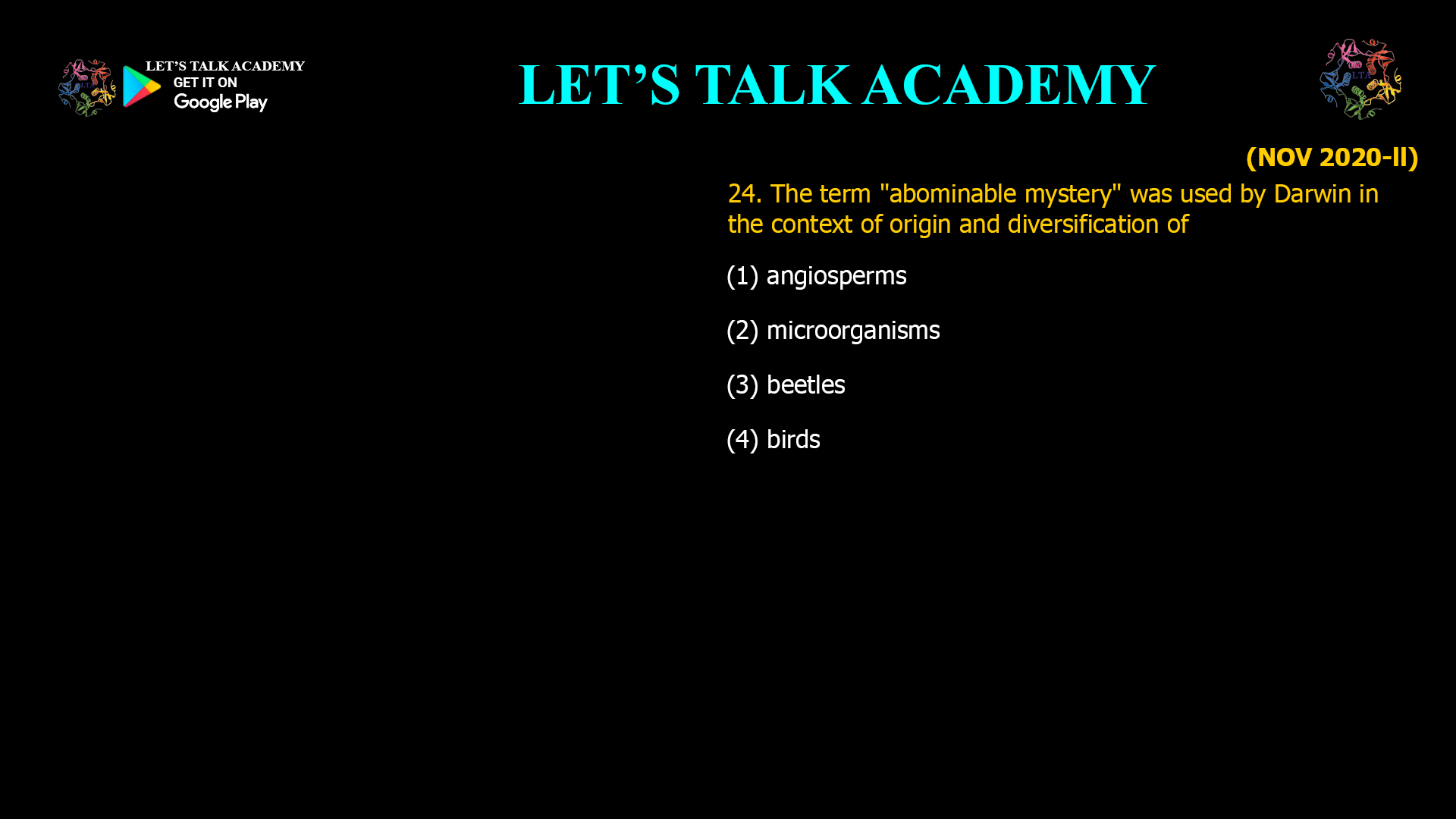
The term "abominable mystery" was used by Darwin in the context of origin and diversification of (1) angiosperms (2) microorganisms (3) beetles (4) birds

Darwin’s “Abominable Mystery”: The Origin and Diversification of Angiosperms

The origin and diversification of Angiosperms was during which geological period? (1) Permian (2) Triassic (3) Jurassic (4) Cretaceous

The Origin and Diversification of Angiosperms: The Cretaceous Period

Which of the following geographical periods is characterized by the first appearance of mammals? (1) Tertiary (2) Cretaceous (3) Permian (4) Triassic

When Did Mammals First Appear? The Triassic Period and the Dawn of Mammalian Evolution

During which of the following major mass extinction events, over 95% of the marine species disappeared from the planet Earth? (1) Ordovician (2) Devonian (3) Permian                                                    (4) Triassic

The Permian–Triassic Extinction: When Over 95% of Marine Species Disappeared

20. Which of the following periods is known as "Age of fishes"? (1) Devonian                                                  (2) Jurassic (3) Cambrian                                                  (4) Carboniferous

The Devonian Period: The Age of Fishes

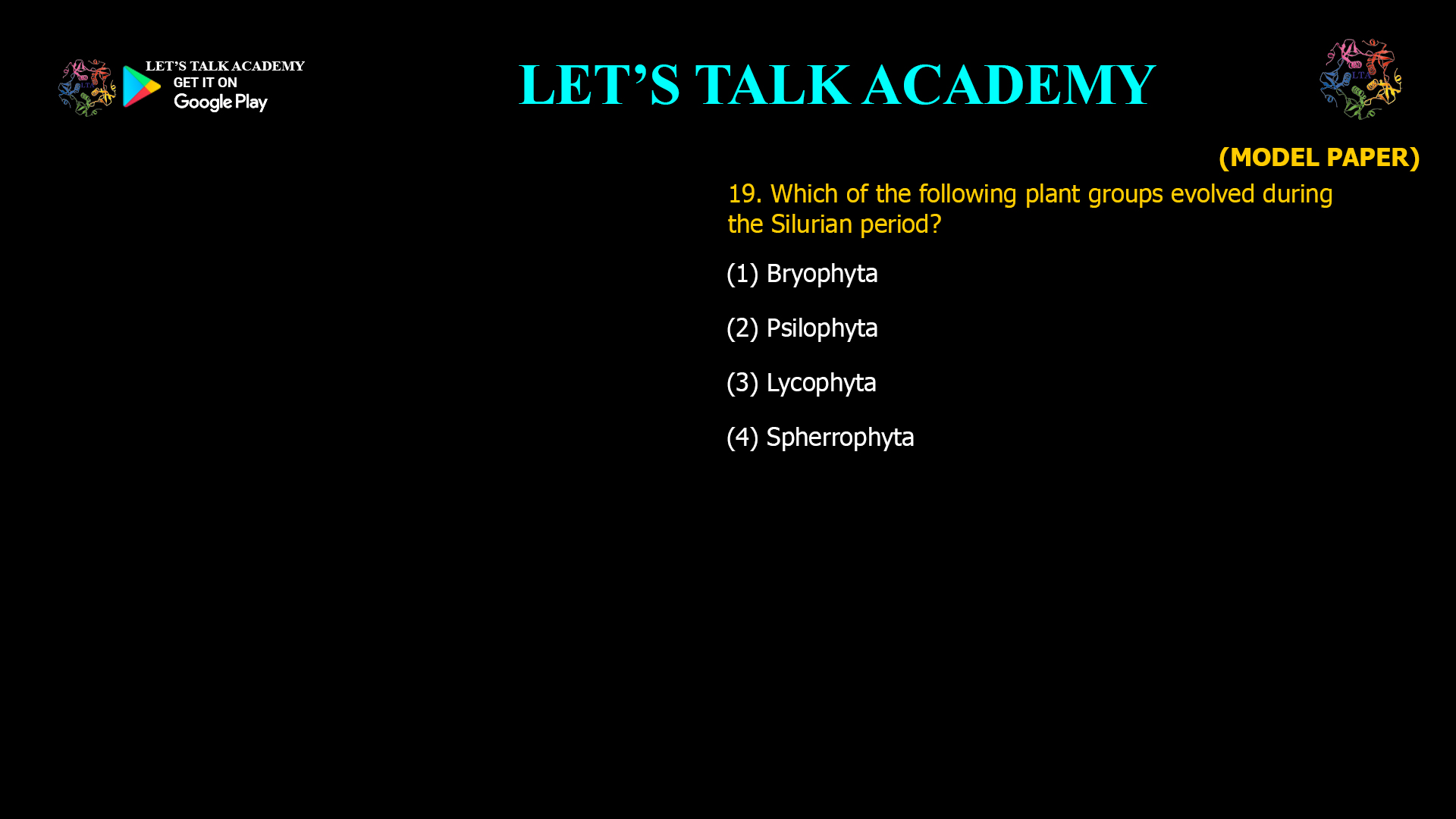
Which of the following plant groups evolved during the Silurian period? (1) Bryophyta (2) Psilophyta (3) Lycophyta                                                          (4) Spherrophyta

Which Plant Groups Evolved During the Silurian Period?

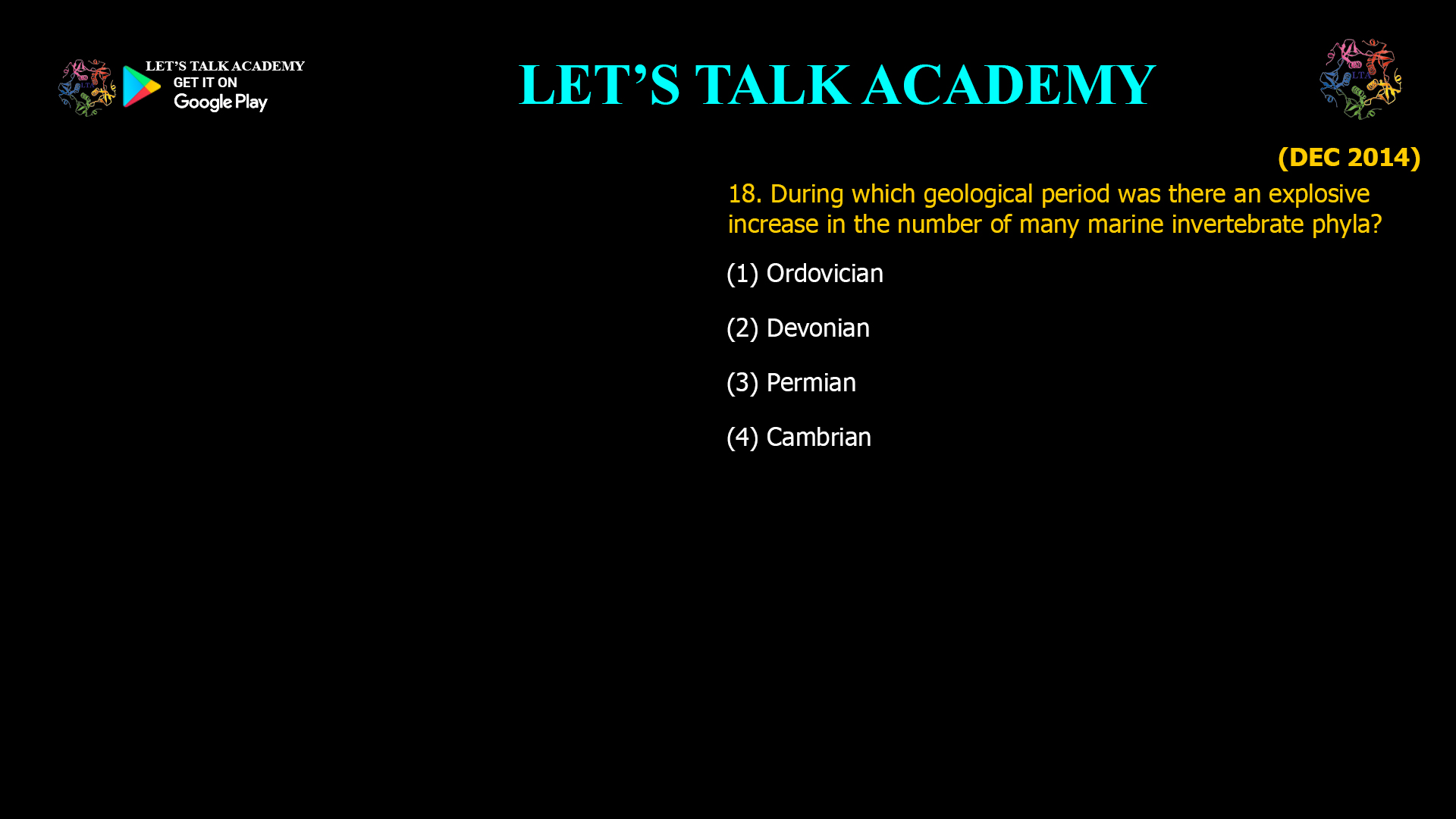
During which geological period was there an explosive increase in the number of many marine invertebrate phyla? (1) Ordovician (2) Devonian (3) Permian (4) Cambrian

The Cambrian Period: The Explosive Increase in Marine Invertebrate Diversity

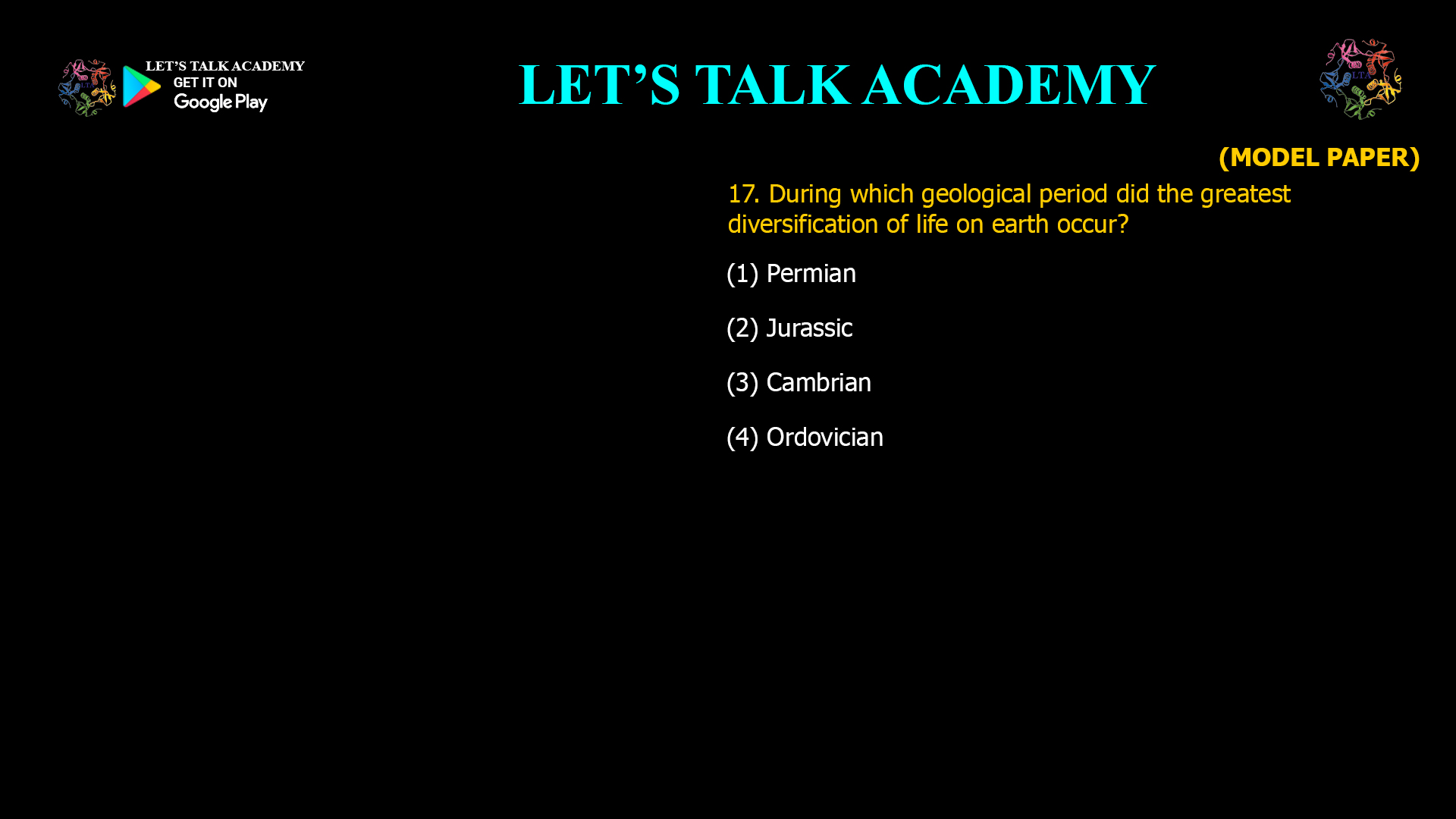
During which geological period did the greatest diversification of life on earth occur? (1) Permian (2) Jurassic (3) Cambrian (4) Ordovician

The Greatest Diversification of Life on Earth: The Cambrian Period

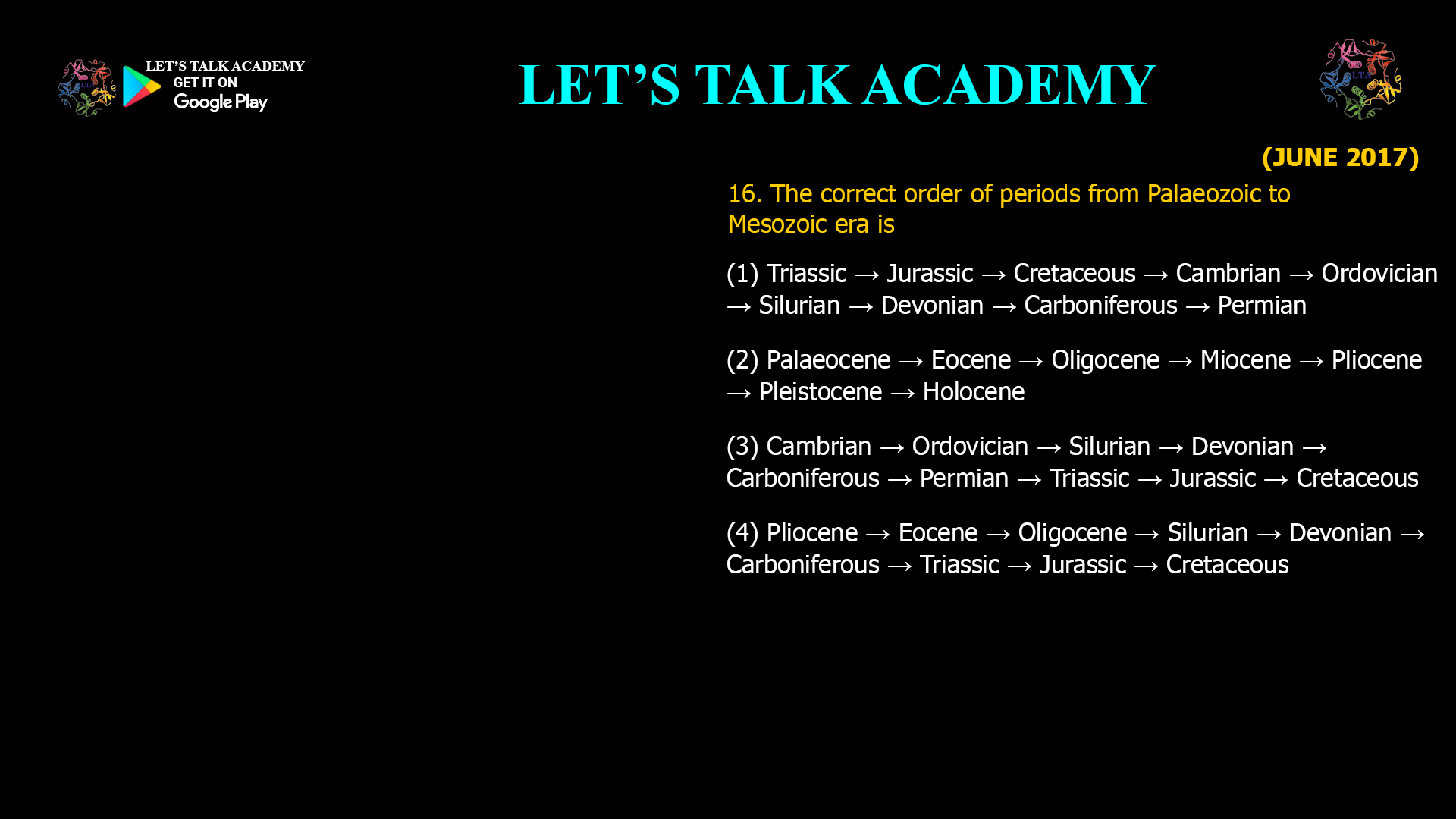
The correct order of periods from Palaeozoic to Mesozoic era is (1) Triassic → Jurassic → Cretaceous → Cambrian → Ordovician → Silurian → Devonian → Carboniferous → Permian (2) Palaeocene → Eocene → Oligocene → Miocene → Pliocene → Pleistocene → Holocene (3) Cambrian → Ordovician → Silurian → Devonian → Carboniferous → Permian → Triassic → Jurassic → Cretaceous (4) Pliocene → Eocene → Oligocene → Silurian → Devonian → Carboniferous → Triassic → Jurassic → Cretaceous

The Correct Order of Geological Periods: From Paleozoic to Mesozoic Era

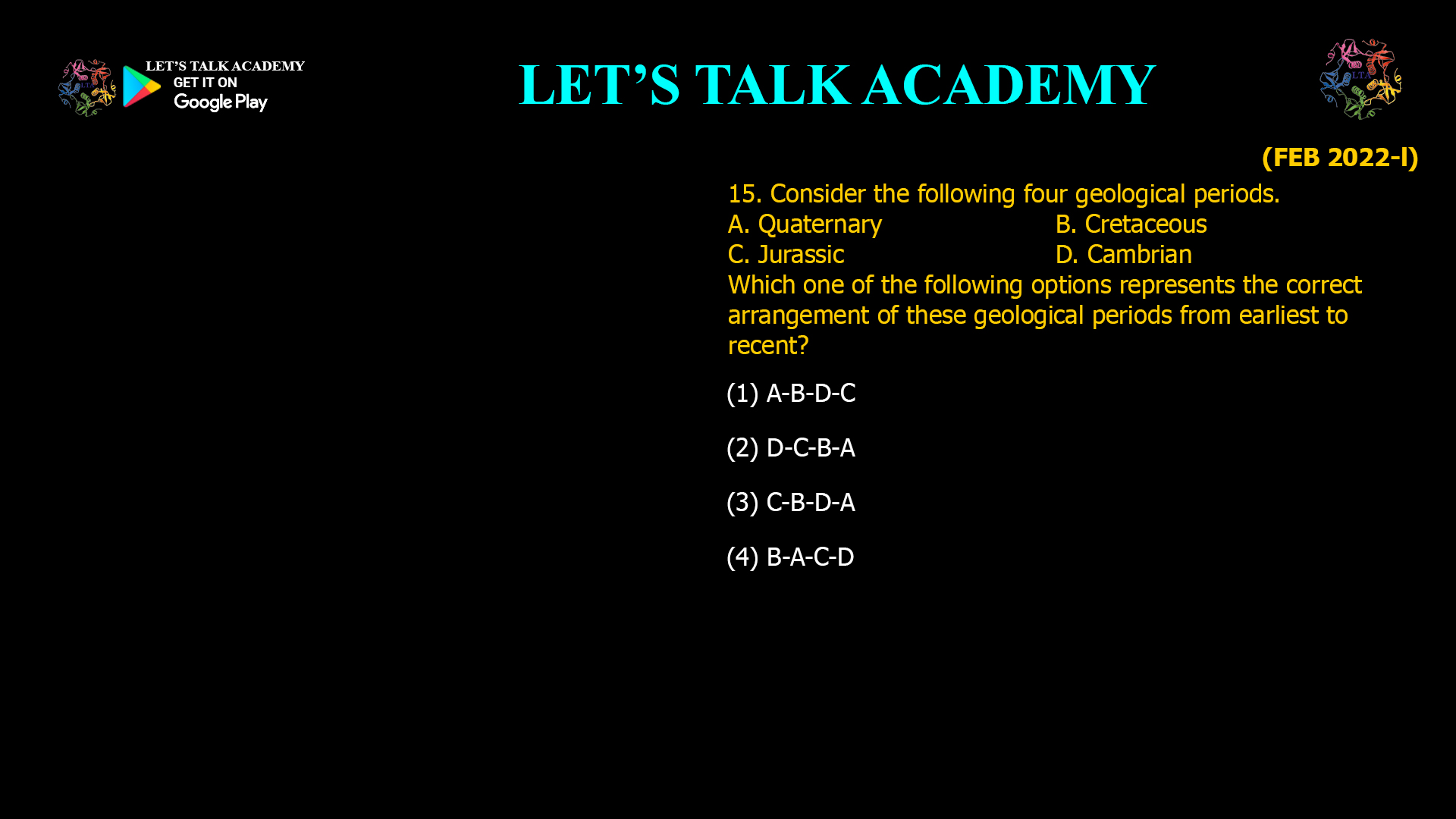
Consider the following four geological periods. A. Quaternary B. Cretaceous C. Jurassic D. Cambrian Which one of the following options represents the correct arrangement of these geological periods from earliest to recent? (1) A-B-D-C                                                    (2) D-C-B-A (3) C-B-D-A                                                    (4) B-A-C-D

Arranging Geological Periods: From the Earliest to the Most Recent

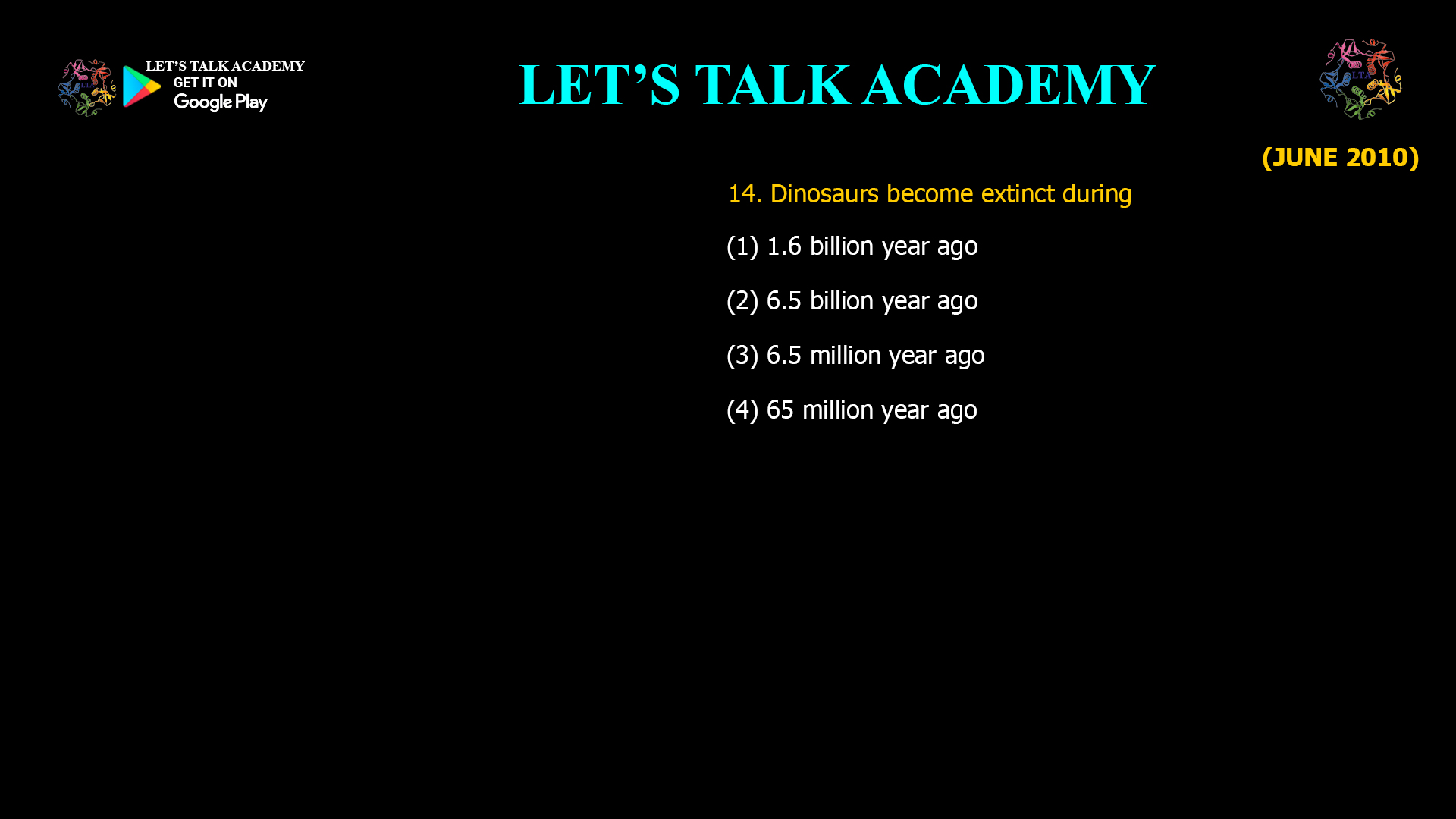
Dinosaurs become extinct during (1) 1.6 billion year ago (2) 6.5 billion year ago (3) 6.5 million year ago (4) 65 million year ago

When Did Dinosaurs Become Extinct? The End of an Era

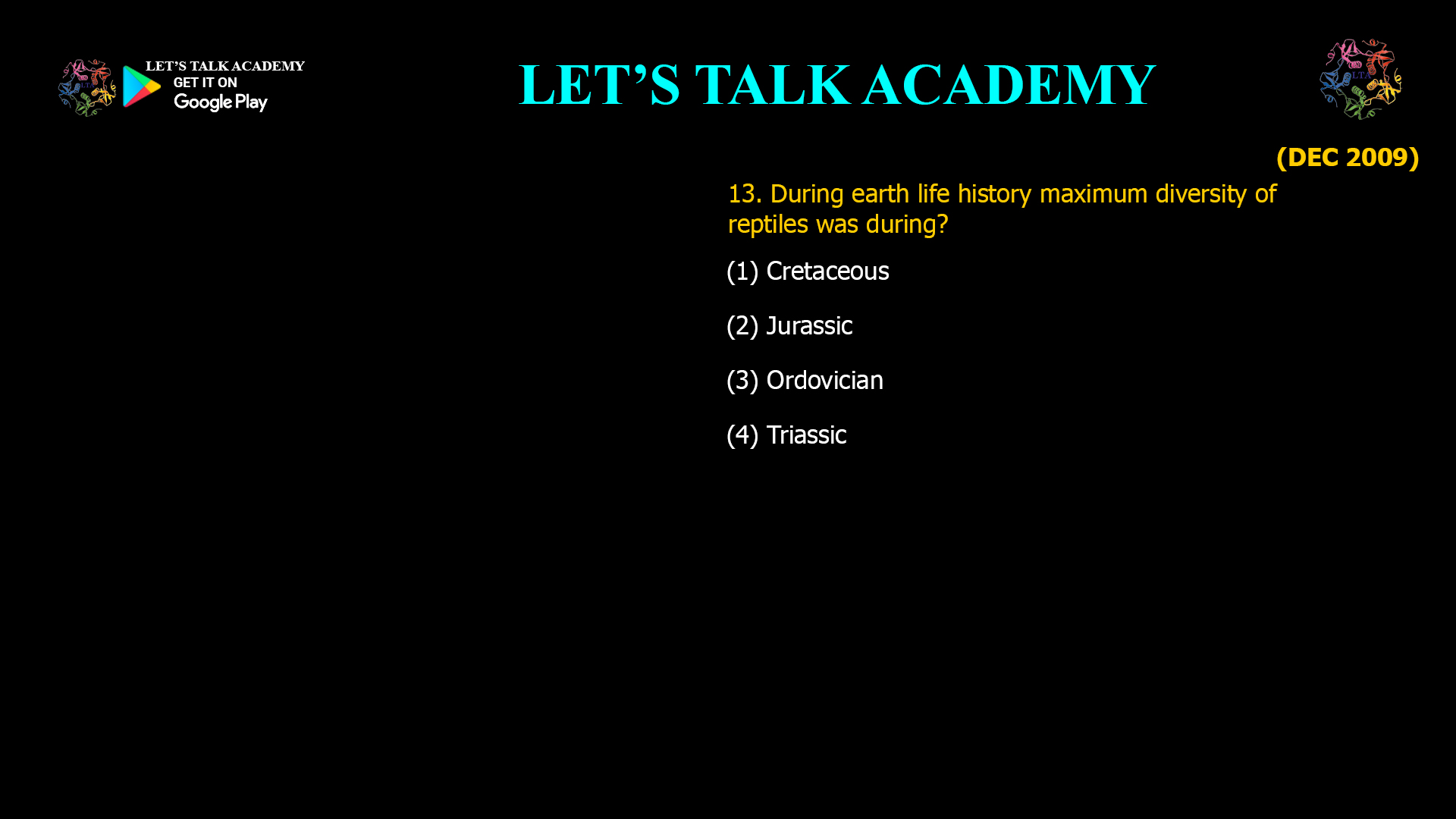
During earth life history maximum diversity of reptiles was during? (1) Cretaceous (2) Jurassic (3) Ordovician (4) Triassic

When Did Reptiles Reach Their Maximum Diversity? Exploring the Cretaceous Peak

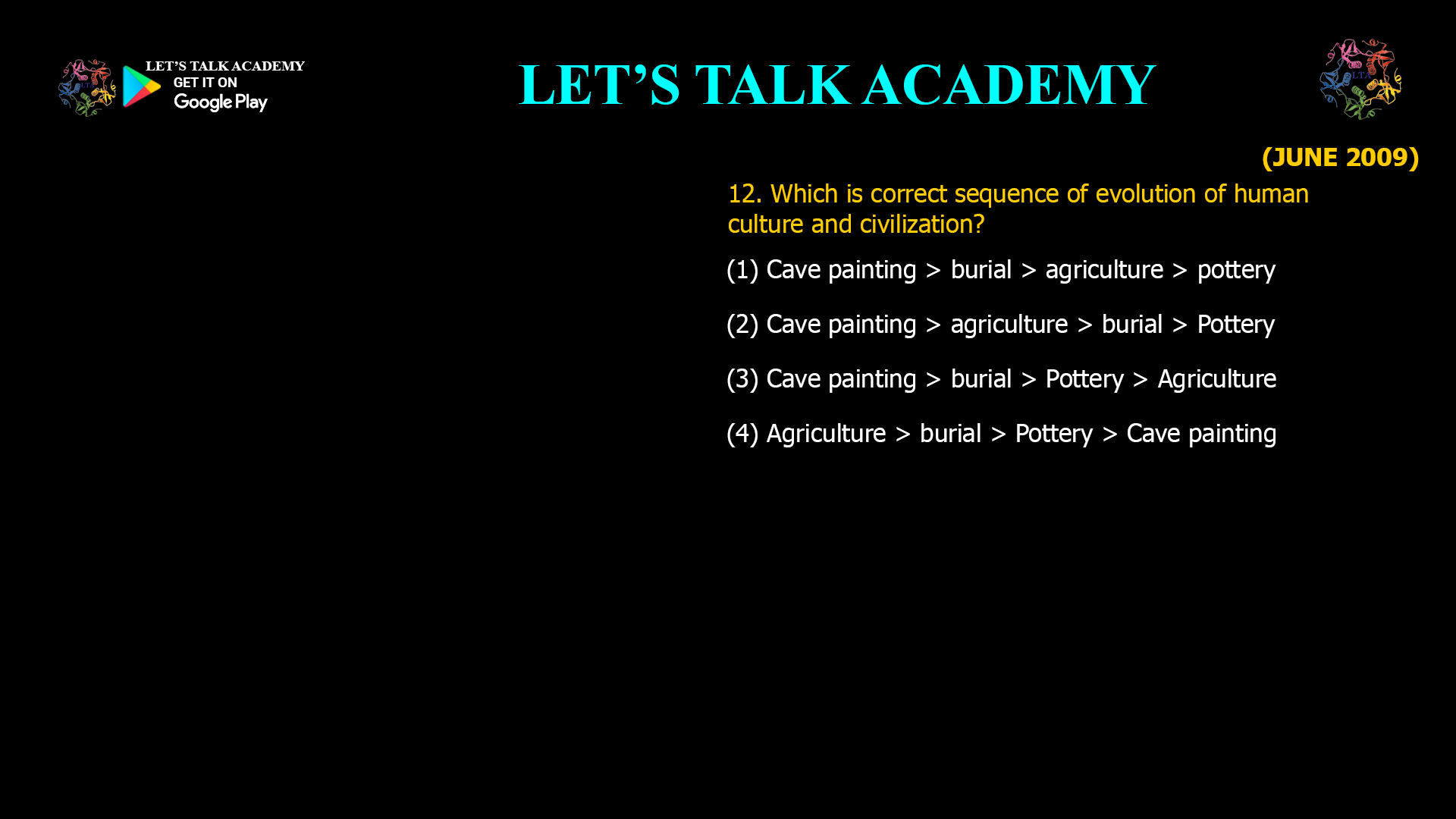
Which is correct sequence of evolution of human culture and civilization? (1) Cave painting> burial>agriculture >pottery (2) Cave painting>agriculture>burial>Pottery (3) Cave painting > burial>Pottery>Agriculture (4) Agriculture>burial> Pottery>Cave painting

The Correct Sequence of Human Cultural and Civilizational Evolution

Which era is characterized by dramatic diversification among eukaryotes? (1) Cambrian (2) Devonian (3) Carboniferous (4) Triassic

Which Era Is Characterized by Dramatic Diversification Among Eukaryotes?

Highest mass extinction during history of earth was observed during (1) End of Permian (2) End of cretaceous (3) End of Devonian (4) End of carboniferous

The Greatest Mass Extinction in Earth’s History: The End-Permian Event

Extensive phyletic diversification of animals was observed in (1) Devonian (2) Silurian (3) Cambrian (4) Mesozoic

The Cambrian Period: The Era of Extensive Animal Diversification

8. Angiosperms originated during (1) Upper cretaceous                                                (2) mid cretaceous (3) Late cretaceous                                         (4) Carboniferous

When Did Angiosperms Originate? Tracing the Dawn of Flowering Plants

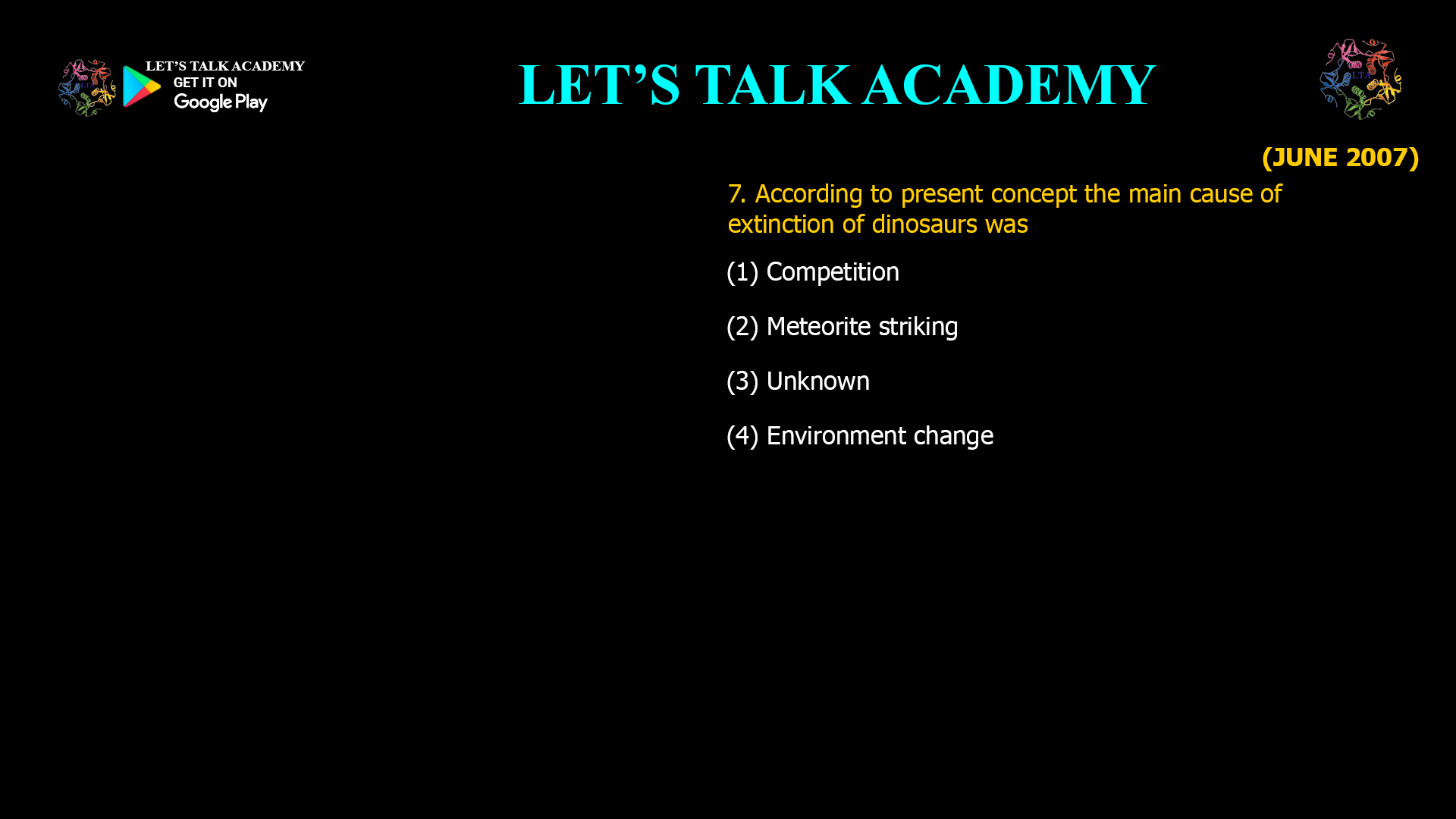
7. According to present concept the main cause of extinction of dinosaurs was (1) Competition (2) Meteorite striking (3) Unknown (4) Environment change

What Caused the Extinction of Dinosaurs? The Meteorite Impact Theory

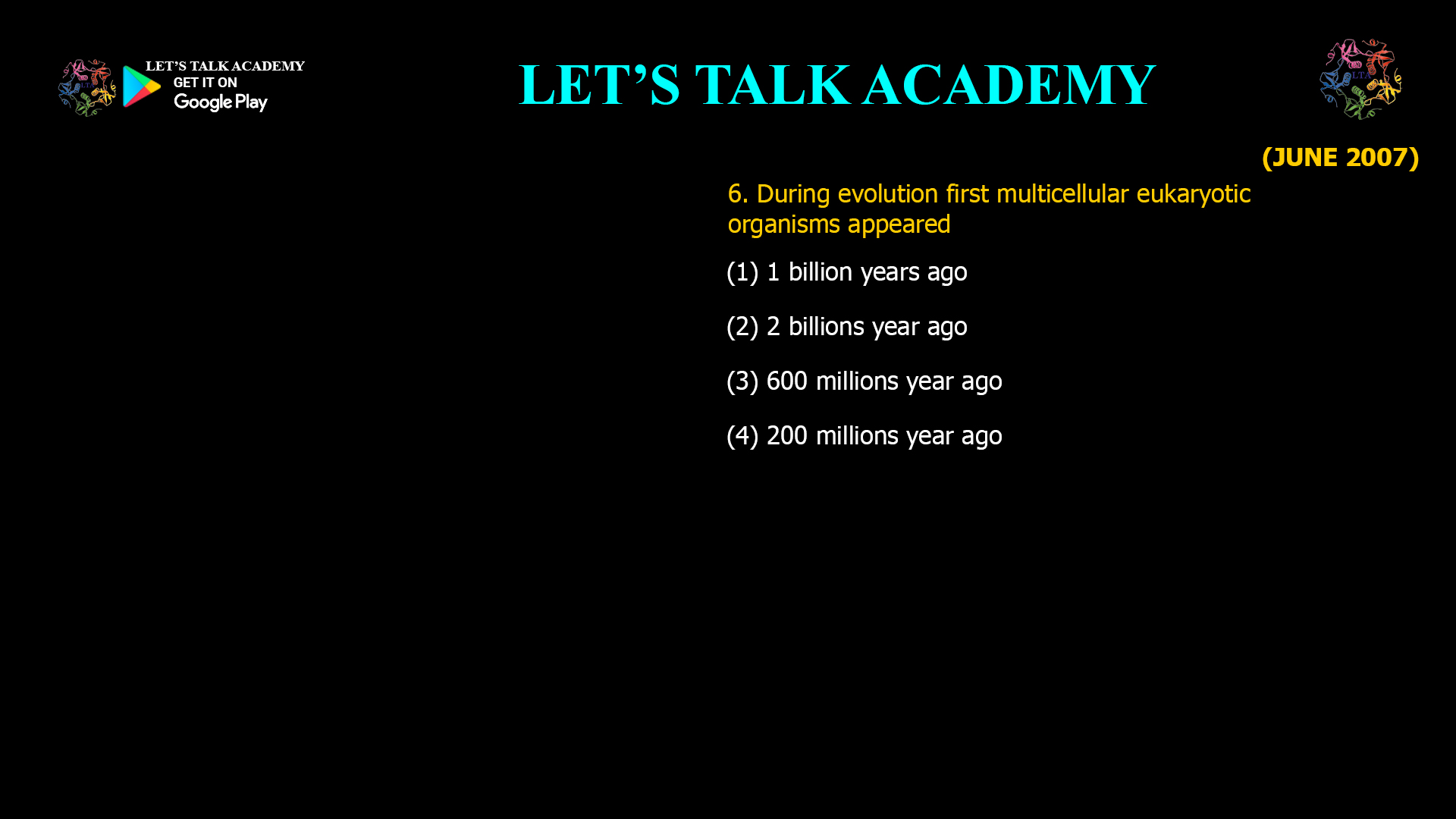
During evolution first multicellular eukaryotic organisms appeared (1) 1 billion years ago (2) 2 billions year ago (3) 600 millions year ago (4) 200 millions year ago

When Did the First Multicellular Eukaryotic Organisms Appear?

Recently reptile fossils of age 200-250 MY have been found in Brazil and Ghana-portion of West Africa. This suggest that the both places were part of large landmass during that period named as (1) Pangea (2) Laurasia (3) Gondwana (4) Tethys Sea

Fossil Evidence and Ancient Landmasses: Brazil and Ghana’s Connection to Pangea

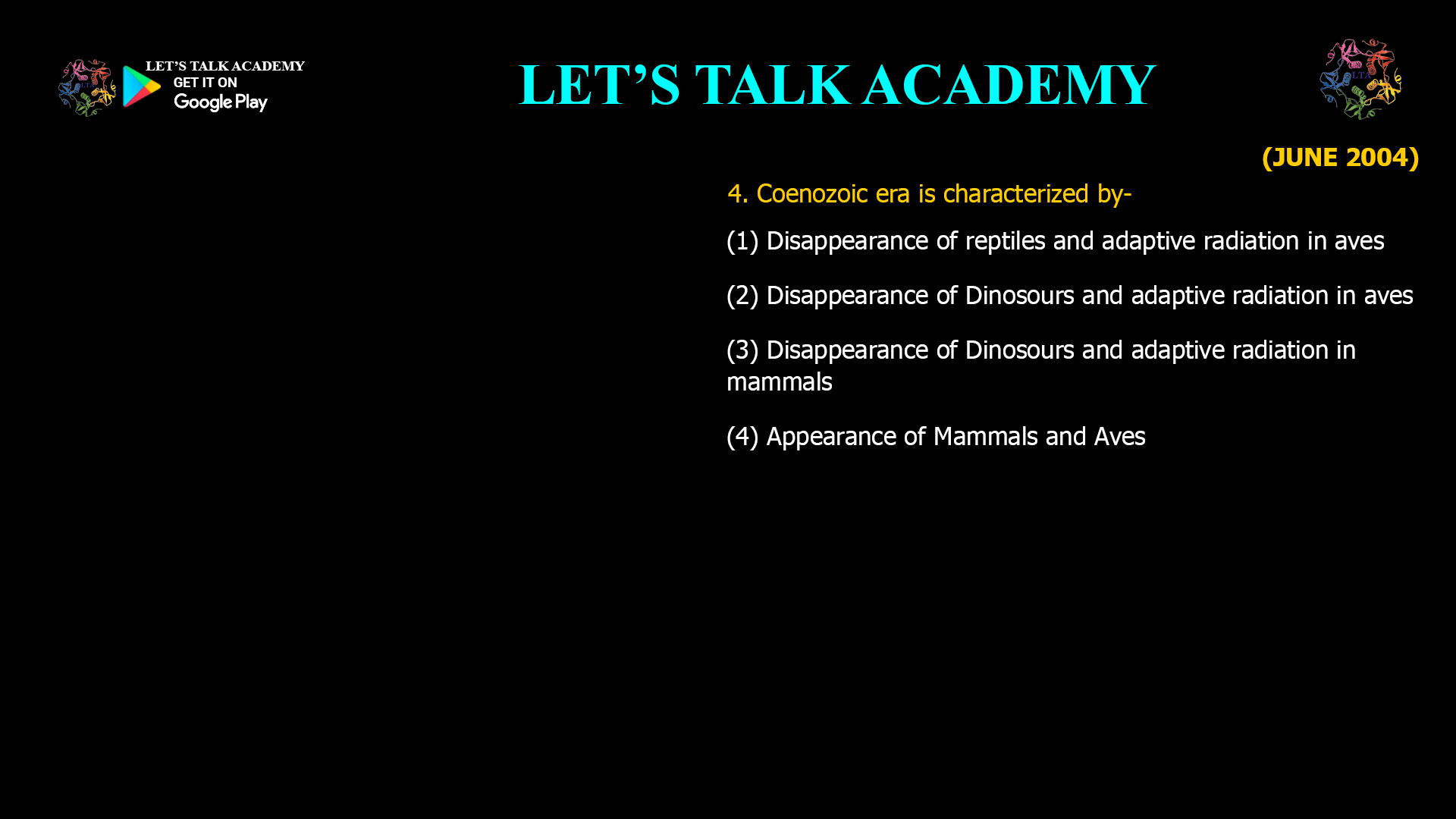
4. Coenozoic era is characterized by- (1) Disappearance of reptiles and adaptive radiation in aves (2) Disappearance of Dinosours and adaptive radiation in aves (3) Disappearance of Dinosours and adaptive radiation in mammals (4) Appearance of Mammals and Aves

Cenozoic Era: The Disappearance of Dinosaurs and the Rise of Mammals

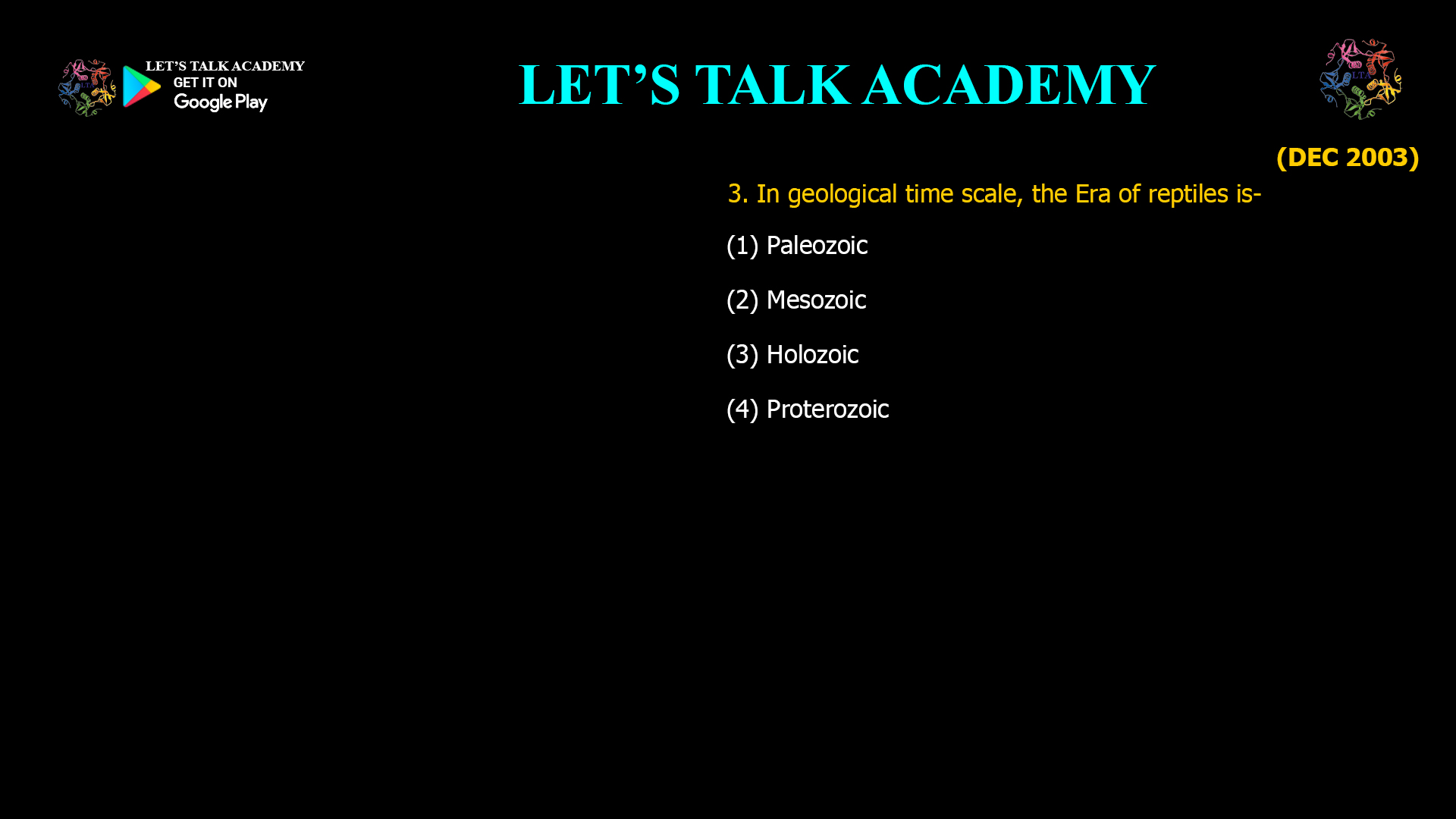
In geological time scale, the Era of reptiles is- (1) Paleozoic (2) Mesozoic (3) Holozoic (4) Proterozoic

The Mesozoic Era: The Age of Reptiles in Earth’s Geological Timeline

The period of Jurassic in million years ago is- (1) 310-250 (2) 250-200 (3) 200-140 (4) 140-100

The Jurassic Period: When Did It Occur in Earth’s History?

The correct hierarchy of geological times is: (1) eon > era > period > epoch (2) period > era > epoch (3) epoch > period > era > eon (4) era > eon > period

Geological Time Scale Hierarchy: Understanding Eons, Eras, Periods, and Epochs

Latest Courses