The two phylogenetic trees given below represent evolutionary patterns in species or population. The differently colored or dashed lines represent a single or gene genealogy. Select the option that correctly identifies the type of evolutionary process that these two figures represent. (1) A- hybridization, sorting B- incomplete lineage (2) A- convergence, sorting B-incomplete lineage (3) A- adaptive introgression,                                      B-hybridization (4) A-hybridization,                                          B-adaptive introgression

Hybridization and Incomplete Lineage Sorting: Decoding Gene Tree Discordance in Phylogenetics

The following statements were made describing the properties of a UPGMA tree (Unweighted Pair Group Method with Arithmetic Mean): A. It describes species relationships and is therefore the best method to describe a new species. B. It is a method of hierarchical clustering. C. The raw data is a similarity matrix and the initial tree is rooted. D. It permits lineages with largely different branch lengths and corrections for multiple substitutions. Which one of the following options represents the correct properties? (1) A and B (2) B and C (3) A and D (4) C and D

Understanding UPGMA Trees: Key Properties and Applications in Phylogenetics

Given are some statements with reference to the use of genes in plant molecular systematics. A. mtDNA are not preferred over cpDNA or rDNA because they generally show slow rate of sequence evolution and fast rate of structural evolution. B. cpDNA are not preferred because of their haploidy, uniparental inheritance, and absence of recombination among cpDNA molecules. C. rDNA such as ITS are preferred for their higher evolutionary rates as well as shorter sequence length. D. rDNA and cpDNA cannot be used simultaneously in molecular systematic since they represent conflicting patterns of inheritance. Which of the above statements are INCORRECT? (1) A, C and D (2) A, B and C (3) A and C only (4) B and D only

Clarifying the Use of Genes in Plant Molecular Systematics: Myths and Facts About mtDNA, cpDNA, and rDNA

In the cladograms given below each nucleotide change is indicated by a black bar Which one of the following options represents two equally most parsimonious trees? (1) A and B                                                    (2) B and C (3) C and D                                                    (4) A and D

Maximum Parsimony in Cladograms: Identifying Equally Most Parsimonious Trees

When James R Brown and W Ford Doolittle (1997) reconstructed the tree of life using a variety of different genes, they found that different genes gave fundamentally different phylogenies as shown below. Note that the genes are unique to the specific trees. From the given options select the process that best explains the observed discrepancies between the trees. (1) polyploidization (2) horizontal gene transfer (3) allopatric speciation (4) localized extinctions

Horizontal Gene Transfer: The Key to Conflicting Phylogenetic Trees in the Tree of Life

In the phylogenetic tree above, branch-lengths are drawn proportional to the number of changes along a lineage. The following inferences were made from this tree. (A) Bacteria are more closely related to Eukarya than to Archaea. (B) Bacteria and Archaea are more similar to each other than either is to Eukarya. (C) Archaea and Eukarya diverged from each other after their common ancestor diverged from bacteria. Which of the following represents a combination of correct inferences? (1) (A), (B) and (C) (2) (A) and (B) only (3) (B) and (C) only (4) (A) and (C) only

Decoding the Evolutionary Relationships Among Bacteria, Archaea, and Eukarya: Insights from Phylogenetic Trees

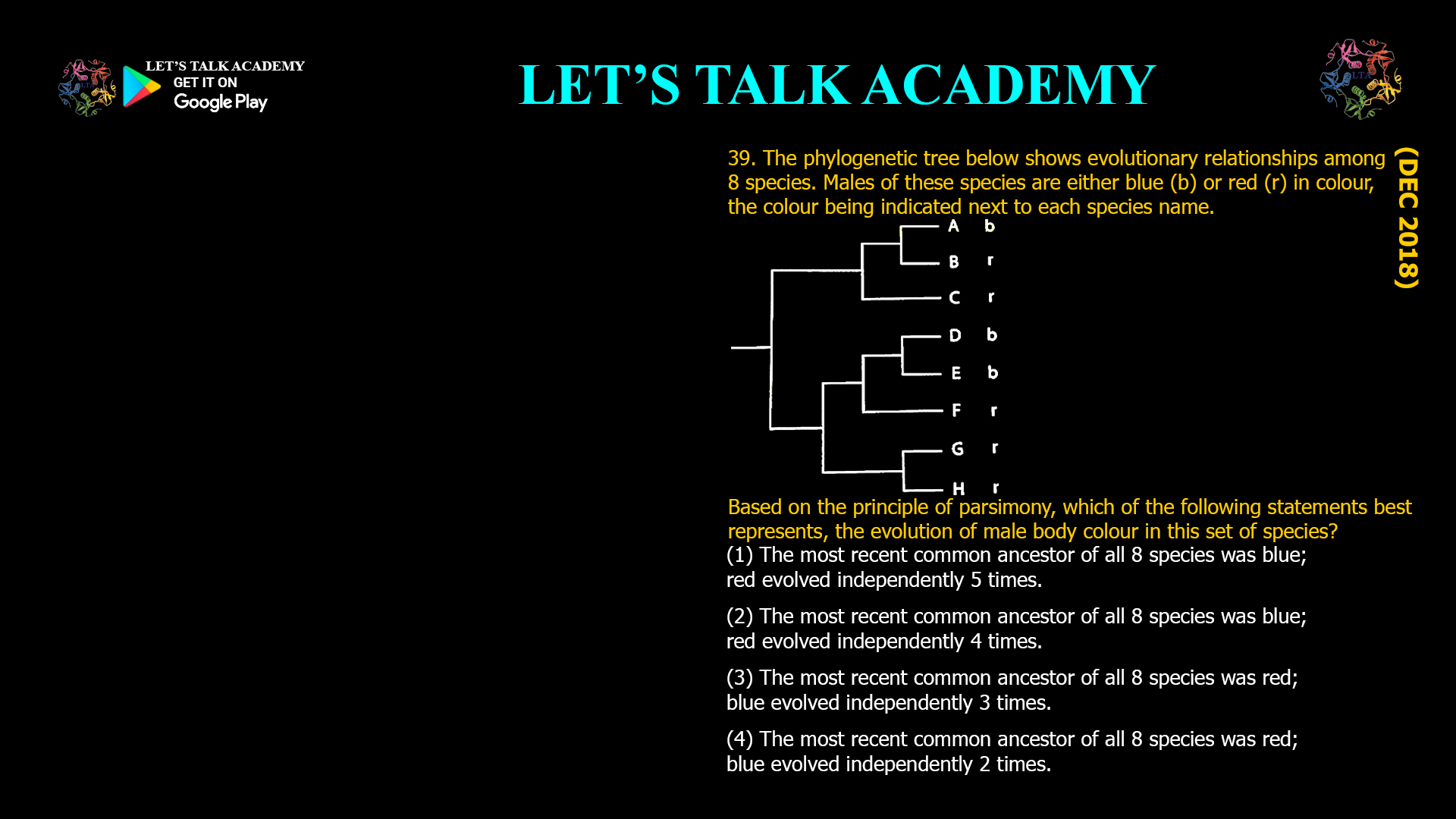
The phylogenetic tree below shows evolutionary relationships among 8 species. Males of these species are either blue (b) or red (r) in colour, the colour being indicated next to each species name. Based on the principle of parsimony, which of the following statements best represents, the evolution of male body colour in this set of species? (1) The most recent common ancestor of all 8 species was blue; red evolved independently 5 times. (2) The most recent common ancestor of all 8 species was blue; red evolved independently 4 times. (3) The most recent common ancestor of all 8 species was red; blue evolved independently 3 times. (4) The most recent common ancestor of all 8 species was red; blue evolved independently 2 times.

Parsimony and the Evolution of Male Body Color in Species: Decoding Ancestral States

The phylogeny below shows evolutionary relationships between 9 extant bird species and whether they display red or blue plumage. Based on the above phylogeny and the distribution of red and blue character states among the extant species, and using the principle of parsimony, which of the following is the correct inference about plumage colour of the ancestor at the root P? (1) Ancestral state at P is blue. (2) Ancestral state at P is red. (3) Ancestral state at P is more likely to be red than blue (4) Ancestral state at P is equally likely to be red or blue.

Using Parsimony to Infer Ancestral Plumage Color in Birds: Red or Blue at the Root?

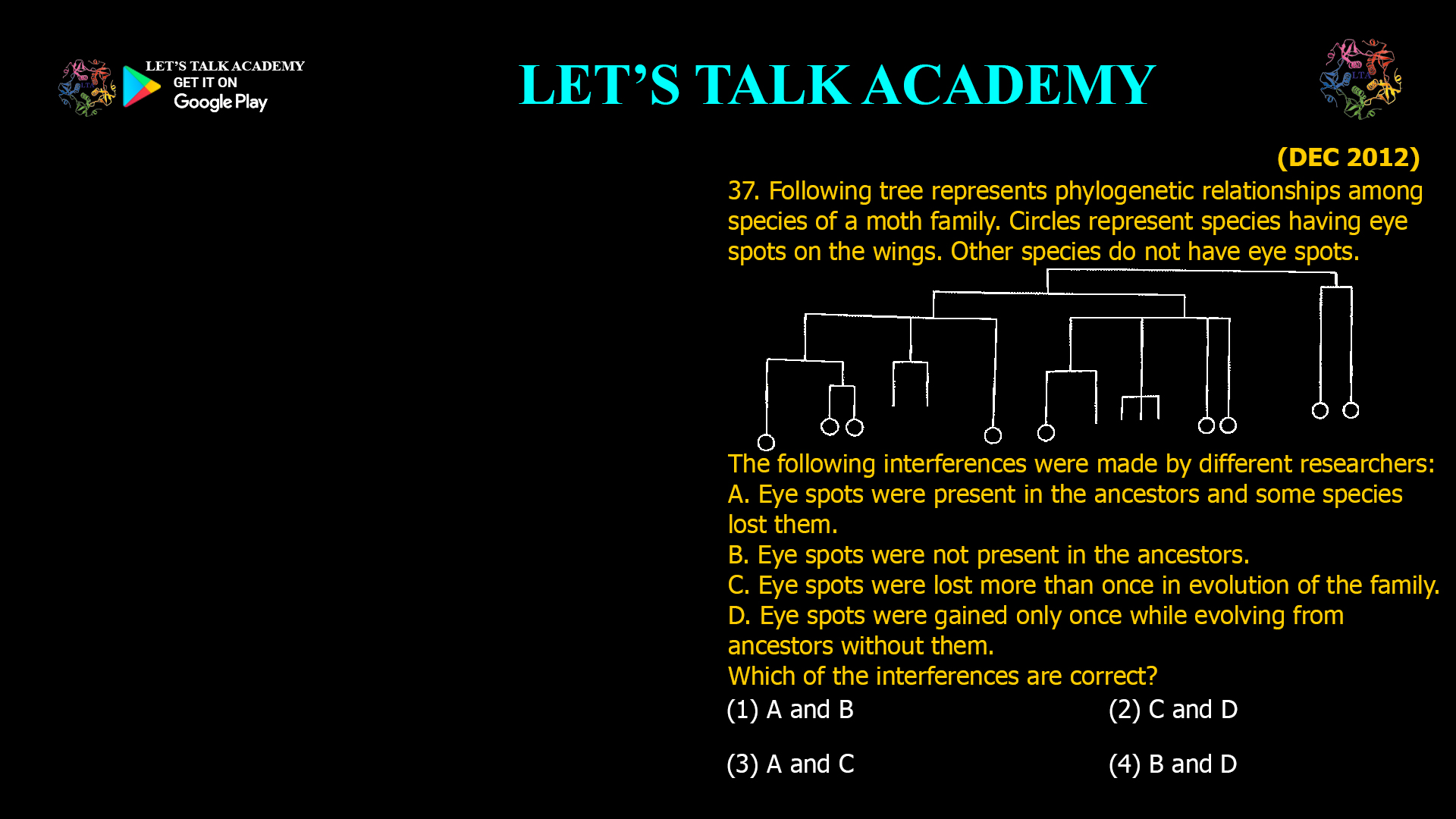
Following tree represents phylogenetic relationships among species of a moth family. Circles represent species having eye spots on the wings. Other species do not have eye spots. The following interferences were made by different researchers: A. Eye spots were present in the ancestors and some species lost them. B. Eye spots were not present in the ancestors. C. Eye spots were lost more than once in evolution of the family. D. Eye spots were gained only once while evolving from ancestors without them. Which of the interferences are correct? (1) A and B (2) C and D (3) A and C (4) B and D

Tracing the Evolution of Eye Spots in Moths: Losses, Gains, and Ancestral States

Which one of the following genomes is most appropriate to determine hybrids in plants and animals? (1) Nuclear (2) Mitochondrial (3) Chloroplast (4) Mitochondria and chloroplast

Nuclear Genome: The Most Reliable Marker for Detecting Hybrids in Plants and Animals

Which of the following processes interferes in sequence-based phylogeny? (1) Horizontal gene transfer (2) Adaptive mutations (3) DNA repair (4) Reverse transcription

How Horizontal Gene Transfer Interferes with Sequence-Based Phylogeny

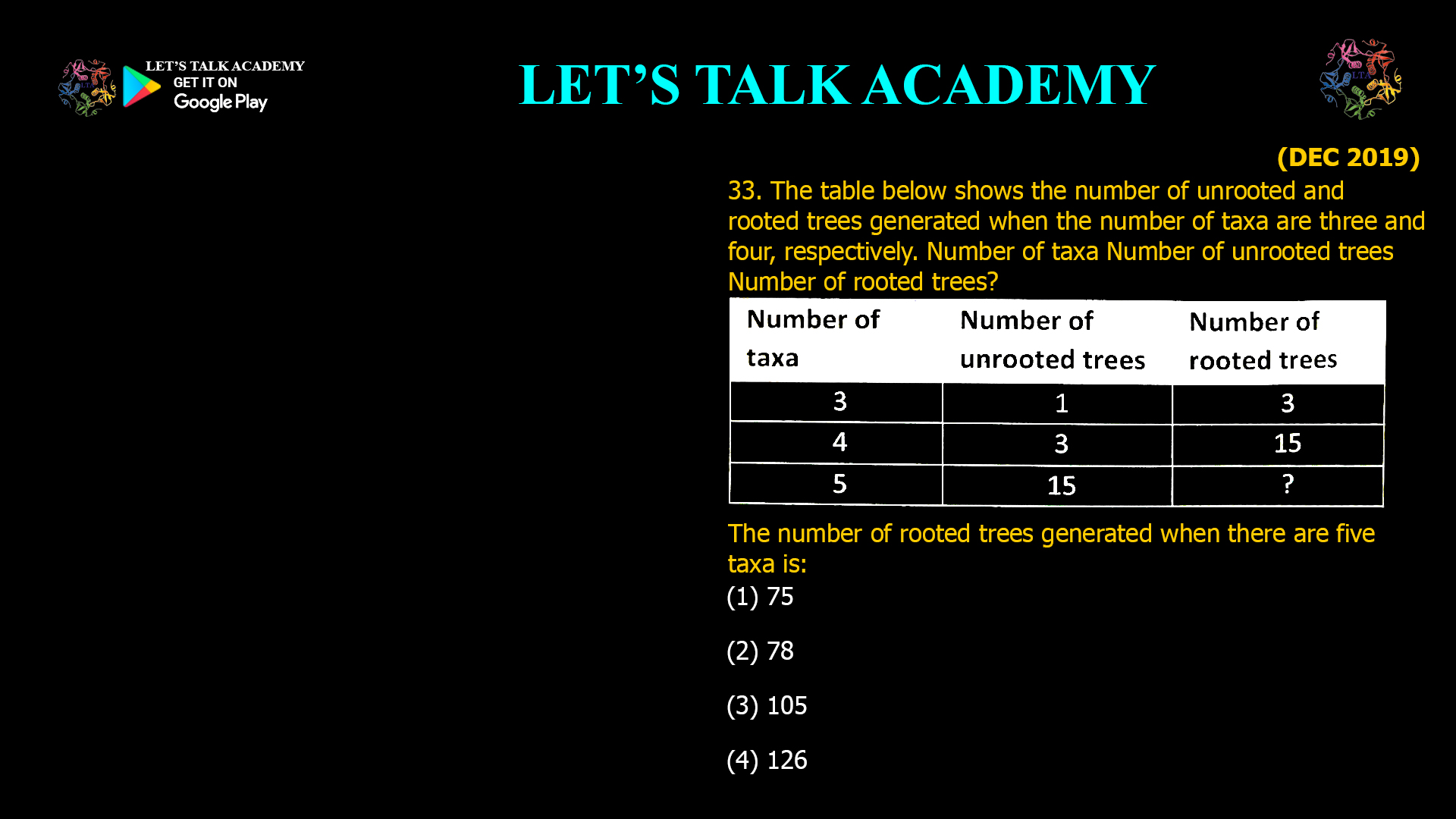
The table below shows the number of unrooted and rooted trees generated when the number of taxa are three and four, respectively. Number of taxa Number of unrooted trees Number of rooted trees? The number of rooted trees generated when there are five taxa is: (1) 75 (2) 78 (3) 105           (4) 126

How Many Rooted Trees Can Be Formed with Five Taxa? Understanding Phylogenetic Tree Calculations

Evolution of multi-gene family occurs by (1) only gene duplication. (2) only unequal crossing-over. (3) random mutations. (4) both duplication and unequal crossing over. 

How Multi-Gene Families Evolve: The Role of Duplication and Unequal Crossing Over

31. For which, of the following characters, convergent evolution is most unlikely? (1) Locomotor organs. (2) Secondary metabolites. (3) Conditionally expressed genes. (4) Base sequence of a gene.

Why Convergent Evolution Is Most Unlikely for Gene Base Sequences

Which species concept utilizes morphological and molecular characters to distinguish between species? (1) Evolutionary (2) Ecological (3) Biological (4) Phylogenetic

The Phylogenetic Species Concept: Defining Species with Morphological and Molecular Evidence

Mayfair genes (HYPOTHETICAL) consist of a superfamily of transcription factors. They are found in 4 clusters in mammals; in 2 clusters in insects; and in a single cluster in an ancestor to insects. These data consistent with all of the following explanations EXCEPT: (1) Two successive genome duplication event occurred between ancestral organisms and vertebrates (2) the first duplication may have taken place before divergence of vertebrates (3) exon shuffling exclusively produced such cluster (4) whole genome duplication could lead to such observation.

Gene Cluster Evolution: Why Exon Shuffling Alone Can’t Explain Mayfair Gene Patterns

Biased gene conversion (BGC) has been proposed to cause changes in allele frequencies in a population. Select the statement that is NOT correct about BGC. (1) BGC is present in bacteria and eukaryotes suggesting it may be present in the Last Universal Common Ancestor (LUCA). (2) BGC can favor the fixation of deleterious donor alleles. (3) BGC is an example of non-adaptive evolutionary process. (4) BGC selects against mal-adaptations resulting in fixation of only advantages mutations.

Biased Gene Conversion: Myths and Facts About Its Role in Genome Evolution

27. Given below are graphs depicting two possible dynamics of gene duplication events over a period of time during genome evolution. Based on the above figures, which one of the following options correctly represents the identity of A, B, C and D? (1) A-Gene duplication event, B-random loss of duplicated genes, C-remaining pairs of duplicated genes, D-additional gene duplication events (2) A-remaining pairs of duplicated genes, B-gene duplication event, C-random loss of duplicated genes, D-additional gene duplication events (3) A-additional gene duplication events, B-random loss of duplicated genes, C- remaining pairs of duplicated genes, D-Gene duplication event (4) A-Random loss of duplicated genes, B-additional gene duplication events, C- gene duplication event, D-remaining pairs of duplicated genes

Gene Duplication Dynamics: Understanding the Fate of Duplicated Genes in Genome Evolution

26. The figure below shows a gene duplication event followed by a divergence event in species 1 and 2. Based on the details given above determine what is represented by A and B (1) A : duplicated genes; B : ancestral genes (2) A : paralogs; B : ancestral genes (3) A : orthologs; B : paralogs (4) A: paralogs; B : orthologs

Paralogs and Orthologs: Decoding Gene Duplication and Divergence in Evolution

The most commonly used molecular tool for phylogentic analysis involves sequencing of (1) mitochondrial DNA. (2) mitochondrial RNA. (3) ribosomal RNA. (4) nuclear DNA.

Why Ribosomal RNA Sequencing Is the Gold Standard for Phylogenetic Analysis

Similarities in sequence and function of two proteins indicate that they are members of a family that share a common ancestor. If they are from different species, they are called (1) homologs. (2) orthologs. (3) paralogs. (4) proteologs.

Orthologs: Understanding Protein Similarity Across Species

23. A monophyletic group of organisms that is, composed of a common ancestor and all its lineal descendants on a phylogenetic tree are termed as (1) clade (2) cline (3) cluster (4) clone

What Is a Clade? Understanding Monophyletic Groups in Evolutionary Biology

22. At present, the relationship between human and monkey can be stated as (1) They both have common ancestors (2) Human have evolved from monkey (3) Both have very distinct phylogeny (4) Relationship cannot be established

Do Humans Evolve from Monkeys? Understanding the True Relationship Between Humans and Monkeys

21. If a gene sequence in Species A is 95 % similar to gene sequence in Species B. Such genes are termed as (1) Orthologous (2) Perilogous (3) Paralogous (4) Allologous

Understanding Orthologous Genes: The Cornerstone of Comparative Genomics

A group of species which are phylogenetically closer but donot share common ancestor are regarded as (1) Monophyletic (2) Polyphyletic (3) Paraphyletic (4) Sympatric

Polyphyletic Groups: When Phylogenetically Close Species Lack a Common Ancestor

Phylogenetic relationship can be best established by- (1) Allozymes (2) Alakaloids (3) Molecular markers (4) Morphology

Molecular Markers: The Gold Standard for Establishing Phylogenetic Relationships

Phylogenetic relationship among organisms cannot be established on basis of- (1) 5 S r-RNA (2) t-RNA sequencing (3) 16 S r-RNA (4) Mitochondrial DNA

Which Molecular Markers Cannot Establish Phylogenetic Relationships? Understanding the Limits of tRNA Sequencing

Human phylogeny is characterized by- (1) Y chromosome (2) Mitochondrial genes (3) Both 1 & 2 (4) VNTR

Human Phylogeny: The Role of Y Chromosome and Mitochondrial Genes in Tracing Ancestry

Scientists discovered two new plant species. "A" and "B" that look similar except that, species "A" bears flowers and leaves that are twice the size of those in species "B". Which method should the scientists use to appropriately investigate if species ''A" is a result of gene duplication in species "B"? (1) Sequence similarity, gene structure and gene size. (2) Plant size, physical proximity of gene and genome size. (3) Sequence similarity, physical proximity of gene, genome size. (4) Sequence length, gene structure and chromosome count.

How to Investigate Gene Duplication in New Plant Species: Best Methods for Modern Genomics

How to Write SEO-Friendly Articles in 2025: A Complete Guide for Top Google Rankings

Given below are the few statements on concepts related to genome evolution. A. Presence of introns in some chloroplast genes suggests that endosymbiosis (leading to organelle evolution) occurred before loss of introns in prokaryotes and supports the hypothesis that genes originated as interrupted structures. B. Negative selection is associated with increased rate of nonsynonymous substitutions as compared to synonymous substitutions. C. Nucleotide substitution rates during evolution can be inferred from divergence of the sequences that are non-functional or neutral. D. Positive selection is associated with increased rate of nonsynonymous substitutions as compared to synonymous substitutions. Which one of the following options represents a combination of all INCORRECT statements? (1) A and C only (2) B and C only (3) A and B only (4) C and D only

Identifying Incorrect Statements on Genome Evolution: Introns, Selection, and Substitution Rates

If the ratio of the number of non-synonymous to snynonymous substitutions per site in protein coding gene is greater than one, it is an evidence of selection that is (1) positive. (2) negative. (3) neutral. (4) random.

Positive Selection and the dN/dS Ratio: Interpreting Evidence from Molecular Evolution

Which of the following is a prediction of neutral theory of molecular evolution that is supported by data? (1) Human and chimps differ more in DNA sequences of psuedogenes than in coding regions of functional genes (2) Human and chimps differ more in DNA sequences of coding regions of functional genes than of pseduogenes (3) Human have a faster evolution of most of their DNA sequences than chimps (4) The more advanced species have more number of functional genes

Neutral Theory Prediction: Why Human and Chimp Pseudogenes Differ More Than Coding Genes

Which one of the following statements is NOT TRUE about the Neutral Theory as proposed by Motoo Kimura? (1) Except for advantageous mutations, most alleles are under neutral selection (2) The rate of evolution for most genes will be equal to the neutral mutation rate (3) Advantageous mutations are exceedingly rare (4) At the level of DNA sequences, genetic drift dominates evolution

Understanding the Neutral Theory of Molecular Evolution: What Is NOT True About Kimura’s Proposal?

Molecular evolution generally do not reflects (1) Species divergence (2) Convergent evolution (3) Natural selection (4) Neutral mutation

What Does Molecular Evolution Reflect? Understanding Its Limits in Convergent Evolution

What is basic assumption for using molecular clocks for estimation of molecular evolution? (1) Rate of neutral mutation is constant over time (2) Rate of evolution is constant over time (3) DNA do not show variations among organisms (4) Proteins are better marker for phylogeny as compare to DNA

What Is the Key Assumption Behind the Molecular Clock Hypothesis?

7. Rate of molecular evolution would be least in (1) Non-synonymous change in codon (2) Synonymous change in codon (3) Flanking regions of genes (4) Introns of genes

Where Is the Rate of Molecular Evolution Slowest? Non-Synonymous Codon Changes Explained

6. Genes between related organism exhibits high variation. The variations would be maximally observed in (1) Exons (2) Intron (3) Promoters (4) Polyadenylation site

Where Is Genetic Variation Highest in Genes? Introns Lead the Way

5. Major cause of evolution of genes and protein is (1) Point mutation (2) Chromosomal aberrations (3) Sexual reproduction (4) Gene duplication and divergence

Gene Duplication and Divergence: The Major Force Behind the Evolution of Genes and Proteins

4. Allele frequency of a particular allele was found to be 0.5 in three different populations. It is probably due to is (1) Neutral allele (2) Stable polymorphism (3) Heterozygote advantage (4) Natural selection

Why Is the Allele Frequency 0.5 in Different Populations? Understanding the Role of Neutral Alleles

3. With time molecular distance between organisms increases during evolution largely due to (1) Natural selection (2) Neutral Mutation (3) Random d rift (4) Point Mutations

How Neutral Mutations Drive Molecular Distance in Evolution

The Molecular Clock Hypothesis: How Neutral Evolution Shapes Phylogenetic Relationships

1. Inactive faulty copy of functional gene is called (1) Recessive gene (2) Pseudo gene (3) Null gene (4) Neutral gene

What Is a Pseudogene? Understanding the Inactive, Faulty Copies of Functional Genes

Latest Courses