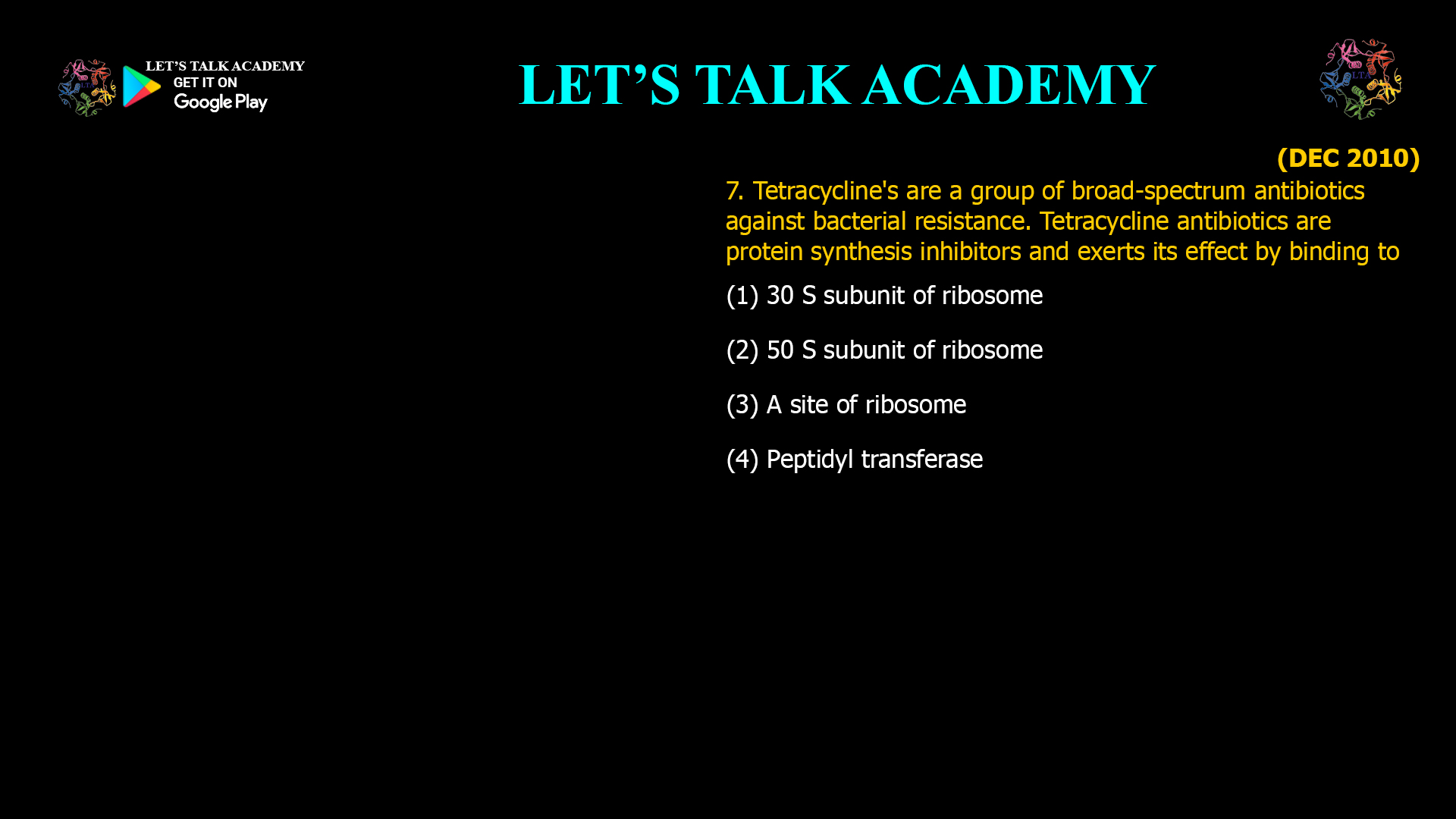
7. Tetracycline’s are a group of broad-spectrum antibiotics against bacterial resistance. Tetracycline antibiotics are protein synthesis inhibitors and exerts its effect by binding to
(1) 30 S subunit of ribosome
(2) 50 S subunit of ribosome
(3) A site of ribosome
(4) Peptidyl transferase
Tetracycline antibiotics are among the most widely used broad-spectrum antibiotics, effective against both Gram-positive and Gram-negative bacteria. Their ability to inhibit protein synthesis makes them invaluable in treating infections, but their mechanism of action is often misunderstood. This article clarifies how tetracyclines exert their antibacterial effects by targeting specific regions of the bacterial ribosome.
Tetracycline’s Primary Target: The 30S Ribosomal Subunit
Tetracyclines inhibit bacterial growth by binding to the 30S subunit of the ribosome, specifically near the A (aminoacyl) site. This binding prevents the aminoacyl-tRNA (aa-tRNA) from attaching to the ribosome, effectively halting the elongation phase of protein synthesis.
Key Steps in Tetracycline’s Mechanism:
-
Binding to the 30S Subunit: Tetracycline reversibly binds to a high-affinity site on the 30S ribosomal subunit, located near helix 34 (h34) of the 16S rRNA. This site is positioned within the ribosome’s A-site crevice.
-
Blocking aa-tRNA Accommodation: By occupying this region, tetracycline sterically hinders the entry of aa-tRNA into the A site. This prevents the anticodon of the tRNA from properly pairing with the mRNA codon.
-
Inhibition of Peptide Chain Elongation: Without aa-tRNA binding, peptide bonds cannot form, and protein synthesis stalls.
Why Not the 50S Subunit or Peptidyl Transferase?
-
50S Subunit: While tetracycline may weakly bind to secondary sites on the 50S subunit, these interactions are not responsible for its primary inhibitory effect.
-
Peptidyl Transferase: This enzyme, located on the 50S subunit, catalyzes peptide bond formation. Tetracycline does not directly inhibit peptidyl transferase activity.
Structural Insights from Crystallography
Cryo-EM and X-ray crystallography studies reveal that tetracycline binds to the 30S subunit in a pocket formed by nucleotides in helix 31 (h31) and helix 34 (h34) of the 16S rRNA. This position overlaps with the path of incoming aa-tRNA, explaining its inhibitory effect. The antibiotic’s interactions are primarily with the rRNA backbone, not specific bases, allowing broad-spectrum activity across bacterial species.
Impact on Translation and Bacterial Resistance
Tetracycline’s binding destabilizes the ribosomal structure required for aa-tRNA accommodation. Resistance arises via:
-
Ribosomal Protection Proteins (e.g., Tet(O)/Tet(M)): These GTPases displace tetracycline from the ribosome, restoring translation.
-
Efflux Pumps: Some bacteria expel tetracycline before it reaches the ribosome.
Summary Table: Tetracycline’s Mechanism
| Target | Effect | Relevance to Inhibition |
|---|---|---|
| 30S subunit | Binds near A site, blocks aa-tRNA entry | Primary inhibitory mechanism |
| 50S subunit | Secondary binding sites (no major role) | Not critical for activity |
| A site | Occupies space required for aa-tRNA accommodation | Prevents codon-anticodon recognition |
| Peptidyl transferase | No direct interaction | Not targeted by tetracycline |
Correct Answer
(1) 30 S subunit of ribosome
Tetracycline exerts its antibacterial effect by binding to the 30S ribosomal subunit, preventing aminoacyl-tRNA from entering the A site and stalling protein synthesis.
Conclusion
Tetracycline’s specificity for the 30S ribosomal subunit underpins its role as a protein synthesis inhibitor. By blocking aa-tRNA accommodation, it disrupts bacterial growth without directly interfering with peptidyl transferase or the 50S subunit. Understanding this mechanism is critical for combating resistance and developing next-generation antibiotics that target similar pathways.


6 Comments
Sakshi yadav
November 3, 2025Tetracycline targets the 30 s subunit
Sakshi Kanwar
November 3, 2025Binds near A site of 30 s subunit and block t rna
Santosh Saini
November 3, 2025Tetracyclines inhibit bacterial growth by binding to the 30s subunit of the ribosome, near the A site
Sonal Nagar
November 4, 2025Option 1st
Muskan Yadav
November 7, 2025Tetracycline exerts its antibacterial effect by binding to the 30S ribosomal subunit, preventing aminoacyl-tRNA from entering the A site and stalling protein synthesis.
Divya rani
November 8, 2025Tertracyclin drug act only in prokaryotes as a translation inhibitor it binds at 30S subunit of ribosome.