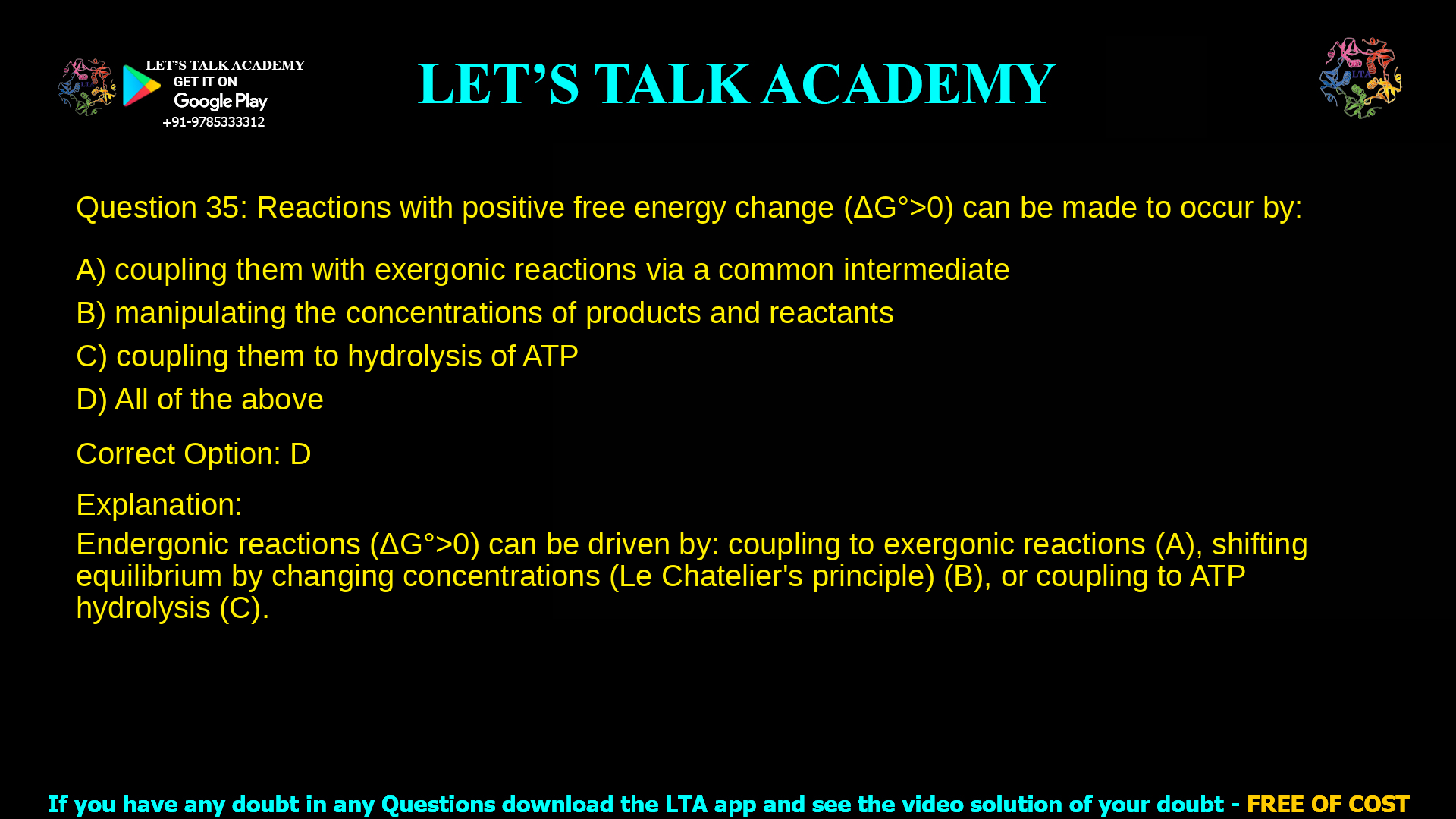
5. Reactions with positive free energy change (ΔG0>0) can be made to occur by:
a. coupling them with exergonic reactions via a common intermediate
b. manipulating the concentrations of products and reactants
c. coupling them to hydrolysis of ATP
d. All of the above
Making Reactions with Positive ΔG⁰ Occur: CSIR NET Life Sciences Guide
Reactions with positive free energy change (ΔG⁰ > 0), known as endergonic reactions, are non-spontaneous and require energy input to proceed in biological systems. These can be driven forward through specific biochemical mechanisms, making option d. All of the above the correct answer for this CSIR NET question.
Option A: Coupling with Exergonic Reactions
Coupling endergonic reactions to exergonic ones (ΔG⁰ < 0) via a common intermediate allows the energy released from the spontaneous reaction to drive the non-spontaneous one. For instance, in glycolysis, the exergonic ATP hydrolysis shares intermediates like glucose-6-phosphate with the endergonic phosphorylation step, resulting in a net negative ΔG. This mechanism ensures cellular processes like biosynthesis occur efficiently.
Option B: Manipulating Concentrations
The actual free energy change (ΔG) follows ΔG = ΔG⁰ + RT ln(

$39.00
A Million To One

$36.00
Book Cover Design

$69.00
Create An EBook Cover

$29.00
EBook Cover Design

$24.00
My Book Cover

$30.00
SEO Tricks & Tips

$15.00
The Book Of Art

Original price was: $39.00.$29.00Current price is: $29.00.
The Hypocrite World

$49.00
The Mind Of Leader

$49.00
Web Design Course
Option C: Coupling to ATP Hydrolysis
ATP hydrolysis (ATP → ADP + Pi) is highly exergonic (ΔG⁰ ≈ -30.5 kJ/mol), providing energy to couple with endergonic reactions through shared intermediates like phosphorylated compounds. This powers processes such as active transport and muscle contraction, where the overall coupled ΔG becomes negative. ATP acts as the universal energy currency in cells.


