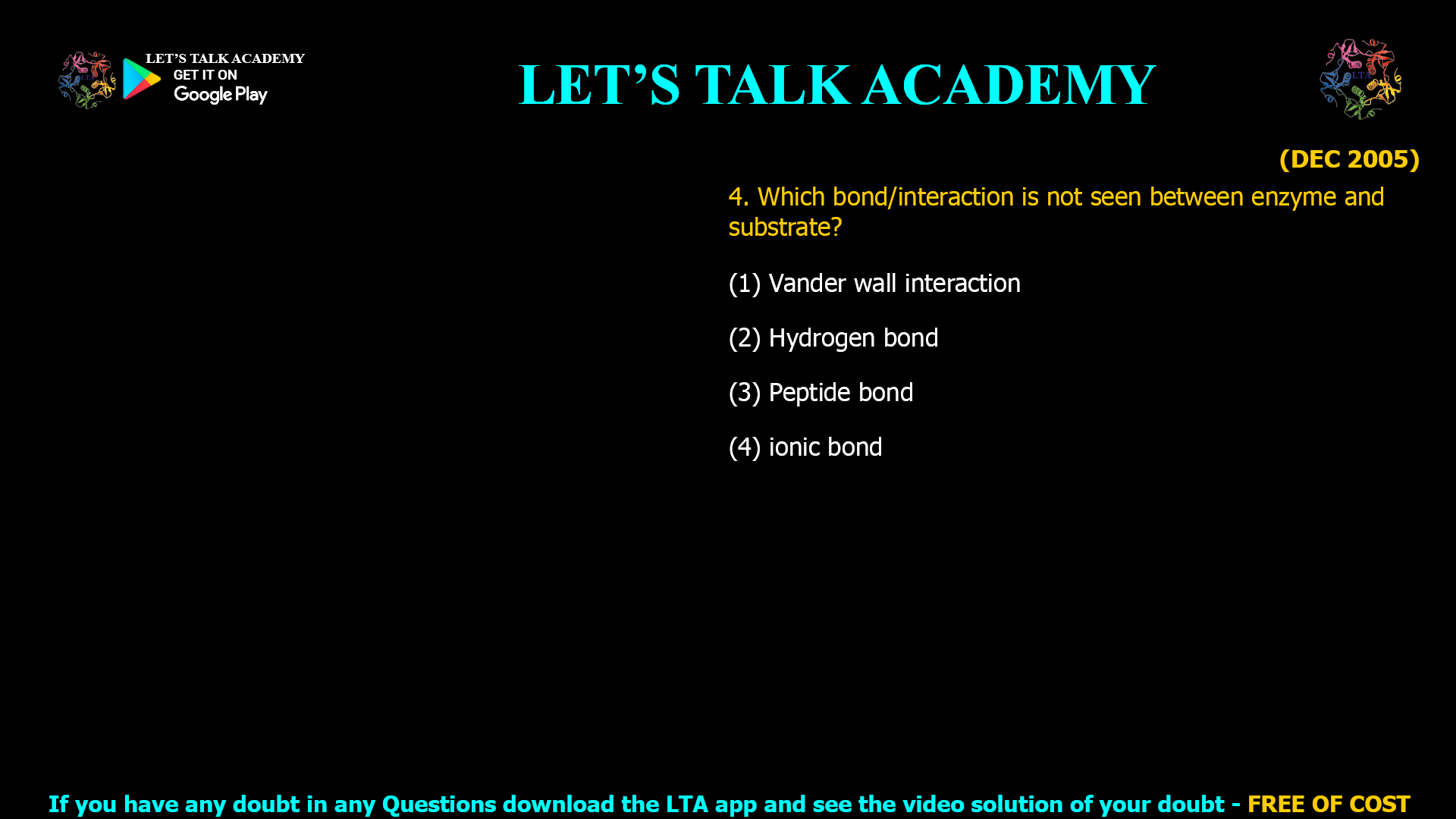
The correct answer is (3) Peptide bond. Peptide bonds are not typically formed between enzyme and substrate; rather, these covalent bonds connect amino acids in proteins, forming the enzyme’s structure, not mediating substrate binding or catalysis.
Introduction
Enzyme-substrate interactions are fundamental to every biochemical reaction in living organisms. Understanding the nature of these interactions is essential for life science students, particularly those preparing for competitive exams such as CSIR NET, GATE, or NEET. This article delves deep into the mechanisms by which enzymes recognize and interact with substrates, focusing on non-covalent forces and highlighting why peptide bonds are not a part of enzyme-substrate interactions.
The Nature of Enzyme-Substrate Interactions
Enzymes, as biological catalysts, increase the rate of chemical reactions without being consumed. Their ability to do this relies on the formation of a transient enzyme-substrate complex at the active site. The bonds and forces that stabilize these complexes are mostly non-covalent, reversible, and optimized for both specificity and efficiency.
Key Interactions
-
Hydrogen Bonds: Form between polar groups on the enzyme and substrate, contributing to specificity and stabilization.
-
Ionic Bonds/Electrostatic Interactions: Occur between oppositely charged groups (e.g., carboxylate side chains on enzymes, charged substrate groups).
-
Van der Waals Forces: Weak, non-covalent interactions arising from close molecular contact, vital for shape complementarity.
-
Hydrophobic Interactions: Involve non-polar regions of enzyme and substrate, which cluster away from water, enhancing binding.
Why Peptide Bonds Are Not Involved
Peptide bonds are a type of covalent bond connecting amino acids to form the primary structure of proteins. This stable covalent linkage is responsible for holding together the amino acid sequence of both enzyme and substrate proteins, but it does not form or break during enzyme-substrate interaction or catalysis.
-
Structural Role: Peptide bonds form the backbone of the enzyme itself, not the temporary connection with substrate.
-
No Temporary Covalent Attachment: Most enzyme-substrate interactions are reversible and non-covalent; an exception exists during covalent catalysis for some enzymes, but even then, peptide bond formation is not a step in substrate binding.
In summary, peptide bonds do not mediate or result from enzyme-substrate complex formation.
Examining Each Type of Interaction
1. Van der Waals Interaction
-
Function: Shape complementarity and molecular fit.
-
Presence: Yes, commonly seen during enzyme-substrate recognition.
2. Hydrogen Bond
-
Function: Provides specificity and strength in substrate binding.
-
Presence: Yes, integral to catalytic site interactions.
3. Peptide Bond
-
Function: Forms the protein backbone, not involved in substrate binding.
-
Presence: No.
4. Ionic Bond
-
Function: Electrostatic attraction/repulsion aids binding, positioning, and catalysis.
-
Presence: Yes, especially with charged substrates or catalytic residues.
Mechanistic Models of Enzyme-Substrate Interaction
Two classical models describe enzyme specificity:
-
Lock-and-Key Model: Substrates fit precisely into the enzyme’s active site, stabilized by hydrogen, ionic, and Van der Waals interactions.
-
Induced-Fit Model: The binding of a substrate induces a conformational change in the enzyme, optimizing interaction and catalytic efficiency.
Both models rely on non-covalent bonding to ensure substrate selectivity and reversible complex formation, not peptide bond formation.
Advanced Concepts: Covalent Catalysis
A few enzymes form temporary covalent bonds with substrates during catalysis (e.g., serine proteases forming acyl-enzyme intermediates), but these usually involve side chains (e.g., ester bonds, thioester bonds) and not peptide bonds. The peptide backbone remains intact and unaffected by such catalytic events.
Biological Significance and Applications
Enzyme Functionality
-
Enzyme-substrate specificity is the cornerstone of metabolic regulation.
-
Mutations affecting key interaction residues can result in loss of function or altered activity.
Drug Design
-
Inhibitors often mimic substrate interactions through hydrogen, ionic, and van der Waals bonds.
-
Covalent inhibitors target active site residues forming temporary (non-peptide) covalent bonds.
Biotechnology and Diagnostics
-
Enzymes used in assays depend on well-characterized interaction mechanisms.
-
Precise knowledge of binding interactions informs protein engineering and synthetic biology.
Common Misconceptions
-
Peptide bonds relate only to protein structure, not transient binding events.
-
Enzymes do not “stick” substrates together using peptide bonds in catalysis or recognition.
-
Non-covalent forces are reversible, allowing enzyme re-use, unlike peptide bonds.
Summary Table: Bonds Involved in Enzyme-Substrate Interactions
| Bond/Interaction | Present in Enzyme-Substrate Complex? | Role |
|---|---|---|
| Van der Waals | Yes | Shape complementarity, stabilization |
| Hydrogen bond | Yes | Specificity, positioning |
| Ionic bond | Yes | Attraction, charge balance |
| Peptide bond | No | Protein backbone only |
Conclusion
Peptide bonds are not seen between enzyme and substrate during binding or catalysis; the major interactions are hydrogen bonds, ionic bonds, van der Waals forces, and hydrophobic interactions. Understanding these distinctions strengthens foundational knowledge in biochemistry, enzymology, and exam preparation for life science studies.
Recap Table
| Interaction Type | Seen in Enzyme-Substrate | Main Function |
|---|---|---|
| Van der Waals | Yes | Stabilization |
| Hydrogen Bond | Yes | Substrate specificity |
| Ionic Bond | Yes | Electrostatic binding |
| Peptide Bond | No | Structure only |


60 Comments
Roopal Sharma
September 12, 2025Peptide bonds are not involved in enzyme substrate binding as they are only backbone of enzymes only for structure.
Aakansha sharma Sharma
September 12, 2025Peptide bonds are covalent bonds not involved in enzyme substrate binding as they are only backbone of enzymes only for structure.
Sakshi yadav
September 12, 2025Peptide bond (covalent bond) so not a break down of substrate and enzyme into product
Sakshi Kanwar
September 12, 2025Peptide bond because it is the bond formed by sharing of electron between carboxyl group and amino group of amino acids which is a covalent bond
Mohd juber Ali
September 12, 2025Pepetide bond is C.B. So rexn is not seen btw enzyme and s
Peoetide form protein structure
Enzyme and substare recn is non C.B. Mean Non-covalent forces are reversible, allowing enzyme re-use, unlike peptide bonds.
Priya dhakad
September 12, 2025Peptide bonds are not formed between enzyme and substrate.
Heena Mahlawat
September 12, 2025Enzymes mostly involve non covalent bonds in reaction catalysis, not covalent peptide bones are formed between enzyme and substrate.
Peptide bonds are present in backbone of ense only not in catalysis rxn.
Mansukh Kapoor
September 12, 2025The correct answer is option 3rd
Peptide bond is not used in bonding between the enzyme and substrate
Mainly it is used between the two amino acid to form protein
Varsha Tatla
September 12, 2025Pepetide bond not formed
Neha Yadav
September 12, 2025Peptide bond are not formed in enzyme substrate interaction because in enzyme substrate interaction noncovalent binding is seen and peptide bond is permanent bonding i.e covalent bonding
Tanvi Panwar
September 12, 2025Peptide bonds are not formed between enzymes and substrate bcz these are covalent bonds which are permanent and would’ve made the reaction non-reversible.
HIMANI FAUJDAR
September 12, 2025Ans Peptide bond is not present in blw Enzyme and substrate,mainly vander wall ,H-bonds, Ionic bonds.
Dharmpal Swami
September 12, 2025Peptide bonds are not seen between enzyme and substrate
Bhawna Choudhary
September 12, 2025Peptide bond is not present in between enzyme and substrate
Kanica Sunwalka
September 13, 2025Peptide bond is not present bw enzyme and substrate
becoz its a covalent bond which provide hinderance in association and dissociation of enzyme with other molecule
Isha gupta
September 13, 2025Peptide bond are not a part of enzyme substrate intrection
Isha gupta
September 13, 2025Peptide bond are not a part of enzyme substrate intrection . peptide bond not formed .peptide bond formed enzyme structure not substrate binding or catalysis.
Isha gupta
September 13, 2025Peptide bond not formed .
Anurag Giri
September 13, 2025Peptide Bond
Forms the protein backbone, not involved in substrate binding
Kirti Agarwal
September 13, 2025In enzyme substrate reaction non covalent bond is formed for catalysis and dissociation but peptide is covalent bond
Nilofar Khan
September 13, 2025The correct answer is (3)
Peptide bond. Peptide bonds are not formed between enzyme and substrate.
Peptide bond is covalent bond.
Soniya Shekhawat
September 13, 2025Peptide bond is not involved in enzyme substrate binding as peptide bond is a backbone of enzyme only for the structure because peptide bond is a covalent bond which is not present in a enzymes of substrate binding based only for non covalent bonding. So 3 is right .
Manisha choudhary
September 13, 2025Catalysis yaa binding k doran Enzyme and substrate k bich mostly noncovalent bond hote h jo enzyme ko reusable bnate h
Peptide bond amino acid k bich hota h jo protein ki blackbone bnata h , enzyme substrate k bich peptide bond nhi bnta
Kuch enzyme covalent bond bnate h pr side chain m , peptide bond nhi hota
Ayush Dubey
September 13, 2025peptide bonds do not mediate or result from enzyme-substrate complex formation.
Pratibha Jain
September 14, 2025Correct option is option (3)
Peptide bonds are not involved in enzyme substrate binding as they are only backbone of enzymes only for structure.
Deepika sheoran
September 14, 2025Peptide bond are not formed between Energy & Substrate..
Aafreen Khan
September 14, 2025Peptide bond is not formed between enzyme and substrate because peptide bond is an covalent bond which makes reaction irreversible. Hence option 3rd is correct answer
Avni
September 14, 2025peptide bonds are not a part of enzyme-substrate interactions
Khushi Agarwal
September 14, 2025The correct answer is (3) Peptide bond. Peptide bonds are not typically formed between enzyme and substrate
Vanshika Sharma
September 14, 2025Peptide bond does not form bw enzyme and substrate.instead it form bw the amino acids to form protien chain
Anjali
September 14, 2025Peptide bond is not present in between enzyme and substrate
Varsha Kanwar shishodiya
September 14, 2025(3) Peptide bond
Simran Saini
September 14, 2025Peptide bonds are not seen between enzyme and substrate.
Mitali saini
September 14, 2025The correct answer is (3) Peptide bond. Peptide bonds are not typically formed between enzyme and substrate; rather, these covalent bonds connect amino acids in proteins, forming the enzyme’s structure, not mediating substrate binding or catalysis.
Kajal
September 14, 2025Peptide bond are not involved
Rishita
September 14, 2025Peptide bond
Arushi Saini
September 14, 2025Peptide bond is a covalent bond . the enzyme and substrate depends upon dissociation and association
Asha Gurzzar
September 14, 2025Peptide bond not seen
Bharti yadav
September 14, 2025Peptide bond are not formed between enzyme and substrate
Pallavi Ghangas
September 14, 2025Covalent bond not seen between enzyme and subtract
anjani sharma
September 14, 2025Peptide bond are not formed between enzyme and substrate
Payal Gaur
September 14, 2025Peptide bond not form between enzyme and substrate
Sachin kant sharma
September 14, 2025Peptide bond are a covalent bond so product are not form easily so it’s hardly to make products
Sachin kant sharma
September 14, 2025Peptide bond are a covalent bond so it’s not break easier and product are not form easily so it’s hardly to make products
Sachin kant sharma
September 14, 2025Peptide bond are not a non covalent bond so it’s not break easier and product are not form easily so it’s hardly to make products
Sneha Kumawat
September 14, 2025Peptide Bond they are not formed between enzyme and subtract
Sachin kant sharma
September 14, 2025All 1,2,4 are non covalent bond and 3rd is covalent bond so product are not form
yashika
September 15, 2025Peptide bond not in enzyme
Preeti
September 15, 2025Peptide bond is not seen
Devika
September 15, 2025Peptide bond
Surendra Doodi
September 15, 2025The bonds and forces that stabilize ES complexes are mostly non-covalent, reversible, and optimized for both specificity and efficiency
Khushi Vaishnav
September 15, 2025Peptide bond.
Anjana sharma
September 16, 2025Peptide bond
Minal Sethi
September 16, 2025peptide bond as they are formed between proteins not enzyme and substrate
Yogita
September 16, 2025Peptide bond are not a part of enzyme substrate interaction, peptide bond are a type of covalent bond
Alec
September 16, 2025peptide bonds are covalent bonds, they are not part of enzyme substrate interaction.
Monika jangid
September 17, 2025Peprmtige bonds are not formed between enz nd substrate
Muskan Yadav
September 17, 2025Option 3is the correct answer Peptide bond. Peptide bonds are not typically formed between enzyme and substrate.
Divya rani
September 17, 2025Peptide bonds are not a part of enzyme substrate interaction.
Priya khandal
September 17, 2025Peptide Bond