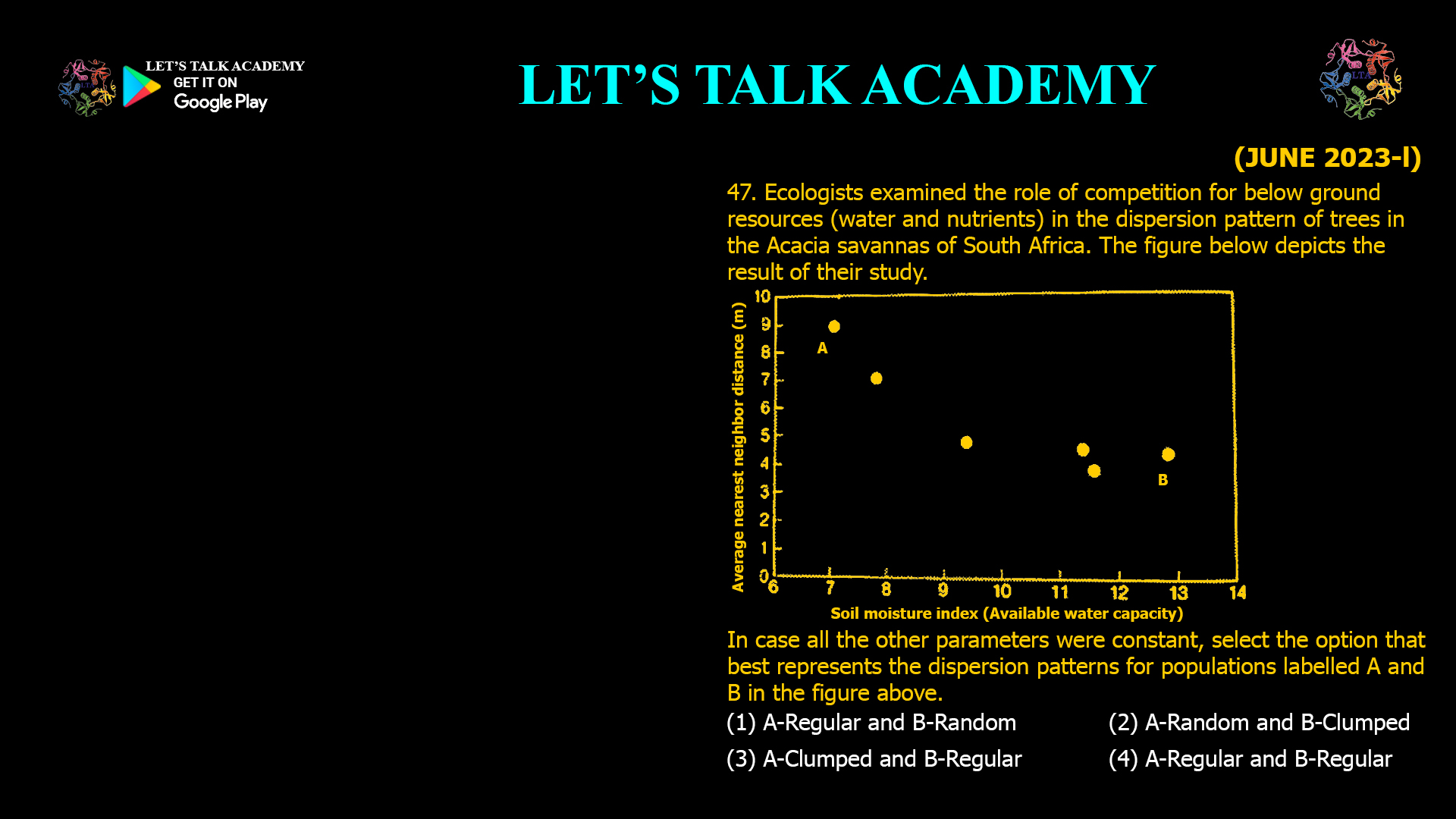

Ecologists examined the role of competition for below ground resources (water and nutrients) in the dispersion pattern of trees in the Acacia savannas of South Africa. The figure below depicts the result of their study. In case all the other parameters were constant, select the option that best represents the dispersion patterns for populations labelled A and B in the figure above. (1) A-Regular and B-Random (2) A-Random and B-Clumped (3) A-Clumped and B-Regular (4) A-Regular and B-Regular

Competition and Dispersion Patterns in Acacia Savannas: Understanding Regular and Clumped Distributions

46. A tree species has leaves that contain an allelochemical compound that leaches into the soil and prevents the growth of its own seedlings. What kind of dispersion pattern is likely as a result of this process in the adult population of this species? (1) Random                                                   (2) Clumped (3) Uniform                                                    (4) Bimodal

How Allelopathy Shapes Tree Dispersion: Why Uniform Patterns Emerge

A researcher observed ants in contact with plant hoppers that were feeding on tree sap. Which of the following conclusions made by her would be correct? (1) This is an example of ants being predatory. (2) This is an example of ants upsetting the ecological balance of nature. (3) This is an example of a multitrophic interaction. (4) This is an example of the tree attracting ants to get rid of plant hoppers.

Ants and Plant Hoppers: A Classic Example of Multitrophic Interaction in Nature

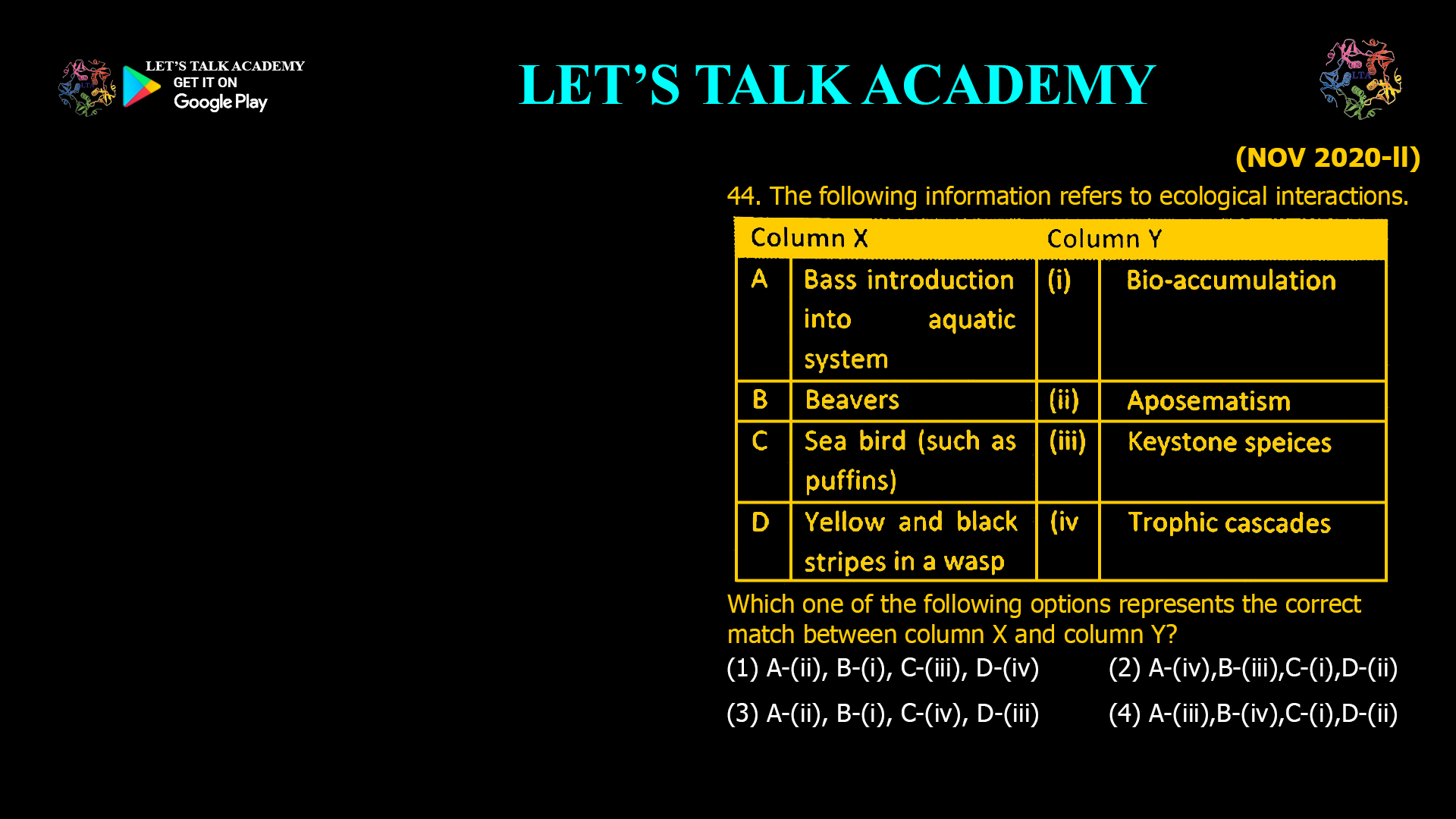
Learn how to correctly match ecological interactions—such as competition, predation, mutualism, and commensalism—with their definitions and examples. Master the basics of community ecology and species relationships.

Matching Ecological Interactions: Understanding the Correct Relationships

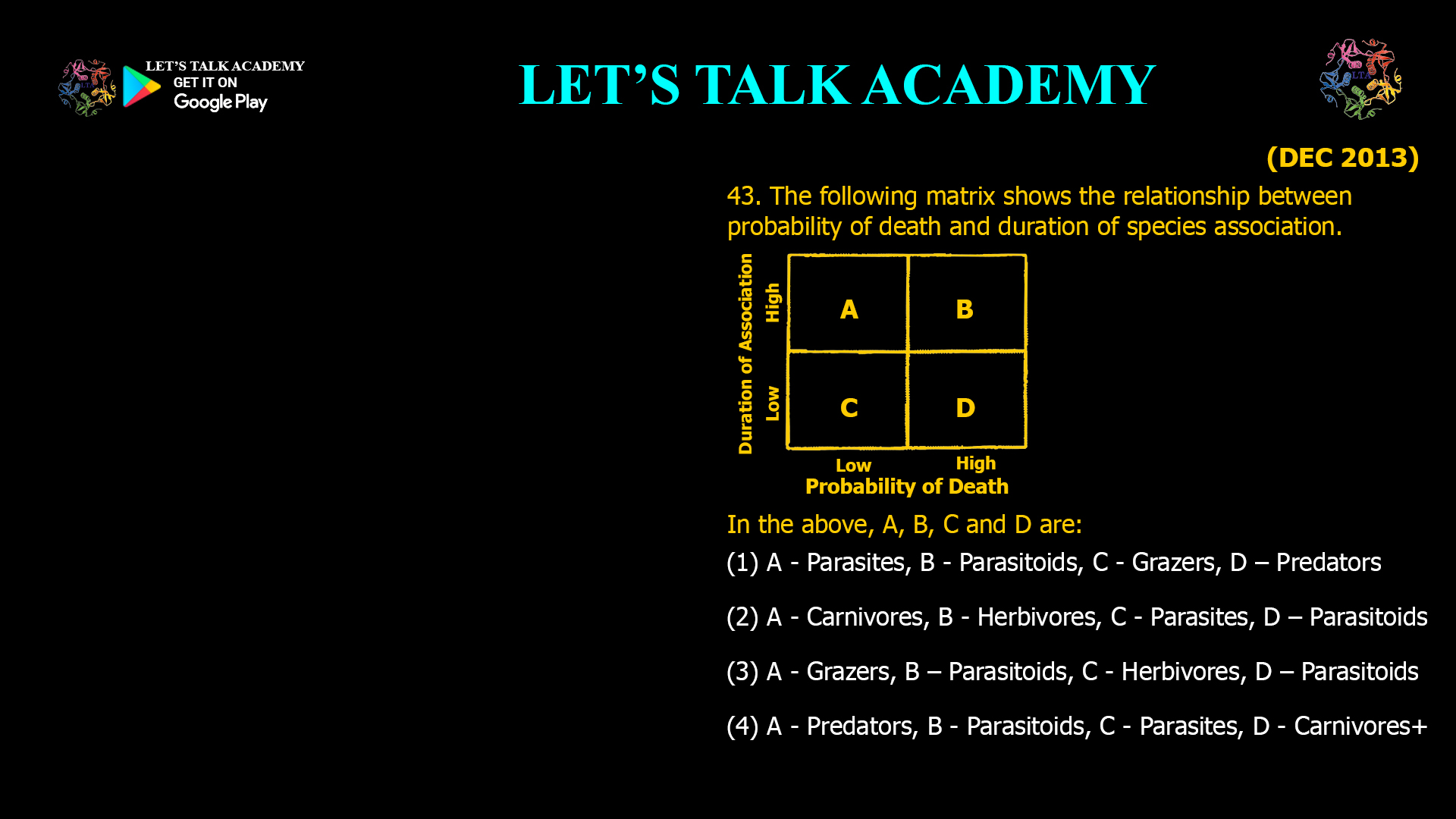
The following matrix shows the relationship between probability of death and duration of species association. In the above, A, B, C and D are: (1) A - Parasites, B - Parasitoids, C - Grazers, D – Predators (2) A - Carnivores, B - Herbivores, C - Parasites, D – Parasitoids (3) A - Grazers, B – Parasitoids, C - Herbivores, D – Parasitoids (4) A - Predators, B - Parasitoids, C - Parasites, D - Carnivores+

Understanding the Relationship Between Probability of Death and Duration of Species Association: Identifying A, B, C, and D

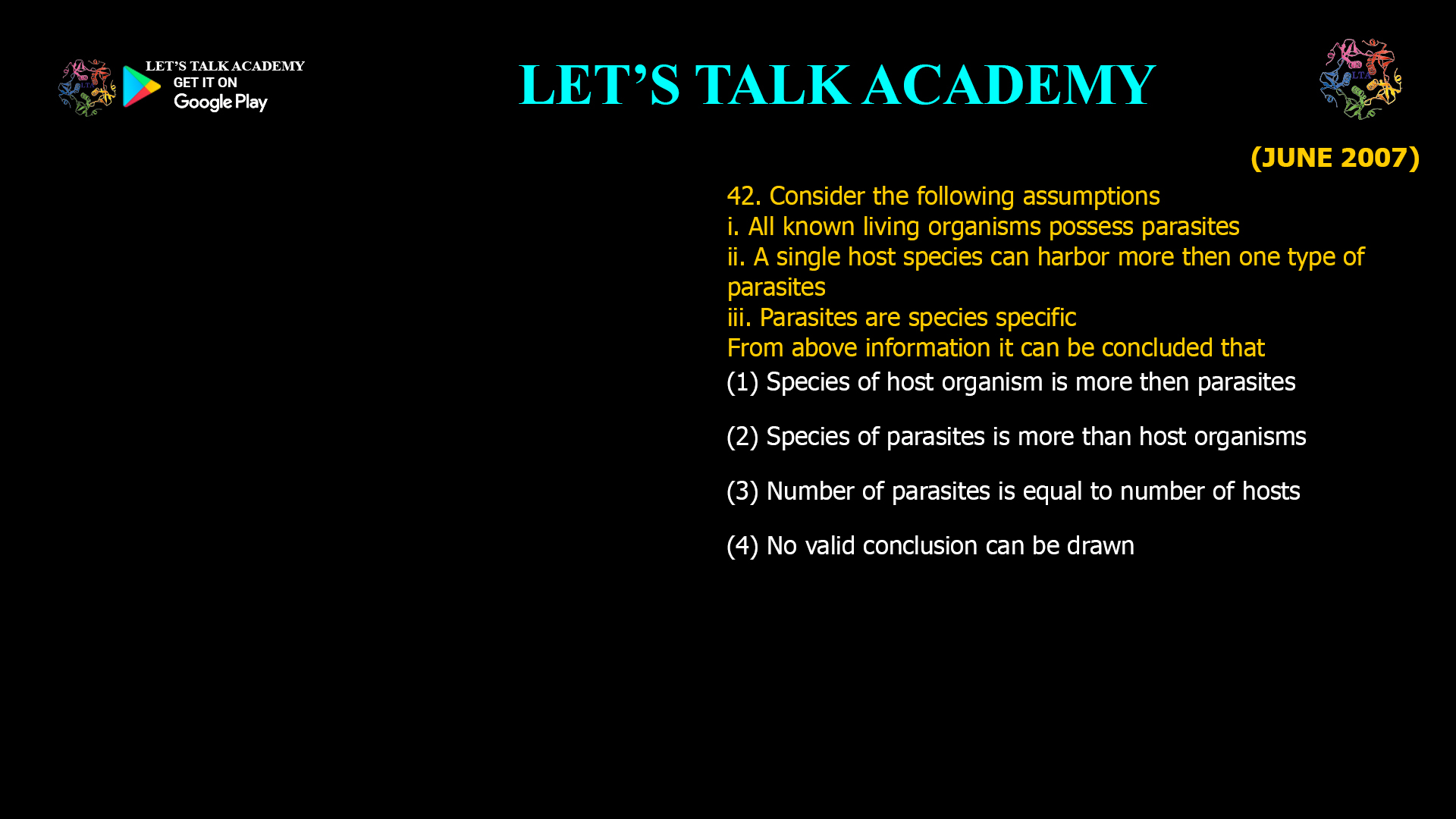
Consider the following assumptions i. All known living organisms possess parasites ii. A single host species can harbor more then one type of parasites iii. Parasites are species specific From above information it can be concluded that (1) Species of host organism is more then parasites (2) Species of parasites is more than host organisms (3) Number of parasites is equal to number of hosts (4) No valid conclusion can be drawn

Host-Parasite Relationships: Are There More Parasite Species Than Host Species?

In grasslands, cattle egrets follows grazing cows. Cow during grazing exposes insects from grasses to egrets. This is an example of (1) Commensalisms (2) parasitism (3) Amensalism (4) Mutualism

Cattle Egret and Grazing Cow: A Classic Example of Commensalism in Grasslands

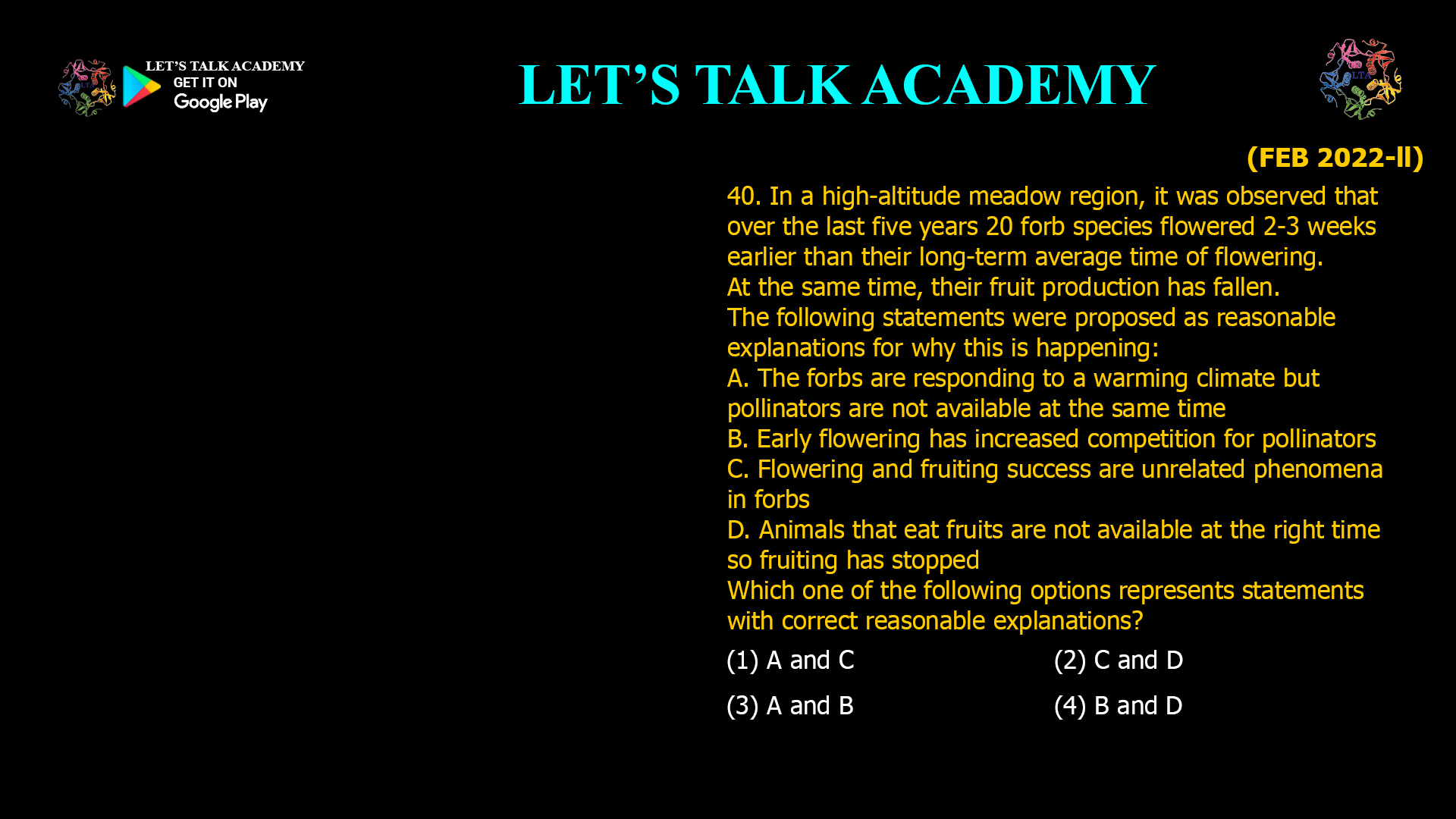
In a high-altitude meadow region, it was observed that over the last five years 20 forb species flowered 2-3 weeks earlier than their long-term average time of flowering. At the same time, their fruit production has fallen. The following statements were proposed as reasonable explanations for why this is happening: A. The forbs are responding to a warming climate but pollinators are not available at the same time B. Early flowering has increased competition for pollinators C. Flowering and fruiting success are unrelated phenomena in forbs D. Animals that eat fruits are not available at the right time so fruiting has stopped Which one of the following options represents statements with correct reasonable explanations? (1) A and C (2) C and D (3) A and B (4) B and D

Why Are High-Altitude Forbs Flowering Earlier but Producing Fewer Fruits? Climate Change, Pollinator Mismatch, and Competition

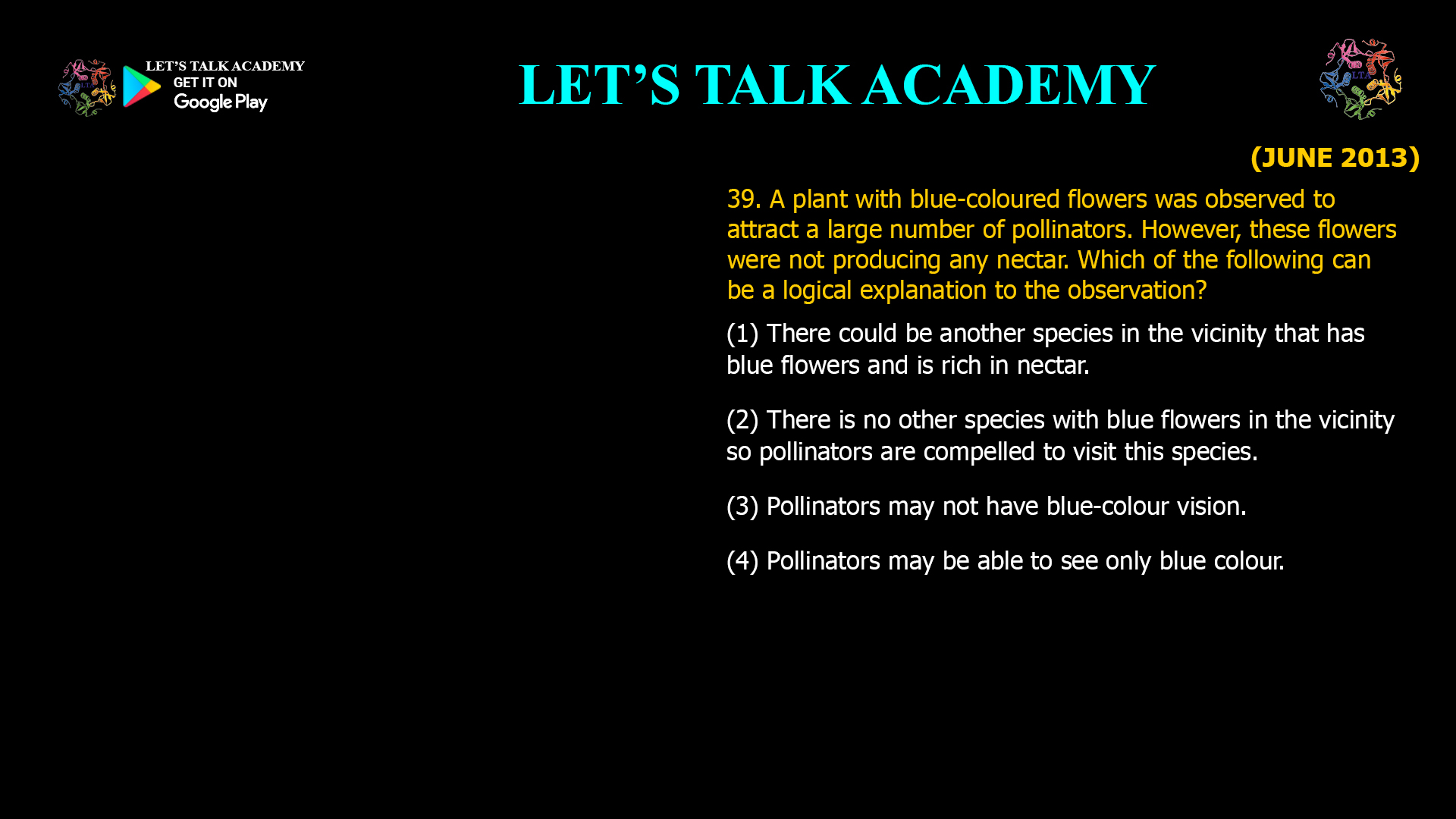
A plant with blue-coloured flowers was observed to attract a large number of pollinators. However, these flowers were not producing any nectar. Which of the following can be a logical explanation to the observation? (1) There could be another species in the vicinity that has blue flowers and is rich in nectar. (2) There is no other species with blue flowers in the vicinity so pollinators are compelled to visit this species. (3) Pollinators may not have blue-colour vision. (4) Pollinators may be able to see only blue colour.

Why Do Pollinators Visit Blue Flowers With No Nectar? The Role of Visual Cues and Floral Mimicry

A red coloured tubular flower without any odour is most likely to be pollinated by (1) beetles. (2) bees. (3) butterflies. (4) birds.

Why Red Tubular Odorless Flowers Are Perfect for Bird Pollination

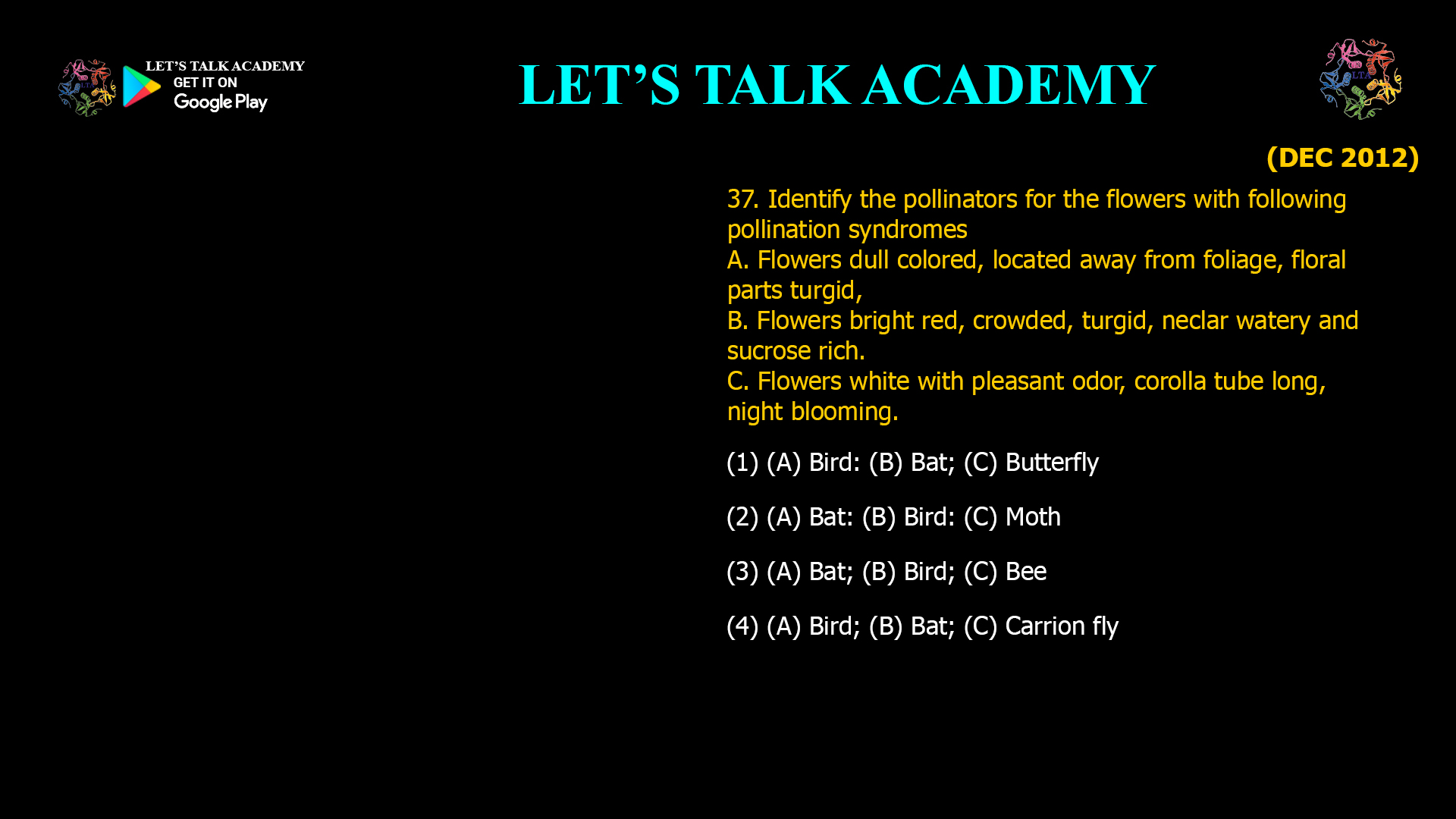
37. Identify the pollinators for the flowers with following pollination syndromes A. Flowers dull colored, located away from foliage, floral parts turgid, B. Flowers bright red, crowded, turgid, neclar watery and sucrose rich. C. Flowers white with pleasant odor, corolla tube long, night blooming. (1) (A) Bird: (B) Bat; (C) Butterfly (2) (A) Bat: (B) Bird: (C) Moth (3) (A) Bat; (B) Bird; (C) Bee (4) (A) Bird; (B) Bat; (C) Carrion fly

Pollination Syndromes: Matching Flower Traits to Their Pollinators

36. A plant is visited by bats during the night and sunbirds during the day. Given this information, which of the following characters best match this plant? (1) The plant is a herb with saucer shaped white flowers (2)The plant is a shrub with tubular, red, diurnal flowers (3) The plant is a liana with tubular cream coloured flowers (4) The plant is a grass with white coloured fragrant, spikelets

Pollination Syndromes: Identifying Plants Visited by Bats and Sunbirds

Following are the main types of defense employed by prey species against predators Types of defense: Chemical with aposematic coloration (A); Cryptic coloration (B); Batesian mimicry (C); Intimidation display (D) Prey Species: Grasshoppers and seahorses (i); Hoverflies and wasps (ii); Bombardier beetles, ladybird beetles, many butterflies (iii); Frilled lizard, Porcupine fish (iv) Which one of the following combinations is correct? (1) A-(i) B-(iii) C- (ii) D-(iv) (2) A-(iv) B-(ii) C-(i) D-(iii) (3) A-(iii) B-(i) C-(ii) D-(iv) (4) A-(ii) B-(iii) C- (i) D- (iv)

Types of Prey Defense Mechanisms: Matching Strategies and Species

A plant species with unisexual flowers has the following traits: floral longevity = 12 hours, pollen: ovule = 10:1, male and female flowers with synchronized anthesis. Given these, which of the following mutations would be most detrimental to seed set in this plant species? (1) The pollen:ovule ratio drops to 3:1. (2) Longevity of male and female flowers increases to 16 hours. (3) Anthesis in male flowers occur 2 hours after female flowers. (4) The pollen:ovule ratio increases to 15:1.

How Flowering Traits Affect Seed Set: The Impact of Mutations in Unisexual Plant Species

Incorporating additional ecological factors into the Lotka-Voltera predator-prey model can change the predator isocline. Given below are three state-space graphsA-C) representing modification of predator isocline due to the ecological factors listed below (i-iii). (i) Victim abundance acting as predator carrying capacity (ii) Availability of alternate prey (victim) population (iii) Predator carrying capacity determined by factors other than victim abundance. Which one of the following options represents all correct matches of the state space graphs with their ecological factor? (1) A — (ii), B — (iii), C — (i) (2) A — (ii), B — (i), C - (iii) (3) A — (iii), B — (ii), C — (i) (4) A — (i), B — (ii), C — (iii)

Matching State-Space Graphs to Ecological Modifications in the Lotka-Volterra Predator Isocline

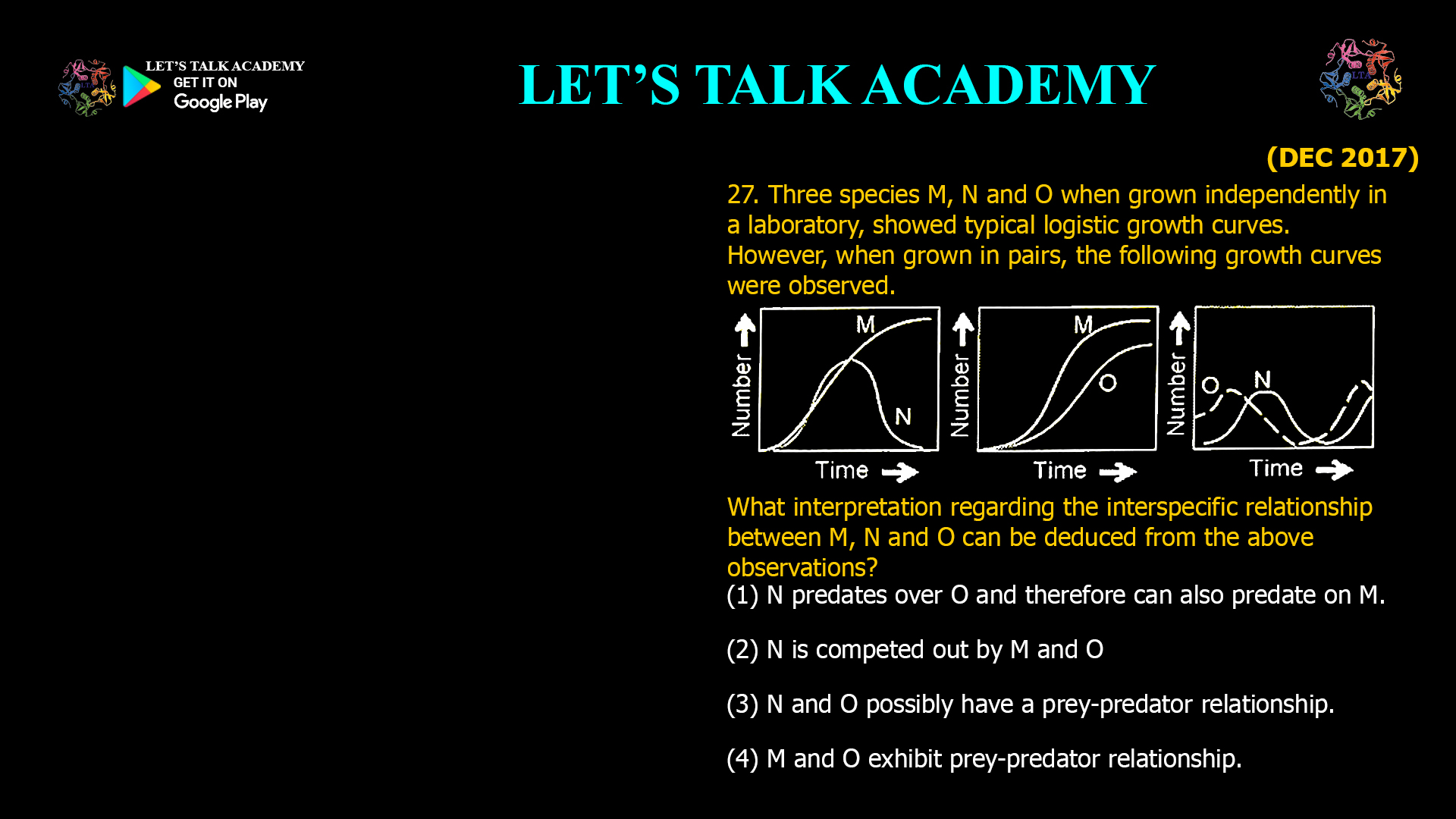
Three species M, N and O when grown independently in a laboratory, showed typical logistic growth curves. However, when grown in pairs, the following growth curves were observed. What interpretation regarding the interspecific relationship between M, N and O can be deduced from the above observations? (1) N predates over O and therefore can also predate on M. (2) N is competed out by M and O (3) N and O possibly have a prey-predator relationship. (4) M and O exhibit prey-predator relationship.

To understand prey-predator relationship, Didinium(predator) and Paramecium (prey) were used. Paramecium population was grown with sand sediment as hiding place or refuge. To this population, Didiniumwas introduced only once. What would happen to the prey population in the course of time? (1) The population will steadily decrease and vanish (2) The population will initially increase and then stabilize (3) The population will initially decrease, then increase and stabilize (4) The population will steadily increase

How Refuges Affect Prey Survival: The Didinium–Paramecium Predator-Prey Experiment

Nearly 25% of all insect species are known to be herbivores. Yet, in spite of such heavy herbivore pressure, globally green plants tend to persist, contributing to a green earth". Which of the following account for the relative success of green plants? (A) Herbivore insects are inefficient feeders (B) Herbivore insect densities are kept low by predators (C) Plants secrete herbivore-deterrent chemicals (1) (A) and (C) (2) (A) only (3) (B) and (C) (4) (A), (B) and (C)

Why Do Green Plants Persist Despite Heavy Herbivore Pressure? Exploring the Success of Plants on a Green Earth

Which of the following statements is correct according to the plant vigor hypothesis dealing with herbivore- plant interaction? (1) Herbivores prefer to attack slow growing stressed plants which produce leaves that are higher in nitrogen. (2) Herbivores prefer to attack fast growing plants rather than slow growing, stressed plants. (3) Small amount of grazing will increase plant growth and fitness rather than cause harm to the plants. (4) Higher plant growth rates will result in less investment in defensive chemicals.

Plant Vigor Hypothesis: Why Herbivores Prefer Fast-Growing Plants

Consider predators with a choice between two prey types: a big prey 1 which has energy value E1, handling time h1, and search time S1 and; a small prey 2 with energy value E2, handling time h2, and search time S2. According to the optimal foraging (diet) theory, when will the predator preferentially select prey 2? (1) When E2/h2> E1/(h1+S1) (2) When the abundance of prey 1 is very high (3) When the abundance of prey 1 and prey 2 are equal (4) When E2/h2=E1/h1

When Do Predators Prefer Smaller Prey? Insights from Optimal Foraging Theory

Functional response of predators means (1) the number of prey successfully attacked per predator as a function of prey density (2) Regulation of predator population by availability of prey (3) Choosing prey depending on density of prey. (4) Number of prey consumed and the density of the prey population is a linear function of prey consumed by predators

What Is the Functional Response of Predators? Definition and Ecological Importance

What should be the criteria for choosing prey-predator relationship for long term of biological control? (1) High host specificity and high virulence (2) low host specificity and high virulence (3) High host specificity and moderate virulence (4) moderate host specificity and moderate virulence

Criteria for Choosing Prey-Predator Relationships in Long-Term Biological Control

21. Profitability of prey for predator lies in its energy content and (1) Prey defense (2) Palatability (3) Foraging time (4) prey morphology

What Determines Prey Profitability for Predators? The Role of Energy Content and Foraging Time

20. The main function of mycorrhiza is (1) Absorption of water (2) Absorption of phosphates (3) Protection from bacteria (4) Defense from insects

What Is the Main Function of Mycorrhiza? Understanding Its Role in Plant Growth

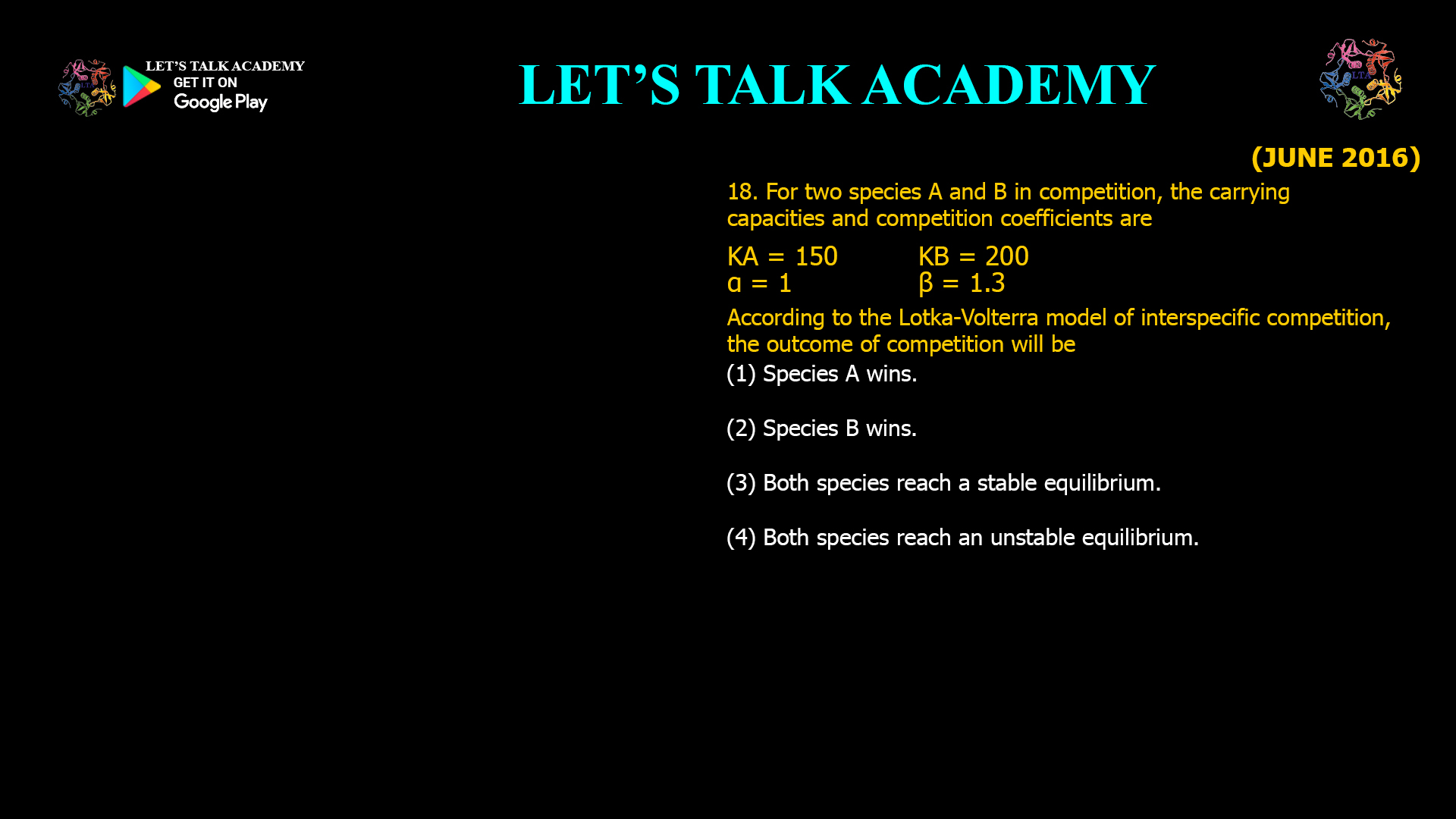
For two species A and B in competition, the carrying capacities and competition coefficients are KA = 150 KB = 200 α = 1 β = 1.3 According to the Lotka-Volterra model of interspecific competition, the outcome of competition will be (1) Species A wins. (2) Species B wins. (3) Both species reach a stable equilibrium. (4) Both species reach an unstable equilibrium.

Lotka-Volterra Competition Model: Predicting the Outcome for Competing Species

The Lotka-Volterra model of competition between species A and B is given by the equations Species A: dNA/dt = rANA (KA-NA-αNB/KA) Species B: dNB/dt = rBNB (KB-NB-βNA/KB) Given that species A always wins, which of the following is true according to the model (1) K2>K1/β and K1K1/ α and K1

Lotka-Volterra Competition Model: When Does One Species Always Win?

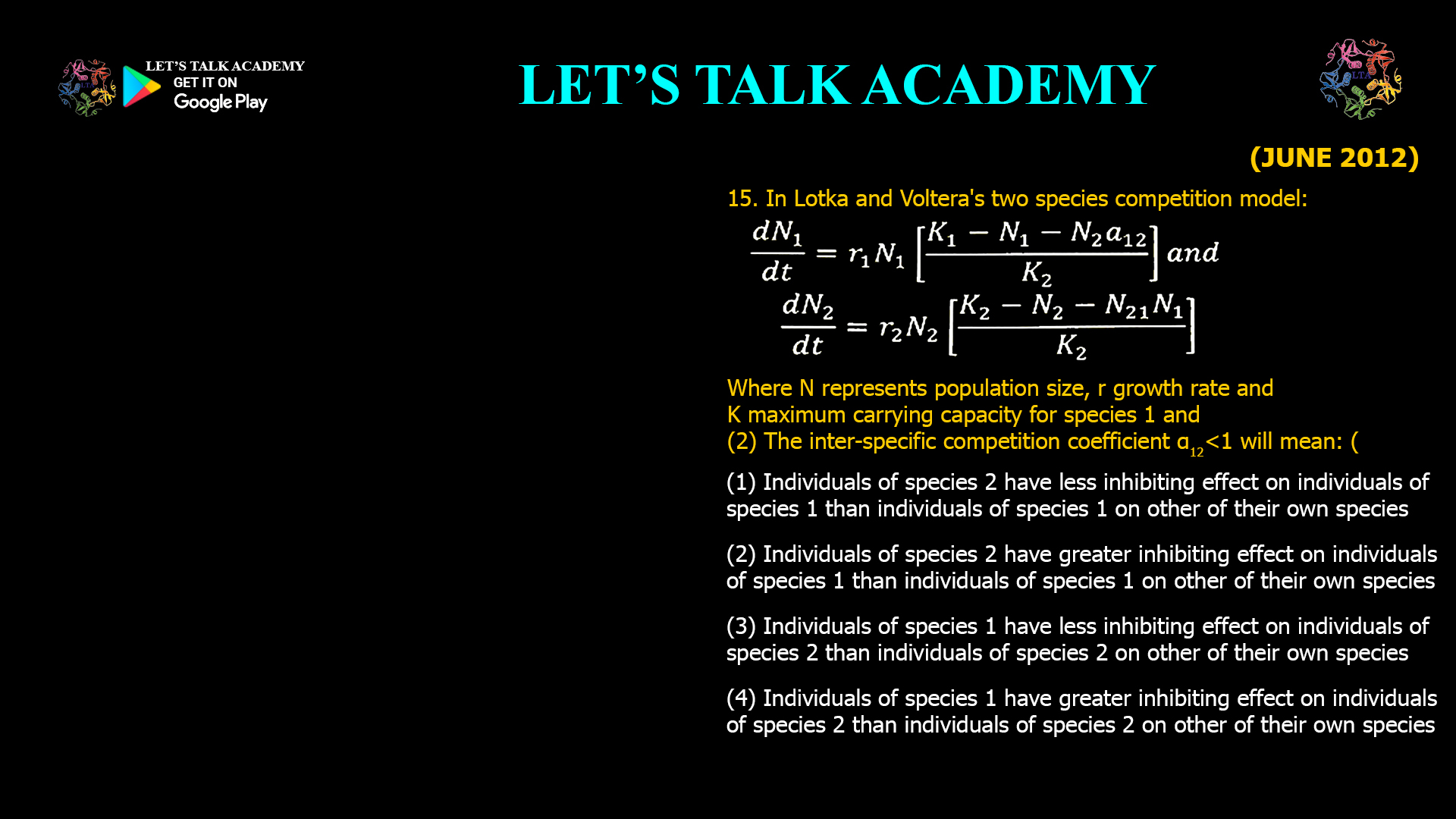
15. In Lotka and Voltera's two species competition model: Where N represents population size, r growth rate and K maximum carrying capacity for species 1 and (2) The inter-specific competition coefficient α12

Understanding the Lotka-Volterra Competition Coefficient: What Does α₁₂ < 1 Mean?

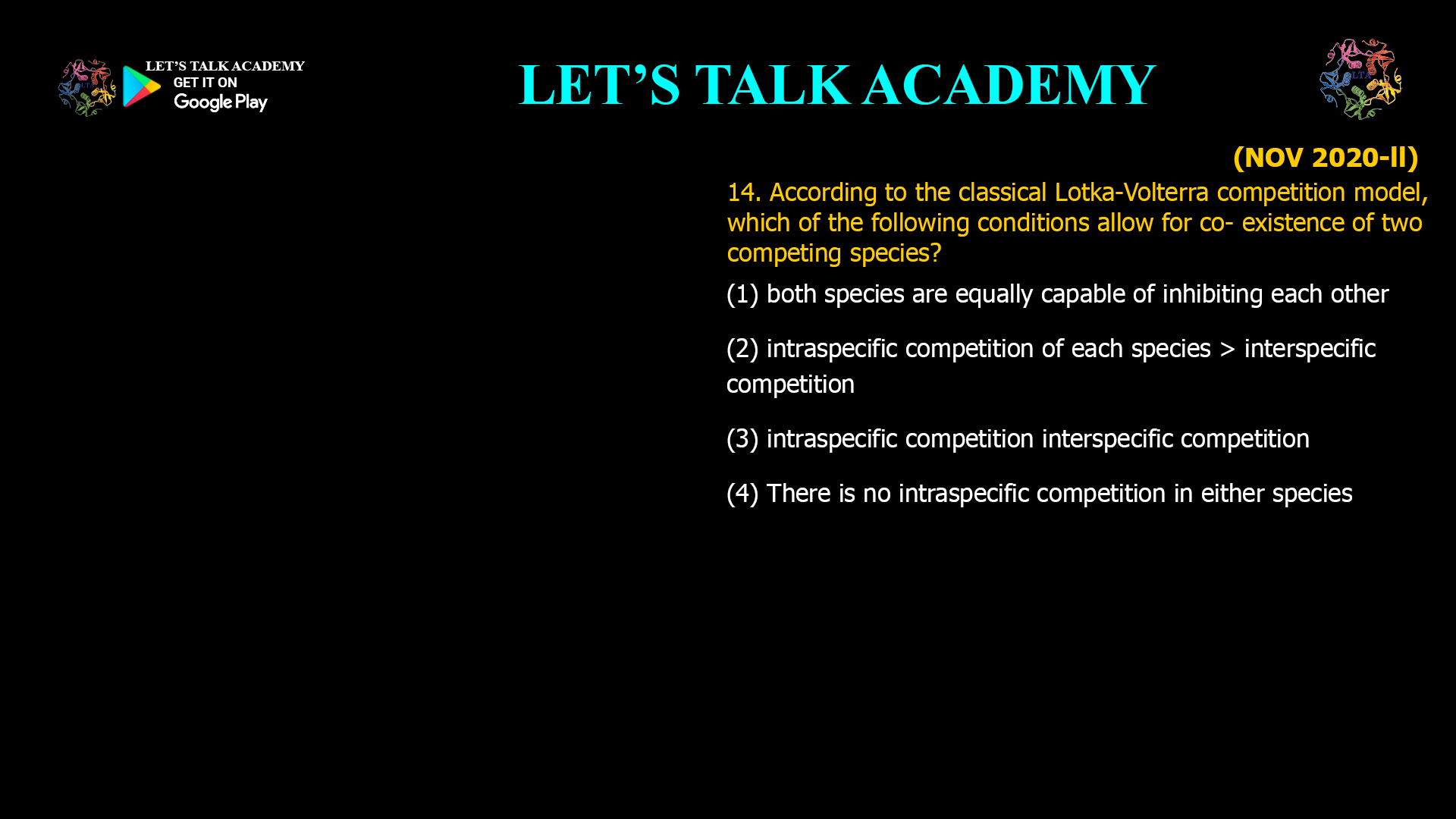
14. According to the classical Lotka-Volterra competition model, which of the following conditions allow for co- existence of two competing species? (1) both species are equally capable of inhibiting each other (2) intraspecific competition of each species > interspecific competition (3) intraspecific competition interspecific competition (4) There is no intraspecific competition in either species

Lotka-Volterra Competition Model: The Key to Coexistence of Competing Species

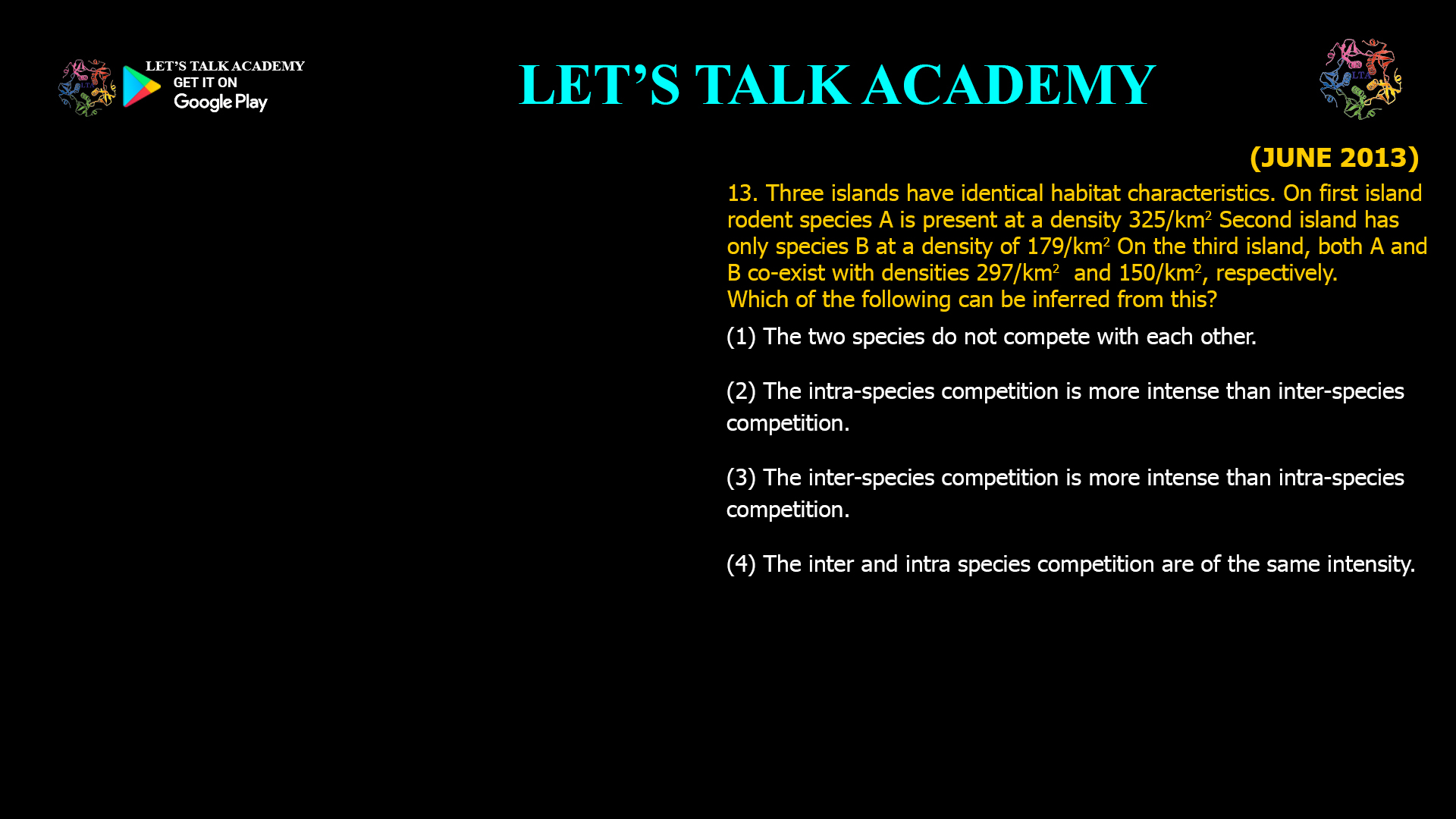
Three islands have identical habitat characteristics. On first island rodent species A is present at a density 325/km2 Second island has only species B at a density of 179/km2 On the third island, both A and B co-exist with densities 297/km2 and 150/km2, respectively. Which of the following can be inferred from this? (1) The two species do not compete with each other. (2) The intra-species competition is more intense than inter-species competition. (3) The inter-species competition is more intense than intra-species competition. (4) The inter and intra species competition are of the same intensity.

Intraspecific vs. Interspecific Competition: Insights from Rodent Populations on Islands

Matching Population Growth Patterns to Ecological Interactions: Mutualism, Commensalism, and Parasitism

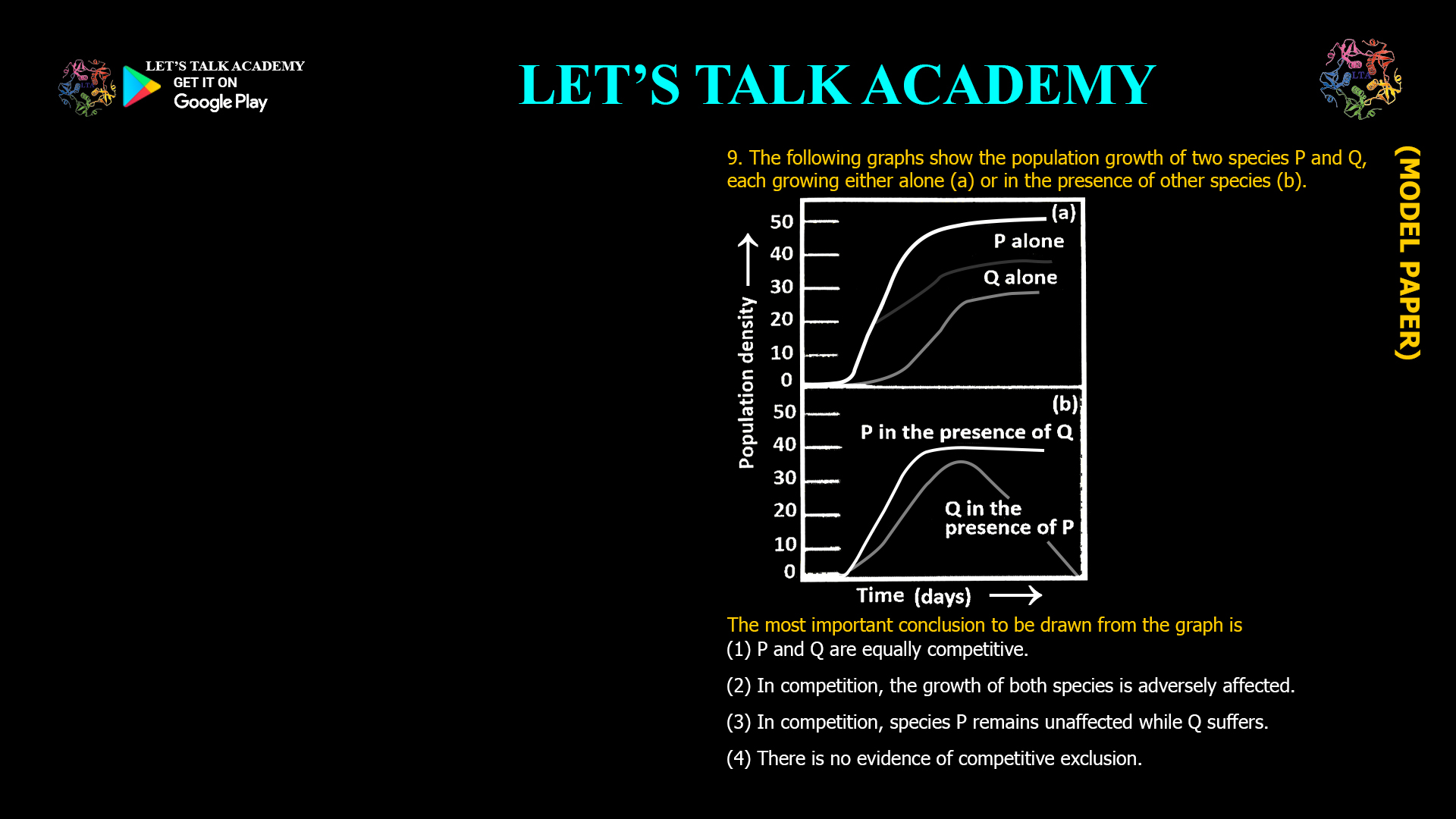
The following graphs show the population growth of two species P and Q, each growing either alone (a) or in the presence of other species (b). The most important conclusion to be drawn from the graph is (1) P and Q are equally competitive. (2) In competition, the growth of both species is adversely affected. (3) In competition, species P remains unaffected while Q suffers. (4) There is no evidence of competitive exclusion.

Interpreting Population Growth Graphs: Evidence of Competition and Its Effects

An example of the species interaction called commensalism is (1) nitrogen-fixing bacteria in association with legume plant roots. (2) A microbes in living human gut. (3) female mosquito deriving nourishment from human blood (4) orchid plant growing on the trunk of mango tree

Commensalism in Nature: The Orchid and Mango Tree Example

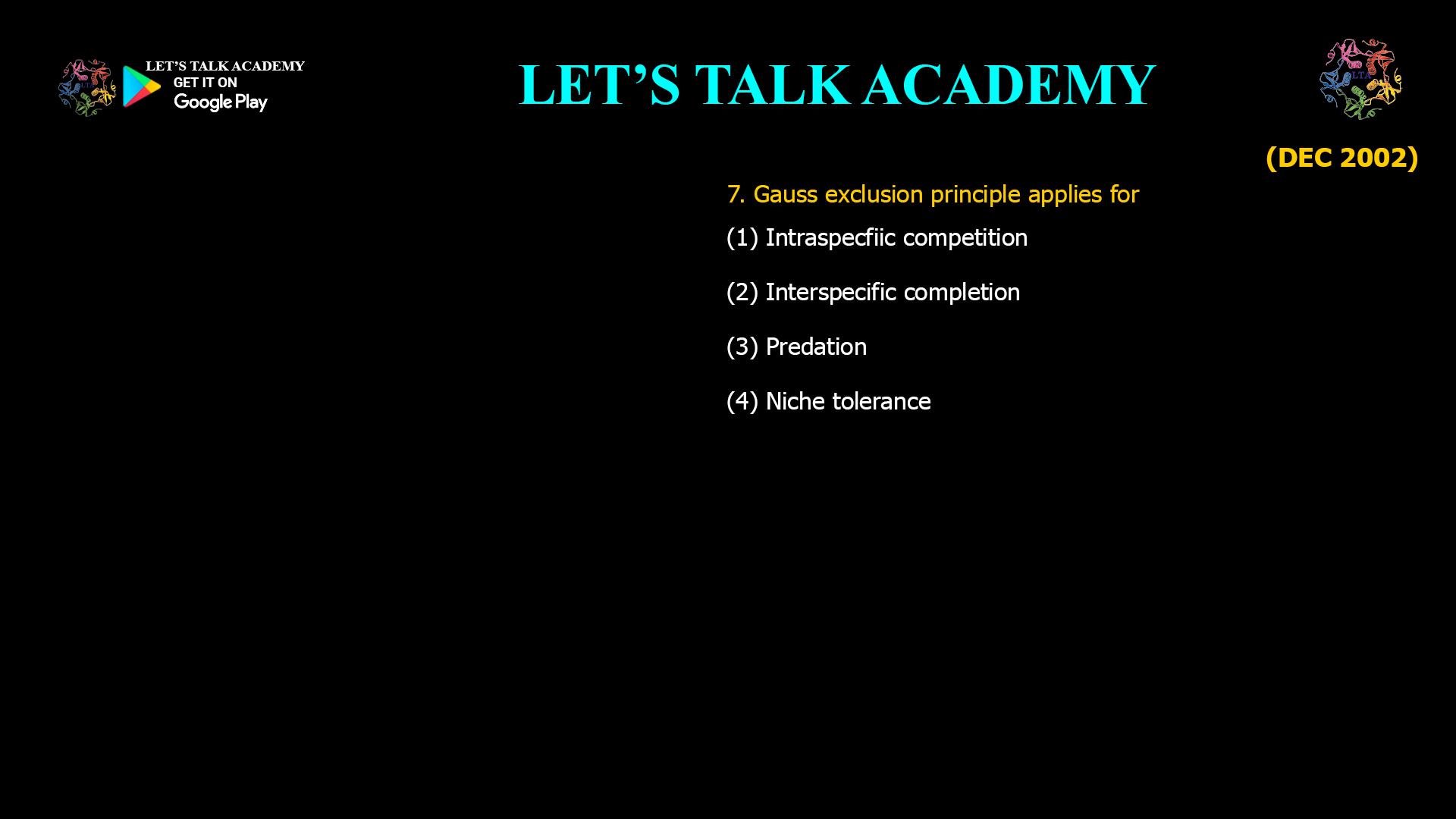
Gauss exclusion principle applies for (1) Intraspecfiic competition (2) Interspecific completion (3) Predation (4) Niche tolerance

Gause’s Exclusion Principle: Understanding Its Application in Ecology

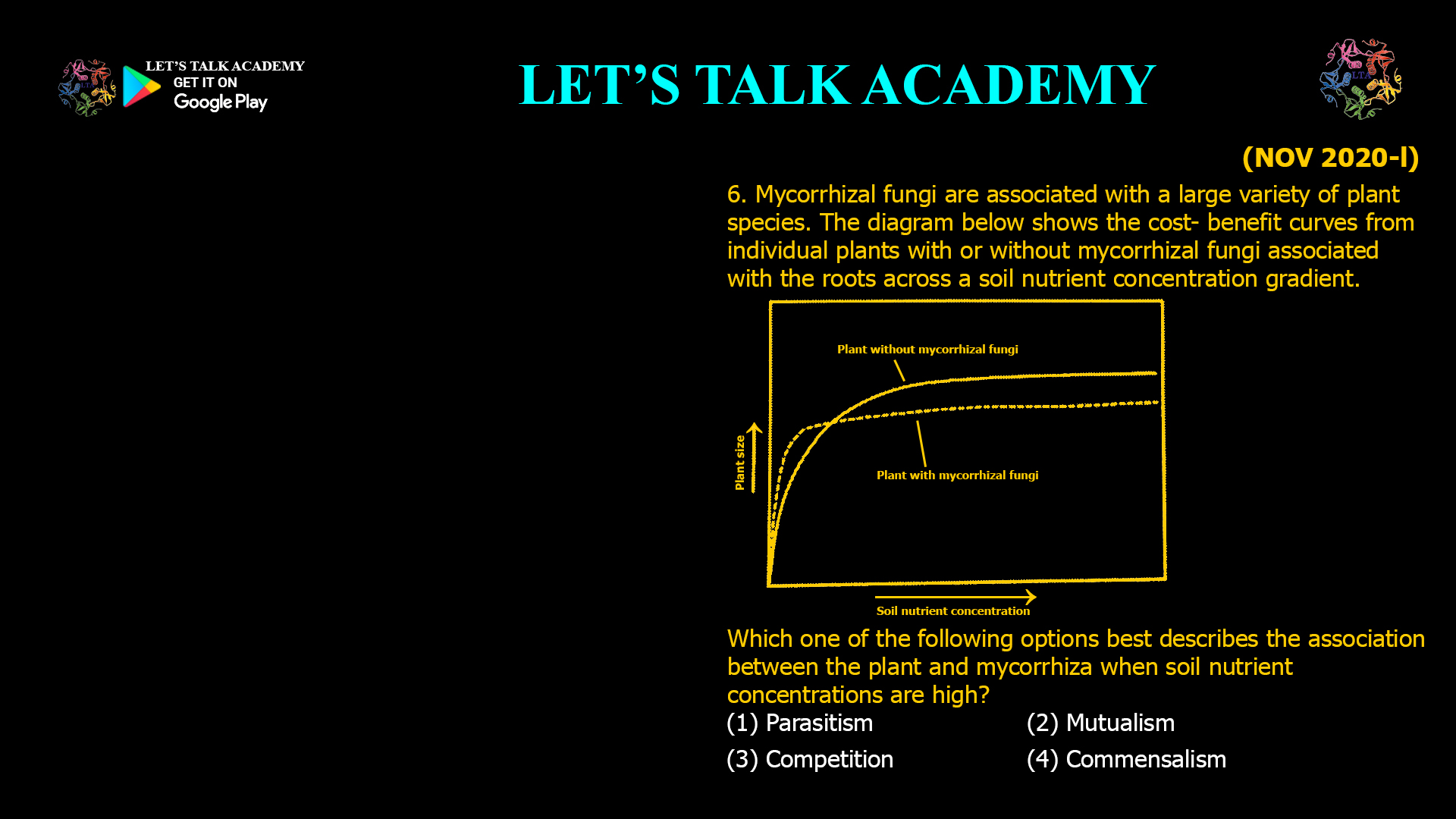
Mycorrhizal fungi are associated with a large variety of plant species. The diagram below shows the cost- benefit curves from individual plants with or without mycorrhizal fungi associated with the roots across a soil nutrient concentration gradient. Which one of the following options best describes the association between the plant and mycorrhiza when soil nutrient concentrations are high? (1) Parasitism (2) Mutualism (3) Competition                                              (4) Commensalism

Mycorrhizal Fungi and Plants: What Happens When Soil Nutrient Levels Are High?

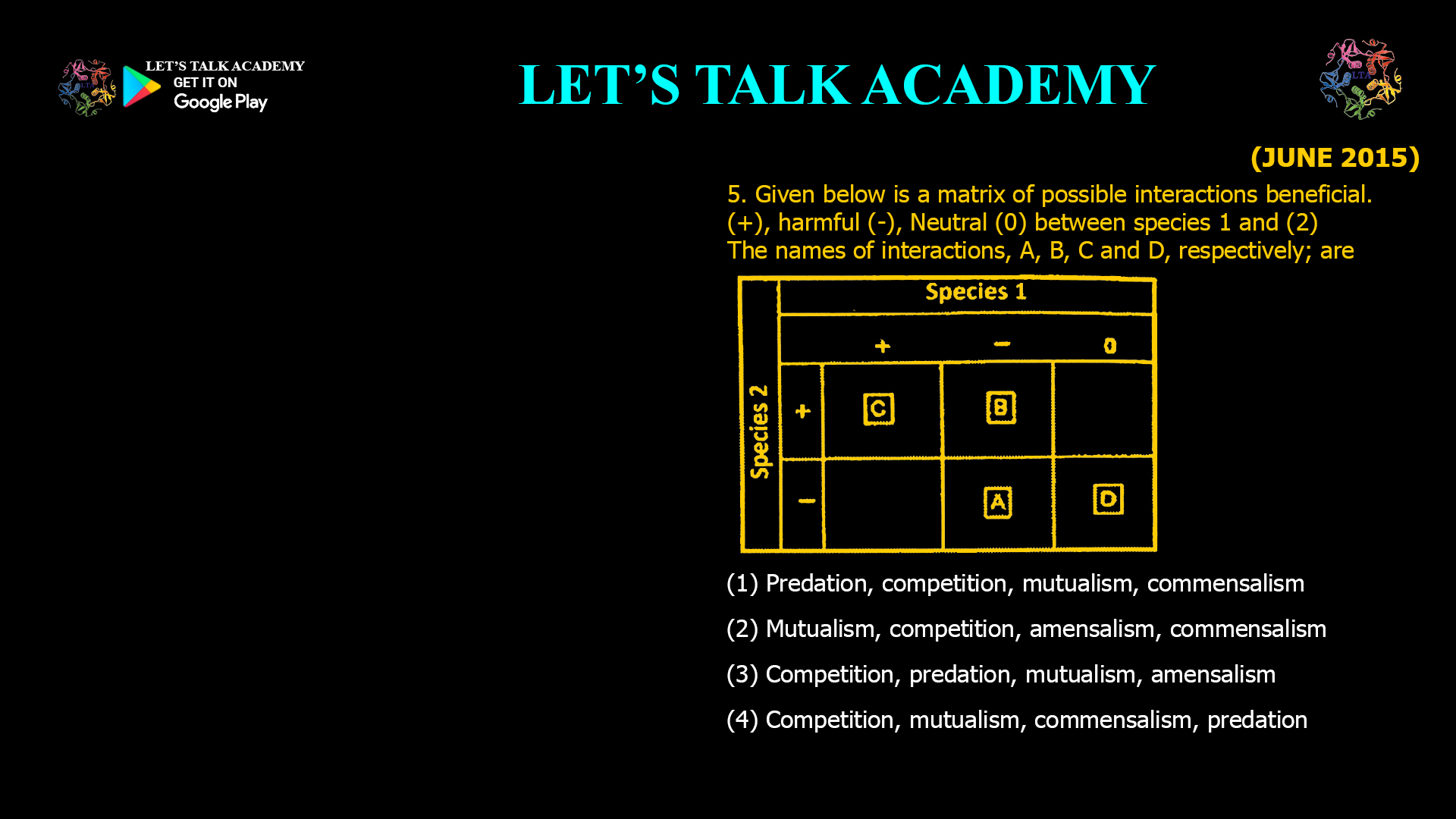
Given below is a matrix of possible interactions beneficial. (+), harmful (-), Neutral (0) between species 1 and (2) The names of interactions, A, B, C and D, respectively; are (1) Predation, competition, mutualism, commensalism (2) Mutualism, competition, amensalism, commensalism (3) Competition, predation, mutualism, amensalism (4) Competition, mutualism, commensalism, predation

Decoding Ecological Interactions: Understanding the Matrix of Species Relationships

A food chain involving Spartina (a plant), the marsh periwinkle snail, the blue crab and an unknown fungus was identified in a Spartina-dominated salt marsh in North America. A study involving control and crab- exclusion experiments revealed: A. Radulations (scrape marks) on the leaf surface made by the snails indicate the presence of snail faeces, fungi and dead plant tissue. B. The fungi were present only at the radulations. C. The density of the radulations increased with higher snail densities. D. Spartina density decreased with increase in the snail density till it reached zero. E. In control experiments, all four species were present till the end. Select the option that correctly depicts the positive (+) and negative (—) interaction-type between fungi-snail and Spartina-crab, respectively: (1) — and + (2) — and — (3) + and — (4) + and +

Positive and Negative Interactions in a Spartina Salt Marsh Food Chain

If + represents the beneficial interaction and - represents the harmful interaction, then the commensalism may be designated as interaction- (1) ++ (2) + - (3) + 0 (4) – 0

Commensalism: The +0 Ecological Interaction Explained

In an interaction one organism is producing the organic matter but it is of no use for itself, while another is using this matter and dependent on it. Such an interaction is termed as (1) Mutualism (2) Proto-cooperation (3) Commensalisms (4) Ammensalism

Commensalism: The Ecological Interaction Where One Organism Benefits Without Affecting the Other

Positive-Negative (+ -) type of interaction is seen in (1) Predation, Parasitism (2) Predation, Commensalisms (3) Parasitism, Mutualism (4) Mutualism, Proto cooperation

Positive-Negative (+ -) Interactions in Ecology: Predation and Parasitism Explained

Latest Courses