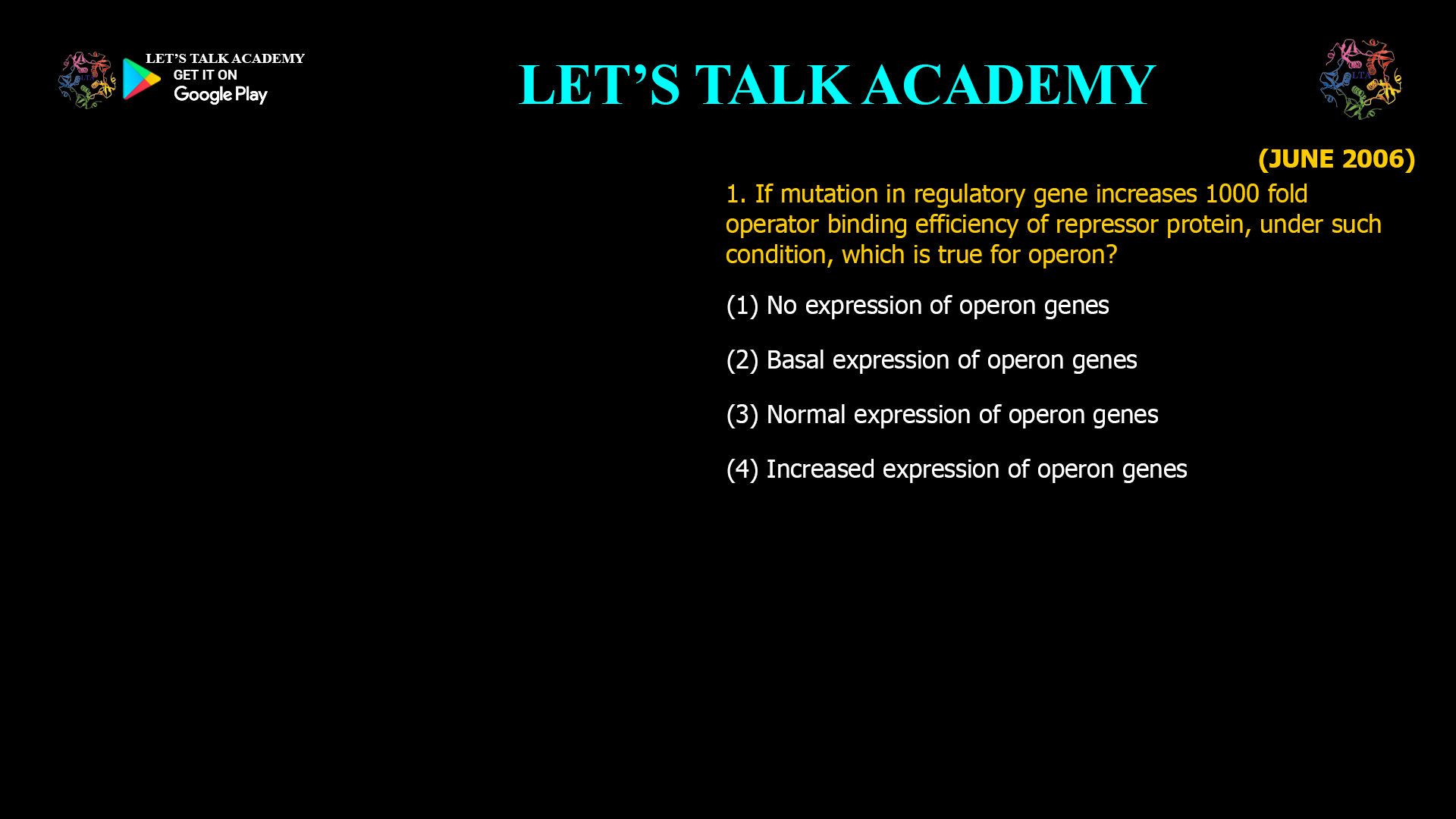
If mutation in regulatory gene increases 1000 fold operator binding efficiency of repressor protein, under such condition, which is true for operon?
(1) No expression of operon genes
(2) Basal expression of operon genes
(3) Normal expression of operon genes
(4) Increased expression of operon genes
Introduction to Operon Regulation and Repressor Proteins
Gene expression in prokaryotes is a highly regulated process, ensuring that cells respond efficiently to environmental changes. One of the most well-studied systems is the operon model, particularly the lac operon in Escherichia coli. Central to this system are regulatory genes, operator regions, and repressor proteins. Understanding how mutations in regulatory genes affect operator binding efficiency of repressor proteins is crucial for grasping the fundamentals of gene regulation.
What is an Operon?
An operon is a cluster of genes under the control of a single promoter and regulated together. The operon model, first described in bacteria, allows coordinated expression of genes involved in a common metabolic pathway. The main components of an operon include:
-
Structural genes: Code for proteins with related functions.
-
Promoter: DNA sequence where RNA polymerase binds to initiate transcription.
-
Operator: DNA segment that acts as a binding site for repressor proteins.
-
Regulatory gene: Encodes the repressor protein that can bind to the operator.
Role of the Repressor Protein and Operator Binding
The repressor protein, produced by the regulatory gene, is a key player in operon regulation. It binds to the operator region, physically blocking RNA polymerase from transcribing the structural genes. This process is known as negative regulation. The binding efficiency of the repressor to the operator determines how tightly gene expression is controlled.
Normal Function
Under normal circumstances, the repressor protein binds to the operator with a certain affinity. In the presence of an inducer (such as lactose in the lac operon), the repressor undergoes a conformational change, reducing its affinity for the operator and allowing gene expression to occur. This balance ensures that the operon is only expressed when needed.
Mutation in Regulatory Gene: Increased Operator Binding Efficiency
Now, consider a scenario where a mutation in the regulatory gene increases the operator binding efficiency of the repressor protein by 1000-fold. This means the repressor binds to the operator much more tightly than usual.
Consequences of Increased Binding Efficiency
-
No Expression of Operon Genes:
With such a high binding affinity, the repressor protein remains firmly attached to the operator, preventing RNA polymerase from accessing the structural genes. Even in the presence of an inducer, the repressor may not detach, resulting in complete repression of gene expression. -
Loss of Basal Expression:
Normally, there is a low level of “leaky” or basal expression, allowing a small amount of enzyme production. However, with a 1000-fold increase in binding efficiency, even this minimal expression is eliminated. -
Impaired Response to Environmental Signals:
The operon’s ability to respond to environmental changes, such as the presence of lactose, is compromised. The repressor’s strong binding prevents the operon from being induced, regardless of external signals. -
Metabolic Consequences:
The inability to express operon genes can be detrimental to the cell, especially if those genes are essential for metabolizing certain substrates.
Detailed Mechanism: How the Mutation Works
The Regulatory Gene Mutation
A mutation in the regulatory gene can alter the structure of the repressor protein, enhancing its affinity for the operator DNA sequence. This could be due to changes in the DNA-binding domain of the repressor, making it fit more snugly onto the operator.
Operator-Repressor Interaction
The operator is a specific DNA sequence recognized by the repressor. Normally, the interaction is reversible, allowing the operon to be switched on or off as needed. With increased binding efficiency, the repressor-operator complex becomes almost irreversible, locking the operon in the “off” state.
Inducer Ineffectiveness
Inducers like allolactose (in the lac operon) usually bind to the repressor, causing it to release the operator. However, with a mutated repressor that binds 1000 times more strongly, the inducer may not be able to dislodge the repressor, rendering the induction mechanism ineffective.
Implications for Gene Regulation
Evolutionary Perspective
While tight repression might seem beneficial for energy conservation, it actually reduces the cell’s flexibility to adapt to changing environments. Evolution has fine-tuned the operator-repressor interaction to balance repression and induction, allowing cells to optimize resource use.
Biotechnology Applications
Understanding these mechanisms is crucial in biotechnology, where operon systems are engineered for controlled gene expression. Mutations that alter repressor binding efficiency can be used to design more stringent or more leaky expression systems, depending on the application.
Medical Relevance
Mutations affecting gene regulation are not limited to bacteria. Similar principles apply in higher organisms, where mutations in regulatory elements can lead to diseases by misregulating gene expression.
Summary Table: Effects of Increased Repressor Binding Efficiency
| Condition | Gene Expression Level | Operon Response to Inducer | Cellular Consequence |
|---|---|---|---|
| Normal Repressor Binding | Basal/Inducible | Operon can be induced | Flexible metabolism |
| 1000-Fold Increased Binding | None | Operon cannot be induced | Loss of metabolic function |
Conclusion
A mutation in the regulatory gene that increases the operator binding efficiency of the repressor protein by 1000-fold results in no expression of operon genes. This drastic change in gene regulation highlights the delicate balance required for proper cellular function. Understanding the interplay between regulatory genes, repressor proteins, operator sequences, and gene expression is fundamental to genetics, molecular biology, and biotechnology.
By mastering these concepts, students and researchers can better appreciate the complexity of gene regulation and its implications for health, disease, and industrial applications.
Mutation in regulatory gene, operator binding efficiency, repressor protein, operon, gene expression, operon regulation, lac operon, structural genes, promoter, operator, regulatory gene mutation, negative regulation, basal expression, inducer, metabolic consequences, biotechnology, gene regulation, DNA-binding domain, operator-repressor interaction, allolactose, lac operon induction, cellular adaptation, genetic control, prokaryotic gene expression, molecular biology, gene expression control.


28 Comments
Manisha
June 12, 2025Nice explanation sir 👍👍
Manisha
June 12, 2025Nice explanation sir 👍👍
Best operon concept
Suman bhakar
June 12, 2025Done sir 👍✅
Anita choudhary
June 13, 2025Done sir 👍
Krishana
June 13, 2025Sir aapne to complete lac operon hi explain kr diya 👍
Arushi
June 14, 2025👍✅
Kajal
November 3, 2025No expression of operon gene
Kirti Agarwal
November 4, 2025No expression of operon genes
Santosh Saini
November 5, 2025No expression of operon gene
Neha Yadav
November 6, 2025No expression of operon gene as due to mutation in regulatory gene repression protein binding efficiency with operator is increased
Heena Mahlawat
November 6, 2025No expression
Roopal Sharma
November 6, 2025No expression
Neelam Sharma
November 6, 2025No expression
Sonal Nagar
November 6, 2025Option 1
Deepika Sheoran
November 6, 2025No expression of operon genes.
Anisha Beniwal
November 6, 2025no expression of operon genes.
Neeraj Sharma
November 6, 2025As binding efficiency increases of repressor protein with operator than their is no expression of the gene
Dipti Sharma
November 6, 2025no expression of operon gene
Sonam Saini
November 7, 20251 is right
Aman Choudhary
November 7, 2025No expression of operon gene
Bhawna Choudhary
November 8, 2025No expression of operon gene
Anurag Giri
November 8, 2025No expression of operon gene
Mansukh Kapoor
November 8, 2025The correct answer is option 1st
No expression of operon gene
Mohd juber Ali
November 9, 2025Regulate gene promote RP to bind on operator so no expression of gene
Sakshi Kanwar
November 10, 2025No expression of operon gene as due to mutation in regulatory gene repression protein binding efficiency with operator is increased
Manisha choudhary
November 12, 2025No expression of operon gene
Sneha .......
January 21, 2026No expression of gene
Nilofarkhan
March 30, 2026Correct answer is (1) No expression of operon gene