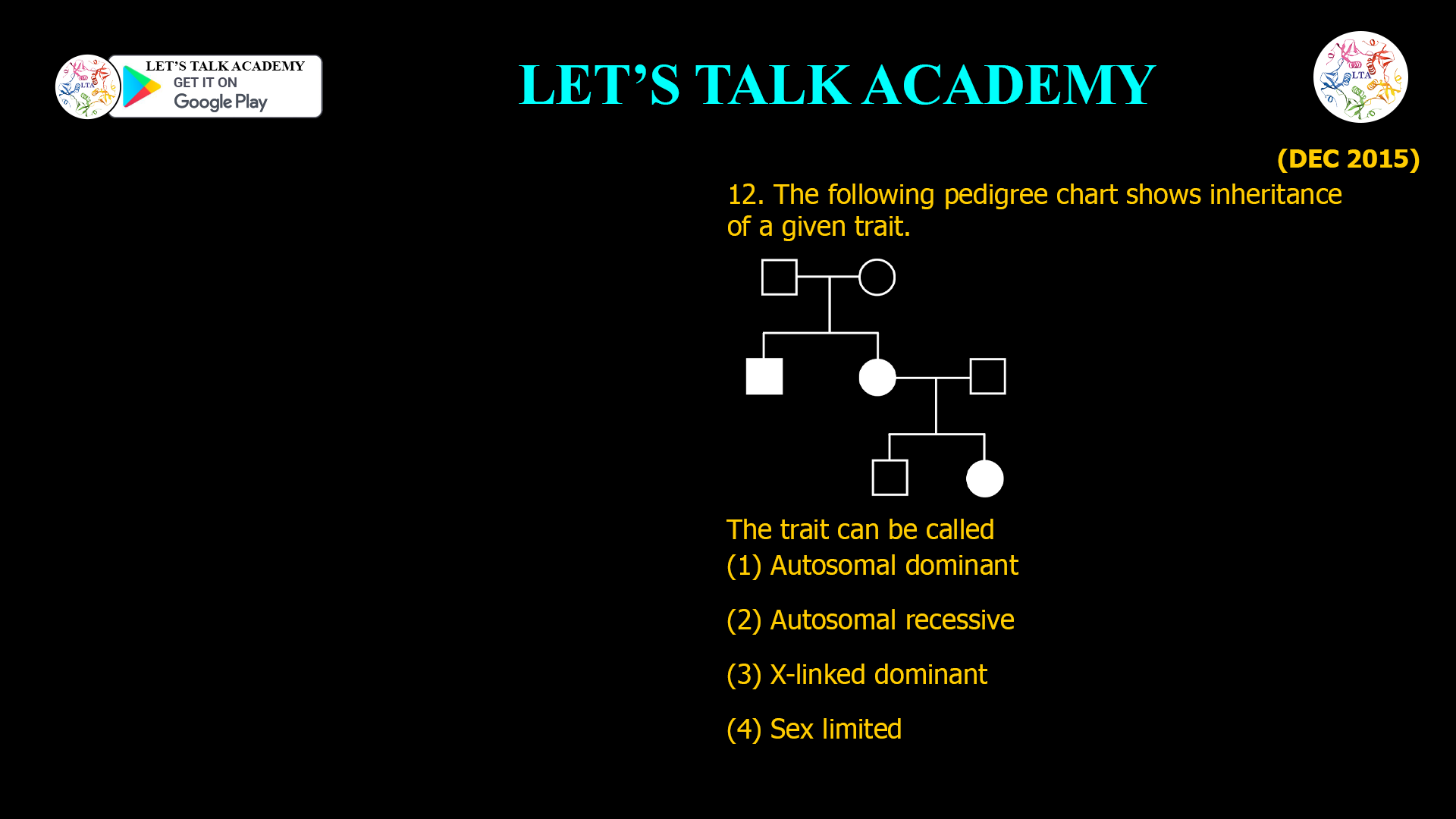
12. The following pedigree chart shows inheritance of a given trait.
The trait can be called
(1) Autosomal dominant
(2) Autosomal recessive
(3) X-linked dominant
(4) Sex limited
The pedigree shows an affected mother transmitting the trait to both a son and a daughter in successive generations, with affected individuals in every generation; this pattern is most consistent with an X‑linked dominant trait.
Identifying the inheritance pattern
In the pedigree, an affected female in the first generation has two children: one affected son and one unaffected daughter, indicating that the trait is not strictly limited to one sex and can appear in males as well as females. The affected son then marries an unaffected female and has two children, one affected daughter and one unaffected son, which shows vertical transmission in every generation and involvement of both sexes. This pattern rules out a sex‑limited trait and strongly suggests a dominant mode of inheritance involving the X chromosome rather than autosomes.
Option (1) Autosomal dominant
Autosomal dominant traits typically appear in every generation, and affected individuals have at least one affected parent. In such cases, males and females are affected in roughly equal proportions, and an affected father can transmit the trait to both sons and daughters because the gene is on an autosome. In the given pedigree, however, the specific pattern—affected female transmitting to a son, and then that affected male transmitting to all daughters but not to sons—is more characteristic of X‑linked dominant inheritance than classical autosomal dominant inheritance, so this option does not best fit the data.
Option (2) Autosomal recessive
Autosomal recessive traits often skip generations, with unaffected carrier parents producing affected offspring when both contribute a recessive allele. Such pedigrees commonly show affected individuals born to unaffected parents and may show clustering of affected siblings rather than clear vertical transmission. Because the trait in this pedigree appears in consecutive generations with affected parents, and there is no clear evidence of skipping generations or unaffected carriers producing affected children, autosomal recessive inheritance is unlikely.
Option (3) X‑linked dominant (Correct)
X‑linked dominant traits are transmitted when a single copy of the mutant allele on the X chromosome is sufficient to express the phenotype. An affected male transmits the trait to all daughters and to none of his sons because sons receive his Y chromosome, while daughters receive his affected X chromosome. In the pedigree, an affected male in the second generation has one affected daughter and one unaffected son with an unaffected spouse, matching the expected X‑linked dominant pattern. The involvement of both sexes, vertical transmission, and the sex‑specific transmission from the affected father to daughter strongly support X‑linked dominant inheritance, making this the correct answer.
Option (4) Sex‑limited
Sex‑limited traits are expressed in only one sex, even though the genes responsible may be present in both sexes. Examples include traits influenced by sex hormones, such as male‑limited pattern baldness or female‑limited traits related to lactation. In the given pedigree, both males and females are affected, meaning the trait is clearly expressed in more than one sex; therefore, the inheritance cannot be categorized as sex‑limited, and this option is incorrect.


