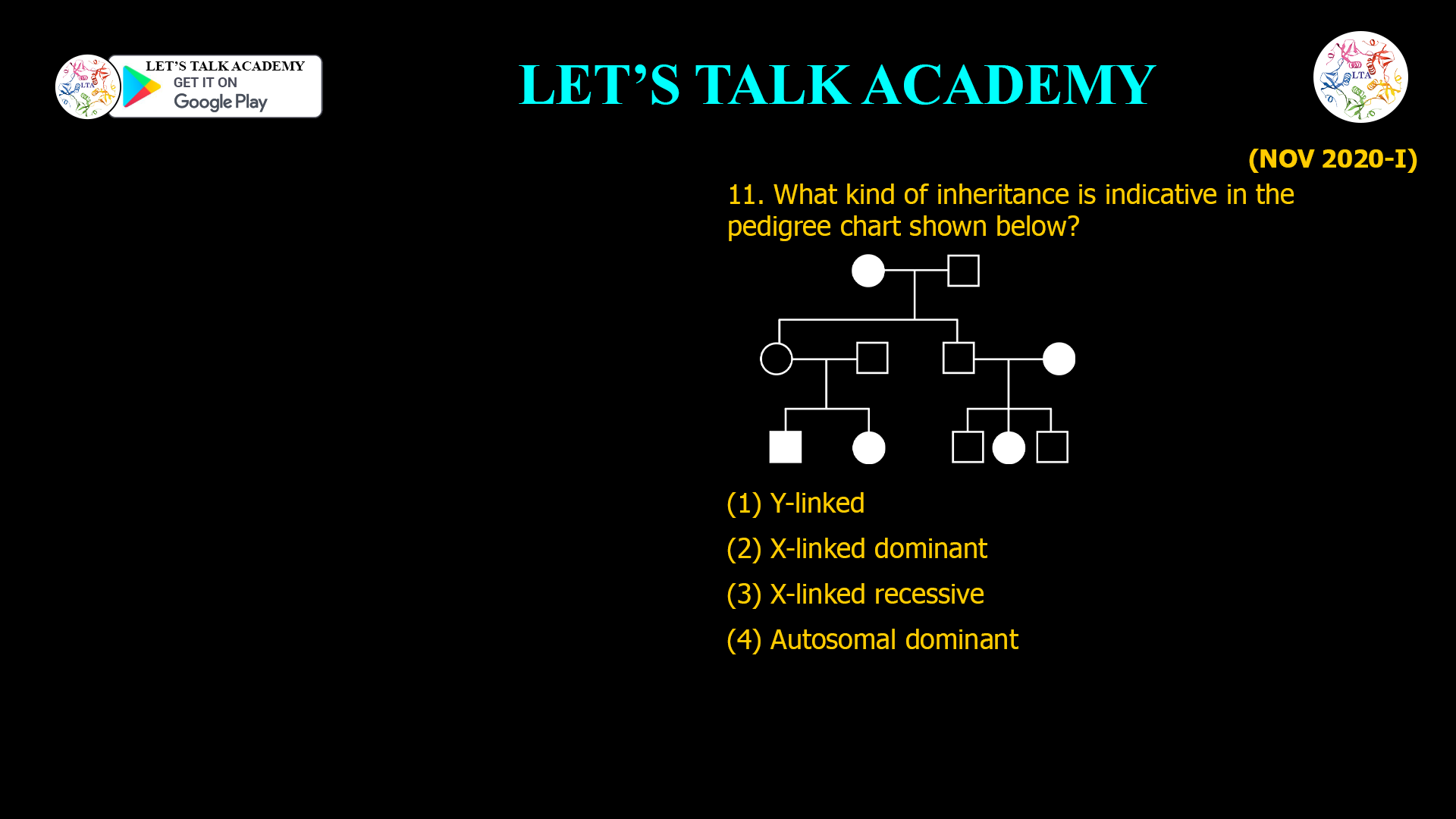
11. What kind of inheritance is indicative in the pedigree chart shown below?
(1) Y-linked
(2) X-linked dominant
(3) X-linked recessive
(4) Autosomal dominant
The pattern of inheritance indicated in the pedigree chart is autosomal dominant (option 4).
Why the pedigree is autosomal dominant
-
Affected individuals appear in every generation, giving a vertical pattern without skipped generations, which is typical of autosomal dominant traits.
-
Both males and females are affected and can transmit the trait to their sons and daughters, indicating an autosomal (non‑sex‑linked) locus rather than X‑linked or Y‑linked.
-
Male‑to‑male transmission is present (affected father to affected son), which rules out X‑linked inheritance and supports autosomal dominant inheritance.
Option‑wise explanation
(1) Y‑linked
-
Y‑linked traits occur only in males and pass strictly from affected fathers to all their sons and to none of their daughters.
-
In the given pedigree, females are affected and not all sons of affected males are affected, so the pattern cannot be Y‑linked.
(2) X‑linked dominant
-
In X‑linked dominant inheritance, an affected male transmits the trait to all daughters and no sons, and affected females often pass it to about half of their children of both sexes.
-
The pedigree shows affected sons of affected fathers and does not show the obligatory “all daughters affected from an affected father” pattern, so X‑linked dominant is inconsistent here.
(3) X‑linked recessive
-
X‑linked recessive traits mainly affect males, are transmitted through carrier females, and affected fathers do not pass the trait to their sons; generations are commonly skipped.
-
Here, both males and females are affected, there is direct father‑to‑son transmission, and there is no strong male bias, so X‑linked recessive is not supported.
(4) Autosomal dominant – correct
-
Autosomal dominant traits typically show:
-
presence in every generation;
-
roughly equal frequency in males and females;
-
male‑to‑male transmission possible.
-
-
The pedigree matches all these features, so autosomal dominant best explains the inheritance pattern.
SEO‑optimized introduction
Pedigree analysis questions such as “what kind of inheritance is indicative in the pedigree chart shown below” are frequent in CSIR NET and other life‑science exams, and they test a student’s ability to recognize autosomal versus sex‑linked inheritance patterns quickly and accurately. By checking generation‑to‑generation occurrence, sex distribution, and presence or absence of male‑to‑male transmission, this particular pedigree can be confidently classified as showing an autosomal dominant mode of inheritance rather than Y‑linked or X‑linked patterns.


