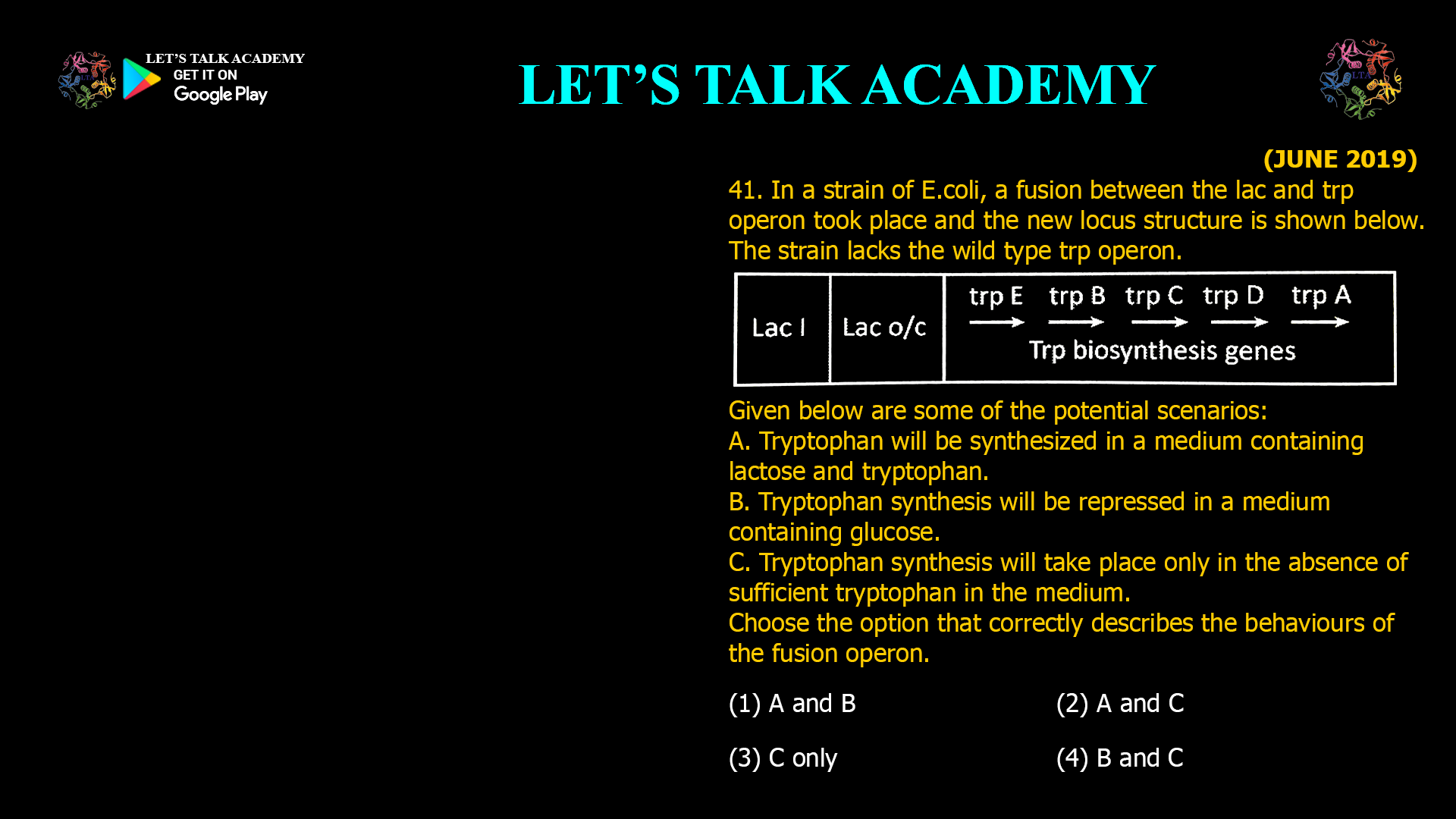
41. In a strain of E.coli, a fusion between the
lac and trp operon took place and the new
locus structure is shown below. The strain
lacks the wild type trp operon.
Given below are some of the potential
scenarios:
A. Tryptophan will be synthesized in a
medium containing lactose and tryptophan.
B. Tryptophan synthesis will be repressed in a
medium containing glucose.
C. Tryptophan synthesis will take place only
in the absence of sufficient tryptophan in themedium.
Choose the option that correctly describes the
behaviours of the fusion operon.
(1) A and B (2) A and C
(3) C only (4) B and C
Genetic engineering and operon fusions have long been used to study and manipulate bacterial gene regulation. In Escherichia coli, the lac and trp operons are classic examples of regulated gene clusters, each responding to different signals and controlling distinct metabolic pathways. When a fusion between these operons is created, the resulting chimeric locus can display novel regulatory properties. This article provides a comprehensive analysis of how a lac-trp fusion operon behaves in different growth conditions and clarifies which scenarios accurately describe its regulation.
Introduction to Operon Fusions
Operon fusions are genetic constructs in which the regulatory elements of one operon are joined to the structural genes of another. This allows the expression of the structural genes to be controlled by the regulatory signals of the fused operon. In the case of the lac and trp operons, fusions have been used to study the regulation of both systems and to engineer strains with unique metabolic capabilities712.
Structure of the lac and trp Operons
The lac Operon
The lac operon in E. coli encodes genes for the transport and metabolism of lactose. It is regulated by a repressor protein (encoded by the lacI gene) and an inducer (lactose or its analog). When lactose is absent, the repressor binds to the operator and blocks transcription. When lactose is present, it binds to the repressor, inactivating it and allowing transcription of the operon3.
The trp Operon
The trp operon encodes enzymes for tryptophan biosynthesis. It is regulated by a repressor protein (encoded by the trpR gene) and the corepressor tryptophan. When tryptophan is abundant, it binds to the repressor, which then binds to the operator and blocks transcription. When tryptophan is scarce, the repressor is inactive and the operon is expressed1.
The Fusion Operon: Regulatory Implications
When a fusion between the lac and trp operons occurs, the regulatory region of one operon (often the lac operon) is joined to the structural genes of the other (the trp operon). In the scenario described, the strain lacks the wild-type trp operon, so tryptophan synthesis is entirely dependent on the fusion operon.
How Does the Fusion Operon Work?
-
Regulation: The structural genes for tryptophan biosynthesis are now under the control of the lac regulatory region.
-
Induction: The operon is induced by the presence of lactose (or a suitable analog), which inactivates the lac repressor and allows transcription.
-
Repression: The operon is repressed in the absence of lactose, regardless of tryptophan levels, because the lac repressor blocks transcription.
Tryptophan itself does not regulate the fusion operon, since the trp repressor and its operator are absent or non-functional in the context of the fusion.
Analyzing the Given Scenarios
Let’s evaluate each scenario in the context of the fusion operon:
A. Tryptophan will be synthesized in a medium containing lactose and tryptophan.
-
Explanation: In the fusion operon, tryptophan synthesis is controlled by the lac regulatory system. Lactose (or an analog) is required to induce the operon. However, the question states that the medium contains both lactose and tryptophan.
-
Lactose: Induces the operon by inactivating the lac repressor.
-
Tryptophan: Does not repress the fusion operon because the trp regulatory system is absent.
-
-
Outcome: Tryptophan will be synthesized as long as lactose is present, even if tryptophan is present. This is because the fusion operon is not regulated by tryptophan.
B. Tryptophan synthesis will be repressed in a medium containing glucose.
-
Explanation: The lac operon is subject to catabolite repression by glucose. When glucose is present, cyclic AMP (cAMP) levels are low, and the cAMP-CRP complex is not formed, which is required for efficient transcription of the lac operon. As a result, the lac regulatory region (and thus the fusion operon) is repressed in the presence of glucose, regardless of lactose or tryptophan.
-
Outcome: Tryptophan synthesis will be repressed in a medium containing glucose.
C. Tryptophan synthesis will take place only in the absence of sufficient tryptophan in the medium.
-
Explanation: In the wild-type trp operon, tryptophan synthesis is repressed when tryptophan is present. However, in the fusion operon, tryptophan synthesis is controlled by the lac regulatory system, not by tryptophan itself.
-
Outcome: Tryptophan synthesis is not dependent on tryptophan levels, but on the presence of lactose and the absence of glucose. Therefore, this scenario is incorrect for the fusion operon.
Summary Table
| Scenario | Description | Correct for Fusion Operon? |
|---|---|---|
| A | Tryptophan synthesis in lactose + tryptophan medium | Yes (regulated by lactose, not tryptophan) |
| B | Tryptophan synthesis repressed in glucose medium | Yes (catabolite repression by glucose) |
| C | Tryptophan synthesis only in absence of tryptophan | No (not regulated by tryptophan) |
Correct Option
Based on the analysis:
-
A is correct: Tryptophan is synthesized when lactose is present, regardless of tryptophan.
-
B is correct: Tryptophan synthesis is repressed when glucose is present.
-
C is incorrect: Tryptophan synthesis is not regulated by tryptophan in the fusion operon.
Therefore, the correct option is (1) A and B.
Biological and Practical Implications
Understanding operon fusions is important for both basic research and biotechnology. By fusing the regulatory elements of one operon to the structural genes of another, scientists can engineer strains with novel regulatory properties. For example, a lac-trp fusion allows tryptophan synthesis to be induced by lactose, which can be useful for controlled expression in industrial or laboratory settings712.
Conclusion
In a strain of E. coli with a lac-trp fusion operon and lacking the wild-type trp operon, tryptophan synthesis is controlled by the lac regulatory system. Tryptophan is synthesized when lactose is present (even if tryptophan is present) and is repressed when glucose is present. It is not regulated by tryptophan itself. Thus, the correct description of the fusion operon’s behavior is given by options A and B.
Key Takeaway:
In a lac-trp fusion operon, tryptophan synthesis is induced by lactose and repressed by glucose, independent of tryptophan levels. The correct answer is (1) A and B.


1 Comment
Sakshi yadav
November 30, 2025A. Tryptophan will be synthesized in a
medium containing lactose and tryptophan.
B. Tryptophan synthesis will be repressed in a medium containing glucose