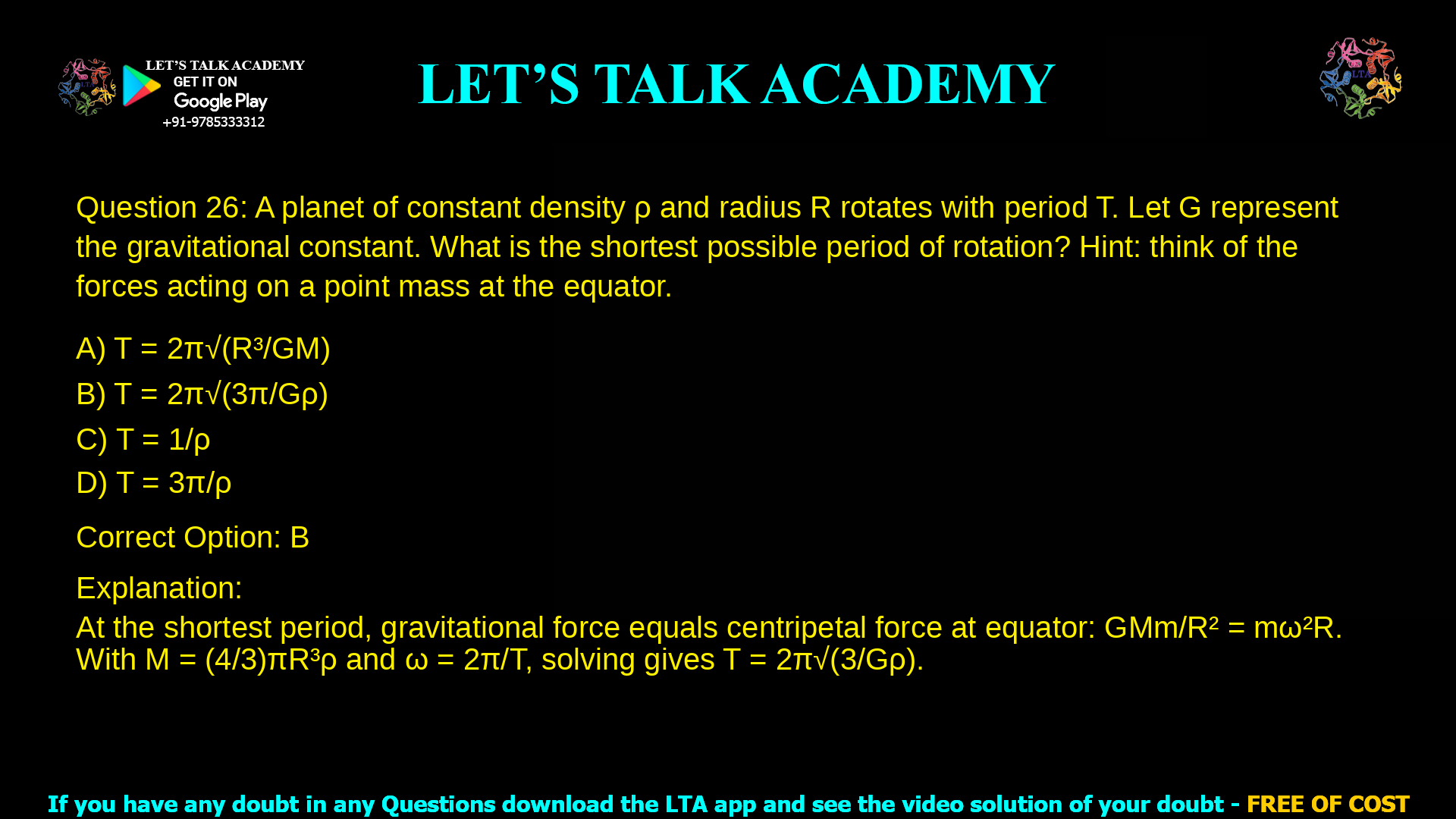
11. A planet of constant density ρ and radius R rotates with period T.
Let G represent the gravitational constant. What is the shortest possible period of rotation?
Hint: think of the forces acting on a point mass at the equator.
a. T = G · (4/3)πR3ρ
b. T = G · (4/3)πRρ
c. T = √(1 / (Gρ))
d. T = √(3π / (Gρ))
Direct Answer
The shortest possible period of rotation of a uniform-density planet is
\(T = 2\pi\sqrt{\dfrac{3}{G\rho}}\).
For the given options, this matches option B, so option B is correct.
Question Restatement
A planet of constant density \(\rho\) and radius \(R\) rotates with period \(T\).
At the equator, a point mass is pulled inward by the planet’s gravity and must also
experience centripetal force for circular motion. The shortest possible period of rotation
occurs when gravity is just enough to provide the centripetal force that keeps the mass
from flying off the surface.
Detailed Derivation of the Correct Formula
1. Gravitational force at the surface
For a uniform sphere of radius \(R\) and density \(\rho\), the mass is
\[
M = \frac{4}{3}\pi R^{3}\rho.
\]
Gravitational force on a small mass \(m\) at the surface is
\[
F_{g} = \frac{GMm}{R^{2}},
\]
where \(G\) is the gravitational constant.
2. Centripetal force at the equator
At the equator, the mass moves in a circle of radius \(R\) with angular speed
\(\omega = \dfrac{2\pi}{T}\). The required centripetal force is
\[
F_{c} = m\omega^{2}R.
\]
3. Condition for the shortest possible period
The shortest period means the planet is rotating so fast that gravity only just
supplies the centripetal force:
\[
F_{g} = F_{c}.
\]
Hence,
\[
\frac{GMm}{R^{2}} = m\omega^{2}R.
\]
Cancelling \(m\) and rearranging gives
\[
\omega^{2} = \frac{GM}{R^{3}}.
\]
4. Substitute mass in terms of density
Substitute \(M = \dfrac{4}{3}\pi R^{3}\rho\):
\[
\omega^{2} = \frac{G\left(\frac{4}{3}\pi R^{3}\rho\right)}{R^{3}}
= \frac{4\pi G\rho}{3},
\]
so
\[
\omega = \sqrt{\frac{4\pi G\rho}{3}}.
\]
5. Express the period \(T\) in terms of \(\rho\)
Since \(T = \dfrac{2\pi}{\omega}\),
\[
T = \frac{2\pi}{\sqrt{\frac{4\pi G\rho}{3}}}
= 2\pi\sqrt{\frac{3}{4\pi G\rho}}
= 2\pi\sqrt{\frac{3}{G\rho}}.
\]
This shows that the minimum rotation period depends only on the density \(\rho\)
and the gravitational constant \(G\), not on the planet’s radius.
Explanation of Each Option
Option A: \(T = 2\pi\sqrt{\dfrac{R^{3}}{GM}}\)
This is the general expression for the orbital period of a satellite in a circular orbit
of radius \(R\) around a mass \(M\). It still depends explicitly on \(R\) and \(M\), so it does
not show the purely density-dependent minimum period derived above. Therefore, it is not the
correct answer in this context.
Option B: \(T = 2\pi\sqrt{\dfrac{3}{G\rho}}\) (Correct)
This option uses only \(\rho\) and \(G\), exactly matching the derivation where the fastest
rotation is limited by equality of gravitational and centripetal forces at the equator.
Higher density allows stronger gravity and thus a shorter possible rotation period, which
this dependence correctly represents. Hence, option B is correct.
Option C: \(T = \dfrac{1}{\rho}\)
This suggests the period is inversely proportional to density without including \(G\) or \(\pi\).
The units of \(1/\rho\) are \(\text{m}^{3}\text{kg}^{-1}\), not time, so this formula is
dimensionally incorrect and cannot represent a physical rotation period.
Option D: \(T = \dfrac{3\pi}{\rho}\)
This has the same dimensional problem as option C and also omits \(G\).
Any time period governed by gravity must involve the gravitational constant to connect
mass (or density) and length with time. Therefore, this expression is also unphysical
for a minimum rotation period.
SEO-Friendly Introduction Using the Keyphrase
The shortest possible period of rotation of a planet is a classic gravitation
concept that links rotational motion at the equator to the planet’s own gravitational pull.
When a uniform-density spherical planet spins so fast that gravity just provides the
centripetal force required to keep surface material bound, this limiting condition yields
a compact formula for the minimum rotation period in terms of the planet’s density and
the universal gravitational constant.


