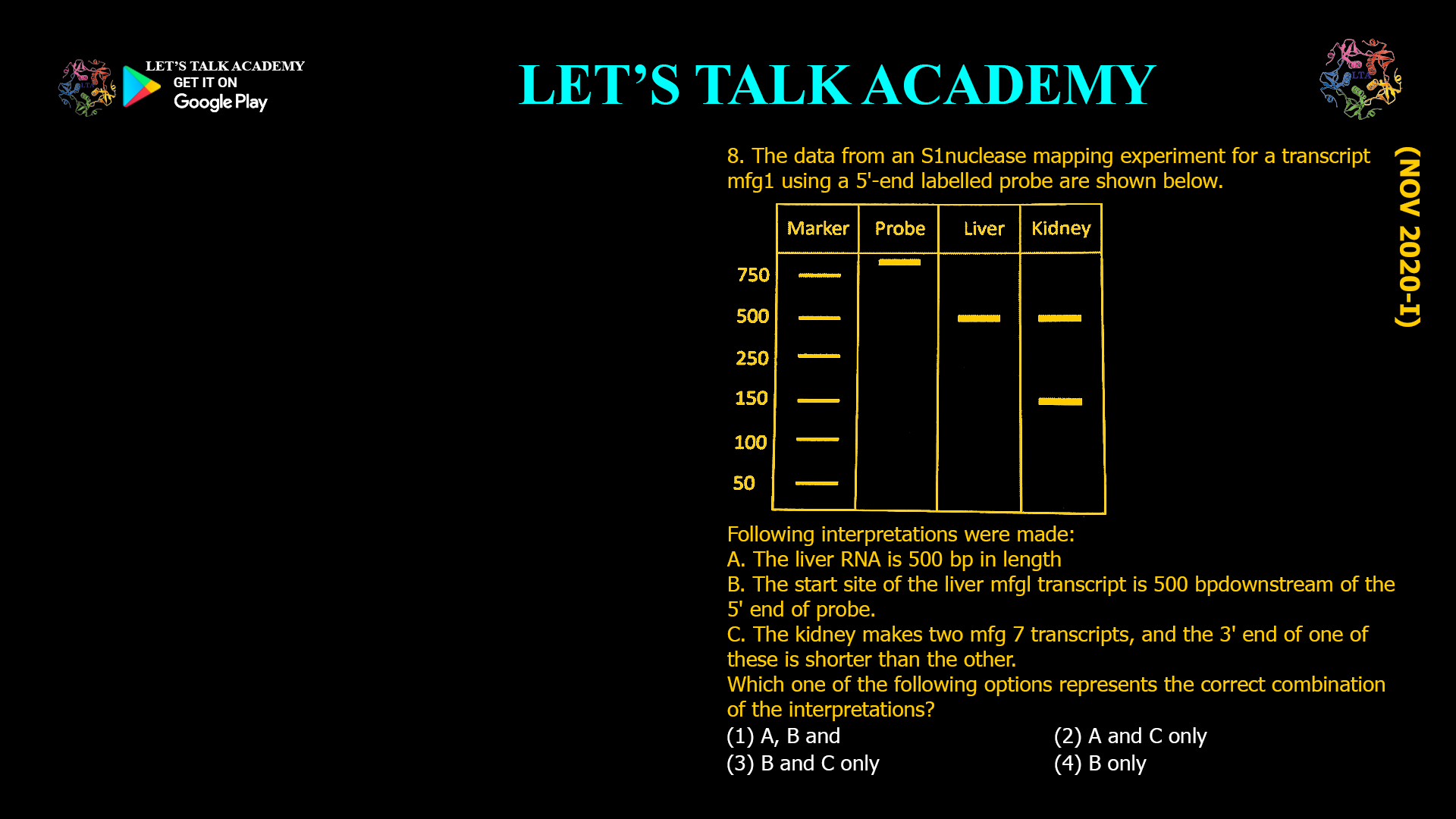
- The data from an S1 nuclease mapping experiment for a transcript mfg1 using a 5′-end labelled probe are shown below.
Following interpretations were made:
A. The liver RNA is 500 bp in length
B. The start site of the liver mfgl transcript is 500 bp downstream of the 5′ end of probe.
C. The kidney makes two mfg 7 transcripts, and the 3′ end of one of these is shorter than the other.
Which one of the following options represents the correct combination of the interpretations?
(1) A, B and (2) A and C only
(3) B and C only (4) B only
Introduction
S1 nuclease mapping is a precise molecular technique used to identify the 5′ and 3′ ends of RNA transcripts, enabling researchers to map transcription start sites and transcript lengths. By hybridizing a labeled DNA probe to RNA and digesting single-stranded regions with S1 nuclease, protected fragments reveal the boundaries of RNA-DNA complementarity. This method is valuable for studying transcript variants and tissue-specific expression patterns. Here, we analyze S1 nuclease mapping data for the mfg1 transcript in liver and kidney tissues and interpret key findings.
Understanding the Statements
The following interpretations were made from the S1 nuclease mapping data:
-
A. The liver RNA is 500 bp in length.
-
B. The start site of the liver mfg1 transcript is 500 bp downstream of the 5′ end of probe.
-
C. The kidney makes two mfg1 transcripts, and the 3′ end of one of these is shorter than the other.
Why Statement A Is Incorrect
-
S1 nuclease mapping measures the length of the protected DNA fragment that corresponds to the RNA-DNA hybrid.
-
The size of the protected fragment reflects the distance from the labeled end of the probe to the transcription start site.
-
The transcript length itself is not directly measured by the protected fragment size; rather, the protected fragment indicates where transcription starts relative to the probe.
-
Therefore, concluding that the liver RNA is 500 bp in length based solely on the protected fragment is incorrect.
Why Statement B Is Correct
-
The protected fragment size of 500 bp indicates that the transcription start site of the liver mfg1 transcript lies 500 nucleotides downstream from the 5′ end of the labeled probe.
-
This is consistent with the principle of S1 nuclease mapping, where the length of the protected fragment corresponds to the distance from the probe’s labeled end to the RNA start site.
-
Thus, statement B accurately reflects the mapping data.
Why Statement C Is Correct
-
The presence of two distinct protected fragments in kidney RNA indicates the existence of two mfg1 transcript isoforms.
-
The difference in fragment sizes suggests that one transcript is shorter at the 3′ end compared to the other.
-
This supports the idea of alternative transcription termination or processing events in kidney tissue, producing transcript variants.
Summary of Correct Interpretations
| Statement | Correctness | Explanation |
|---|---|---|
| A | Incorrect | Protected fragment size ≠ transcript length |
| B | Correct | Start site is 500 bp downstream of probe end |
| C | Correct | Two transcripts with different 3′ ends in kidney |
Conclusion
The correct combination of interpretations from the S1 nuclease mapping data is:
(3) B and C only
This means the liver mfg1 transcript start site is located 500 bp downstream of the probe’s 5′ end, and the kidney expresses two transcript variants differing in their 3′ ends, while the transcript length cannot be directly inferred from the protected fragment size


