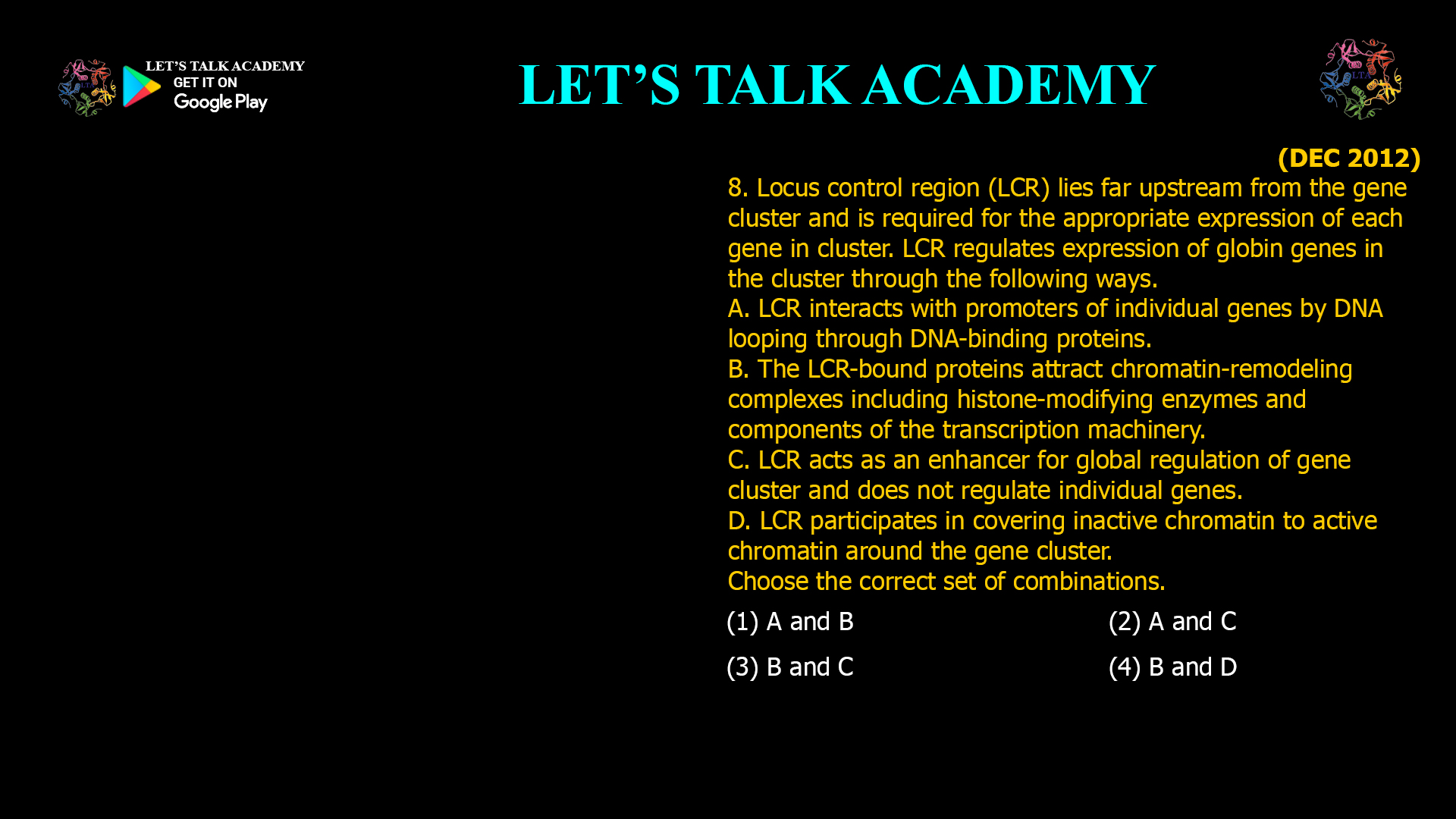
8. Locus control region (LCR) lies far upstream from the gene cluster and is required for the appropriate expression of each gene in cluster. LCR regulates expression of globin genes in the cluster through the following ways.
A. LCR interacts with promoters of individual genes by DNA looping through DNA-binding proteins.
B. The LCR-bound proteins attract chromatin. remodeling complexes including histone-modifying enzymes and components of the transcription machinery.
C. LCR acts as an enhancer for global regulation of gene cluster and does not regulate individual genes.
D. LCR participates in covering inactive chromatin to active chromatin around the gene cluster.
Choose the correct set of combinations.
(1) A and B (2) A and C
(3) B and C (4) B and D
Introduction
Locus Control Regions (LCRs) are powerful regulatory DNA elements located far upstream of gene clusters, playing a crucial role in orchestrating the appropriate expression of multiple genes within a cluster. One of the best-studied examples is the LCR that regulates the globin gene cluster, essential for hemoglobin production during different developmental stages. This article delves into the mechanisms by which LCRs regulate globin genes, highlighting their interaction with promoters, recruitment of chromatin remodeling complexes, and their influence on chromatin architecture.
What is a Locus Control Region (LCR)?
An LCR is a long-range cis-regulatory element that can enhance the expression of linked genes over large genomic distances. Unlike typical enhancers that regulate individual genes, LCRs coordinate the expression of entire gene clusters, ensuring robust, tissue-specific, and developmentally regulated transcription.
In the human β-globin locus, the LCR is located tens of kilobases upstream of the gene cluster and comprises several DNase I hypersensitive sites (HSs), which are regions of open chromatin accessible to transcription factors.
Mechanisms of LCR-Mediated Regulation of Globin Genes
A. DNA Looping to Interact with Individual Gene Promoters
One key mechanism by which the LCR regulates globin genes is through DNA looping. The LCR physically interacts with the promoters of individual globin genes by looping out the intervening DNA. This looping is mediated by DNA-binding proteins and transcription factors that bridge the LCR and promoters, bringing them into close spatial proximity despite their linear distance on the chromosome.
These dynamic interactions are crucial for activating transcription at the appropriate developmental stage and in the correct cell type. The frequency and stability of these LCR-promoter loops determine the level of gene expression.
B. Recruitment of Chromatin Remodeling Complexes and Transcription Machinery
The LCR-bound proteins serve as a hub to recruit chromatin remodeling complexes, including histone-modifying enzymes and components of the basal transcription machinery. This recruitment results in:
-
Opening of chromatin structure: Making the DNA more accessible for transcription.
-
Histone modifications: Such as acetylation and methylation that mark active chromatin.
-
Assembly of transcription complexes: Facilitating efficient transcription initiation at globin gene promoters.
This coordinated recruitment ensures that the entire globin locus adopts an active chromatin configuration conducive to high-level gene expression.
C. Chromatin State Modulation Around the Gene Cluster
The LCR also participates in maintaining the active chromatin state of the globin gene cluster. It helps convert or maintain chromatin from a closed, inactive state (heterochromatin) to an open, transcriptionally active state (euchromatin). This chromatin remodeling is essential for allowing transcription factors and RNA polymerase II to access the globin genes.
Incorrect or Less Supported Mechanisms
-
LCR as a global enhancer without regulating individual genes:
While the LCR acts as a powerful enhancer for the entire gene cluster, it does regulate individual genes through specific interactions, not just global activation. Thus, the notion that it does not regulate individual genes is incorrect.
Summary of Correct Mechanisms
| Statement | Correctness | Explanation |
|---|---|---|
| A. LCR interacts with promoters of individual genes by DNA looping through DNA-binding proteins. | Correct | LCR-promoter looping is essential for gene activation. |
| B. The LCR-bound proteins attract chromatin remodeling complexes including histone-modifying enzymes and transcription machinery. | Correct | Recruitment of these complexes opens chromatin and facilitates transcription. |
| C. LCR acts as an enhancer for global regulation of gene cluster and does not regulate individual genes. | Incorrect | LCR regulates individual genes via looping and specific interactions. |
| D. LCR participates in converting inactive chromatin to active chromatin around the gene cluster. | Correct | LCR maintains an open chromatin environment essential for gene expression. |
Conclusion
Based on current scientific understanding, the Locus Control Region (LCR) regulates globin gene clusters primarily by:
-
Forming DNA loops to interact with individual gene promoters.
-
Recruiting chromatin remodeling complexes and transcription machinery.
-
Modulating chromatin state to maintain an active, accessible configuration.
Thus, the correct combination of statements describing LCR function is:
(1) A and B
Additional Insights
The dynamic nature of LCR interactions with globin genes allows for developmental switching of gene expression, such as the transition from fetal to adult globin genes. The LCR’s ability to maintain an open chromatin domain and facilitate selective promoter interactions is fundamental to this tightly controlled process.
Understanding LCR function has important implications for gene therapy, especially for diseases like β-thalassemia and sickle cell anemia, where reactivation or correction of globin gene expression can be therapeutic.
Key Takeaway:
The Locus Control Region (LCR) regulates globin gene clusters by DNA looping to individual promoters and recruiting chromatin remodeling complexes, ensuring precise and robust gene expression through chromatin state modulation.
This article provides a comprehensive overview of LCR-mediated regulation of globin genes, synthesizing current knowledge to clarify the molecular mechanisms involved.


