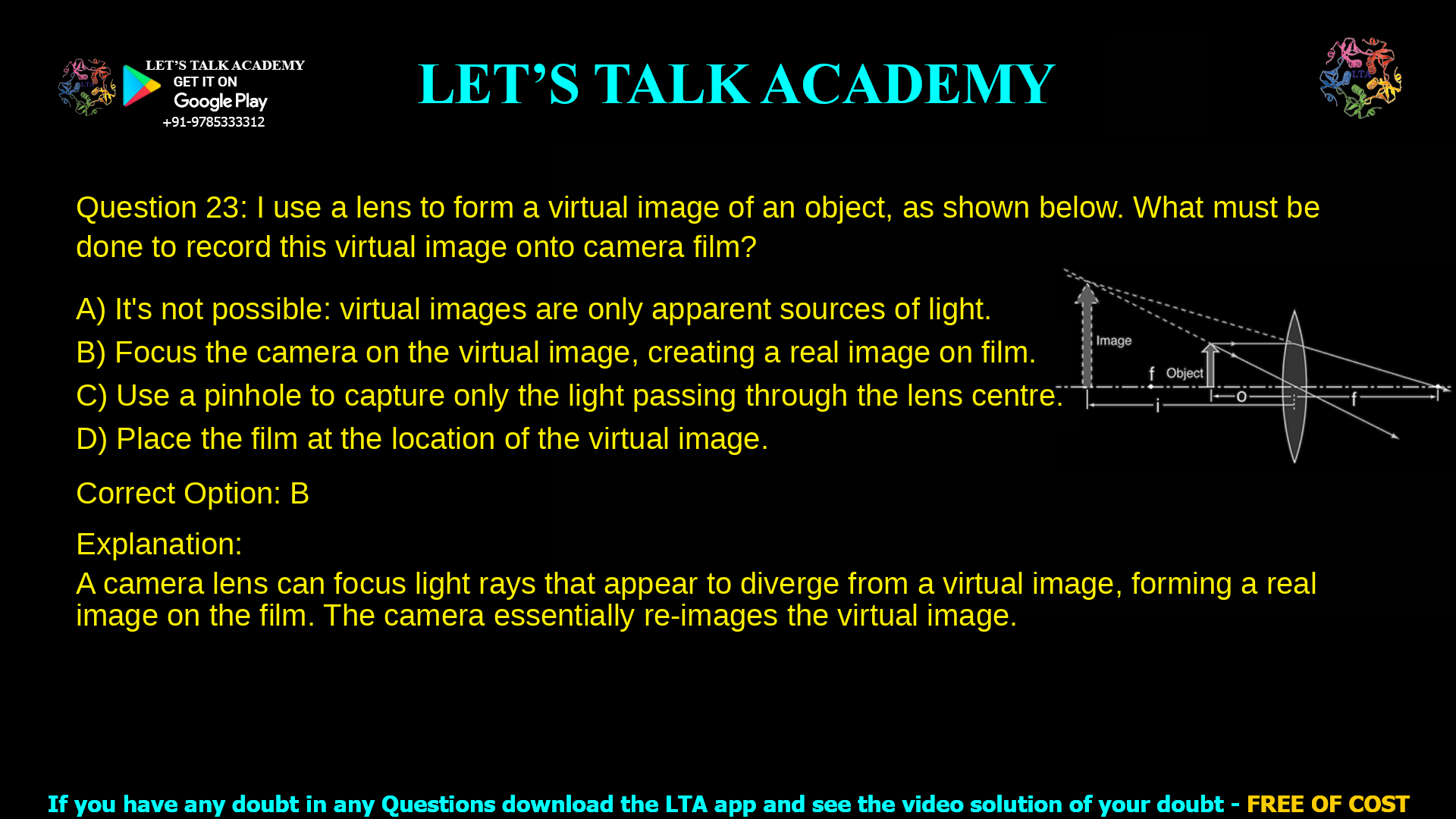
8. I use a lens to form a virtual image of an object, as shown below. What must be
done to record this virtual image onto camera film?
a. It’s not possible: virtual images are only apparent sources of light.
b. Focus the camera on the virtual image, creating a real image on film.
c. Use a pinhole to capture only the light passing through the lens centre.
d. Place the film at the location of the virtual image.
The virtual image formed by the lens can be recorded on camera film by focusing the camera on that virtual image so that the camera lens forms a new real image on the film.
Correct option and concept
A virtual image cannot itself fall on a screen or film because the light rays leaving the lens are diverging and only appear to come from the image position behind the lens. The camera’s lens, however, can intercept those diverging rays and bend them so that they converge to form a real image on the film or sensor, which can then be recorded. Therefore, option b. Focus the camera on the virtual image, creating a real image on film is correct.
Why options a, c and d are wrong
-
Option a: “It’s not possible: virtual images are only apparent sources of light.”
Virtual images are not just “apparent” in the sense of being unreal; the light rays coming toward your eye (or the camera) are real physical rays that can be refracted again by another lens. Because those real rays carry information about the virtual image, a camera lens can form a real image from them on the film, so it is definitely possible to photograph a virtual image. -
Option c: “Use a pinhole to capture only the light passing through the lens centre.”
A pinhole camera forms an image without a lens by letting a very small bundle of rays from each point of the object reach the film directly. In this setup a pinhole does not “convert” a virtual image into a real one; it would simply form its own (usually very dim) real image of the original object, not of the virtual image shown in the diagram, so this does not solve the problem. -
Option d: “Place the film at the location of the virtual image.”
A virtual image cannot be projected on a screen or film placed at its apparent location because no light actually converges there. Putting the film where the virtual image seems to be would result in no sharp image being recorded, just blurred light, so this option is incorrect.
How the camera records the virtual image (option b in detail)
When the lens in the diagram forms a virtual image, the outgoing rays leave the lens as if they originated from the image point behind it. A camera placed on the right-hand side (where those rays are actually travelling) uses its own converging lens to focus these diverging rays onto the film, creating a real, inverted image of the virtual object. By adjusting the focus ring, the photographer sets the camera lens so that the virtual image distance acts as the “object distance” for the camera, producing a sharp real image on the film.
Introduction
In geometric optics exams and competitive tests, students are often asked how to record a virtual image on camera film when a lens first produces that virtual image from an object. Understanding this concept requires a clear grasp of real and virtual images, how camera lenses work, and why simply putting film at the virtual image position does not work.
Real vs virtual images in this question
A real image is formed where rays actually converge and can be caught on a screen or film, while a virtual image is formed where rays only appear to diverge from a point behind a lens or mirror. In the given diagram, the first lens creates a virtual image that cannot by itself be projected, but those diverging rays can still be refocused by a second lens (the camera) into a new real image on the film.
Evaluating each option
-
Option a falsely claims that virtual images are only apparent sources and cannot be photographed, but the real rays coming from a virtual image can be refracted again to form a real image on the camera film.
-
Option b correctly states that focusing the camera on the virtual image allows its lens system to generate a real image on the film, effectively treating the virtual image as the object for the camera.
-
Option c proposes using a pinhole, but this would simply form a dim real image of the original object rather than specifically recording the virtual image produced by the first lens.
-
Option d fails because a virtual image cannot appear on film placed at that location, since no rays actually meet there, so nothing sharp is recorded.
By focusing the camera on the virtual image and letting its lens form a new real image on the film, the problem is solved and the correct choice—option b—is justified both conceptually and practically.


