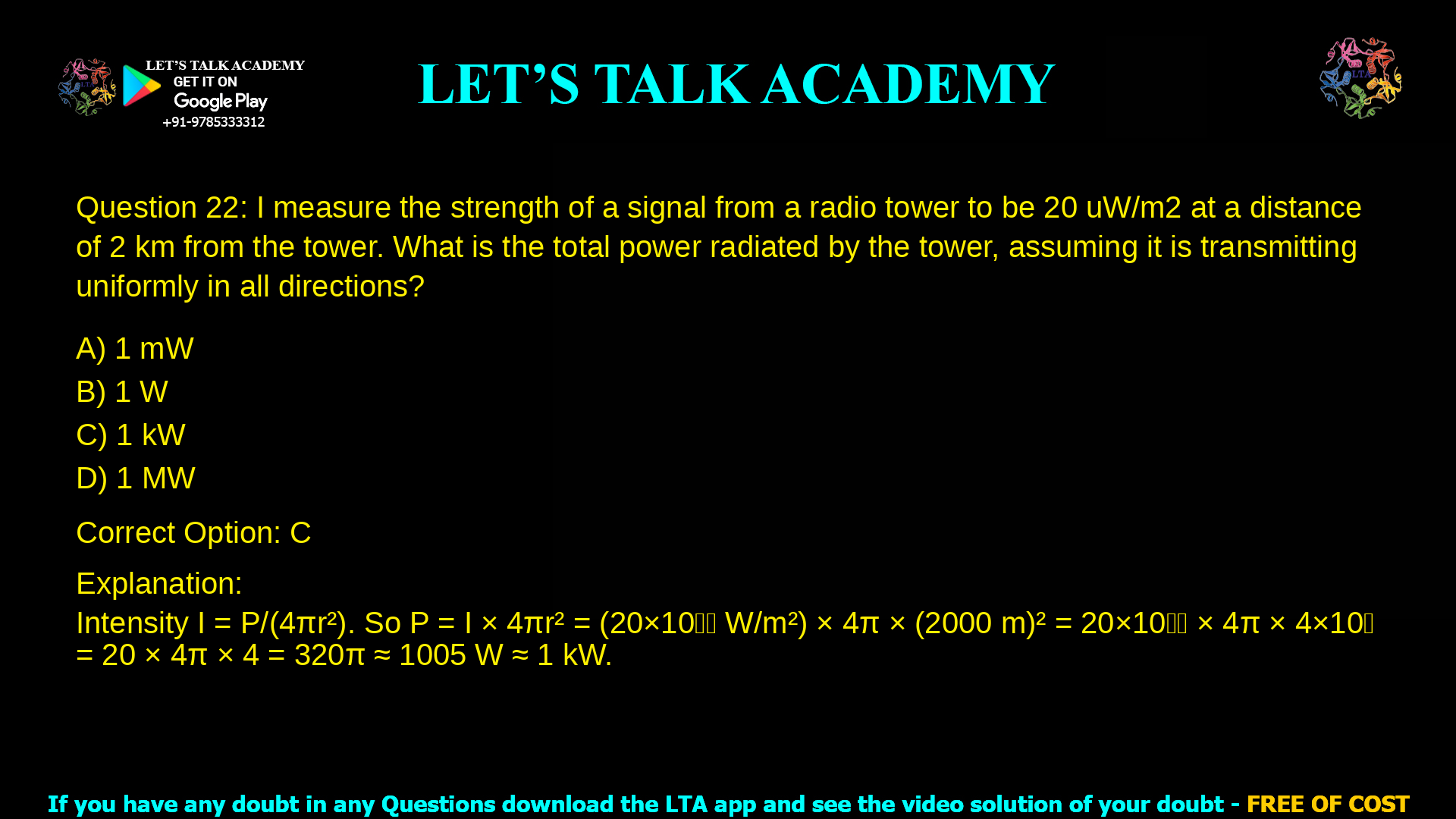
7. I measure the strength of a signal from a radio tower to be 20 uW/m2 at a distance
of 2 km from the tower. What is the total power radiated by the tower, assuming it is
transmitting uniformly in all directions?
a. 1 mW
b. 1 W
c. 1 kW
d. 1 MW
Solution Explanation
The intensity I = 20 μW/m² = 20 × 10⁻⁶ W/m² is measured at distance r = 2 km = 2000 m from a radio tower radiating uniformly in all directions. For isotropic radiation, power spreads over a sphere’s surface, so I = P / (4πr²), where P is total radiated power. Solving gives P = I × 4πr² = 20 × 10⁻⁶ × 4π × (2000)² ≈ 1005 W ≈ 1 kW.
Option Analysis
- a. 1 mW: This equals 10⁻³ W, far too low; actual P ≈ 1005 W exceeds it by a million-fold due to large spherical area 4π(2000)² ≈ 5.03 × 10⁷ m².
- b. 1 W: Still too small by factor of 1000; intensity over vast surface dilutes power significantly.
- c. 1 kW: Matches calculation (1005 W ≈ 1 kW); correct for uniform spherical radiation.
- d. 1 MW: Overestimates by 1000 times; assumes unrealistically high power for given low intensity.
Core Formula
Power density I at distance r is I = P / (4πr²), rearranging to P = 4πr²I. Here, r = 2000 m, I = 20 × 10⁻⁶ W/m², yielding P ≈ 1 kW.
Practical Implications
Such calculations assess antenna effective radiated power (ERP) in telecommunications, ensuring safety limits like 1000 μW/m². Real towers approximate isotropy in far field.
Quick Option Summary
| Option | Power Value | Why Incorrect/Correct |
|---|---|---|
| a | 1 mW | Too low by ~10⁶ |
| b | 1 W | Too low by ~1000 |
| c | 1 kW | Matches ~1005 W |
| d | 1 MW | Too high by ~1000 |


