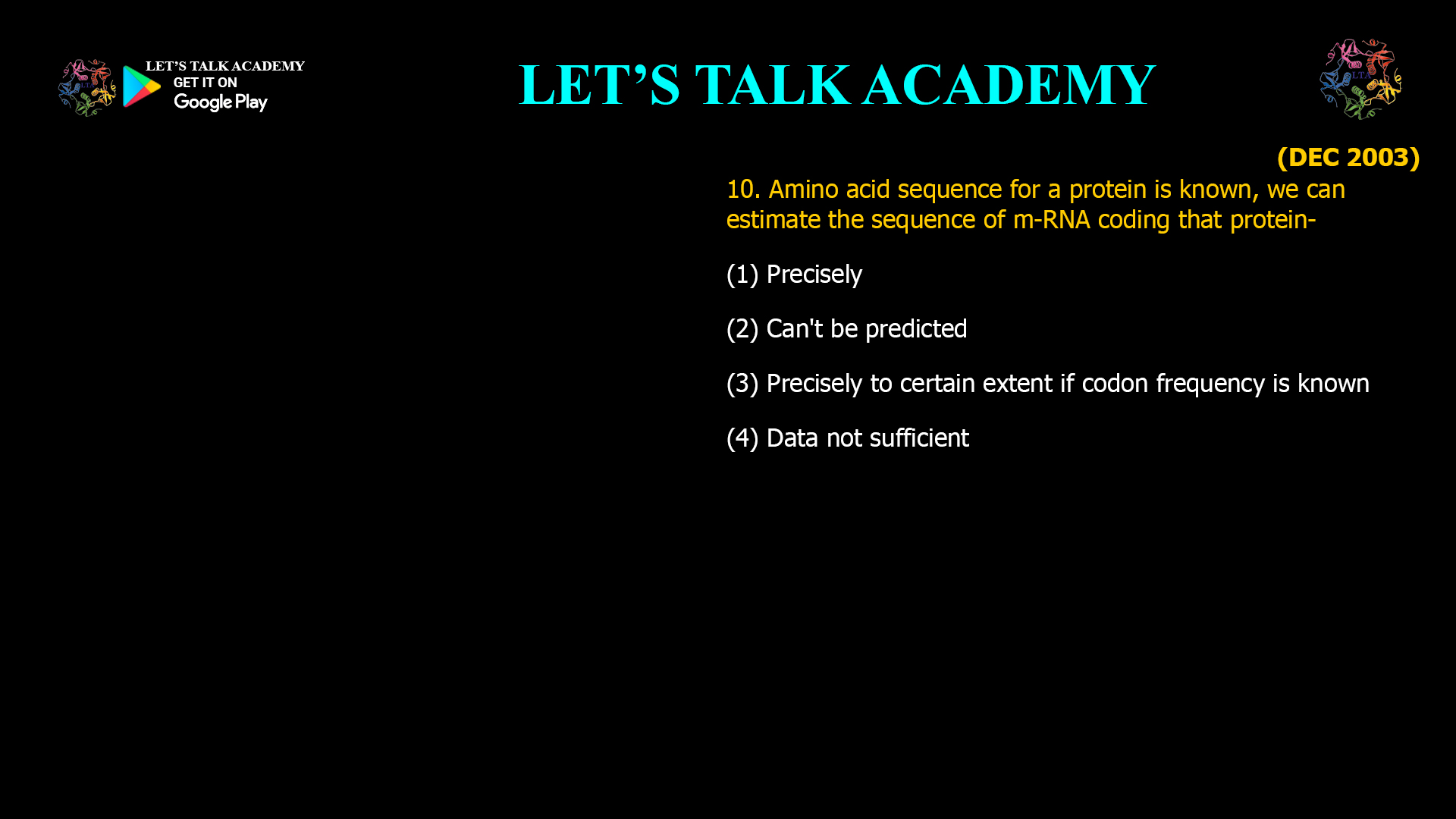
- Amino acid sequence for a protein is known, we canestimate the sequence of m-RNA coding that protein-
(1) Precisely
(2) Can’t be predicted
(3) Precisely to certain extent if codon frequency is known
(4) Data not sufficientCan the mRNA Sequence Coding for a Known Protein Be Precisely Predicted?
Understanding the relationship between a protein’s amino acid sequence and its corresponding mRNA sequence is fundamental in molecular biology. Given the amino acid sequence of a protein, can we precisely determine the mRNA sequence that encodes it? The answer is nuanced due to the degeneracy of the genetic code and codon usage biases.
The Genetic Code and Degeneracy
-
The genetic code is degenerate, meaning most amino acids are encoded by more than one codon. For example, leucine is encoded by six different codons.
-
This degeneracy means that a single amino acid sequence can correspond to multiple possible mRNA sequences.
Predicting mRNA Sequence from Protein Sequence
-
Precise prediction of the exact mRNA sequence is generally not possible because multiple codons can encode the same amino acid (Option 1 is incorrect).
-
However, prediction can be made to a certain extent by considering codon usage frequencies specific to the organism or tissue (Option 3). Organisms preferentially use certain codons over others, a phenomenon known as codon bias.
-
Advanced computational models use comparative protein sequences from related species and codon usage tables to narrow down possible mRNA sequences with high accuracy.
-
For example, models have achieved near 100% accuracy in predicting mRNA sequences when multiple homologous protein sequences are available and closely related species are considered.
Why Other Options Are Less Appropriate
-
Option 2 (Can’t be predicted): While exact sequences cannot be pinpointed without additional data, partial prediction using codon bias is feasible.
-
Option 4 (Data not sufficient): Some data, like codon frequency and related protein sequences, can improve prediction, so this is not entirely true.
Summary Table
Option Explanation Correctness (1) Precisely Not possible due to codon degeneracy Incorrect (2) Can’t be predicted Prediction is possible to some extent Incorrect (3) Precisely to certain extent if codon frequency is known Codon bias allows partial prediction Correct (4) Data not sufficient Some data can improve prediction Incorrect
Keywords for SEO Optimization
-
mRNA sequence prediction
-
Protein to mRNA translation
-
Codon degeneracy and bias
-
Genetic code redundancy
-
Computational prediction of mRNA
-
Codon usage frequency
-
Protein sequence reverse translation
-
Homologous protein sequence analysis
-
mRNA and protein sequence correlation
-
Bioinformatics in gene prediction
Conclusion
Given an amino acid sequence, the exact mRNA sequence cannot be predicted precisely due to the degeneracy of the genetic code. However, by leveraging codon usage frequencies and comparative protein data, scientists can estimate the mRNA sequence to a certain extent. This approach aids in designing cDNA probes, synthetic genes, and understanding gene expression patterns.
Correct answer: (3) Precisely to certain extent if codon frequency is known
-


7 Comments
Santosh Saini
November 3, 2025Precisely to certain extant if codon frequency is known
Divya rani
November 3, 2025Amino acid sequence for a protein is known , we can estimate the sequence of m RNA coding that Protein precisely to certain extent if codon frequency is known because codon bias allows partial prediction.
anjani sharma
November 3, 2025The genetic code is degenerate (multiple codons code for one amino acid), the exact mRNA sequence cannot be determined precisely just from the amino acid sequence, but it can be estimated by knowing codon frequency.
Priya khandal
November 3, 20253 is correct
Pooja
November 4, 2025Precisely to certain extent if codon frequency is known
Heena Mahlawat
November 5, 2025Precisely to certain extent, due to degeneracy of code
Sakshi Kanwar
November 8, 2025Precisely to certain extent if codon frequency is known