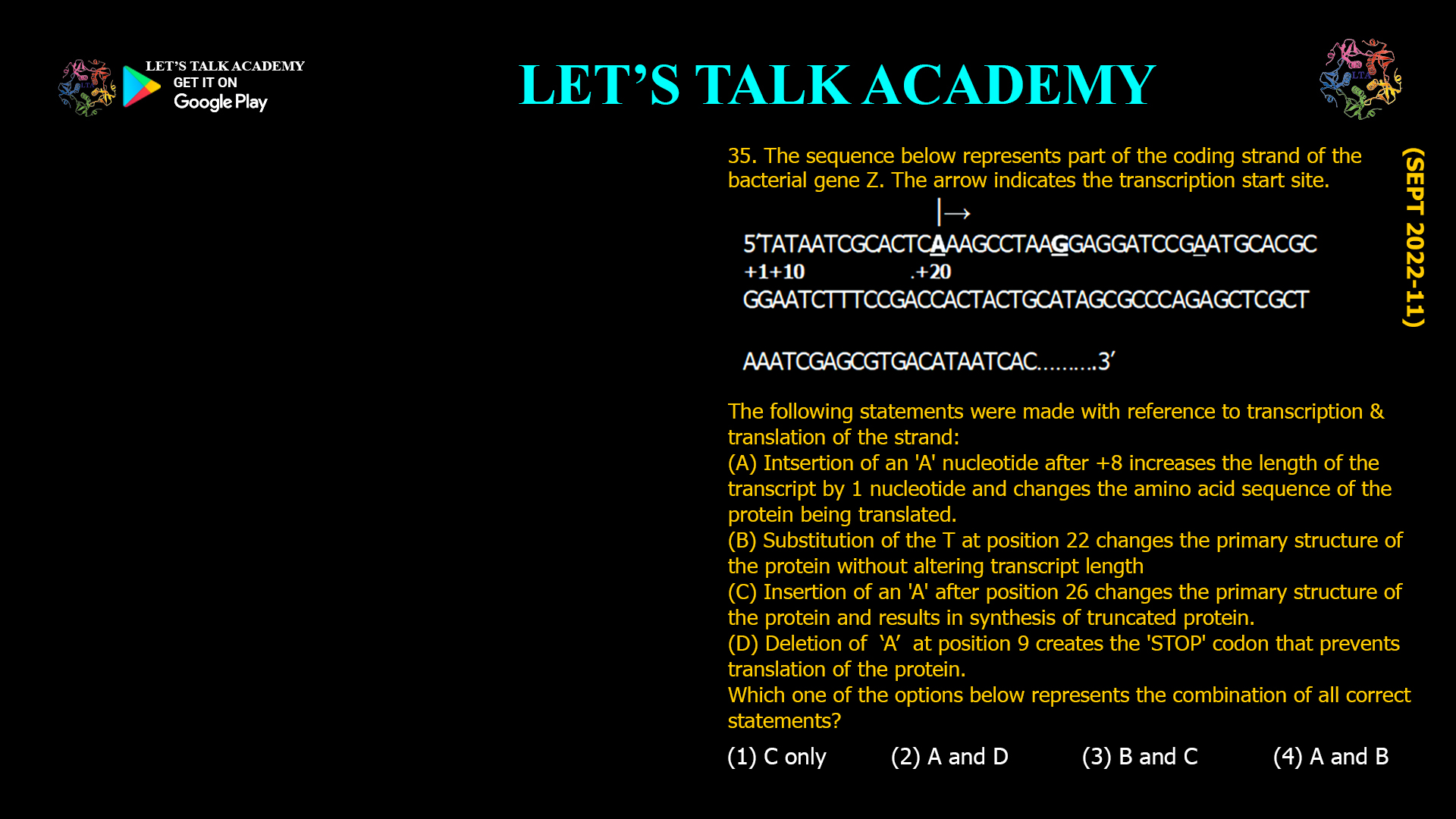
- The sequence below represents part of the coding strand of the bacterial gene Z. The arrow indicates the transcription start site.
|→
5’TATAATCGCACTCAAAGCCTAAGGAGGATCCGAATGCACGC
+1+10 .+20
GGAATCTTTCCGACCACTACTGCATAGCGCCCAGAGCTCGCTAAATCGAGCGTGACATAATCAC……….3’
The following statements were made withreference to transcoption& translation of the strand:
(A) Intsertion of an ‘A’ nucleotide after +8 increases the length of the transcript by 1 nucleotide and changes the amino acid sequence of the protein being translated.
(B) Substitution of the T at position 22 changes the primary structure of the protein without altering transcript length
(C) Insertion of an ‘A’ after posrtton 26 changes the primary structure of the protein and results in synthesis of truncated protein.
(D) Deletion of ‘A’ at position 9 creates the ‘STOP’ codon that prevents translation of the protein.
Which one of the options below represents the combination of all correct statements?
(1) C only (2) A and D
(3) B and C (4) A and BUnderstanding the Polar Effect of Nonsense Mutations in Bacterial Operons
In bacterial operons, a nonsense mutation in an upstream gene can lead to a significant decrease in the expression of downstream genes. This phenomenon is known as the polar effect of the mutation. It occurs because premature termination of translation affects both translation and transcription processes of the operon.
Key Features of the Polar Effect
-
A nonsense mutation introduces a premature stop codon in the upstream open reading frame (ORF).
-
This premature stop causes early termination of translation, leading to a reduction in ribosome density downstream.
-
The absence of ribosomes downstream allows the Rho factor to bind the mRNA and induce premature transcription termination, reducing the synthesis of downstream gene products.
-
The polar effect thus couples translation termination with transcription termination in bacteria.
Evaluation of the Statements
Statement Explanation Correctness (A) Premature stop codon leads to termination of protein synthesis, depleting ribosomes for downstream ORFs but does not affect transcription. Incorrect — transcription is affected due to Rho-dependent termination. (B) Polar effect occurs only if nonsense mutation creates stem-loop causing Rho-independent termination. Incorrect — polar effects often involve Rho-dependent termination, not only Rho-independent. (C) Depletion of ribosomes downstream allows Rho to bind and cause premature transcription termination. Correct — this is a key mechanism of polarity. (D) Suppressor tRNA reading the nonsense codon is essential for causing polar effect. Incorrect — suppressor tRNAs reduce polar effects by allowing readthrough. (E) Suppressor tRNA presence diminishes polar effect consequences. Correct — suppressor tRNAs alleviate polarity by suppressing premature termination.
Correct Combination
The correct statements are (C) and (E), which describe the mechanism of polar effect and the mitigating role of suppressor tRNAs.
Keywords for SEO Optimization
-
Polar effect in bacterial operons
-
Nonsense mutation polarity
-
Rho-dependent transcription termination
-
Suppressor tRNA and polar mutations
-
Translation-transcription coupling in bacteria
-
Premature translation termination effects
-
Operon gene expression regulation
-
Polycistronic mRNA translation
-
Genetic mutation effects on operons
-
Bacterial gene regulation mechanisms
Conclusion
The polar effect of a nonsense mutation in an operon arises because premature translation termination reduces ribosome coverage downstream, allowing Rho factor to prematurely terminate transcription. Suppressor tRNAs reduce the polar effect by enabling readthrough of the nonsense codon. Therefore, the correct answer is:
(3) C and E
-


2 Comments
Kajal
November 4, 2025Correct answer is C and E
Santosh Saini
November 9, 2025Statement C and E are correct