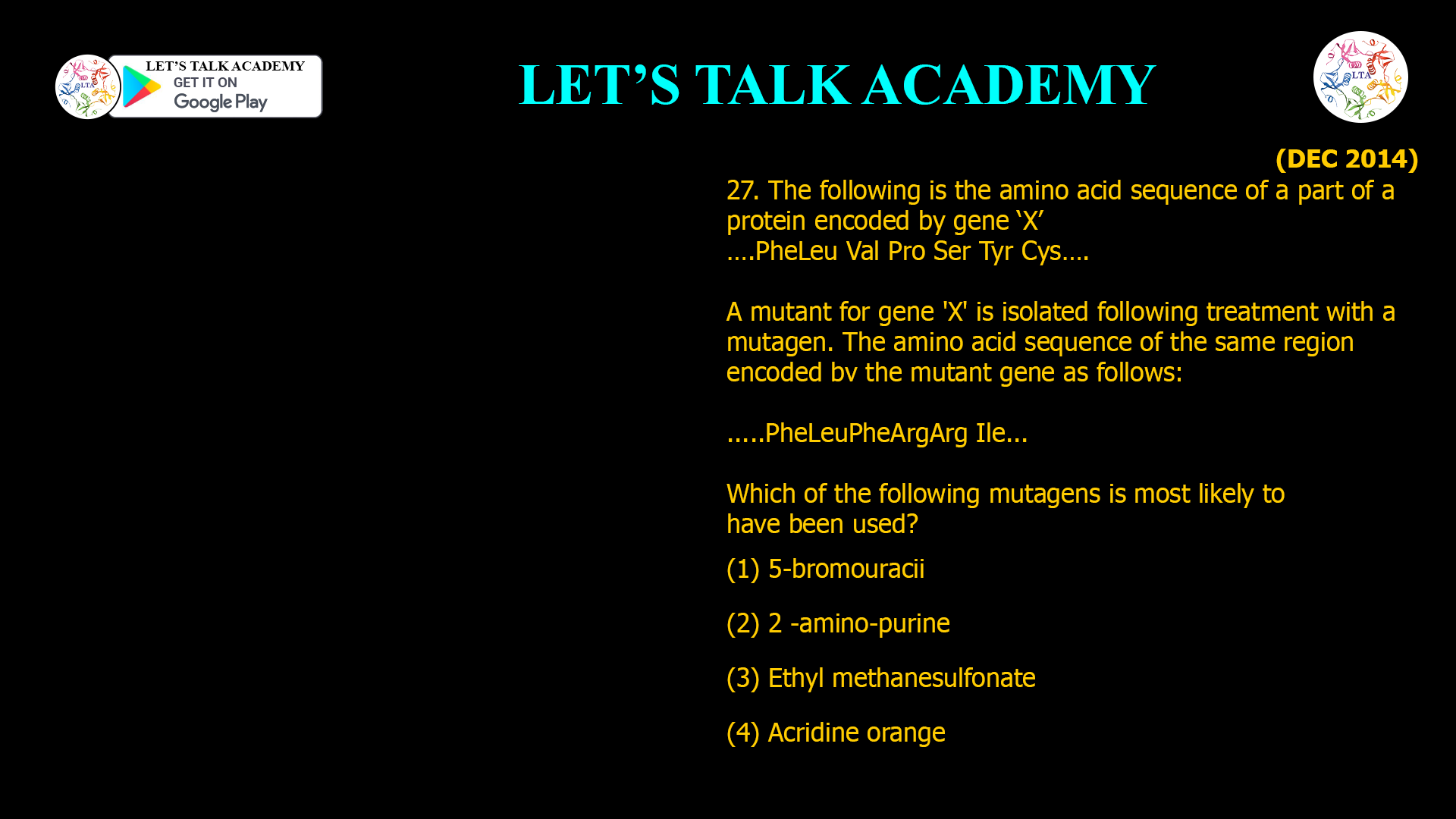
- The following is the amino acid sequence of a part of a protein encoded by gene ‘X’
….Phe Leu Val Pro Ser Tyr Cys….A mutant for gene ‘X’ is isolated following treatment with a mutagen. The amino acid sequence of the same region encoded bv the mutant gene as follows:
…..Phe Leu Phe Arg Arg Ile…
Which Of the following mutagens is most likely to have been used?
(1) 5-bromouracii
(2) 2 -amino-purine
(3) Ethyl methanesulfonate
(4) Acridine orange
The correct answer is (4) Acridine orange, as the mutant sequence shows a frameshift mutation rather than simple base substitutions. The wild-type sequence ….Phe-Leu-Val-Pro-Ser-Tyr-Cys…. shifts to ….Phe-Leu-Phe-Arg-Arg-Ile…., indicating an insertion or deletion that alters the reading frame after the second codon, producing a cascade of amino acid changes inconsistent with single nucleotide transitions or transversions.
Codon Analysis Reveals Frameshift
Wild-type codons could be UUU/C (Phe)-CUG (Leu)-GUU (Val)-CCU (Pro)-UCU (Ser)-UAU (Tyr)-UGU (Cys), forming a continuous reading frame. In the mutant, the first two amino acids match (Phe-Leu, e.g., UUU-CUG), but subsequent codons shift: the original Val (GUU) becomes part of Phe (UU-GUU → UUU if +1 deletion before), followed by frameshifted reading of original Pro-Ser-Tyr-Cys as Phe (e.g., CCCUCUAUUGU → CCU-CUA-UUG → but shifted to UUU-AGA-AGA-AUU for Phe-Arg-Arg-Ile). This +1 or -1 shift explains the grouped Arg-Arg-Ile pattern, typical of intercalators.
Option-Wise Mutagen Mechanisms
-
(1) 5-Bromouracil: Base analog induces transitions (GC↔AT) by tautomerizing to pair A instead of T, or vice versa; cannot cause Val→Phe (GUU→UUU requires transversion G→U) or clustered changes.
-
(2) 2-Aminopurine: Adenine analog causes transitions (AT↔GC) via mispairing with C; limited to single substitutions like Tyr→Cys (UAU→UGU transition), not frameshifts or Val→Phe transversion.
-
(3) Ethyl methanesulfonate (EMS): Alkylates guanine (O6-ethylG pairs with T), primarily GC→AT transitions; produces point mutations like Pro→Leu possible but not the reading frame disruption seen here.
-
(4) Acridine orange: Intercalates DNA, causing +1/-1 frameshifts in runs (e.g., G/C stretches); perfectly matches the shifted sequence after Leu, replacing original amino acids with new frame reading.
This frameshift signature distinguishes acridine orange, crucial for CSIR NET genetics preparation on mutation types.


