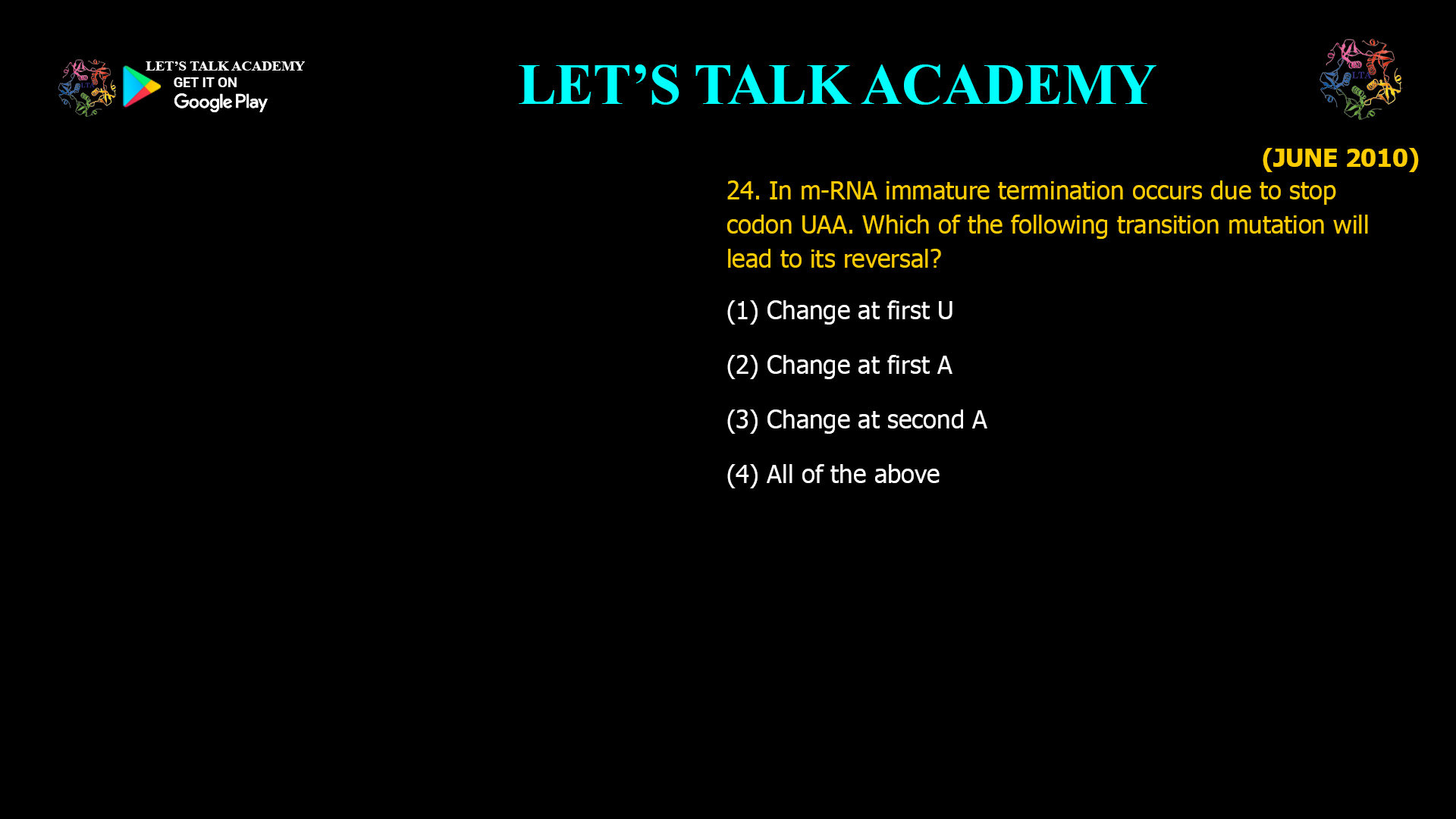
- In m-RNA immature termination occurs due to stop codon UAA. Which of the following transition mutation will lead to its reversal?
(1) Change at first U
(2) Change at first A
(3) Change at second A
(4) All of the above
Introduction to mRNA Termination and Stop Codons
Messenger RNA (mRNA) serves as the template for protein synthesis during translation. The process of translation is tightly regulated and terminates when the ribosome encounters a stop codon in the mRNA. In the standard genetic code, there are three stop codons: UAA, UAG, and UGA. These codons signal the end of the polypeptide chain and trigger the release of the newly synthesized protein from the ribosome248.
Premature or immature termination occurs when a stop codon appears earlier than expected in the coding sequence, resulting in a truncated protein. This can be caused by mutations that introduce a stop codon (nonsense mutations) or by errors during transcription or splicing. Understanding how mutations in stop codons can reverse premature termination is crucial for insights into genetic diseases and gene regulation.
The Role of Stop Codons in Translation Termination
Stop codons play a pivotal role in terminating protein synthesis. When the ribosome reaches a stop codon (UAA, UAG, or UGA) in the A site, it does not recruit a tRNA but instead recruits release factors. These factors catalyze the release of the polypeptide chain from the ribosome, marking the end of translation248.
-
UAA: Often referred to as “ochre,” one of the most common stop codons.
-
UAG: Known as “amber,” another stop codon.
-
UGA: Called “opal,” the third stop codon.
Premature termination at any of these codons can lead to non-functional or truncated proteins, which may cause disease or loss of protein function.
Transition Mutations and Their Impact on Stop Codons
A transition mutation is a point mutation that changes a purine to another purine (A ↔ G) or a pyrimidine to another pyrimidine (C ↔ U/T). These mutations can alter the meaning of a codon, potentially converting a stop codon into a sense codon (coding for an amino acid) or another stop codon.
To reverse premature termination at the UAA stop codon, a transition mutation must change UAA into a codon that does not signal termination. This can be achieved by altering any of the three nucleotides in the UAA codon, provided the resulting codon is not a stop codon.
Analyzing Transition Mutations in the UAA Codon
Let’s examine the effect of transition mutations at each position of the UAA codon:
-
First position (U):
-
U → C: UAA → CAA (codes for glutamine)
-
U → G: Not possible via transition (only purine-to-purine or pyrimidine-to-pyrimidine)
-
U → A: Not a transition (pyrimidine to purine)
-
So, only U → C is a transition, resulting in CAA (glutamine), which is a sense codon.
-
-
Second position (A):
-
A → G: UAA → UGA (codes for stop, “opal”)
-
A → C: Not a transition (purine to pyrimidine)
-
A → U: Not a transition (purine to pyrimidine)
-
So, only A → G is a transition, resulting in UGA (stop), which does not reverse termination.
-
-
Third position (A):
-
A → G: UAA → UAG (codes for stop, “amber”)
-
A → C: Not a transition
-
A → U: Not a transition
-
So, only A → G is a transition, resulting in UAG (stop), which does not reverse termination.
-
Conclusion:
Only a transition mutation at the first U (U → C) will convert UAA into a sense codon (CAA, glutamine), thereby reversing premature termination. Transition mutations at the other positions either do not change the stop codon or convert it into another stop codon.Key Concepts and Keywords
-
mRNA: Messenger RNA, the template for protein synthesis.
-
Premature termination: Early termination of translation due to a stop codon.
-
Stop codon: UAA, UAG, or UGA; signals the end of translation.
-
Transition mutation: A point mutation between purines (A ↔ G) or pyrimidines (C ↔ U/T).
-
Reversal of termination: Converting a stop codon into a sense codon.
-
Genetic code: The set of rules by which mRNA is translated into proteins.
-
Release factors: Proteins that recognize stop codons and mediate polypeptide release.
-
Nonsense mutation: A mutation that introduces a premature stop codon.
-
Truncated protein: A protein that is shorter than normal due to premature termination.
-
Translation: The process of synthesizing proteins from mRNA.
-
Ribosome: The molecular machine that performs translation.
-
Sense codon: A codon that codes for an amino acid.
-
Glutamine: The amino acid coded by CAA.
-
Genetic diseases: Disorders caused by mutations, including premature stop codons.
Detailed Mechanism of Premature Termination and Its Reversal
Premature Termination: Causes and Consequences
Premature termination occurs when a mutation introduces a stop codon in the middle of a coding sequence. This can happen through:
-
Nonsense mutations: Point mutations that convert a sense codon into a stop codon.
-
Frameshift mutations: Insertions or deletions that shift the reading frame and introduce a premature stop codon.
-
Splicing errors: Incorrect splicing can introduce stop codons in the mature mRNA.
The result is a truncated protein that may be non-functional or harmful, leading to genetic diseases such as cystic fibrosis, Duchenne muscular dystrophy, and many others6.
Reversing Premature Termination
Reversing premature termination requires converting the premature stop codon back into a sense codon. This can be achieved by:
-
Suppressor tRNAs: tRNAs engineered to recognize stop codons and insert an amino acid, allowing translation to continue6.
-
Gene editing: Techniques such as CRISPR can be used to correct the mutation at the DNA level.
-
Transition mutations: As discussed, a transition mutation at the first position of UAA (U → C) converts it into CAA (glutamine), a sense codon.
Transition Mutations vs. Transversion Mutations
-
Transition mutation: A ↔ G or C ↔ U/T.
-
Transversion mutation: Purine ↔ pyrimidine (A or G ↔ C or U/T).
Only transition mutations are considered in this context, as specified in the question.
Suppressor tRNAs and Genetic Code Expansion
Engineered suppressor tRNAs can be used to suppress premature termination codons (PTCs) by inserting an amino acid at the stop codon, allowing translation to continue6. This approach is being explored as a therapeutic strategy for genetic diseases caused by nonsense mutations.
Genetic code expansion by stop codon suppression is influenced by the context of the stop codon and the efficiency of the suppressor tRNA7. However, in the context of the question, we are focusing on DNA-level transition mutations that reverse premature termination.
Conclusion
Premature termination at the UAA stop codon in mRNA can be reversed by a transition mutation that changes the first U to a C, converting UAA into CAA (glutamine), a sense codon. Transition mutations at the other positions of UAA either do not change the stop codon or convert it into another stop codon, thus not reversing termination.
Correct Answer:
(1) Change at first U -


6 Comments
Suman bhakar
June 12, 2025Easy sir 👍
Arushi
June 12, 2025👍✅nice explanation sir
Kirti Agarwal
November 3, 2025Change at first U
Swati
November 3, 2025Easy( change at first U)
Swati
November 3, 2025( change at first U)……is the correct choice
Santosh Saini
November 8, 2025Change at first U