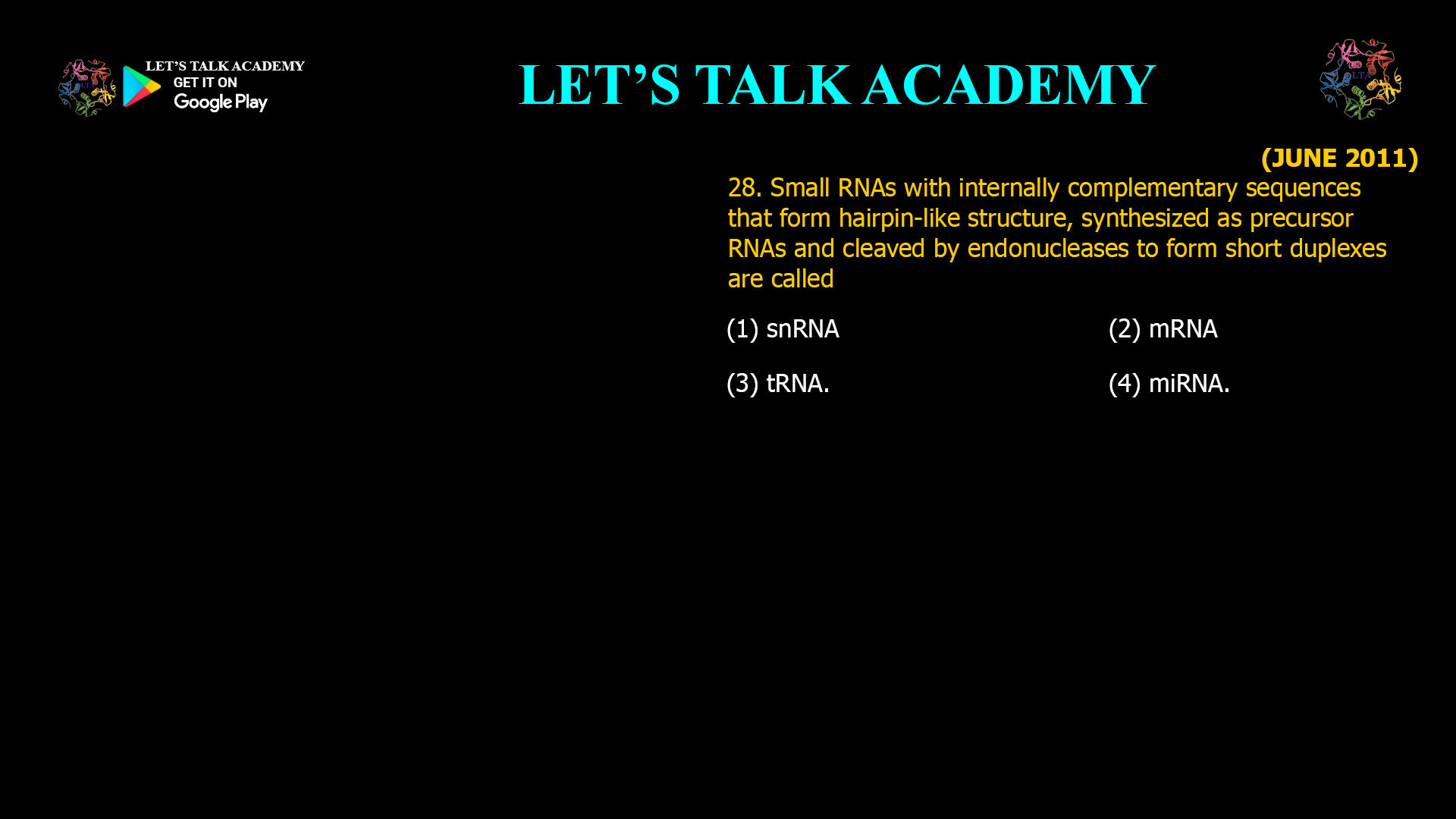
- Small RNAs with internally complementary sequences that form hairpin-like structure, synthesized as precursor RNAs and cleaved by endonucleases to form short duplexes are called
(1) snRNA(2) mRNA
(3) tRNA. (4) miRNA.
Introduction
MicroRNAs (miRNAs) are a class of small, non-coding RNAs that regulate gene expression post-transcriptionally. They are initially synthesized as long primary transcripts containing characteristic hairpin structures. These hairpins are sequentially processed by specific endonucleases to generate short RNA duplexes that guide gene silencing.
Biogenesis of miRNAs
-
Primary miRNA (pri-miRNA): Transcribed by RNA polymerase II, containing one or more hairpin structures.
-
Drosha processing: In the nucleus, the Drosha-DGCR8 complex cleaves pri-miRNAs to release precursor miRNAs (pre-miRNAs) with hairpin structures.
-
Dicer processing: In the cytoplasm, Dicer cleaves pre-miRNAs to produce ~22 nucleotide miRNA duplexes.
-
RISC incorporation: One strand of the duplex is loaded into the RNA-induced silencing complex (RISC) to target complementary mRNAs for repression.
Functional Importance
miRNAs play crucial roles in development, differentiation, and disease by fine-tuning gene expression through mRNA degradation or translational inhibition.
Conclusion
Small RNAs with internally complementary sequences forming hairpin structures, processed by Drosha and Dicer into short duplexes, are microRNAs (miRNAs). Their biogenesis and function are essential for regulating gene expression in eukaryotic cells.
This explanation clarifies the identity and biogenesis of hairpin-structured small RNAs as microRNAs.
-