11. Polysome profiling of cells treated with three hypothetical translation inhibitors is shown in the plot below. These three inhibitors are
(i) CHP — leaky inhibitor of translation
(ii) LTM — arrests ribosomes at the initiation codon
(iii)PTM — inhibits ribosome scanning
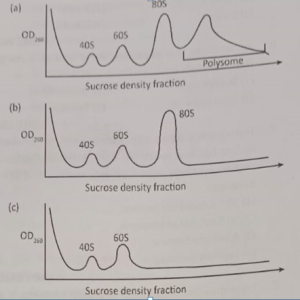 Match the polysome profile to the inhibitor
(1) (i) – a; (ii) – b; (iii) -C
(2) (i) -b; (ii) -c; (iii)–a
(3) (i) -c; (ii)-b; (iii) – a
(4) (i) – a; (ii) – c; (iii) —b
Polysome profiling is a powerful technique to analyze translation by separating ribosome-mRNA complexes based on the number of ribosomes bound to mRNAs. Different translation inhibitors affect distinct stages of protein synthesis, leading to characteristic changes in polysome profiles. Here, we explore three hypothetical translation inhibitors—CHP, LTM, and PTM—and how their modes of action translate into unique polysome profile signatures.
The Three Inhibitors and Their Modes of Action
-
CHP (Leaky Inhibitor of Translation):
A partial or leaky inhibitor that reduces translation efficiency but does not completely block any specific step. Ribosomes can still initiate and elongate, but at a reduced rate. -
LTM (Arrests Ribosomes at the Initiation Codon):
Completely blocks translation at the initiation stage, causing ribosomes to stall at the start codon without proceeding to elongation. -
PTM (Inhibits Ribosome Scanning):
Prevents the ribosome from scanning the mRNA 5’ untranslated region (UTR) to locate the start codon, thereby blocking initiation complex formation.
Interpreting Polysome Profiles
-
Profile a: Shows a moderate polysome peak with some monosomes and polysomes, indicating partial translation activity.
-
Profile b: Shows a strong monosome (80S) peak with reduced polysomes, indicating ribosomes stalled at initiation codons.
-
Profile c: Shows a large free ribosomal subunit peak and reduced monosomes and polysomes, indicating failure in scanning and initiation complex formation.
Matching Profiles to Inhibitors
-
CHP (Leaky Inhibitor):
Because CHP only partially inhibits translation, some polysomes remain, but overall polysome abundance is reduced. This matches profile a. -
LTM (Arrests Ribosomes at Initiation Codon):
Ribosomes accumulate at the start codon, increasing the 80S monosome peak and reducing polysomes. This corresponds to profile b. -
PTM (Inhibits Ribosome Scanning):
Preventing scanning reduces formation of initiation complexes, leading to fewer monosomes and polysomes and more free ribosomal subunits, matching profile c.
Correct Matching
(1) (i) – a; (ii) – b; (iii) – c
Summary Table
| Inhibitor | Mode of Action | Polysome Profile | Explanation |
|---|---|---|---|
| CHP | Leaky inhibitor of translation | a | Partial inhibition; reduced but present polysomes |
| LTM | Arrests ribosomes at initiation | b | Ribosomes stalled at start codon; increased monosomes |
| PTM | Inhibits ribosome scanning | c | Fewer initiation complexes; increased free subunits |
Conclusion
Polysome profiling provides a snapshot of translation states in cells treated with different inhibitors. By understanding the specific effects of CHP, LTM, and PTM on translation initiation and elongation, we can accurately interpret their polysome profiles. This knowledge is essential for dissecting mechanisms of translation regulation and the action of novel inhibitors.
Answer: (1) (i) – a; (ii) – b; (iii) – c


7 Comments
Kirti Agarwal
November 1, 2025Opt 1
MOHIT AKHAND
November 3, 2025Done sir ✅
Sakshi yadav
November 3, 2025Option 1 .is correct in 1.- CMP – binding dissociation continues so polysomes form 2. LMP – so at the initiation codon arrer ribosome so it intitate at 80 s. 3. PTM- inhibits ribosomes scanning so Peak inhibit at the 60 s
Neha Yadav
November 3, 2025Opt (1) – (i) – a; (ii) – b; (iii) – c
Kajal
November 4, 2025Correct answer is (1) (i) – a; (ii) – b; (iii) – c
Deepika Sheoran
November 4, 2025Option 1st
Santosh Saini
November 9, 20251st is correct option (i) – a, (ii) – b, (iii) – c