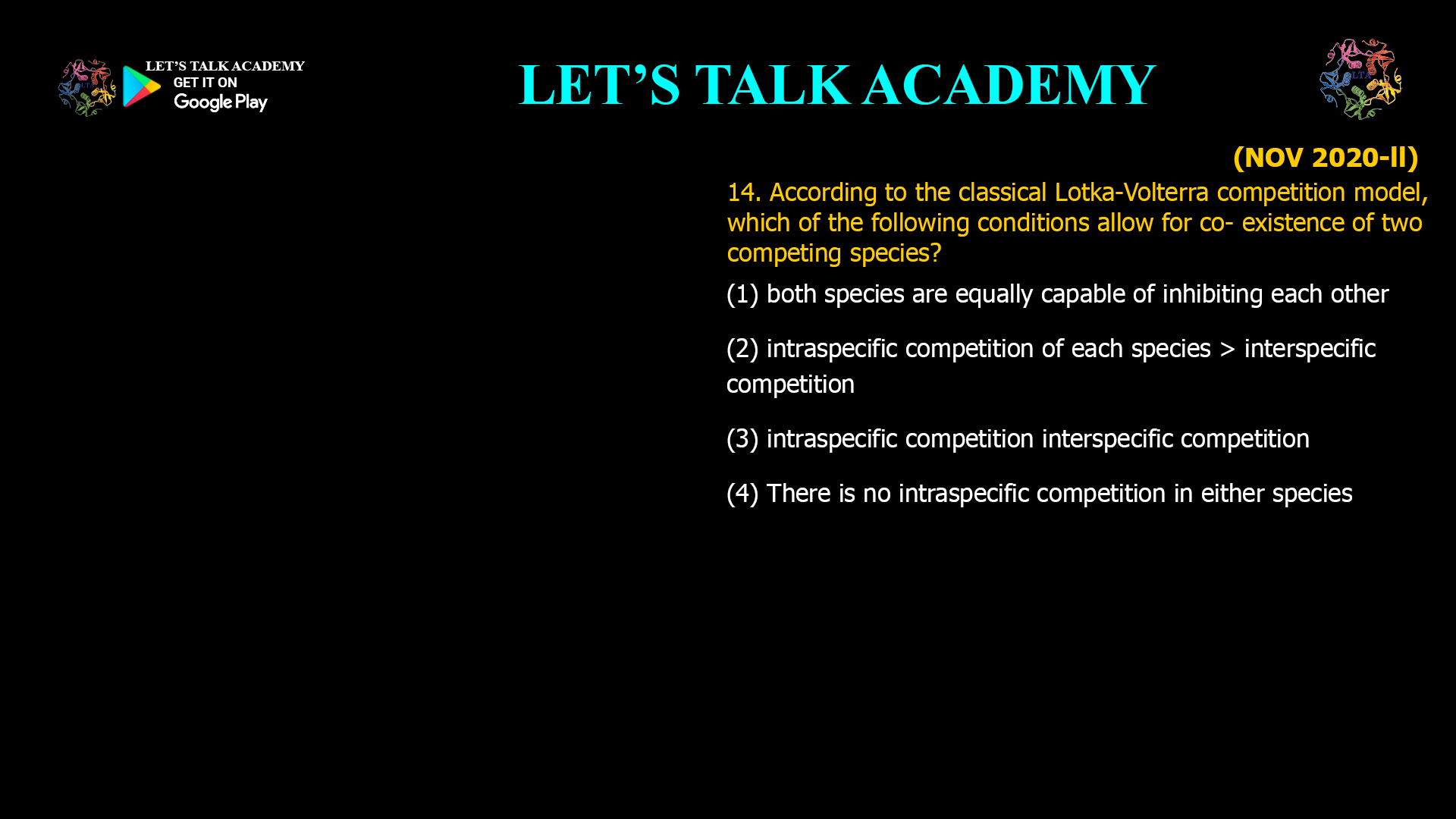
- According to the classical Lotka-Volterra competition model, which of the following conditions allow for co- existence of two competing species?
(1) both species are equally capable of inhibiting each other
(2) intraspecific competition of each species > interspecific competition
(3) intraspecific competition interspecific competition
(4) There is no intraspecific competition in either speciesWhat Is the Lotka-Volterra Competition Model?
The Lotka-Volterra competition model describes the population dynamics of two species that compete for the same limited resources. Each species’ growth is affected by both its own population density (intraspecific competition) and the density of the other species (interspecific competition). The model uses competition coefficients to quantify how strongly each species affects the other’s growth.
The Principle of Competitive Exclusion
A central outcome of the Lotka-Volterra model is the competitive exclusion principle: two species competing for identical resources cannot stably coexist if their niches are too similar. However, the model also reveals the precise conditions under which coexistence is possible.
Condition for Coexistence: Intraspecific Competition Must Be Stronger
According to the classical Lotka-Volterra equations, stable coexistence occurs only when each species inhibits its own growth more than it inhibits the growth of the other species. In other words, intraspecific competition (within a species) must be stronger than interspecific competition (between species)123.
Why is this the case?
-
If intraspecific competition is stronger, each species’ population is self-regulated, preventing either from completely outcompeting the other.
-
If interspecific competition is stronger, one species will eventually drive the other to extinction, violating the possibility of coexistence.
This condition ensures that each species limits its own population growth more than it limits the other’s, allowing both to persist over time.
Supporting Evidence from the Literature
-
Nature (2018): The classical Lotka-Volterra competition equation has shown that coexistence of competitive species is only possible when intraspecific competition is stronger than interspecific competition1.
-
LibreTexts Ecology: Two species cannot coexist unless their niches are sufficiently different that each limits its own population growth more than it limits that of the other2.
-
Wikipedia: The competition coefficients in the equations must be such that self-limitation (intraspecific) is greater than the limitation imposed by the other species (interspecific)3.
Evaluating the Options
Let’s review the given options:
-
Both species are equally capable of inhibiting each other.
-
Intraspecific competition of each species > interspecific competition.
-
Intraspecific competition < interspecific competition.
-
There is no intraspecific competition in either species.
The correct answer is:
(2) Intraspecific competition of each species > interspecific competition.
Why Not the Other Options?
-
Option 1: Equal inhibition does not guarantee coexistence; it may lead to competitive exclusion.
-
Option 3: If interspecific competition is stronger, one species will outcompete the other, leading to exclusion.
-
Option 4: Without intraspecific competition, populations would not self-regulate, and competitive exclusion would be inevitable.
Conclusion
The classical Lotka-Volterra competition model teaches us that coexistence between two competing species is only possible when each species is more limited by its own population density than by the presence of the other species. This principle underpins much of modern community ecology and helps explain the patterns of biodiversity observed in nature.
Correct answer: (2) Intraspecific competition of each species > interspecific competition.
-


2 Comments
Kajal
November 9, 2025Option 2
Sakshi Kanwar
November 27, 2025intraspecific competition of each species > interspecific competition