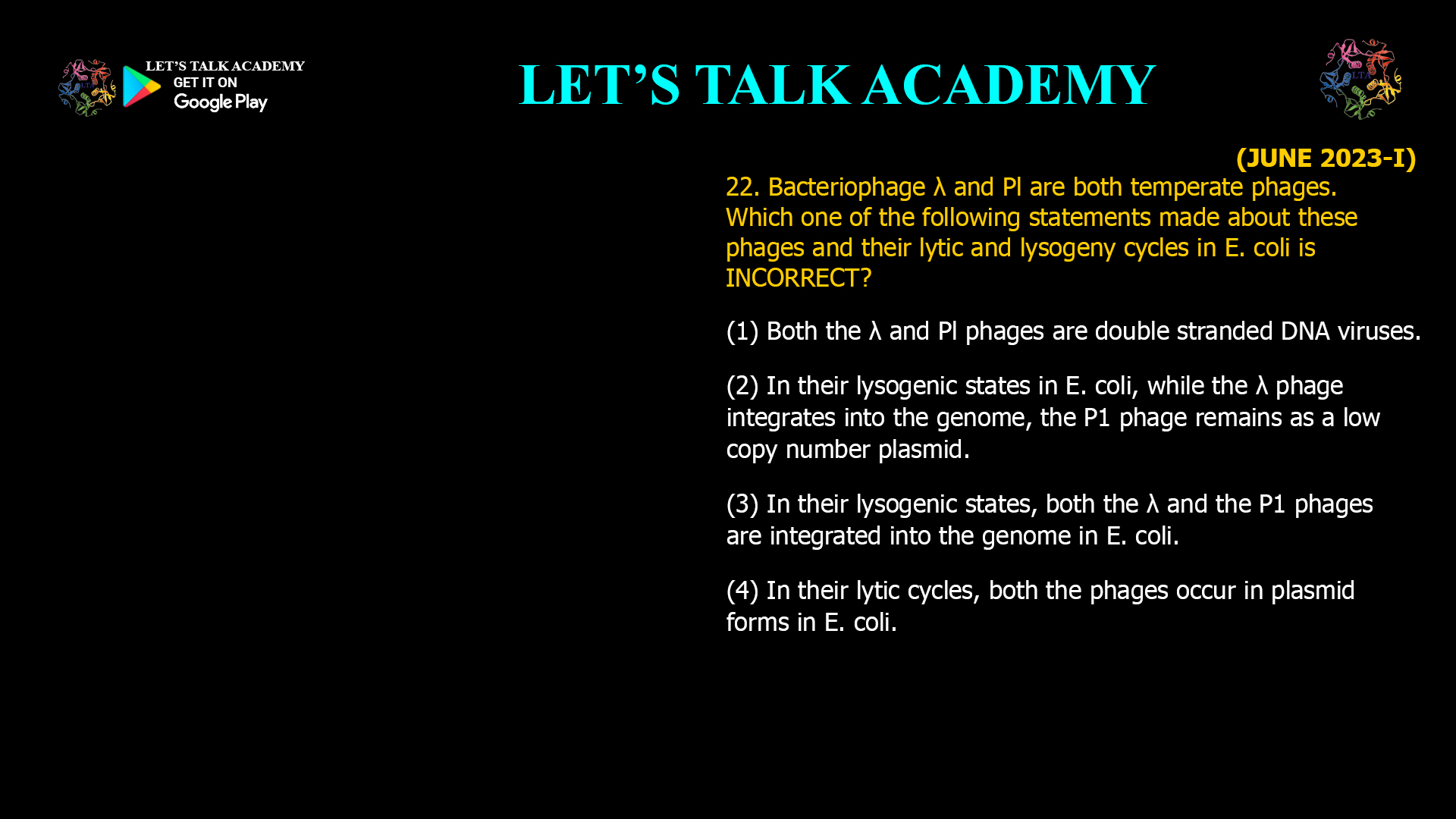
22. Bacteriophage λ and Pl are both temperate phages. Which one of the following statements made about these phages and their lytic and lysogeny cycles in E. coli is INCORRECT?
(1) Both λ and Pl phages are double stranded DNA viruses.
(2) In their lysogenic states in E. coli, while
the λ phage integrates into the genome, the P1 phage remains as a low copy number plasmid.
(3) In their lysogenic states, both the λ and the P1 phages are integrated into the genome in E. coli.
(4) In their lytic cycles, both the phages occur in plasmid forms in E. coli.
Bacteriophage lambda (λ) and bacteriophage P1 are both temperate phages capable of infecting Escherichia coli. Despite their similarities, they exhibit fundamental differences in how they establish lysogeny and maintain their genomes within the host. Understanding these differences is crucial for appreciating phage biology and their interactions with bacterial hosts.
1. Both λ and P1 Are Double-Stranded DNA Viruses
-
Both phages possess double-stranded DNA genomes, characteristic of many bacteriophages.
-
This shared feature allows them to carry complex genetic information and regulate sophisticated life cycles.
-
Statement (1) is correct.
2. Lysogenic States: Integration vs. Plasmid Maintenance
-
Lambda phage (λ) integrates its genome into the bacterial chromosome at a specific attachment site (attB) via site-specific recombination mediated by the phage-encoded integrase (Int).
-
This integrated form, called a prophage, is replicated passively with the host genome during cell division.
-
In contrast, P1 phage does not integrate into the host chromosome. Instead, it persists as a low copy number plasmid within the bacterial cytoplasm.
-
P1 plasmid replication and stable inheritance are ensured by its own replication origin and partitioning systems.
-
Statement (2) is correct.
3. Incorrect Statement: Both λ and P1 Integrate into the Genome
-
The statement that both λ and P1 integrate into the genome is incorrect.
-
Only λ integrates; P1 remains extrachromosomal as a plasmid during lysogeny.
-
Statement (3) is incorrect.
4. Lytic Cycle Forms: Phage Particles, Not Plasmids
-
During the lytic cycle, both λ and P1 phages replicate their genomes to produce new virions, leading to host cell lysis.
-
Neither phage exists as plasmids during the lytic phase; instead, their DNA is packaged into phage heads.
-
The idea that both phages occur as plasmids in the lytic cycle is incorrect.
-
Statement (4) is incorrect.
Summary Table of Statements
| Statement | Description | Correctness |
|---|---|---|
| (1) | Both λ and P1 are double-stranded DNA viruses | Correct |
| (2) | λ integrates into genome; P1 remains as low-copy plasmid | Correct |
| (3) | Both λ and P1 integrate into genome | Incorrect |
| (4) | Both phages occur as plasmids during lytic cycle | Incorrect |
Biological Implications
-
Lambda’s integration allows it to be stably inherited with the host chromosome but requires precise recombination machinery.
-
P1’s plasmid maintenance strategy avoids integration, relying on plasmid partitioning systems to ensure inheritance, which can influence its stability and copy number control.
-
These differences affect how each phage responds to environmental cues and host conditions to switch between lysogeny and lysis.
Conclusion
The incorrect statement among those given is:
(3) In their lysogenic states, both the λ and the P1 phages are integrated into the genome in E. coli.
Lambda phage integrates into the host genome during lysogeny, whereas P1 phage persists as a low copy number plasmid. Both are double-stranded DNA viruses, but they differ significantly in genome maintenance strategies during lysogeny. Additionally, neither phage exists as a plasmid during the lytic cycle.
This distinction between lambda and P1 phages highlight


