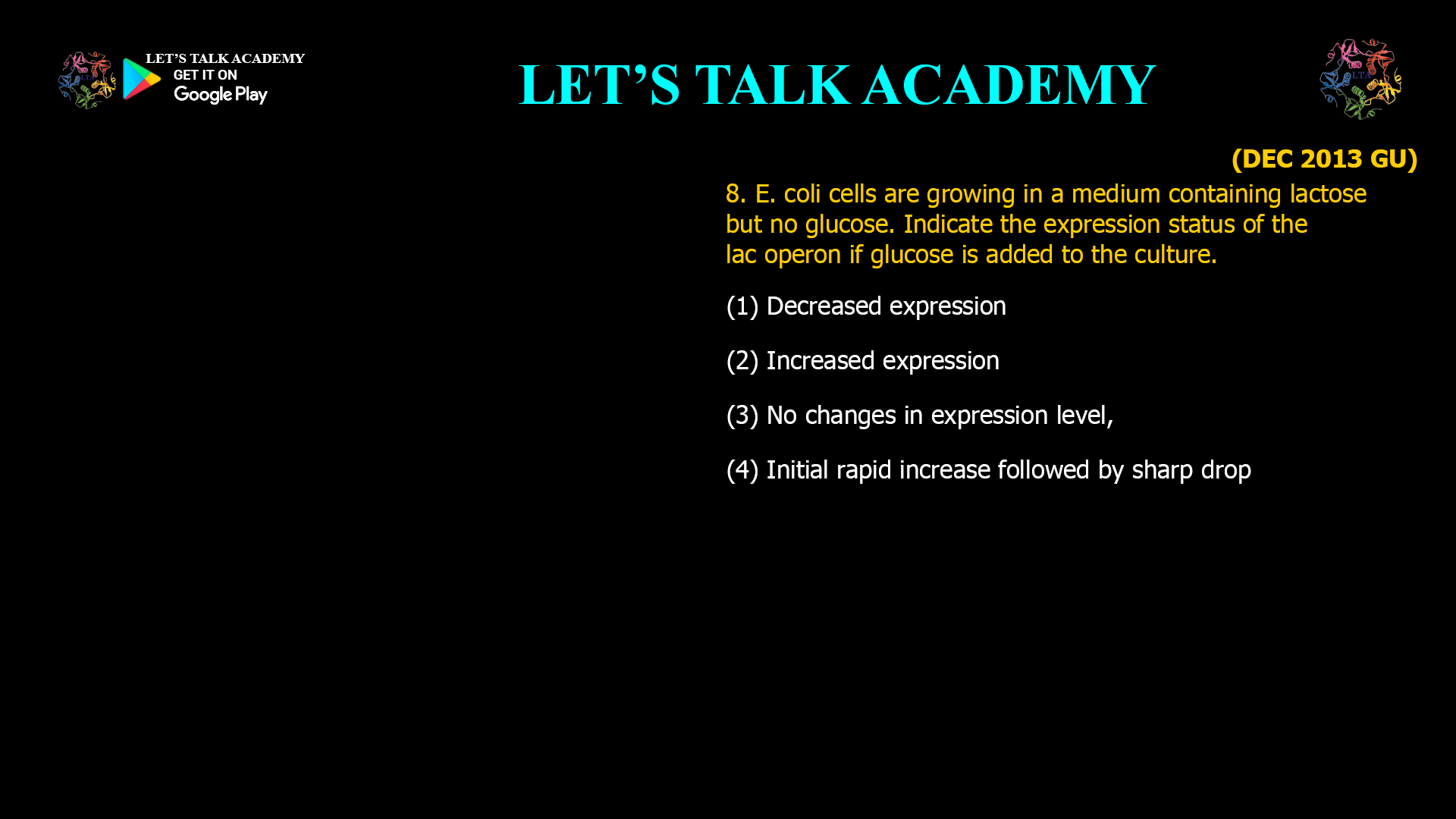
8. E. coli cells are growing in a medium containing lactose but no glucose. Indicate the expression status of the lac operon if glucose is added to the culture.
(1) Decreased expression
(2) Increased expression
(3) No changes in expression level,
(4) Initial rapid increase followed by sharp drop
The lac operon in Escherichia coli (E. coli) is a classic example of how bacteria regulate gene expression in response to environmental nutrient availability. This operon enables E. coli to metabolize lactose, but its expression is tightly controlled by the presence of glucose and lactose. If E. coli cells are growing in a medium containing lactose but no glucose, the lac operon is fully active. But what happens to lac operon expression if glucose is suddenly added to this culture? Let’s explore the molecular mechanisms behind this regulatory switch and provide the correct answer to this fundamental question in bacterial genetics.
The Lac Operon: Dual Regulation for Efficient Sugar Use
The lac operon consists of genes that encode proteins essential for lactose uptake and metabolism, including β-galactosidase, permease, and transacetylase. Its expression is regulated by two main systems:
-
Negative Regulation by the Lac Repressor: In the absence of lactose, the lac repressor binds to the operator, blocking transcription. When lactose (or its isomer allolactose) is present, it binds to the repressor, inactivating it and allowing transcription.
-
Positive Regulation by CAP-cAMP Complex: When glucose is absent, cAMP levels rise, allowing the catabolite activator protein (CAP) to bind cAMP. The CAP-cAMP complex attaches near the lac promoter, enhancing RNA polymerase binding and boosting transcription.
Catabolite Repression: Why Glucose Is Preferred
E. coli prefers glucose because it is the most energy-efficient sugar. When glucose is present, it exerts catabolite repression:
-
Glucose Inhibits Adenylate Cyclase: This lowers cAMP levels.
-
Low cAMP Means Inactive CAP: Without the CAP-cAMP complex, RNA polymerase binds poorly to the lac promoter, and transcription of the lac operon drops dramatically—even if lactose is available.
-
Result: The lac operon is repressed in the presence of glucose, regardless of lactose availability.
What Happens When Glucose Is Added to a Lactose-Only Culture?
If E. coli is growing in a medium with lactose (and no glucose), the lac operon is highly expressed. The addition of glucose triggers several molecular events:
-
Rapid Drop in cAMP Levels: Glucose uptake reduces cAMP, inactivating CAP.
-
Loss of CAP-cAMP Activation: RNA polymerase is less efficiently recruited to the lac promoter.
-
Transcription Decreases: The lac operon is no longer strongly transcribed, and β-galactosidase production falls.
-
Catabolite Repression Dominates: E. coli switches to using glucose, repressing the machinery for lactose metabolism.
Correct Answer
Given the scenario—E. coli cells growing in lactose, with glucose added—the expression of the lac operon will:
(1) Decreased expression
Biological Significance
This regulatory system ensures E. coli always uses the most efficient energy source available. By repressing the lac operon when glucose is present, the cell avoids wasting resources on unnecessary enzyme production. When glucose is depleted, cAMP levels rise, CAP is activated, and the lac operon is switched back on—allowing the cell to metabolize lactose or other alternative sugars.
Summary Table: Lac Operon Expression Based on Sugar Availability
| Glucose | Lactose | cAMP Level | CAP Activity | Lac Operon Expression |
|---|---|---|---|---|
| Absent | Present | High | Active | High |
| Present | Present | Low | Inactive | Decreased |
| Present | Absent | Low | Inactive | None |
| Absent | Absent | High | Active | None |
Frequently Asked Questions
Q: Why does the lac operon expression decrease when glucose is added, even if lactose is present?
A: Glucose lowers cAMP levels, inactivating CAP. This reduces RNA polymerase binding to the lac promoter, sharply decreasing lac operon transcription.
Q: Can the lac operon be expressed at all when both glucose and lactose are present?
A: Only at very low, basal levels due to weak RNA polymerase binding in the absence of CAP-cAMP activation.
Q: What is the advantage of this system for E. coli?
A: It ensures the bacterium always uses the most energy-efficient sugar first, conserving resources and maximizing growth.
Conclusion
The addition of glucose to an E. coli culture growing on lactose causes a rapid decrease in lac operon expression due to catabolite repression. This elegant regulatory mechanism allows E. coli to prioritize glucose metabolism and only express the lac operon when glucose is absent and lactose is available.
Keywords: lac operon, E. coli, glucose, lactose, catabolite repression, CAP, cAMP, gene regulation, β-galactosidase, operon expression, bacterial metabolism, negative regulation, positive regulation, RNA polymerase, molecular biology, sugar metabolism, operon model.


25 Comments
Suman bhakar
June 12, 2025Done sir 👍
Anita choudhary
June 13, 2025✅👍
Arushi
June 14, 2025👍✅
Kajal
November 3, 2025Correct answer is decreased expression
Divya rani
November 4, 2025In the presence of glucose bacteria do not occur transcription because it directly use the glucose for Energy and its growth so gene is OFF or decrease expression of gene.
Kirti Agarwal
November 4, 2025Expression is decreased
Santosh Saini
November 5, 2025Decreased expression
Neha Yadav
November 6, 2025Decreased expression when Glucose is added to culture
Heena Mahlawat
November 6, 2025Decrease
Roopal Sharma
November 6, 2025Decreased expression
Sonal Nagar
November 6, 2025Option 1st
Deepika Sheoran
November 6, 2025Decrease expression.
Neelam Sharma
November 6, 2025Decreased expression
Neeraj Sharma
November 6, 2025On adding glucose in the medium the expression will decrease
Dipti Sharma
November 6, 2025The lac operon is repressed in the presence of glucose
Do
November 7, 2025Jab culture me glucose milaya jata h to expression decrease hota h
Sonam Saini
November 7, 2025Jab culture me glucose milaya jata h to expression decrease hota h
Aman Choudhary
November 7, 2025Decreased expression
Anurag Giri
November 8, 2025E. coli cells growing in lactose, with glucose added—the expression of the lac operon will
Bhawna Choudhary
November 8, 2025Decreased expression
Mansukh Kapoor
November 8, 2025The correct answer is option 1st
Expression will decrease
Anisha Beniwal
November 8, 2025Expression is decreased
Mohd juber Ali
November 9, 2025Decrease expression
Sakshi Kanwar
November 10, 2025Addition of glucose causes a rapid decrease in lac operon expression
Manisha choudhary
November 12, 2025Decrease