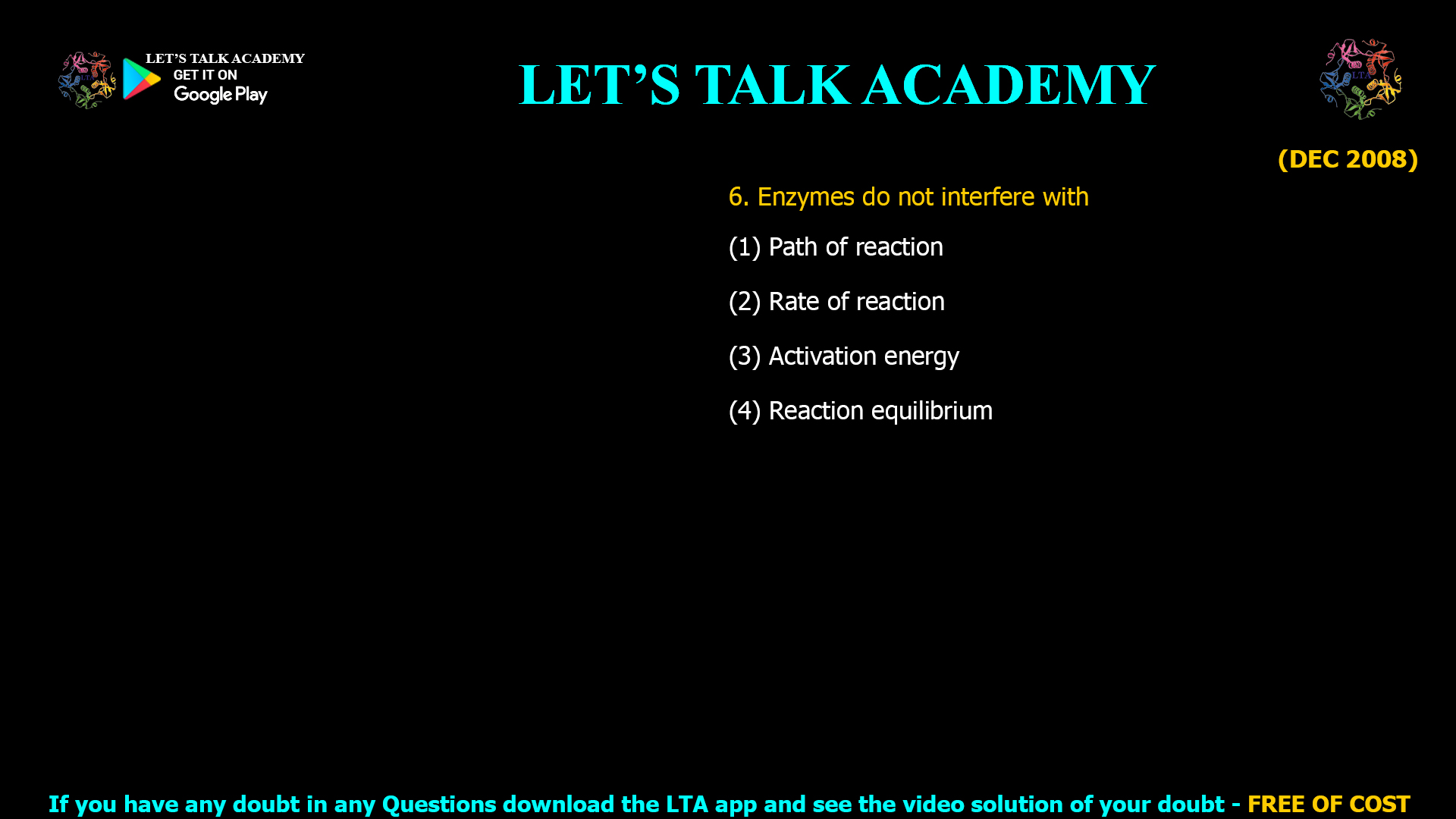
6. Enzymes do not interfere with
(1) Path of reaction (2) Rate of reaction
(3) Activation energy (4) Reaction equilibrium
The correct answer is (4) Reaction equilibrium. Enzymes accelerate the rate of reaction, lower the activation energy, and offer alternative reaction pathways, but they do not interfere with or change the reaction equilibrium.
Introduction
Enzymes are biological catalysts essential for regulating metabolic pathways and biochemical reactions. Their specificity and efficiency stem from their unique ability to recognize and interact with specific substrate molecules. This interaction occurs at the enzyme’s active site and follows well-studied models and mechanisms. Understanding these enzyme-substrate interactions is pivotal for students of biochemistry, molecular biology, and those preparing for competitive examinations like CSIR NET Life Sciences.
What Are Enzymes and Substrates?
-
Enzymes are typically proteins that catalyze specific biochemical reactions without being consumed or permanently altered.
-
Substrates are the molecules upon which enzymes act, transforming them into products through chemical reactions.
-
The enzyme and substrate form a transient enzyme-substrate complex (ES complex) during catalysis.
The Active Site: The Heart of Enzyme Specificity
-
The active site is the region of the enzyme where substrate binding and catalysis occur.
-
It is composed of specific amino acid residues whose shape, charge, hydrophobicity, and polarity create a chemical environment tailored to bind only certain substrates.
-
The tertiary folding of the enzyme protein brings these critical residues together spatially to form the active site.
-
This structural specificity underpins the enzyme’s remarkable selectivity for its substrate(s).
Models of Enzyme-Substrate Interaction
Lock and Key Model
-
Proposed by Emil Fischer, this model likens the enzyme to a lock and the substrate to a key.
-
Substrate binds only if it fits exactly into the active site, like a key fitting into a lock.
-
This model explains enzyme specificity but assumes a rigid enzyme structure.
Induced Fit Model
-
Proposed by Daniel Koshland, this more dynamic model describes the enzyme as flexible.
-
Upon substrate binding, the enzyme undergoes conformational changes that “mold” the active site around the substrate.
-
This interaction strengthens enzyme-substrate binding and facilitates catalysis.
Types of Enzyme-Substrate Interactions
-
Non-covalent interactions dominate:
-
Hydrogen bonds: stabilize the substrate in the active site.
-
Ionic bonds: electrostatic attractions between charged groups.
-
Van der Waals forces: weak interactions contributing to close molecular fit.
-
Hydrophobic interactions: nonpolar groups cluster to avoid water, stabilizing binding.
-
-
Covalent catalysis: In some enzymes, transient covalent bonds form between enzyme residues and the substrate, facilitating the reaction. For example, serine proteases form covalent intermediates during peptide bond hydrolysis.
Catalytic Mechanisms
-
Catalysis by bond strain: Enzyme binding induces strain on substrate bonds, making them more reactive.
-
Covalent catalysis: An enzyme forms a temporary covalent bond with the substrate.
-
General acid-base catalysis: Enzymes provide proton donors or acceptors to stabilize reaction intermediates.
-
Catalysis by proximity and orientation: Enzymes bring substrates into close, specific orientation for efficient reaction.
-
Metal ion catalysis: Some enzymes use metal ions to stabilize charged intermediates or contribute to catalysis.
Environmental Factors Affecting Enzyme Activity
-
Temperature: Increases reaction rate up to an optimum; beyond this, enzymes denature.
-
pH: Each enzyme has an optimum pH; deviation affects charge states of amino acids in active sites, impacting substrate binding and catalysis.
Enzyme-Substrate Complex Formation and Reaction
-
The substrate binds reversibly to the enzyme’s active site to form the ES complex.
-
Enzyme catalysis lowers the activation energy, facilitating substrate turnover to product.
-
Products are released, and the enzyme returns to its original state, ready for another catalytic cycle.
Significance in Life Sciences and Competitive Exams
-
Understanding enzyme-substrate interactions is critical in molecular biology, drug design, and biotechnology.
-
It forms a foundation for explaining metabolic control, enzyme inhibition, and kinetics.
-
Competitive exam questions often focus on models, types of interactions, and catalytic mechanisms.
Conclusion
Enzyme-substrate interactions exemplify nature’s precision in regulating biological reactions. Through specific binding and catalytic processes, enzymes greatly enhance reaction rates with high specificity. Mastery of these concepts is essential for life science students and researchers aiming to understand biochemistry at a molecular level.
This detailed overview provides a robust framework for understanding enzyme-substrate interactions in life sciences, valuable in academic learning and exam preparation.


57 Comments
Roopal Sharma
September 12, 2025Enzymes cannot interfere with equilibrium of reactions.
Aakansha sharma Sharma
September 12, 2025Reaction equilibrium
Sakshi yadav
September 12, 2025Enzymes can not interfere with reaction of equilibrium
Sakshi Kanwar
September 12, 2025(4) Reaction equilibrium
Mohd juber Ali
September 12, 2025Enzyme do not interfer or change rexn equlibrium
Priya dhakad
September 12, 2025Enzymes accelerate the rate of rxn, lower the activation energy, and offer alternative reaction pathways, but they do not interfere with or change the reaction equilibrium.
Heena Mahlawat
September 12, 2025Enzymes do not interfere with the reaction equilibrium
Mansukh Kapoor
September 12, 2025The correct answer is option 4th
Enzymes donot inturpts the equilibrium of the reaction
Varsha Tatla
September 12, 2025Enz never interfere with equilibrium of reaction
Tanvi Panwar
September 12, 2025Enzymes do not interfere with reaction equilibrium.
HIMANI FAUJDAR
September 12, 2025Ans Enzymes do not interfere in the equilibrium of the reaction.
Santosh Saini
September 13, 2025Enzymes do not interfere with or change the reaction equilibrium
Kanica Sunwalka
September 13, 2025enzymes do not interfere with rxn eqb
Dharmpal Swami
September 13, 2025Enzyme do not interfere with reaction equilibrium
Kirti Agarwal
September 13, 2025Reaction equilibrium
Bhavana kankhedia
September 13, 2025Reaction equilibrium
Neha Yadav
September 13, 2025Enzyme do not interfere with reaction equilibrium
Soniya Shekhawat
September 13, 2025Enzyme do not change the equilibrium of chemical reaction .
Bhawna Choudhary
September 13, 2025Enzyme do not interfere with reaction equilibrium
Bhavana kankhedia
September 13, 2025Enzyme do not change the equilibrium of chemical reaction
Ayush Dubey
September 13, 2025Reaction equilibrium
Manisha choudhary
September 14, 2025Enzyme reaction equilibrium ko affect nhi krta h
Reaction equilibrium unchanged rahti h
Deepika sheoran
September 14, 2025Reaction equilibrium.
Nilofar Khan
September 14, 2025correct answer is (4) Reaction equilibrium.
Enzym
do not interfere with or change the reaction equilibrium.
Nilofar Khan
September 14, 2025correct answer is (4) Reaction equilibrium.
Enzyme do not interfere with or change the reaction equilibrium.
Pratibha Jain
September 14, 2025correct answer is option (4)
Reaction equilibrium.
Aafreen Khan
September 14, 2025Option 4 is correct
Reaction Equilibrium because Enzymes do not interfere with or change the reaction equilibrium
Vanshika Sharma
September 14, 2025Opt 4
Khushi Agarwal
September 14, 2025Option d is correct answer
not change the reaction’s equilibrium.
Anjali
September 14, 2025Correct answer is 4
Avni
September 14, 2025Enzymes do not interfere with or change the reaction equilibrium.
Anurag Giri
September 14, 2025The correct answer is (4) Reaction equilibrium. Enzymes accelerate the rate of reaction, lower the activation energy, and offer alternative reaction pathways, but they do not interfere with or change the reaction equilibrium
Simran Saini
September 14, 2025Reaction equilibrium.
Mitali saini
September 14, 2025The correct answer is (4) Reaction equilibrium. Enzymes accelerate the rate of reaction, lower the activation energy, and offer alternative reaction pathways, but they do not interfere with or change the reaction equilibrium.
Kajal
September 14, 2025Enzyme do not interfere with rxn. equilibrium hence option 4is correct and rest three have roles of enzyme
Rishita
September 14, 2025Enzyme do not interfere with rxn. equilibrium hence option 4is correct and rest three have roles of enzyme
Arushi Saini
September 14, 2025Enzymes never disturb the reaction equilibrium
Asha Gurzzar
September 14, 2025Equilibrium in a reaction is never disturbed by enzyme
Bharti yadav
September 14, 2025Enzymes do not interfere or change the reaction equilibrium.
Pallavi Ghangas
September 14, 2025Reaction do not interfere with equilibrium
anjani sharma
September 14, 2025Answer 4
Enzymes do not interfere with the reaction equilibrium
Payal Gaur
September 14, 2025Enzyme not interfere in reaction equilibrium.
Sachin kant sharma
September 14, 2025In enzyme reaction equilibrium not react
Sneha Kumawat
September 14, 2025Reaction equilibrium
Devika
September 15, 2025Reaction equilibrium
Preeti
September 15, 2025Reaction equilibrium
Khushi Vaishnav
September 15, 2025Cannot not change the reaction equilibrium
Anjana sharma
September 16, 2025Reaction equilibrium
Minal Sethi
September 16, 2025Enzyme do not interfere with equilibrium of the reaction
Yogita
September 16, 2025Reaction equilibrium
Muskan singodiya
September 16, 2025Reaction equilibrium
Alec
September 16, 2025Enzymes do not interfere with reaction equilibrium.
Alec
September 16, 2025Enzymes does not interfere with equilibrium of the reaction.
Monika jangid
September 17, 2025Enz do not interfere with equilibrium
Muskan Yadav
September 17, 2025The correct option is 4 – Reaction equilibrium. Enzymes accelerate the rate of reaction, lower the activation energy, and offer alternative reaction pathways, but they do not interfere with or change the reaction equilibrium.
Divya rani
September 17, 2025Enzyme do not interfere with the equilibrium of The reaction.
Priti khandal
September 17, 2025Rateof equilibrium