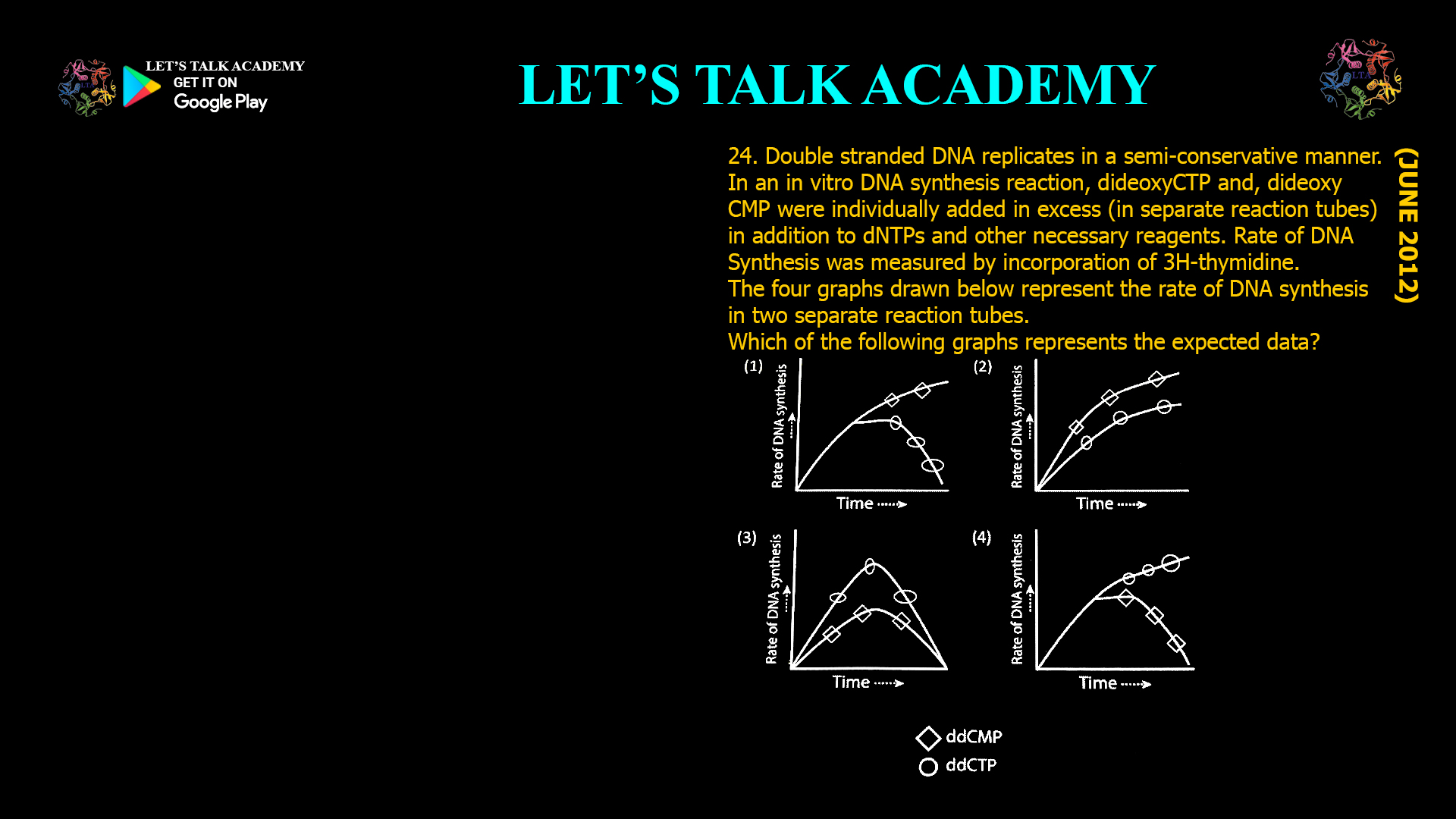
- Double stranded DNA replicates in a semi-conservative manner. In an in vitro DNA synthesis reaction, dideoxyCTP and, dideoxy CMP were individually added in excess (in separate reaction tubes) in addition to dNTPs
and other necessary reagents. Rate of DNA Synthesis was measured by incorporation of 3H-thymidine. The four graphs drawn below represent the rate of DNA synthesis in two separate reaction tubes.
Which of the following graphs represents the expected data?
Introduction
DNA synthesis by DNA polymerases requires the incorporation of deoxyribonucleoside triphosphates (dNTPs) into a growing DNA strand. Dideoxynucleotides (ddNTPs), lacking a 3′-OH group, act as chain terminators because their incorporation prevents further nucleotide addition. This property is exploited in Sanger sequencing to generate DNA fragments of varying lengths.
In an in vitro DNA synthesis assay containing DNA polymerase, Mg^2+, dATP, dGTP, dCTP, dTTP (including ^3H-thymidine for detection), the addition of ddCTP or dideoxy CMP (ddCMP) separately influences DNA synthesis differently:
-
ddCTP (dideoxycytidine triphosphate): A chain-terminating nucleotide analog that competes with dCTP for incorporation. Once incorporated, it halts DNA synthesis immediately.
-
ddCMP (dideoxycytidine monophosphate): The monophosphate form lacks the triphosphate group necessary for incorporation by DNA polymerase and thus does not act as a chain terminator.
Expected Effects on DNA Synthesis Rate
-
With ddCTP added in excess:
-
DNA polymerase incorporates ddCTP in place of dCTP randomly during DNA synthesis.
-
Incorporation of ddCTP terminates chain elongation because it lacks the 3′-OH group required for phosphodiester bond formation with the next nucleotide.
-
This causes a sharp decrease in the rate of DNA synthesis as more chains terminate prematurely.
-
The DNA synthesis curve will show a rapid decline compared to control without ddCTP.
-
-
With ddCMP added in excess:
-
ddCMP cannot be incorporated into DNA because DNA polymerase requires nucleoside triphosphates (dNTPs) for polymerization.
-
ddCMP acts as an inert molecule in this context and does not inhibit DNA synthesis.
-
The rate of DNA synthesis remains similar to the control reaction with only dNTPs.
-
Summary of Expected Graph Patterns
| Reaction Condition | Expected DNA Synthesis Rate Over Time |
|---|---|
| Control (dNTPs only) | Steady increase in DNA synthesis rate |
| dNTPs + excess ddCTP | Rapid decline in DNA synthesis rate due to chain termination |
| dNTPs + excess ddCMP | DNA synthesis rate similar to control (no inhibition) |
Explanation
-
Dideoxynucleotides (ddNTPs) lack the 3′-OH group essential for DNA chain elongation, causing termination upon incorporation.
-
Dideoxy nucleoside monophosphates (ddNMPs) cannot be incorporated by DNA polymerase as they lack the triphosphate group necessary for catalysis.
-
Therefore, only ddNTPs act as effective chain terminators and inhibitors of DNA synthesis.
Conclusion
In an in vitro DNA synthesis reaction, the addition of ddCTP results in a significant decrease in DNA synthesis rate due to chain termination. In contrast, ddCMP does not inhibit DNA synthesis because it cannot be incorporated by DNA polymerase. The expected graph will show a sharp decline in synthesis rate with ddCTP, while the rate remains unchanged with ddCMP.


10 Comments
Manisha choudhary
July 28, 2025Done sir 🤓
Surbhi Rajawat
July 29, 2025Answer is 1st because with ddCMP the DNA replication will go on Smoothly because it won’t bind. And with ddCTP it will mimic dCTP and once binded will stop the replication altogether
Priya Khandal
July 29, 2025Sir ye nahi hua
Priti Khandal
July 29, 2025Sir ye samajh nahi aaya
shruti sharma
July 30, 2025read it sir
Aafreen
July 30, 2025Ans -1 :- a continuous decrease for ddCTP compared to ddCMP, which is the expected outcome due to the chain-terminating property of ddCTP.
Diksha Chhipa
July 31, 2025Not completely understand so want to skip.
Santosh Saini
July 31, 2025I did not understand anything in the question
Mahima Sharma
August 2, 2025❓
Soniya Shekhawat
August 3, 2025ddCTP is lacks of 3’OH so not formed PDB means it has chain termination property that means if we added excess then it inhibit dna synthesis rate rapidly where ddCMP does not inhibit dna synthesis that is shown in graph 1st so answer is 1st option