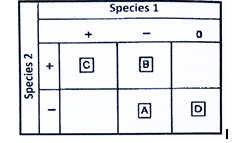
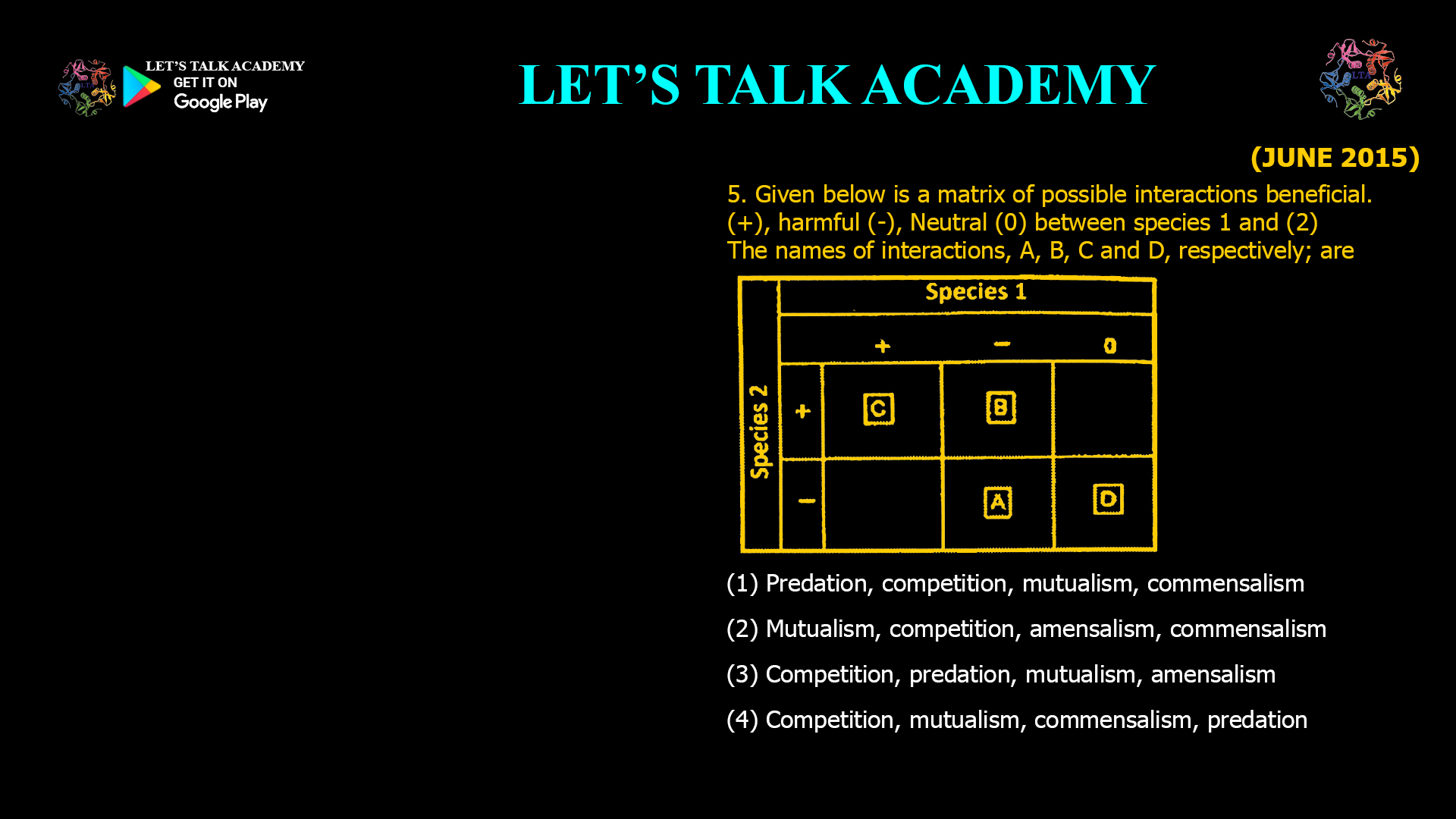
- Given below is a matrix of possible interactions beneficial. (+), harmful (-), Neutral (0) between species 1 and (2) The names of interactions, A, B, C and D, respectively; are
(1) Predation, competition, mutualism, commensalism
(2) Mutualism, competition, amensalism, commensalism
(3) Competition, predation, mutualism, amensalism
(4) Competition, mutualism, commensalism, predationSpecies interactions form the backbone of ecological communities, shaping the structure, function, and evolutionary dynamics of ecosystems. Ecologists classify these interactions based on whether they are beneficial (+), harmful (–), or neutral (0) to each participant. Understanding these relationships is crucial for grasping concepts like food webs, biodiversity, and ecosystem stability.
One common way to represent these interactions is through a matrix, where the effects on each species are denoted as positive (+), negative (–), or neutral (0). Let’s explore how to interpret such a matrix and identify the correct names for each interaction type.
The Matrix of Species Interactions
Consider a matrix showing the effects of interactions between two species:
Interaction Species 1 Species 2 A + + B – – C – 0 D + 0 Each cell represents the outcome for each species in the pairwise interaction.
Decoding Each Interaction
A: (+, +) — Both Benefit
Name: Mutualism
Description: Both species benefit from the interaction.
Examples:-
Bees and flowering plants (pollination)
-
Mycorrhizal fungi and plant roots
B: (–, –) — Both Harmed
Name: Competition
Description: Both species are harmed as they vie for the same limited resource.
Examples:-
Two plant species competing for sunlight
-
Lions and hyenas competing for prey
C: (–, 0) — One Harmed, One Unaffected
Name: Amensalism
Description: One species is harmed, while the other is unaffected.
Examples:-
A large tree shading out smaller plants (the tree is unaffected, the smaller plants are harmed)
-
Penicillium mold secreting antibiotics that kill bacteria (the mold is unaffected, bacteria are harmed)
D: (+, 0) — One Benefits, One Unaffected
Name: Commensalism
Description: One species benefits, while the other is neither helped nor harmed.
Examples:-
Barnacles attaching to whales (barnacles benefit, whales are unaffected)
-
Birds nesting in trees
Matching the Matrix to the Correct Option
Given the interaction matrix and the options:
-
Predation, competition, mutualism, commensalism
-
Mutualism, competition, amensalism, commensalism
-
Competition, predation, mutualism, amensalism
-
Competition, mutualism, commensalism, predation
Let’s match:
-
A (+, +): Mutualism
-
B (–, –): Competition
-
C (–, 0): Amensalism
-
D (+, 0): Commensalism
Option 2 correctly matches the interaction names:
(2) Mutualism, competition, amensalism, commensalism
Why Is This Classification Important?
Understanding these interaction types helps ecologists:
-
Predict how changes in one species can affect others
-
Manage ecosystems for conservation and restoration
-
Model food webs and energy flow
-
Understand the evolution of cooperation and conflict in nature
Conclusion
Ecological interactions can be systematically categorized using a matrix of beneficial, harmful, and neutral effects. The correct names for the interactions described in the matrix are:
-
A: Mutualism (+, +)
-
B: Competition (–, –)
-
C: Amensalism (–, 0)
-
D: Commensalism (+, 0)
Therefore, the correct answer is: (2) Mutualism, competition, amensalism, commensalism.
-


3 Comments
Manisha choudhary
November 6, 20253rd option is correct answer
Kajal
November 8, 20253
Sakshi Kanwar
November 27, 2025A Competition, B predation, C mutualism, D amensalism