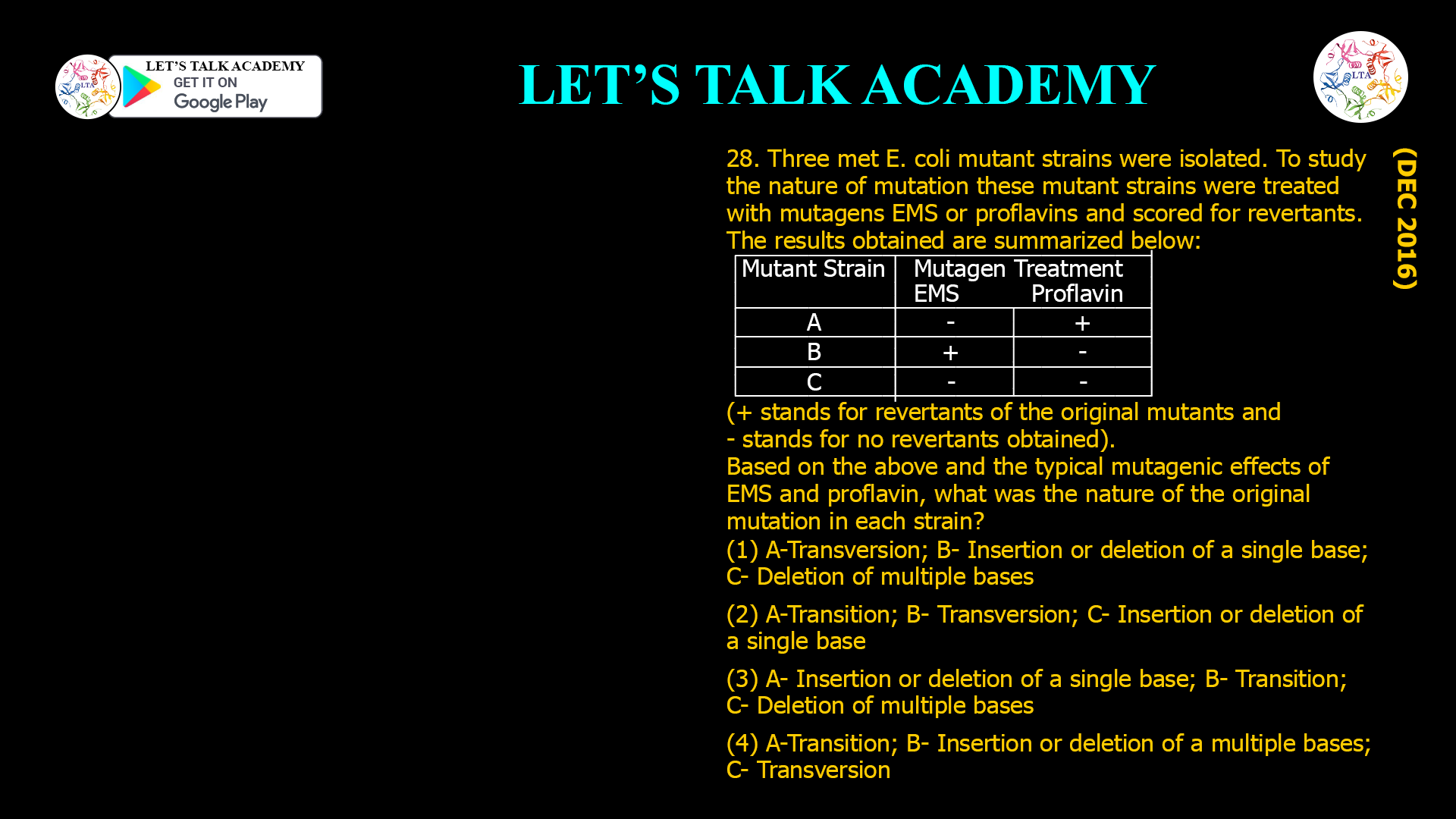
- Three met E. coli mutant strains were isolated. To study the nature of mutation these mutant strains were treated with mutagens EMS or proflavins and scored for revertants.
The results obtained are summarized below:
| Mutant Strain | Mutagen Treatment EMS Proflavin |
|
| A | – | + |
| B | + | – |
| C | – | – |
(+ stands for revertants of the original mutants and – stands for no revertants obtained).
Based on the above and the typical mutagenic effects of EMS and proflavin, what was the nature of the original mutation in each strain?
(1) A-Transversion; B- Insertion or deletion of a single base; C- Deletion of multiple bases
(2) A-Transition; B- Transversion; C- Insertion or deletion of a single base
(3) A- Insertion or deletion of a single base; B- Transition; C- Deletion of multiple bases
(4) A-Transition; B- Insertion or deletion of a multiple bases; C- Transversion
The correct answer is option (3):
A – insertion or deletion of a single base; B – transition; C – deletion of multiple bases.
Question recap and key concept
Three E. coli methionine auxotroph mutant strains (A, B, C) were treated with two mutagens, EMS and proflavin, and revertants were scored. In the table, “+” indicates revertants (mutation reversed) and “−” indicates no revertants: A shows revertants only with proflavin, B only with EMS, and C with neither. EMS typically induces base substitutions (mainly transitions), whereas proflavin (an acridine dye) typically causes single-base insertions or deletions (frameshifts).
-
Strain A: reverts only with proflavin → original mutation must be a single base insertion or deletion (frameshift) because proflavin can produce the opposite +1/−1 event to restore reading frame.
-
Strain B: reverts only with EMS → original mutation must be a base substitution, most consistent with a transition, because EMS mainly causes G·C → A·T transitions, which can back-mutate or create compensating changes.
-
Strain C: does not revert with either mutagen → likely a more drastic lesion such as deletion of multiple bases, which is rarely precisely reversed by EMS or proflavin.
Thus, option (3) correctly matches each pattern of reversion with the typical mutagenic specificity of the agents.
Why other options are incorrect
-
Option (1): Assigns A as a transversion and B as single-base indel. This contradicts the known spectra because proflavin does not typically revert transversions efficiently, and EMS does not preferentially cause frameshift corrections.
-
Option (2): Assigns A as a transition and C as single-base indel. This ignores that A responds only to proflavin (frameshift mutagen) and that a single-base indel in C should sometimes be revertible by proflavin.
-
Option (4): Assign


