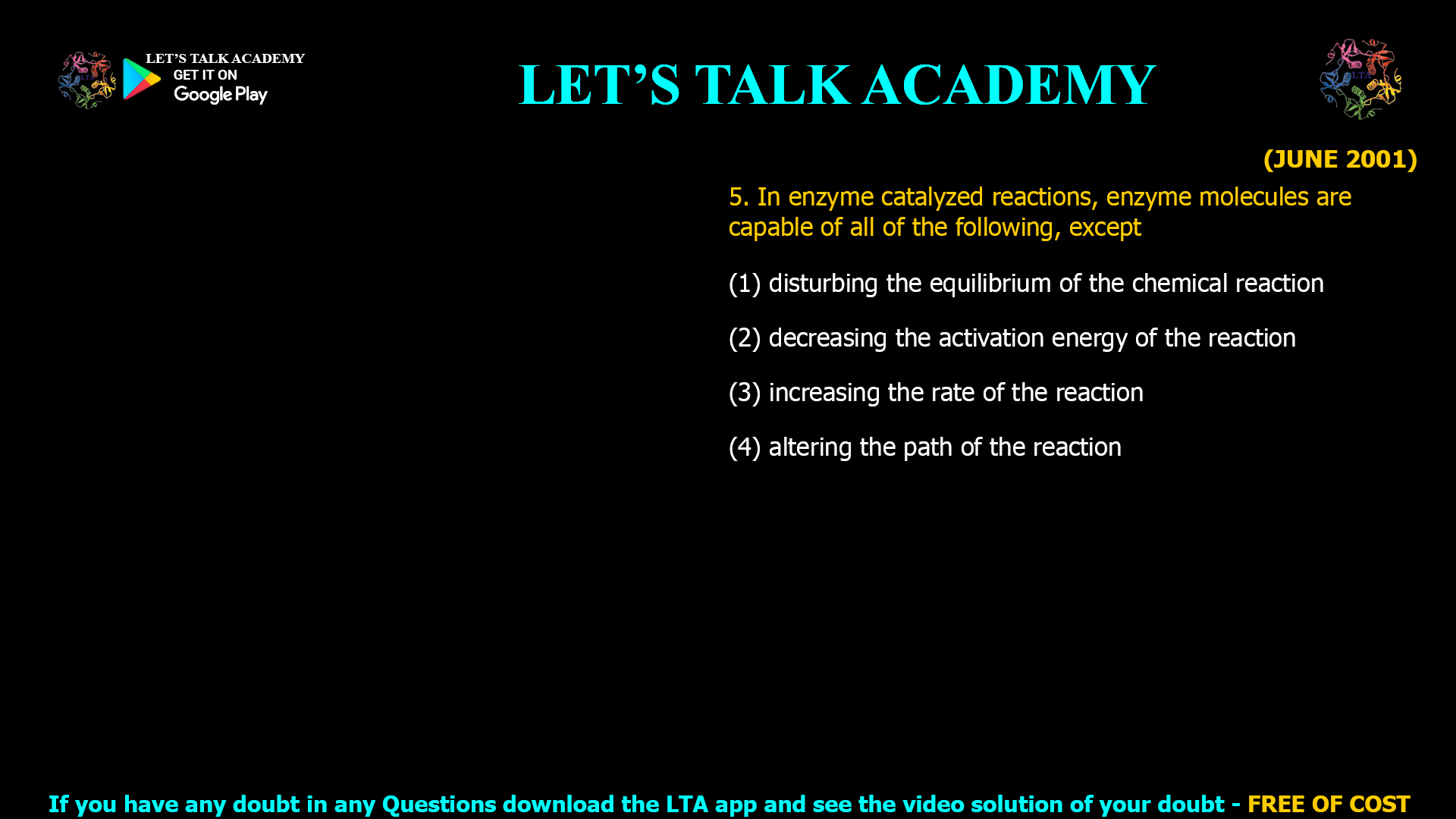
The correct answer is (1) disturbing the equilibrium of the chemical reaction. Enzymes are biological catalysts—they speed up reactions and alter the pathway (lower activation energy), but do not change the reaction’s equilibrium.
Introduction
Enzymes play a central role in biological reactions, speeding up transformation from substrates to products with astonishing efficiency. But despite their critical function in lowering activation energy and increasing reaction rates, enzymes follow strict physical laws and do not alter the final equilibrium position of a chemical reaction. This article covers every aspect of enzyme catalysis, exploring what enzymes can and cannot do, with a special focus on why they cannot disturb chemical equilibrium—a key concept for life science students and educators.
The Fundamentals of Enzyme Catalysis
Enzymes are biological catalysts. Unlike reactants, they are not consumed during the reaction and can perform their function repeatedly.
How Enzymes Work
-
Lower Activation Energy: Enzymes provide an alternative pathway for reactions, reducing the barrier (activation energy, Ea) needed for substrate conversion to product.
-
Increase Reaction Rate: By stabilizing the transition state, enzymes make reactions happen much faster—often millions of times quicker than uncatalyzed reactions.
-
Alter Reaction Pathway: The enzyme active site holds substrates in a specific orientation, favoring the formation of products via a controlled mechanism.
Importantly:
Enzymes cannot “push” the reaction forward beyond its natural equilibrium.
Chemical Equilibrium: Core Principles
Chemical equilibrium is defined by the relative concentrations of reactants and products when the forward and reverse reaction rates are equal.
Keq=[Products][Reactants]
-
Thermodynamics governs the ratio of products and reactants.
-
Catalysts, including enzymes, speed up reaching equilibrium but don’t change its position.
What Enzymes CAN and CANNOT Do
Enzyme Capabilities
-
Decrease Activation Energy: Enzymes lower the energy hill that substrates must climb to become products, increasing the proportion of molecules that react.
-
Increase Rate of Reaction: The speed at which equilibrium is reached is massively increased.
-
Alter Reaction Path: The presence of the enzyme provides a new molecular mechanism, often involving direct participation of active site residues, temporary covalent bonds, and substrate orientation.
-
Catalyze in Both Directions: Enzymes facilitate both forward and reverse reactions, never being consumed and always remaining unchanged.
Enzyme Limitations
-
Cannot Disturb Equilibrium: Catalysts only speed up both forward and reverse reactions equally, leaving the equilibrium constant Keq unchanged.
-
Cannot Make Non-Spontaneous Reactions Spontaneous: Enzymes do not supply energy; they only lower the barrier to reaction.
Detailed Explanation of Options
(1) Disturbing the Equilibrium
-
Incorrect Statement: Enzymes do not disturb or shift the chemical equilibrium. Catalyst speeds up achieving equilibrium but does not change the proportion of products to reactants at equilibrium.
(2) Decreasing Activation Energy
-
Correct Statement: Enzymes lower activation energy, which is the main reason for their catalytic power.
(3) Increasing the Rate of the Reaction
-
Correct Statement: Enzymes can increase reaction rates by factors as large as 108.
(4) Altering the Path of the Reaction
-
Correct Statement: Enzymes can provide an alternative pathway for the reaction, often involving unique mechanistic steps.
Graphical Illustration: Enzyme Effect on Energy Profile
Enzyme-catalyzed reactions are typically depicted as energy profiles showing:
-
Lower peak for activation energy
-
Same starting and ending points (reactants/products)
-
Unchanged equilibrium concentrations of reactants and products
Misconceptions: Why Equilibrium Is Untouchable
-
Students often think catalysts “favor” product formation, but they simply speed up the process for both directions.
-
Real change in equilibrium requires altering reaction conditions (temperature, pressure, concentration), not adding a catalyst.
Real-World Examples
-
Hydrogen Peroxide Decomposition: Enzyme catalase accelerates breakdown into water and oxygen, but the ratio of water to oxygen at equilibrium doesn’t change.
-
Cellular Respiration: Enzymes speed up individual steps, ensuring rapid ATP synthesis but don’t shift equilibrium of underlying chemical reactions.
Applications and Importance
-
Biotechnology: Enzymes used in manufacturing, diagnostics, and research catalyze reactions quickly without consuming extra energy or shifting reaction outcomes.
-
Medicine: Drug inhibitors target enzyme pathways without disturbing equilibrium but can slow or stop undesired reactions.
-
Metabolism: Metabolic pathways are tightly regulated via enzymes, balancing speed with cellular needs; however, actual concentrations at equilibrium are defined by thermodynamics.
Summary Table: Enzyme Catalysis Effects
| Effect | Enzymes Capable? | Explanation |
|---|---|---|
| Disturbing chemical equilibrium | No | Equilibrium unchanged |
| Lowering activation energy | Yes | Speeds up reaction |
| Increasing rate of reaction | Yes | Faster equilibrium achievement |
| Altering reaction path | Yes | Offers alternative mechanism |
Conclusion
Enzymes are powerful tools for biological catalysis, but they do not disturb the chemical equilibrium of any reaction. While enzymes accelerate reactions, lower activation energy, and provide efficient alternative pathways, the ratio of products to reactants at equilibrium remains constant—anchored by the fundamental principles of thermodynamics. Understanding this distinction is crucial for students, researchers, and anyone interested in the life sciences


53 Comments
Roopal Sharma
September 12, 2025Enzymes cannot disturb the equilibrium of reactions.
Aakansha sharma Sharma
September 12, 2025correct answer is (1) disturbing the equilibrium of the chemical reaction. Enzymes are biological catalysts—they speed up reactions and alter the pathway (lower activation energy), but do not change the reaction’s equilibrium.
Sakshi yadav
September 12, 2025Enzyme are speed up the reaction but not distrub the equilibrium
Sakshi Kanwar
September 12, 2025Enzyme does not change the proportion of products to reactants at equilibrium And in case of enzyme equilibrium term can’t be used
Option A
Mohd juber Ali
September 12, 2025Option a
Enzyme do not change the rexn equlibrium bcz they are biological catalyst they speed up rexn and alter the oathway
Priya dhakad
September 12, 2025Option 1 is correct disturbing the equilibrium of the chemical reaction.Enzymes are speed up reactions and alter the pathway but do not change the reaction’s equilibrium.
Heena Mahlawat
September 12, 2025Enzymes mostly known for their catalysis property without getting consumed and change in physical state, they do not alter or change the reaction equilibrium as their work is to stabilize transition state which lowers the activation energy.
Mansukh Kapoor
September 12, 2025The correct answer is option 1st
Enzymes are biological catalysts they speed up reactions and lower activation energy but do not change the reactions equilibrium
Varsha Tatla
September 12, 2025Enz. Are speed up the reaction by lowering activation energy and alter the path
Tanvi Panwar
September 12, 2025Enzymes do not disturbs the equilibrium of the reaction.
HIMANI FAUJDAR
September 12, 2025Ans Enzymes are used for biological catalysis but they cannot disturb the equilibrium of reaction ,they can only speed up the reaction and increase the rate of reaction.
Bhawna Choudhary
September 12, 2025Distrubing the equilibrium of the chemical reaction because enzyme do not distrub or shift the chemical equilibrium
Santosh Saini
September 13, 2025Disturbing the equilibrium of the reaction and enzymes are biological catalysts they speed up reaction and lower activation energy but do not disturb the chemical equilibrium of any reaction
Kanica Sunwalka
September 13, 2025enzymes can not push the rxn beyond its natural eqb
=> not disturbing the eqb
Isha gupta
September 13, 2025Enjyme can not push the reaction forward beyond it’s natural equilibrium.
Kirti Agarwal
September 13, 2025Disturbed the equilibrium of reaction
Neha Yadav
September 13, 2025Enzyme catalyst reaction enzyme never disturbed equation of the chemical reaction
Soniya Shekhawat
September 13, 2025Enzyme cannot be disturbed the equilibrium of chemical reaction.
Bhavana kankhedia
September 13, 2025disturbing the equilibrium of the chemical reaction.
Ayush Dubey
September 13, 2025disturbing the equilibrium of the chemical reaction
It’s a false statement
Manisha choudhary
September 14, 2025Enzyme equilibrium ko disturb nhi krte h equilibrium unchanged rahta h , reactant and product ki concentration bhi same rahti h
Forward and reverse dono reaction ko krwate h
Enzyme Activation energy ko km kr dete h jis s reaction fast ho jati h
Alternative pathway provide krwate h
Rate of reaction ko increase krte h
Deepika sheoran
September 14, 2025Enzyme do not change the reaction equilibrium.Disturbing the equilibrium of the chemical reaction.
Pratibha Jain
September 14, 2025correct answer is option (1)
Enzymes are biological catalysts—they speed up reactions and alter the pathway (lower activation energy), but do not change the reaction’s equilibrium.
Aafreen Khan
September 14, 2025Disturbing the equilibrium of the chemical reaction because Enzymes are catalysts and they speed up reactions and lower activation energy, but do not change the reactions of equilibrium hence option 1 st is correct answer
Dharmpal Swami
September 14, 2025Enzyme are biocatalyst which increases the rex rate but don’t change the chemical equilibrium
Avni
September 14, 2025Enzymes not disturb the chemical equilibrium of any reaction
Khushi Agarwal
September 14, 2025Option A is wrong statement about enzymes catalysed rex…
do not change the reaction’s equilibrium.
Vanshika Sharma
September 14, 2025Enzymes not disturb the equilibrium of the reaction
Anjali
September 14, 2025Enzymes not disturb the equilibrium of the any reaction
Anurag Giri
September 14, 2025correct answer is (1) disturbing the equilibrium of the chemical reaction. Enzymes are biological catalysts—they speed up reactions and alter the pathway (lower activation energy), but do not change the reaction’s equilibrium
Simran Saini
September 14, 2025Disturbing the equilibrium of the chemical reaction.
Mitali saini
September 14, 2025correct answer is (1) disturbing the equilibrium of the chemical reaction. Enzymes are biological catalysts—they speed up reactions and alter the pathway (lower activation energy), but do not change the reaction’s equilibrium.
Kajal
September 14, 2025Enzyme do not interfere with equilibrium constant of the reaction
Rishita
September 14, 2025disturbing the equilibrium of the chemical reaction
Arushi Saini
September 14, 2025Enzymes can not disturb the equilibrium
Asha Gurzzar
September 14, 2025Disturbing the equilibrium of the chemical reaction
Bharti yadav
September 14, 2025option 1 disturbing the equilibrium of the chemical reaction. Becoz Enzymes speed up the reaction but not change the reaction equilibrium
Pallavi Ghangas
September 14, 2025Enzyme do not disturb reaction equilibrium
anjani sharma
September 14, 2025Answer 1
Disturbing the equilibrium of the chemical reaction
Payal Gaur
September 14, 2025Enzyme do not disturb the chemical equilibrium.
Sneha Kumawat
September 14, 2025Enzyme do not disturb the equilibrium
Devika
September 15, 2025Decreasing the equilibrium of chemical reaction
Preeti
September 15, 2025Correct answer is 1 disturbing the equilibrium of chemical reaction
Khushi Vaishnav
September 15, 2025Cannot disturb the equilibrium of the chemical reaction
Anjana sharma
September 16, 2025disturbing the equilibrium of the chemical reaction
Minal Sethi
September 16, 2025Enzyme do not disturb the equilibrium of the reaction
Yogita
September 16, 2025Disturbed the equilibrium of reaction
Muskan singodiya
September 16, 2025Distrubing the equilibrium of the chemical reaction
Alec
September 16, 2025option 1 – disturbing the equilibrium of the reaction
Monika jangid
September 17, 2025Disturbing the equilibrium of the rxn
Muskan Yadav
September 17, 2025The correct answer is 1 disturbing the equilibrium of the chemical reaction.
Divya rani
September 17, 2025Enzymes speed up the biochemical reactions by lowering the activation energy but do not disturb the equilibrium of reaction.
Priti khandal
September 17, 20251is right