Which law states that evolution tends to increase body size over geological time in a lineage of populations? (1) Copes rule (2) Allen's rule (3) Bergman's rule (4) Jordon's rule

Cope’s Rule: The Evolutionary Law of Increasing Body Size Over Geological Time

The following statements are potential explanations for the continued existence of genes that control eye development in eyeless cavefish. A. They have inherited these genes from their ancestors and this remains even though they no longer have eyes. B. In case of a possibility that they return to the surface environment retention of vision would be advantageous, so evolution retains this trait. C. Evolution can only lead to gain of a trait, not loss of a trait. D. These genes are retained because of combined role of these genes with other sensory mechanisms. Which one of the following options represents the combination of correct statements? (1) A and B (2) B and C (3) A and D (4) C and D

Why Do Eyeless Cavefish Retain Genes for Eye Development? Exploring Genetic, Evolutionary, and Functional Explanations

Which of the following events/examples represent observation of evolutionary changes on a human time scale? Here human time scale is defined by an average human age of approximately 70-80 years. (1) Complete eye degeneration in cave fishes (2) Human bipedalism (3) Evolution of flowering plants (4) Drug resistance in HIV

Evolutionary Changes Observable on a Human Time Scale: Understanding Rapid Adaptations

Plasmids are self-replicating small circular DNA elements in bacterial cells that can be said to have a stable symbiotic existence with the host cell. They often carry genes useful to the host. Which of the following is a potential threat to the evolution and stability of the symbiotic coexistence? (1) 'Copy-up' mutations that increase the rate of plasmid replication per host cell cycle. (2) Reversible integration of plasmid DNA into the host DNA (3) Transfer of plasmids to new cells by conjugation (4) Spontaneous curing of plasmids in a small proportion of host cells

Threats to Plasmid-Host Symbiosis: How ‘Copy-Up’ Mutations Challenge Evolutionary Stability in Bacteria

According to which evolutionary theory, there are long periods without significant evolutionary changes interrupted by short episodes of rapid evolution? (1) Saltation (2) Punctuated equilibrium (3) Mutation (4) Neutrality

Punctuated Equilibrium: Explaining Rapid Evolutionary Bursts Amid Long Periods of Stability

In an experiment that has continued for more than 50 years, corn has been propagated by breeding only from plants with the height amount of oil in the seeds. The average oil content is now much greater than any of the plants in the original population. The following hypotheses were proposed as explanations for this observation. (A) Mutations occurred that increased the oil content in seeds. (B) Plants with high oil content were stimulated to produce offspring with more oil in their seeds. (C) The breeding led to increased frequency of alleles at multiple loci, so that new combinations of genes for even higher oil content were formed. Which of the following represents a combination of correct statements? (1) (A) and (B) only (2) (A) and (C) only (3) (B) and (C) only (4) (A), (B) and (C)

How Long-Term Selective Breeding Increases Oil Content in Corn: Genetic Mechanisms and Hypotheses Explained

The rate of mutation in E. coli from lac- to lac+ are determined using medium containing lactose, as the only sole source of energy. The principle of spontaneity can be said to be violated if: (1) the rate of mutation increase during starvation (2) in the presence of lactose the rate of mutation from lac- to lac+ increases but overall rate of mutation is not (3) The rate of mutation in lac gene is always greater than in other genes (4) The rate of mutation in lac gene is always less than in other genes

Understanding Mutation Rates in E. coli: When Is the Principle of Spontaneity Violated?

Which of the following statements about evolution is NOT true? (1) Evolution is the product of natural selection. (2) Evolution is goal-oriented. (3) Prokaryotes evolve faster than eukaryotes. (4) Evolution need not always lead to a better phenotype.

Debunking Evolution Myths: Is Evolution Goal-Oriented?

Change in allele frequency at species or below species level is termed as (1) Microevolution (2) Macroevolution (3) Mega evolution (4) Silent evolution

Microevolution: The Process Behind Changes in Allele Frequency at or Below the Species Level

If E. coli is grown on lactose free medium for 20 generations under presence of constant mutagen which produces the lac- mutants as well as lac- revertants in equal amount. At the end it will be observed that (1) Equal number of Lac- and Lac revertants (2) More number of Lac revertants at the end (3) More number of Lac- at the end of experiment (4) Cannot be predicted

Predicting Lac Mutant Frequencies in E. coli: What Happens Under Constant Mutagen Exposure?

Which is essential for bringing variation and evolution? (1) Mutation (2) Reproduction (3) Mitosis (4) Genetic drift

Mutation: The Essential Force Driving Variation and Evolution

65. Smallest unit which can evolve is- (1) Individual (2) Species (3) population (4) Gene

Why Population Is the Smallest Unit That Can Evolve: Unraveling the Basics of Evolution

The primary cause of variation among different individual in population is presence of (1) Recombination (2) Mutation (3) Multiple alleles (4) Hybridization

The Primary Cause of Variation Among Individuals in a Population: The Role of Mutation

Examples of antibiotic resistance highlight important features of natural selection. Which of the following statements is NOT true? (1) Evolution by natural selection is progressive, it makes individuals 'better'. (2) Natural selection acts on individuals but it is populations that change with time. (3) Natural selection does not cause genetic changes in individuals (4) Natural selection acts on phenotype

Debunking Myths: What Antibiotic Resistance Teaches Us About Natural Selection

Which one of the following statements is TRUE for positive-frequency dependent selection? (1) Fitness of a genotype increases as it becomes less common. (2) Fitness of a genotype increases as it becomes more common. (3) Fitness of a genotype decreases as it becomes less common. (4) Fitness of a genotype decreases as it becomes common and gets fixed.

Understanding Positive Frequency-Dependent Selection: When Fitness Favors the Common

Reduction in the frequency of heterozygous genotype with a concomitant increase in the frequency of homozygous genotype, in context of random mating is due to (1) Genetic drift (2) Intense inbreeding (3) Reverse mutation (4) Founder effect

Genetic Drift: The Reason Behind Reduced Heterozygosity and Increased Homozygosity in Randomly Mating Populations

In spite of its two-fold cost, sexual reproduction is the most dominant mode of reproduction among the living organisms. Which of the following reasons might account for this? (A) Sexual reproduction generates genetic heterogeneity through recombination (B) Sexual reproduction helps in purging deleterious mutations (C) Sexual reproduction evolved to stay evolutionarily ahead of fast evolving internal parasites. (1) (A) only (2) (A) and (B) (3) (C) only (4) (A), (B) and (C)

Why Sexual Reproduction Prevails: Genetic Diversity, Mutation Purging, and the Red Queen Hypothesis

The Galapagos finches were an important clue to Darwin's thinking about the origin of species. These finches are believed to have descended from a single ancestral species that colonized the Galapagos archipelago, America, over a short period of time. The Galapagos finches differ in their beak shape and size. Different species feed on seeds that vary in size and hardness. Which of the following is the most likely explanation for these patterns? (1) The finches represent an example of directional trend in beak size from small to big. (2) Beak shapes changed in response to different seed types and these changes were inherited by subsequent generations. (3) The ancestral finch already had all the beak variations and different lineages formed that were specialized to eat different seed (4) The finches represent an example of adaptive radiation in which beak variation was generated by mutation followed by selection by different seed types.

Adaptive Radiation in Galapagos Finches: How Mutation and Selection Shaped Beak Diversity

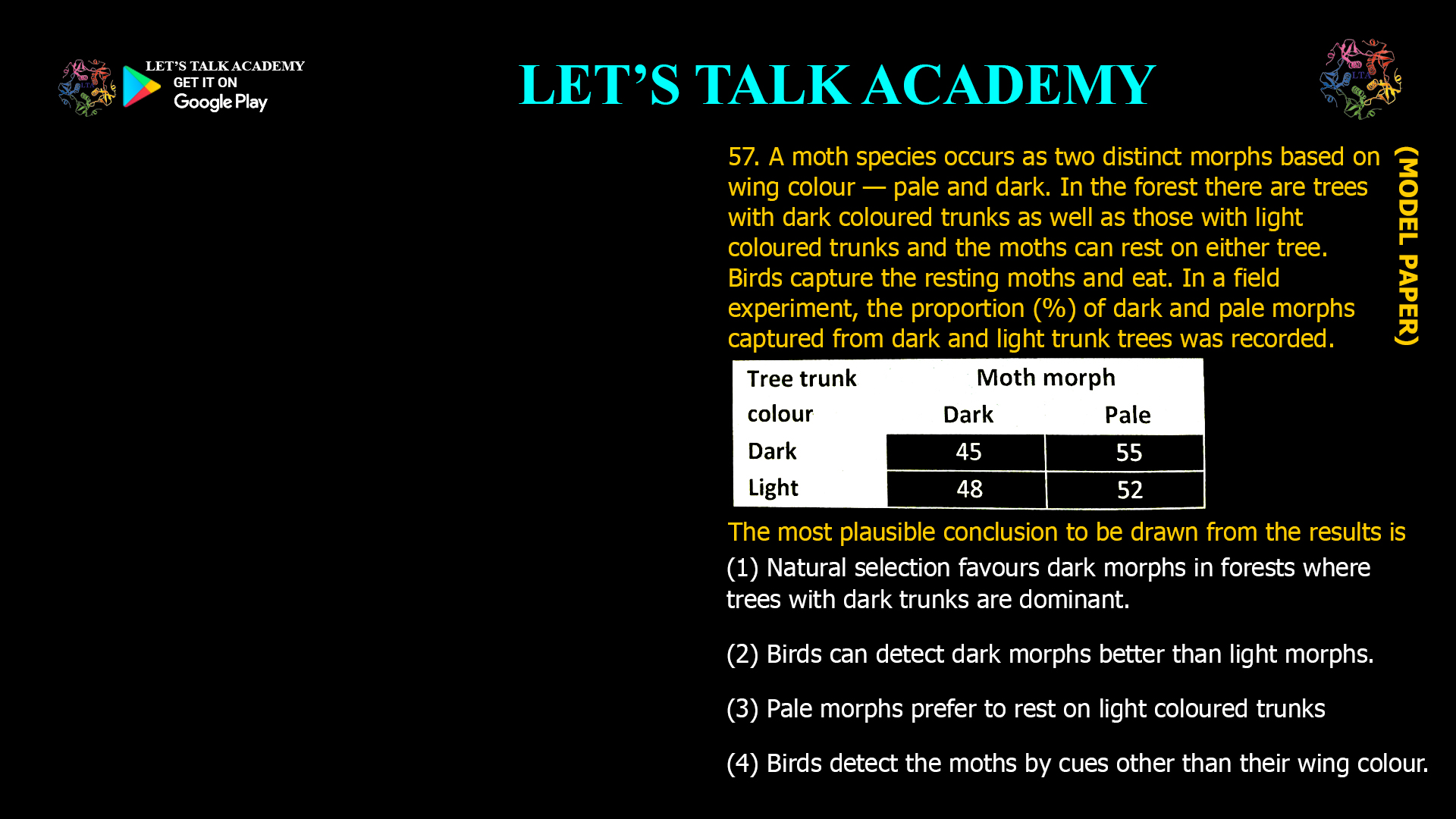
A moth species occurs as two distinct morphs based on wing colour — pale and dark. In the forest there are trees with dark coloured trunks as well as those with light coloured trunks and the moths can rest on either tree. Birds capture the resting moths and eat. In a field experiment, the proportion (%) of dark and pale morphs captured from dark and light trunk trees was recorded. The most plausible conclusion to be drawn from the results is (1) Natural selection favours dark morphs in forests where trees with dark trunks are dominant. (2) Birds can detect dark morphs better than light morphs. (3) Pale morphs prefer to rest on light coloured trunks (4) Birds detect the moths by cues other than their wing colour.

 How Natural Selection Favors Moth Color Morphs in Different Forest Environments

56. In pre-industrial period in England, peppered moths had light coloration which effectively camouflaged' them against light coloured trees and lichens. During industrial revolution, many lichens died out and trees became blackened by soot from factories and interestingly, dark coloured moths were predominantly seen. This happened due to (1) natural selection of dark coloured moths which were initially present in fewer numbers. (2) new mutation which arose due to environmental pollution. (3) macroevolution occurring due to environmental change. (4) natural selection of the camouflaging mechanism or the moths.

The Peppered Moth: A Classic Example of Natural Selection in Action

In Africa "AS" represent a carrier of sickle cell anemia, where A is the allele for normal haemoglobin and S for sickle cell haemoglobin. If the allele S is maintained at a high frequency in some populations, this represents a case of (1) homozygote advantage (2) heterozygote advantage (3) dominance (4) genetic drift

Heterozygote Advantage: Why the Sickle Cell Allele Persists at High Frequency in African Populations

It is found that people with the genetic disease called sickle cell anemia are resistant to malaria. Which of the following best describes the underlying mechanism? (1) Frequency-dependent selection (2) Superiority of heterozygotes / Heterozygote Advantage (3) Transient polymorphism (4) Balanced polymorphism

Sickle Cell Anemia and Malaria: The Evolutionary Advantage of Heterozygote Superiority

Directional Selection for a particular trait will lead to the frequency of the trait: (1) being normally distributed in the population. (2) always showing a left-skewed distribution in the population. (3) always showing a right-skewed distribution in the population. (4) showing either a right- or a left-skewed distribution in the population.

How Directional Selection Alters Trait Distribution in Populations

Selection in which two extreme phenotypes leave more offspring than the intermediate phenotype is called (1) directional selection. (2) disruptive selection. (3) stabilizing selection. (4) neutral selection. 

 Disruptive Selection: How Nature Favors Extremes and Drives Evolutionary Diversity

If natural selection favors an average phenotype by selecting against extreme variation, under such condition (1) Both alleles will coexist in population (2) Only dominant alleles will exist (3) Only recessive alleles will exist (4) Both the alleles will be lost 

How Stabilizing Selection Maintains Both Alleles in a Population

In a population individuals having heterozygous phenotype are more favored then homozygous dominant which are more favored then homozygous recessive genotypes, under such condition (1) Recessive alleles would be lost from population (2) Dominant alleles would be lost (3) Both alleles would remain in population (4) Alleles would be lost randomly 

Heterozygote Advantage: How Both Alleles Persist in a Population

The body weight of adult female of a strain ofDrosophila is 1.8±0.45 mg (mean ± standard deviation).In a laboratory experiment, each of the 3 groups (A, B, C) of this strain was subjected to a different type of selection pressure having influence on the female body weight. After many generations of experimental selection pressure, the body weight changed as follows: Group A: Body weight distribution - Normal, 1.8 ± 0.08 mg Group B: Body weight distribution - Bimodal at 1.4 and 2.2 mg Group C: Body weight distribution - Normal, 2.2 ± 0.08 mg  Which of the following correctly gives the types of selection that have occurred in the three groups? (1) Group A: Directional; Group B: Stabilizing; Group C: Disruptive (2) Group A: Disruptive; Group B: Directional; Group C: Stabilizing (3) Group A: Stabilizing; Group B: Disruptive; Group C: Directional (4) Group A: Directional; Group B: Disruptive; Group C: Stabilizing

Types of Natural Selection in Drosophila: Stabilizing, Disruptive, and Directional Selection Explained

The mean (µ) and standard deviation (σ) of body size in a Drosophila population are 8.5 and 2.2 mm, respectively. Under natural selection over many generations the µ and σ of body size change to 8.5 and 0.8 mm, respectively. The type of natural selection responsible for the change is called (1) directional. (2) neutral. (3) disruptive. (4) stabilizing. 

 Understanding Stabilizing Selection: How Natural Selection Narrows Variation in Drosophila Body Size

Under which condition of natural selection no allele would be lost when (1) Any one homozygote is favored (2) Both homozygote are favored (3) Heterozygote are favored (4) Heterozygote is not favored 

Heterozygote Advantage: The Natural Selection Mechanism That Preserves Genetic Diversity

Phenotype A has selective advantage over B, B has over C and C has over A. The condition is like "paper-scissor-rock". Under such condition in nature (1) All phenotype would be selected (2) Only A and C phenotype would be selected (3) A and B phenotype together selected (4) Only B phenotype would be selected 

Cyclic Selection: How “Rock-Paper-Scissors” Dynamics Maintain Biodiversity in Nature

Natural selection against extreme phenotype is termed as (1) Directional selection (2) Diversifying selection (3) Disruptive selection (4) Stabilizing selection 

Stabilizing Selection: How Nature Preserves the Average by Selecting Against Extremes

If the two extreme morphological forms are favored against heterozygotes, such a selection is termed as (1) Disruptive (2) Directional (3) Stabilizing (4) Cyclic 

Disruptive Selection: The Evolutionary Force Favoring Extremes Over Intermediates

A person heterozygous for sickle cell anemia has advantage for both malaria and sickle cell anemia. It illustrates (1) Directional selection (2) Heterozygote advantage  (3) Disruptive selection (4) Directed mutation selection

Heterozygote Advantage: The Evolutionary Benefit Behind Sickle Cell Trait and Malaria Resistance

Selection which operates against any direction and donot allow to disrupt the existing mean is termed as (1) Directional (2) Stabilizing (3) Disruptive (4) Balancing 

Stabilizing Selection: The Evolutionary Force That Maintains the Mean

Type of selection in which there is elimination of extremes is termed as (1) Directional selection (2) Disruptive selection (3) Stabilizing selection (4) Cyclic selection

 Stabilizing Selection: How Nature Favors the Average by Eliminating Extremes

Given below are proposed analogous structures among organisms A. wings of birds and bats B. wings of bats and tetrapod digits C. tendrils of vitis and tendrils of pumpkin D. tubers of potatoes and sweet potatoes E. fins of fish and flippers of a whale Which one of the following options correctly states the analogous structures? (1) A, C and D (2) B, C and D (3) A, C and E (4) A, D and E

 Identifying Analogous Structures: Wings, Tendrils, Tubers, and Fins Explained

The following statements were made about adaptive radiation: (A) Adaptive radiation is a kind of divergent evolution driven by ecological diversification. (B) Adaptive radiation is the divergence of unrelated taxa into different niches. (C) Adaptive radiation is rare on archipelagos removed from the mainland. (D) Processes unrelated to niche exploitation can be major drivers of species diversification Choose the option that represents all correct statements. (1) A and B (2) C and D (3) B and C (4) A and D 

Adaptive Radiation: Divergent Evolution and the Drivers of Species Diversification

Formation of various species from one common ancestor is termed as (1) Adaptive radiation (2) Phylogeny (3) Cladistics (4) Natural selection 

Adaptive Radiation: The Formation of Various Species from a Common Ancestor

Darwinian evolutionary fitness is measured in turn of (1) Good health (2) Ability to fight with others (3) Reproductive success (4) Lesser mutations 

Darwinian Fitness: Why Reproductive Success Is the True Measure of Evolutionary Fitness

Darwinian finches of three different size of beaks-large, intermediate and small feeds on seeds size with bimodal distribution. Under such condition natural selection will favor finches having beak size (1) Intermediate (2) Large (3) Large and Small both (4) All types of beak size 

Disruptive Selection in Darwin’s Finches: How Bimodal Seed Distribution Favors Extreme Beak Sizes

Antibiotic resistance among bacteria represents (1) Balancing selection (2) Stabilizing selection (3) Directional selection (4) Disruptive selection 

Antibiotic Resistance in Bacteria: A Case Study of Directional Selection in Action

The replica plating experiment of Lederberg supports (1) Natural selection (2) Mutation (3) Conjugation (4) Transformation 

 Lederberg’s Replica Plating Experiment: Proving the Spontaneous Nature of Mutation

After implication of Green Air Act in England whichinsect form become virtually absent- (1) Biston betularia carbonifera (2) Biston betularia typical (3) Drosophila (4) Apes Americana 

How the Green Air Act Led to the Decline of the Dark Peppered Moth in England

A certain organism developed an adaptation as to adaptexisting environment but if this adaptation prove usefulfor some other function as well, it is termed as- (1) Co-adaptation (2) Adaptive radiation (3) Exadaptation (4) Co-evolution 

Exaptation: How Evolution Repurposes Adaptations for New Functions

During Beagle voyage of Charles Darwin he observed that the flora of tropical America is most similar to- (1) Asia (2) Temperate America (3) Europe (4) Australia 

 Darwin’s Beagle Voyage: Why the Flora of Tropical America Most Resembles Temperate America

Germplasm theory was proposed by- (1) Dobszzhanky (2) Weismann (3) Meyer (4) Mendel 

August Weismann and the Germplasm Theory: Foundations of Modern Genetics

The repeated evolution of a specific trait or body plan from the same ancestor lineage but at different times is termed as (1) Iterative evolution (2) Convergent evolution (3) Coevolution (4) parallel evolution 

 Iterative Evolution: How Traits Re-Emerge from the Same Ancestral Lineage Across Time

The Cuvier's theory, which states that there had been several creations, each preceded by another due to some large scale geographical disturbances. Such theory is termed as- (1) Theory of catastrophism (2) Special creation (3) Pangenesis (4) Eternity of life

Cuvier’s Theory of Catastrophism: How Catastrophic Events Shaped Life on Earth

Rarely there is occurrence of gill clefts in higher animals. The reason for this rare appearance is (1) They may be useful for that organism (2) Ancestral returns of that character (3) Favorable mutation in organism (4) Retrogressive Evolution 

Why Gill Clefts Rarely Appear in Higher Animals: The Evolutionary Return of Ancestral Traits

Early embryonic stages of pig and mouse are almost identical, it reveals- (1) Common ancestry (2) Progressive evolution (3) Directional Evolution (4) Homoplasy 

Early Embryonic Similarities Between Pig and Mouse: Evidence for Common Ancestry

In an experiment bacterial cell wall was removed usingenzymatic methods. It was observed that on culturingsuch cell wall deficient bacteria, for many generations result into stable forms of bacteria permanently lacking cell wall. It is proof to (1) Inheritance of acquired character (2) Recessive mutation (3) Reverse mutation (4) Adaptive mutation 

Stable Cell Wall-Deficient Bacteria and the Proof of Adaptive Mutation: Understanding Bacterial Evolution

First fossils were discovered (1) Prior to both Lamarck and Darwin (2) Prior to Lamarck but after Darwin (3) After Lamarck but prior to Darwin (4) After Lamarck and Darwin

When Were the First Fossils Discovered? A Look at Fossil History Before Lamarck and Darwin

Age of Fossils older than 1 million year ago is usuallydetermined by- (1) Sediment deposition (2) Mineral deposition (3) Radioactive decay of isotopes in fossil (4) Age of surrounding rock 

How Are Fossils Older Than 1 Million Years Dated? The Science Behind Determining Ancient Fossil Ages

Age of fossils lesser the 20,000 year old can be preciselyestimated by- (1) Carbon/Nitrogen (2) Potassium/Argon (3) Uranium/Lead (4) Uranium/Thorium 

How to Precisely Date Fossils Less Than 20,000 Years Old: The Role of Carbon/Nitrogen Radiometric Dating

Fossils are gencambarally found in- (1) Sedimentary rocks (2) Igneous rocks (3) Metamorphic rocks (4) Ice 

Why Fossils Are Generally Found in Sedimentary Rocks: The Science Explained

Among the following the living fossil is- (1) Ginkgo biloba (2) Taxus bacata (3) Psilotum (4) Nepenthes khasiana 

Ginkgo biloba: The True Living Fossil Among Ancient Plants

Among the following the living fossil is- (1) Trilobite (2) Peripatus (3) Archaeopteryx (4) Dinosaur

 Which Organism Is a Living Fossil? Understanding the Concept and Identifying the Right Example

Match the organisms in column A with their status in Column B. (1) A, C are X; B, D are Y (2) A, D are X; B, C are Y (3) B, C are X; A, D are Y (4) A, B are X; C, D are Y

How to Match Organisms with Their Conservation Status: A Guide for Students

Given below are statements on "living fossils'. Select the correct statements. (1) Living fossils are impressions of extant organisms in old rocks. (2) Living fossils show high morphological divergence from fossil records. (3) Living fossils are always an evolutionary link between two classes of organisms. (4) Living fossils are organisms that have remained unchanged for millions of years.

 What Are Living Fossils? Definition, Characteristics, and Correct Statements

During evolution the limbs of snakes were lost. Thecorrect explanation for this is (1) Limbs degenerated due to disuse (2) This was more adapted (3) Limbs reduced the fitness of snakes (4) Genetic drift 

 Why Did Snakes Lose Their Limbs? The Evolutionary Science Behind Limb Loss

Pelvic girdle and hind limbs in python are example of- (1) Analogous organ (2) Homologous organ (3) Vestigial organ (4) Orthologous organ 

Pelvic Girdle and Hind Limbs in Pythons: A Classic Example of Vestigial Organs

Convergent evolution creates: (1) Analogous structures (2) Homologous structures (3) Synapomorphies (4) Pleiotropic structures

Convergent Evolution: How Analogous Structures Arise in Nature

Which of the following is an example of convergent evolution (homoplasy)? (1) The wings of birds and bats (2) The hemoglobin gene family (3) The ribosomal RNA genes (4) The number of toes on horses and humans 

Convergent Evolution Explained: Why Bird and Bat Wings Are a Classic Example of Homoplasy

Fossils of the same species of fresh water reptiles have been found in South America and Africa. Based on the current understanding. Which of the following is the best possible explanation for this pattern? (1) The same species originated and evolved independently in these two places. (2) Species migrated from Africa to establish new populations in South America.  (3) Species migrated from South America to establish new populations in Africa. (4) South America and Africa were joined at some point in Earth's history

 Fossils of the Same Freshwater Reptile in South America and Africa: The Gondwana Connection Explained

Tigers do not occur in Sri Lanka while they are seen India. While the leopards are seen in both India and Sri Lanka. The main reason is (1) Tigers are not good swimmers (2) Sri Lankans have removed tiger due to excessive hunting (3) India care more for tigers (4) Leopard originated before separation of India and Sri Lanka due to continental drift 

 Why Tigers Are Absent in Sri Lanka but Leopards Thrive: An Evolutionary and Biogeographical Perspective

The flightless birds ostrich, rhea and emu are distributedon different continents. What is the most plausibleexplanation that is given by an evolutionary biologist for this discontinuous observation? (1) The birds were able to fly earlier, but lost their flight ability later (2) Prehistoric humans transported these birds to different continents (3) The birds, although flightless, may have used drifting logs to cross the ocean and reach other continents (4) All the continents used to be one single supercontinent earlier and the flightless birds were isolated after the break up of the landmass. 

: Why Are Ostriches, Rheas, and Emus Found on Different Continents? The Evolutionary Biologist’s Explanation

Creationism is rejected by evolutionary biologists because (1) it offers no explanation about the origin of adaptation (2) it suggests that all species descended from a common ancestor (3) theologians have not settled on a date for the origin of life on earth (4) supernatural events have not been shown to be very common 

Why Evolutionary Biologists Reject Creationism: Scientific Reasons Explained

3. Column X lists evolutionary ideas and scientists who proposed them, and Column Y lists the description of these ideas. Which one of the following options represents all correct matches between Column X and Column Y? (1) A-iii, B-iv, C-ii, D-l (2) A- i, B-ii, C-iv, D-iii (3) A-ii, B-iv, C-iii, D-l (4) A-iv, B-i, C-ii, D-iii

 Correctly Matching Evolutionary Ideas and Their Proponents: A Comprehensive Guide

Given below are names of scientists and phrases describing their work, which may or may not be matched Which one of the following options represent correct matches between the scientist and his/her work? (1) i-A; ii-B; iii-C; iv-E (2) i-B; ii-C; iii-A; iv-D (3) i-A; ii-C; iii-E; iv-B (4) i-E; ii-D; iii-A; iv-C

Correctly Matching Famous Scientists to Their Groundbreaking Discoveries

1.Column A lists names of evolutionary biologists and column B lists descriptions of evolutionary mechanisms proposed by them in random order (1) A-(i), B-(ii), C-(iv), D-(iii) (2) A-(ii), B-(iii), C-(i), D-(iv) (3) A-(iii), B-(i), C-(ii), D-(iv) (4) A-(ii), B-(iii), C-(iv), D-(i)

Matching Evolutionary Biologists with Their Proposed Mechanisms: A Clear Guide

Latest Courses