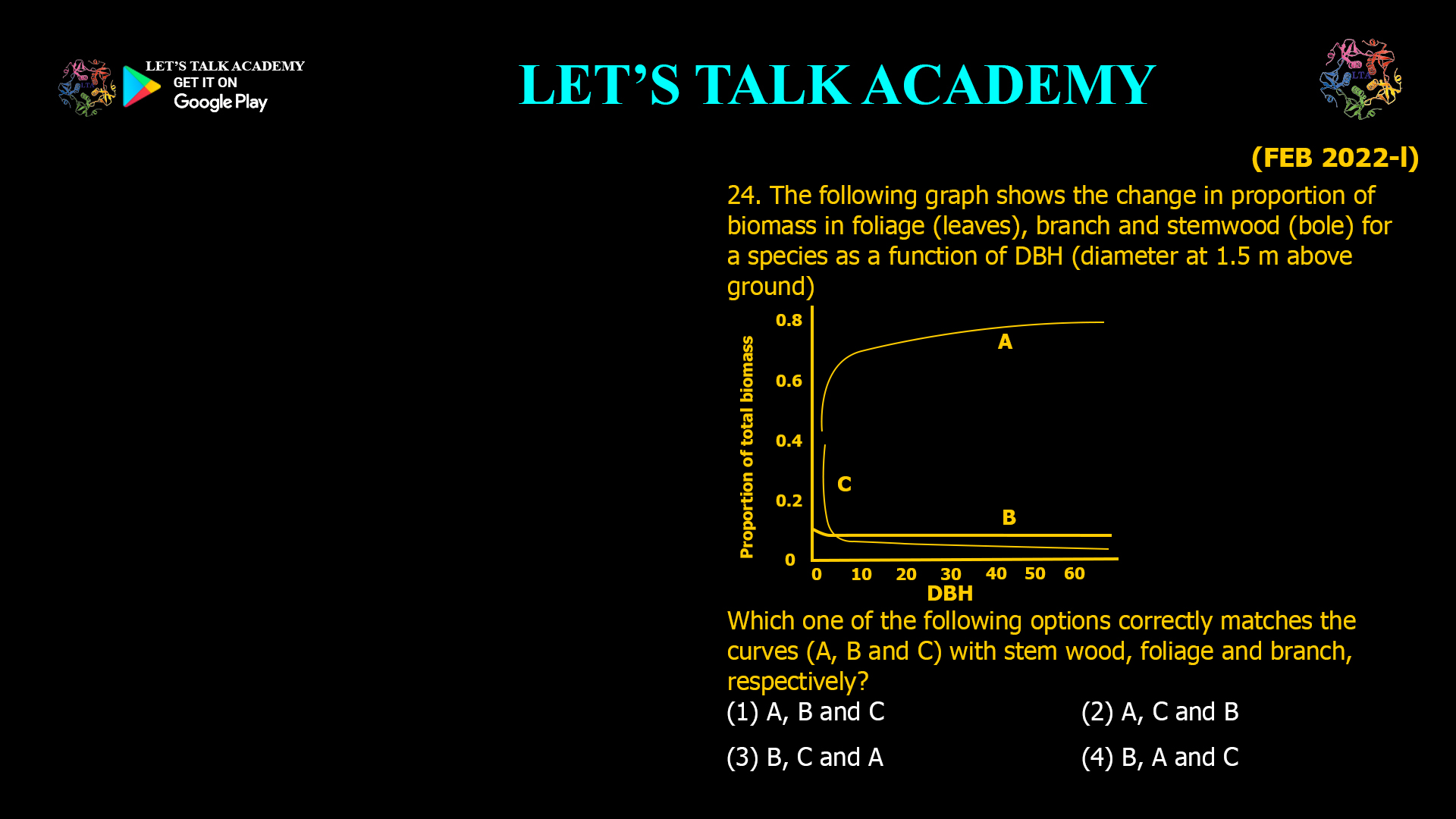
24. The following graph shows the change in proportion of biomass in foliage (leaves), branch and stemwood (bole) for a species as a function of DBH (diameter at 1.5 m above ground) Which one of the following options correctly matches the curves (A, B and C) with stem wood, foliage and branch, respectively? (1) A, B and C (2) A, C and B (3) B, C and A (4) B, A and C

How Tree Biomass Proportions Change with DBH: Matching Curves to Stemwood, Foliage, and Branch

23. Complete the following sentence with the most appropriate option. Global analysis of a large number of plant species traits showed that with increase in leaf lifespan (1) specific leaf area increases whereas leaf nitrogen and net photosynthesis rate decrease. (2) specific leaf area, leaf nitrogen and net photosynthesis rate increase. (3) specific leaf area, leaf nitrogen and net photosynthesis rate decrease. (4) specific leaf area decreases whereas leaf nitrogen and net photosynthesis rate increase.

How Leaf Lifespan Affects Plant Traits: A Global Perspective on Specific Leaf Area, Nitrogen, and Photosynthesis

A large patch of forested area was devastated by raging fires. After some years, the area was found to recover its species. Which one of the following options best describes the process of re-establishment in the area? (1) mosses and lichens grasses → shrubs and small plants → woody trees (2) Grasses → woody trees → herbs and shrubs → mosses and lichens (3) woody plants → lichens and mosses → herbs and shrubs (4) Grasses → herbs and shrubs → woody trees

How Do Forests Recover After Fire? – Understanding the Process of Secondary Succession

Historical frequencies of fires in an area can be determined by (1) radioactive dating of the tree remains. (2) examining the fire scars in growth rings of living trees. (3) measuring carbon content on the soil surface after fire (4) examining records of evacuation history of the nearby villages.

How Are Historical Frequencies of Fires Determined? – Exploring Methods in Fire Ecology

20. The graphs given below show the possible behavior of two species over the course of succession. Possible effects observed during succession are: i. Total suppression ii. Convergence iii. Sequential succession Choose the correct option matching the graphs with the possible effect: (1) A-(i) B-(ii) C-(iii) (2) A-(ii) B-(iii) C-(i) (3) A-(iii) B-(ii) C-(i) (4) A-(iii) B-(i) C-(ii)

How Do Species Behaviors Shape Ecological Succession? – Matching Graphs to Suppression, Convergence, and Sequential Patterns

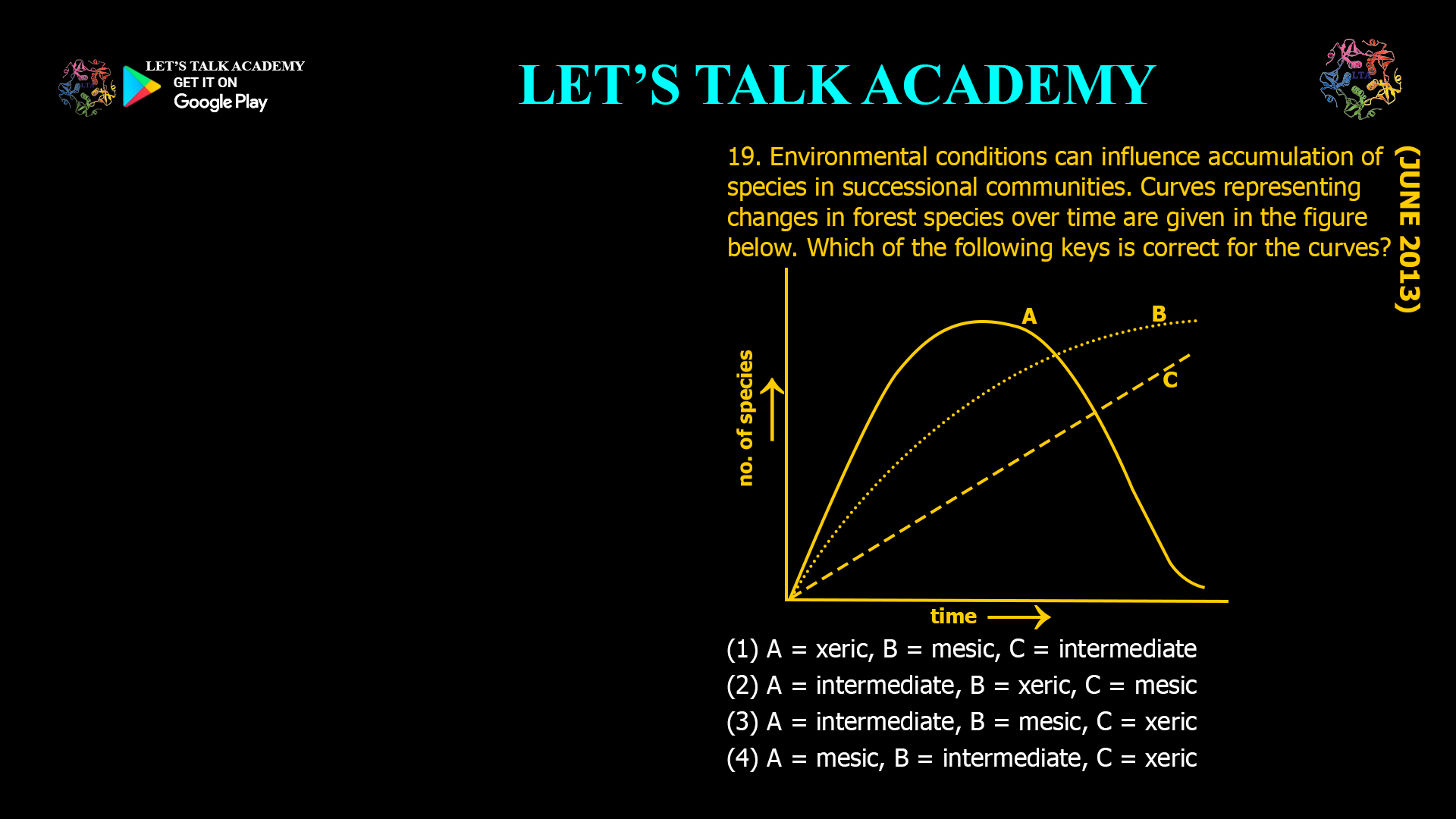
19. Environmental conditions can influence accumulation of species in successional communities. Curves representing changes in forest species over time are given in the figure below. Which of the following keys is correct for the curves? (1) A = xeric, B = mesic, C = intermediate (2) A = intermediate, B = xeric, C = mesic (3) A = intermediate, B = mesic, C = xeric (4) A = mesic, B = intermediate, C = xeric

How Do Environmental Conditions Influence Forest Succession? – Understanding Xeric, Mesic, and Intermediate Species Accumulation Curves

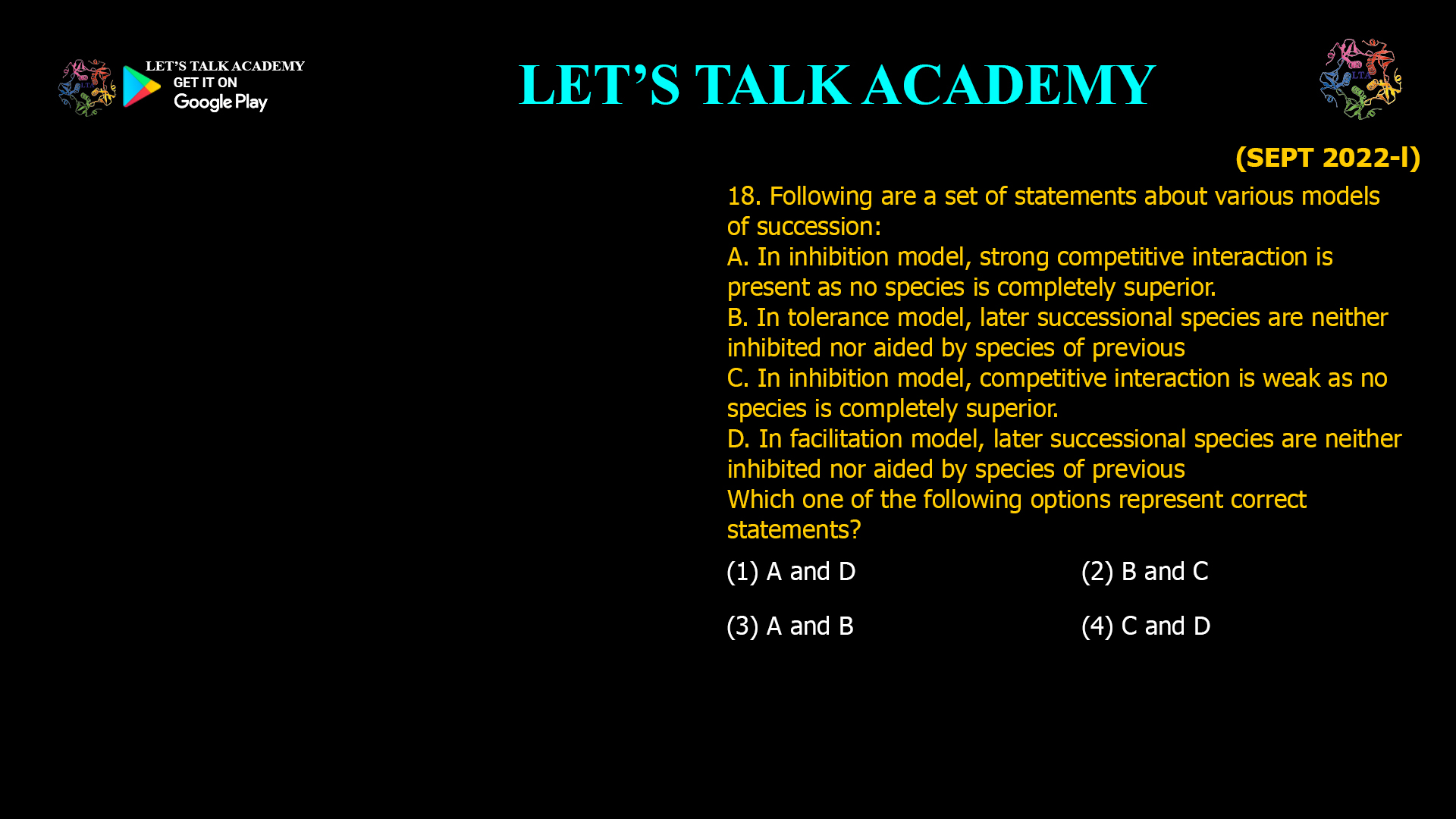
18. Following are a set of statements about various models of succession: A. In inhibition model, strong competitive interaction is present as no species is completely superior. B. In tolerance model, later successional species are neither inhibited nor aided by species of previous C. In inhibition model, competitive interaction is weak as no species is completely superior. D. In facilitation model, later successional species are neither inhibited nor aided by species of previous Which one of the following options represent correct statements? (1) A and D (2) B and C (3) A and B (4) C and D

Which Statements About Ecological Succession Models Are Correct? – Analyzing Facilitation, Tolerance, and Inhibition

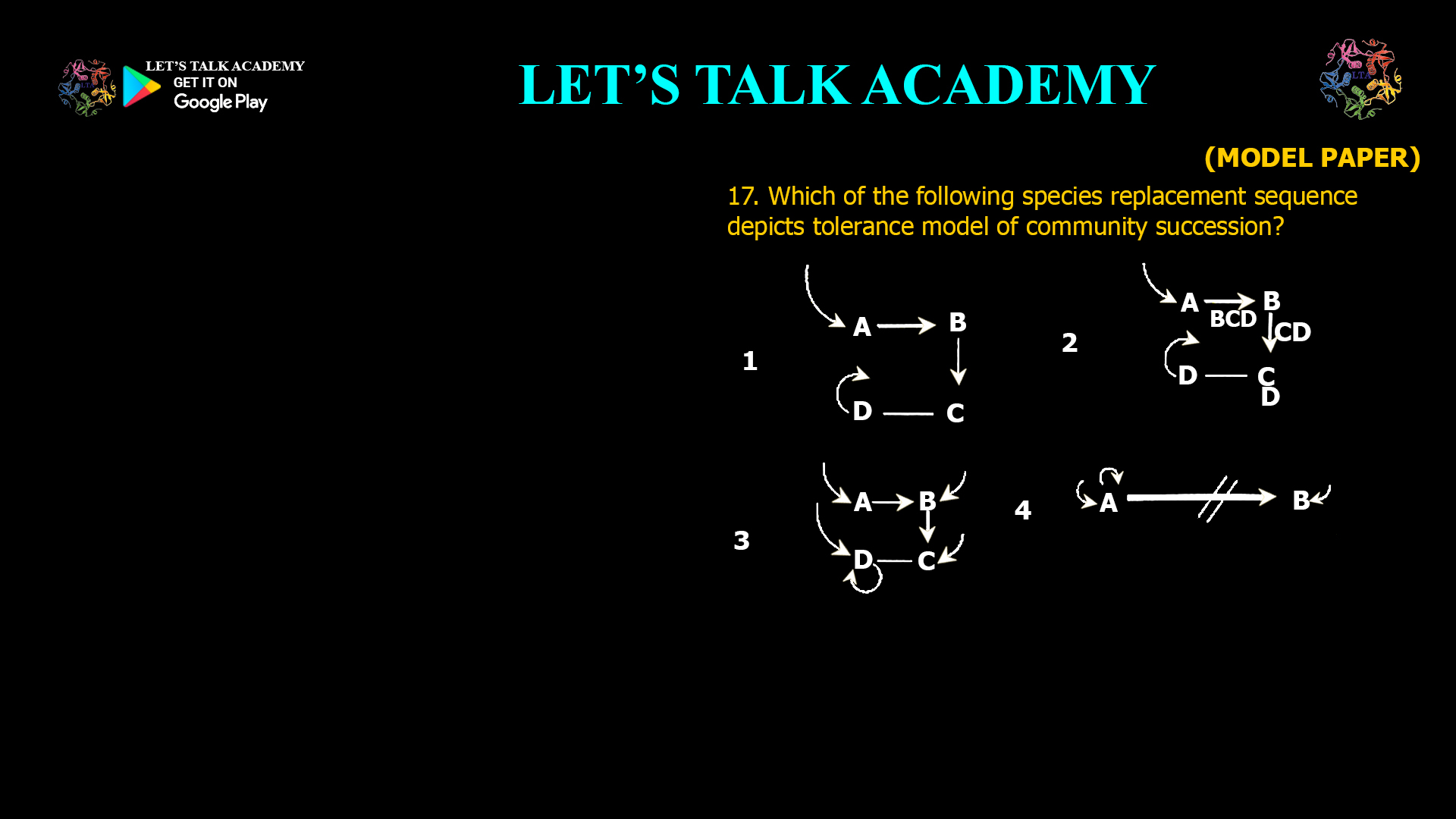
17. Which of the following species replacement sequence depicts tolerance model of community succession?

Which Species Replacement Sequence Depicts the Tolerance Model of Community Succession? – Understanding Ecological Succession Dynamics

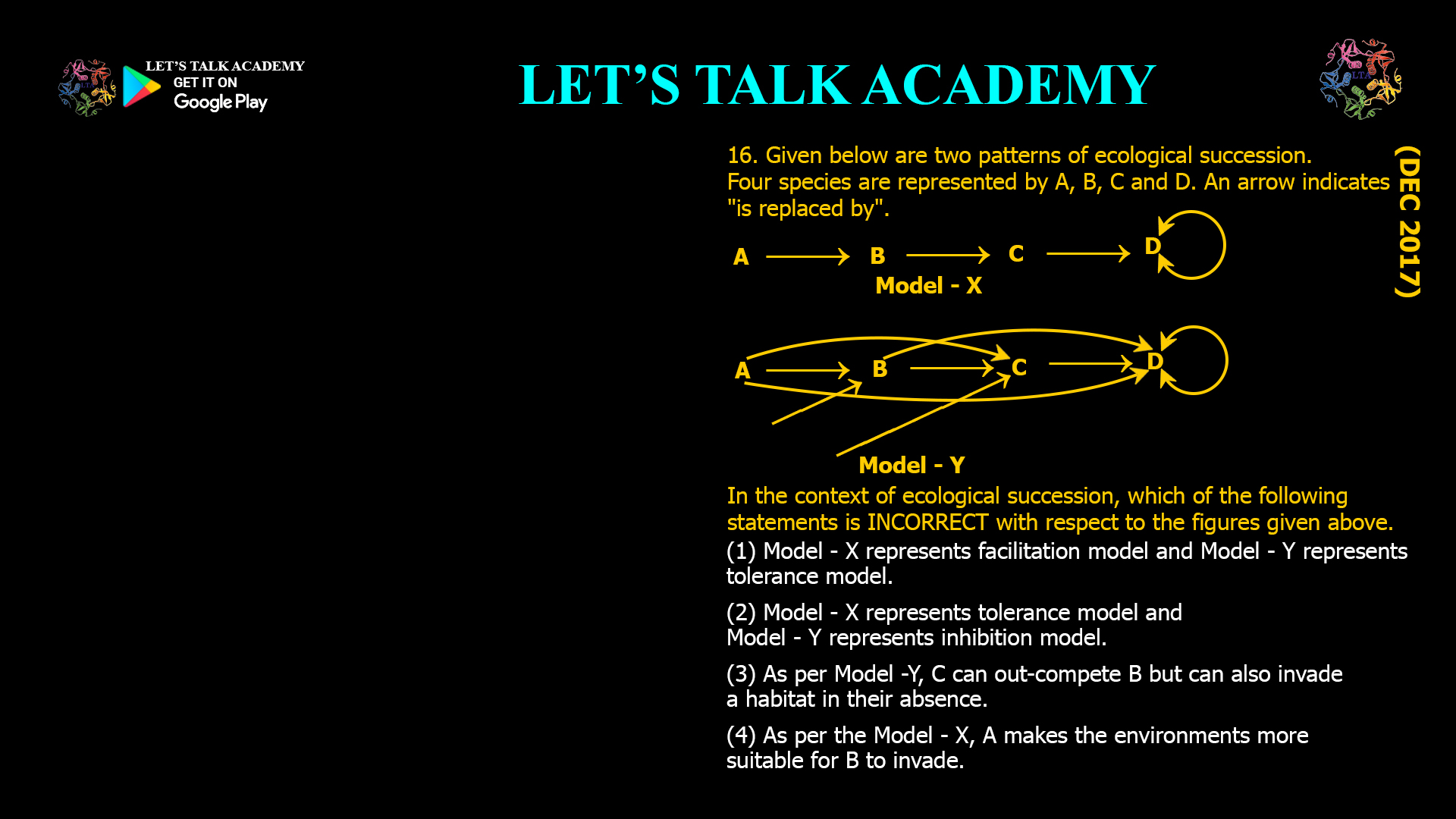
16. Given below are two patterns of ecological succession. Four species are represented by A, B, C and D. An arrow indicates "is replaced by". In the context of ecological succession, which of the following statements is INCORRECT with respect to the figures given above. (1) Model - X represents facilitation model and Model - Y represents tolerance model. (2) Model - X represents tolerance model and Model - Y represents inhibition model. (3) As per Model -Y, C can out-compete B but can also invade a habitat in their absence. (4) As per the Model - X, A makes the environments more suitable for B to invade.

Which Statement Is Incorrect About Ecological Succession Models? – Understanding Facilitation, Tolerance, and Inhibition

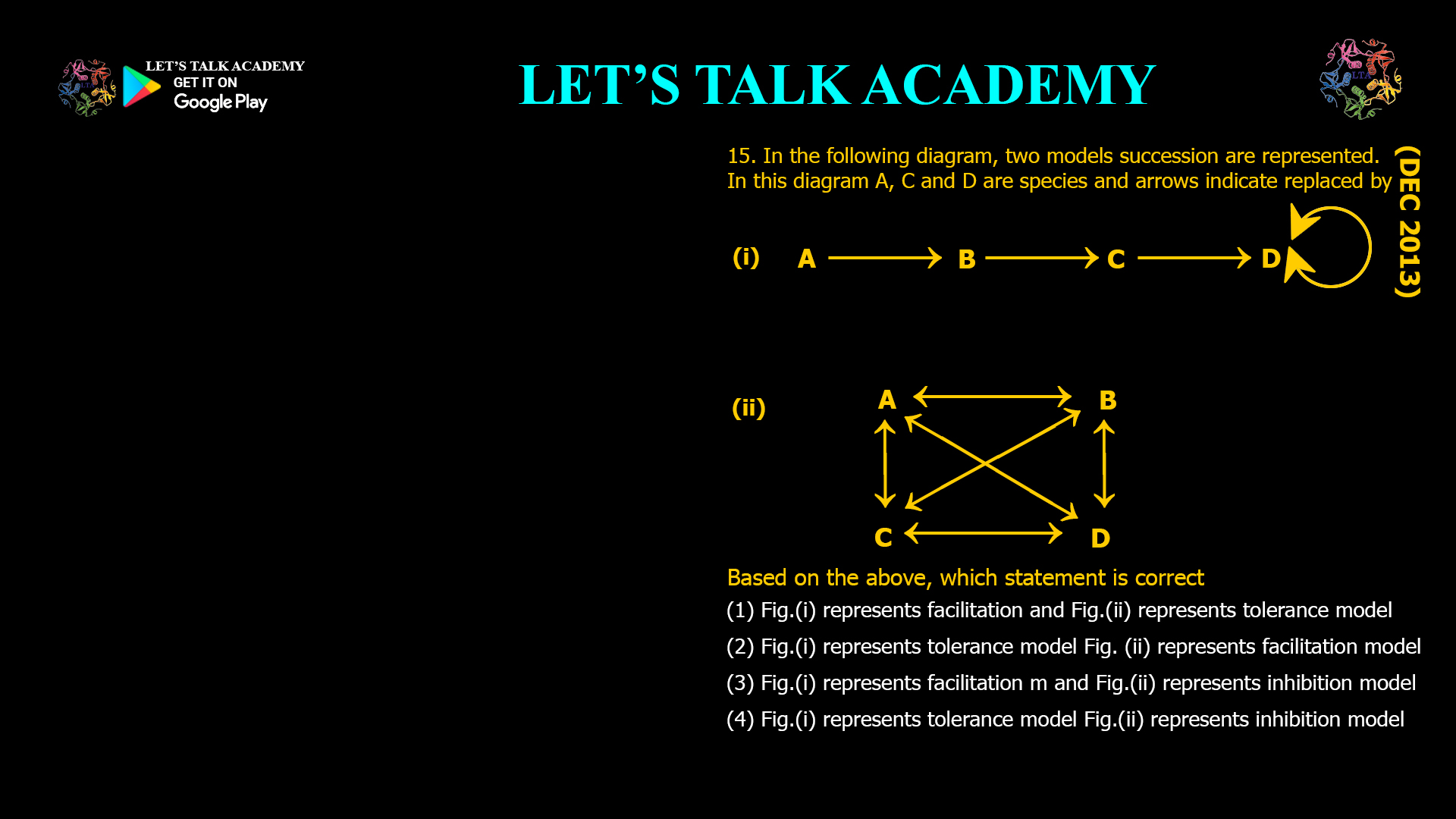
15. In the following diagram, two models succession are represented. In this diagram A, C and D are species and arrows indicate replaced by Based on the above, which statement is correct (1) Fig.(i) represents facilitation and Fig.(ii) represents tolerance model (2) Fig.(i) represents tolerance model Fig. (ii) represents facilitation model (3) Fig.(i) represents facilitation m and Fig.(ii) represents inhibition model (4) Fig.(i) represents tolerance model Fig.(ii) represents inhibition model

Which Succession Model Does Each Diagram Represent? – Understanding Facilitation, Tolerance, and Inhibition in Ecological Succession

14. In tolerance model of succession, environment modified by early occupants is (1) less suitable for subsequent recruitment of Early Successional Species (ESS), but has little or no effect on the subsequent recruitment of Late Successional Species (LSS). (2) less suitable for subsequent recruitment of ESS and more suitable for the recruitment of LSS. (3) more suitable for subsequent recruitment of ESS and less suitable for the recruitment of LSS. (4) less suitable for the subsequent recruitment of both ESS and LSS.

How Does the Tolerance Model of Succession Affect Species Recruitment? – Understanding Early and Late Successional Dynamics

Which one of the following options lists mechanisms that drive ecological succession? (1) Only facilitation and tolerance (2) Disturbance and tolerance (3) Only tolerance and inhibition (4) Facilitation, tolerance and inhibition

What Mechanisms Drive Ecological Succession? – Exploring Facilitation, Tolerance, and Inhibition

12. Which of the following is NOT a characteristic of late successional forest plant species? (1) Large seed size, high root to shoot ratio. (2) Long seed dispersal distance, long seed viability (3) Slow growth rate, long maximum life span. (4) Low light saturation intensity, high efficiency at low light.

Which Is NOT a Characteristic of Late Successional Forest Plant Species? – Traits of Mature Forest Plants

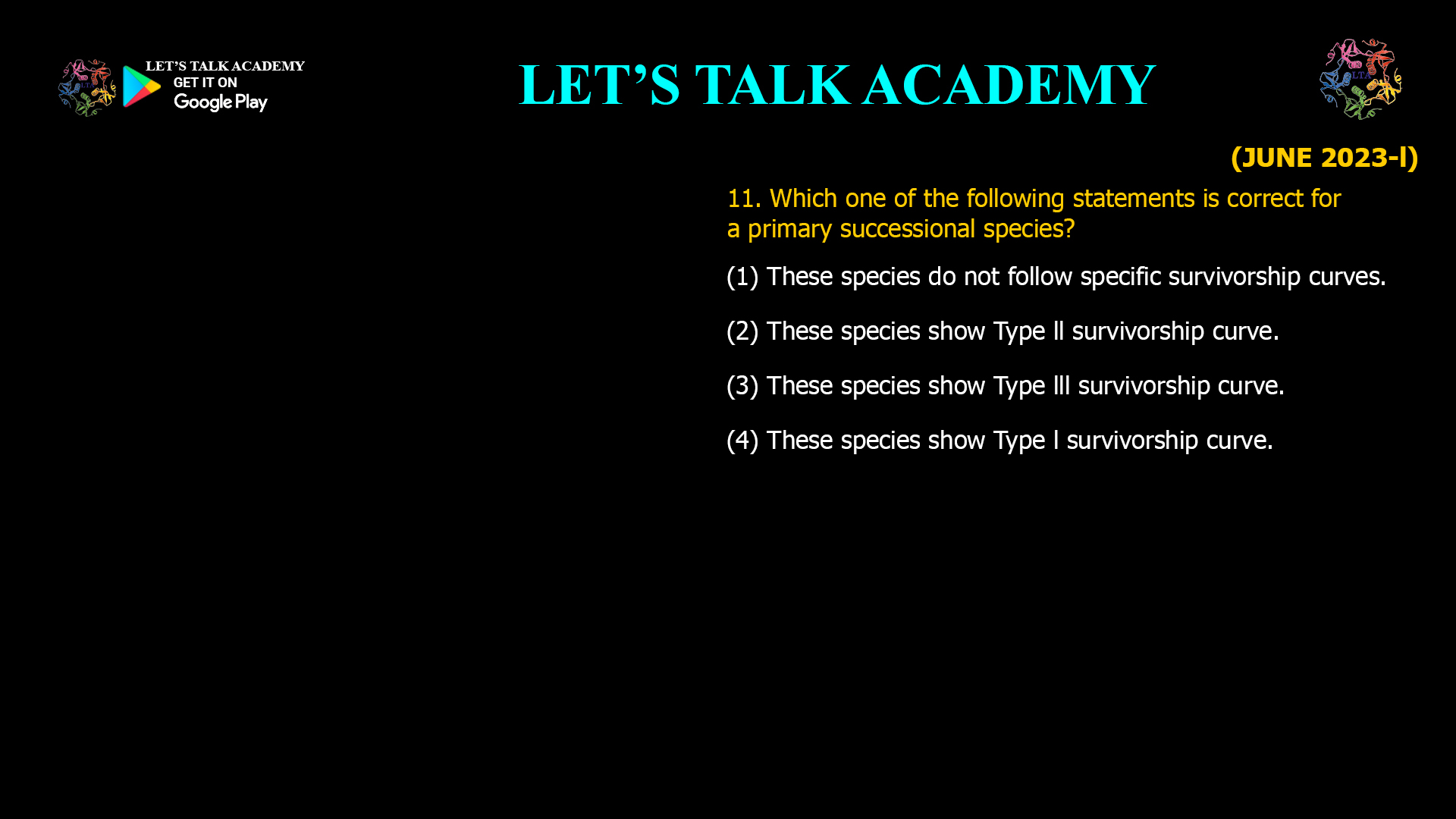
Which one of the following statements is correct for a primary successional species? (1) These species do not follow specific survivorship curves. (2) These species show Type ll survivorship curve. (3) These species show Type lll survivorship curve. (4) These species show Type l survivorship curve.v

What Survivorship Curve Do Primary Successional Species Exhibit? – Understanding Pioneer Life Histories

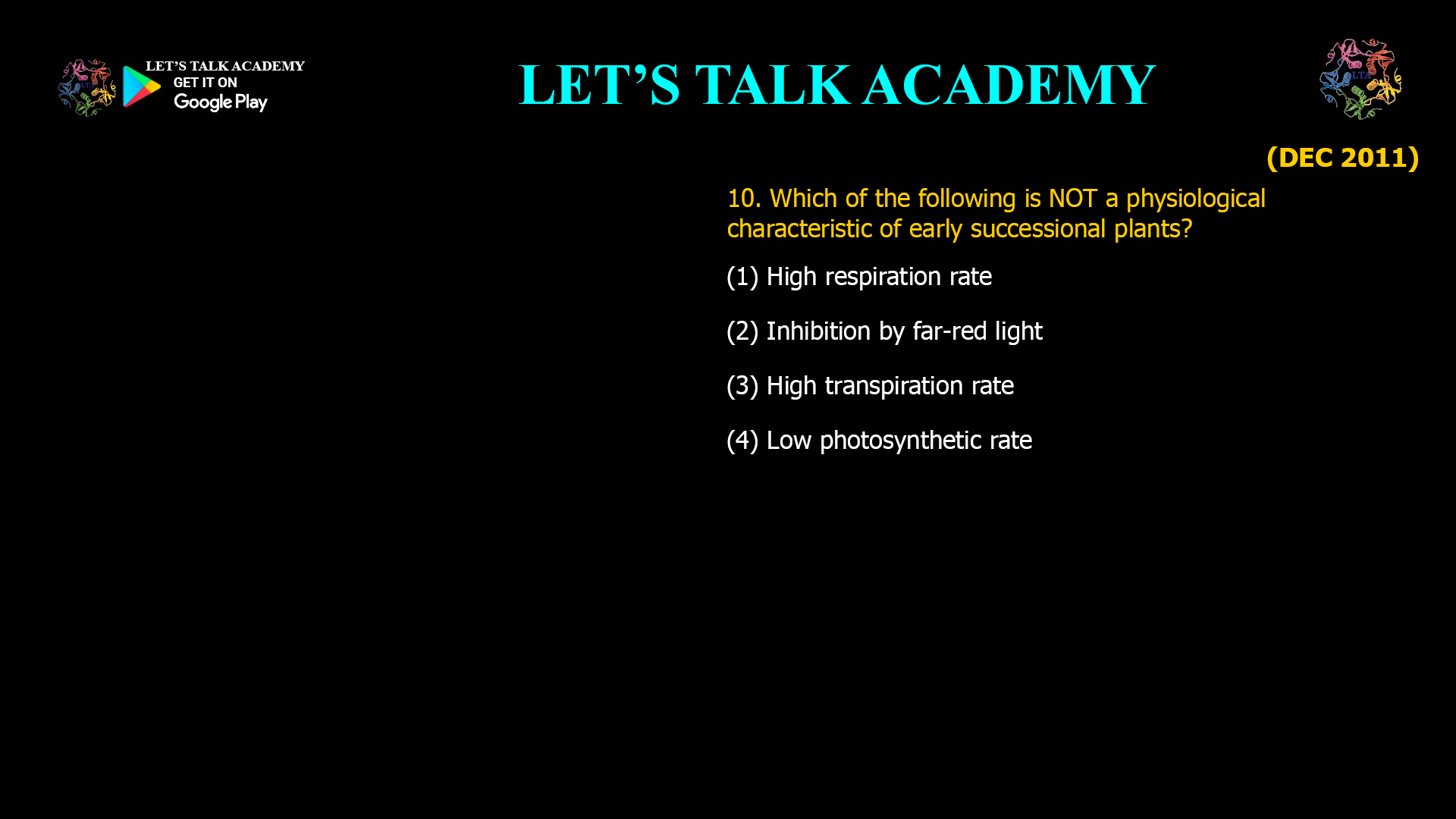
Which of the following is NOT a physiological characteristic of early successional plants? (1) High respiration rate (2) Inhibition by far-red light (3) High transpiration rate (4) Low photosynthetic rate

Which Is Not a Physiological Characteristic of Early Successional Plants? – Understanding Pioneer Plant Traits

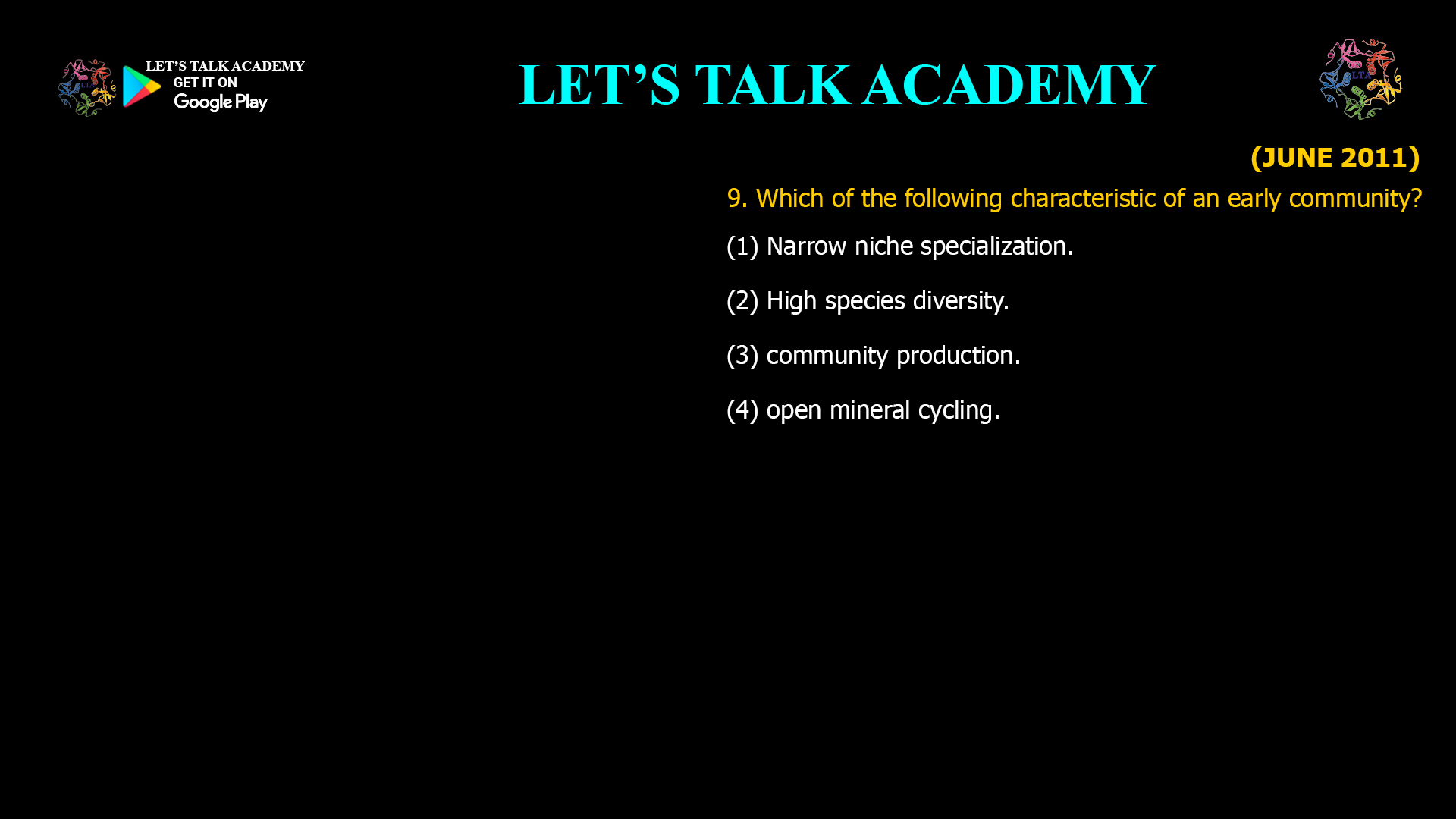
Which of the following characteristic of an early community? (1) Narrow niche specialization. (2) High species diversity. (3) community production. (4) open mineral cycling.

Which Characteristic Defines an Early Ecological Community? – Exploring Pioneer Traits and Succession

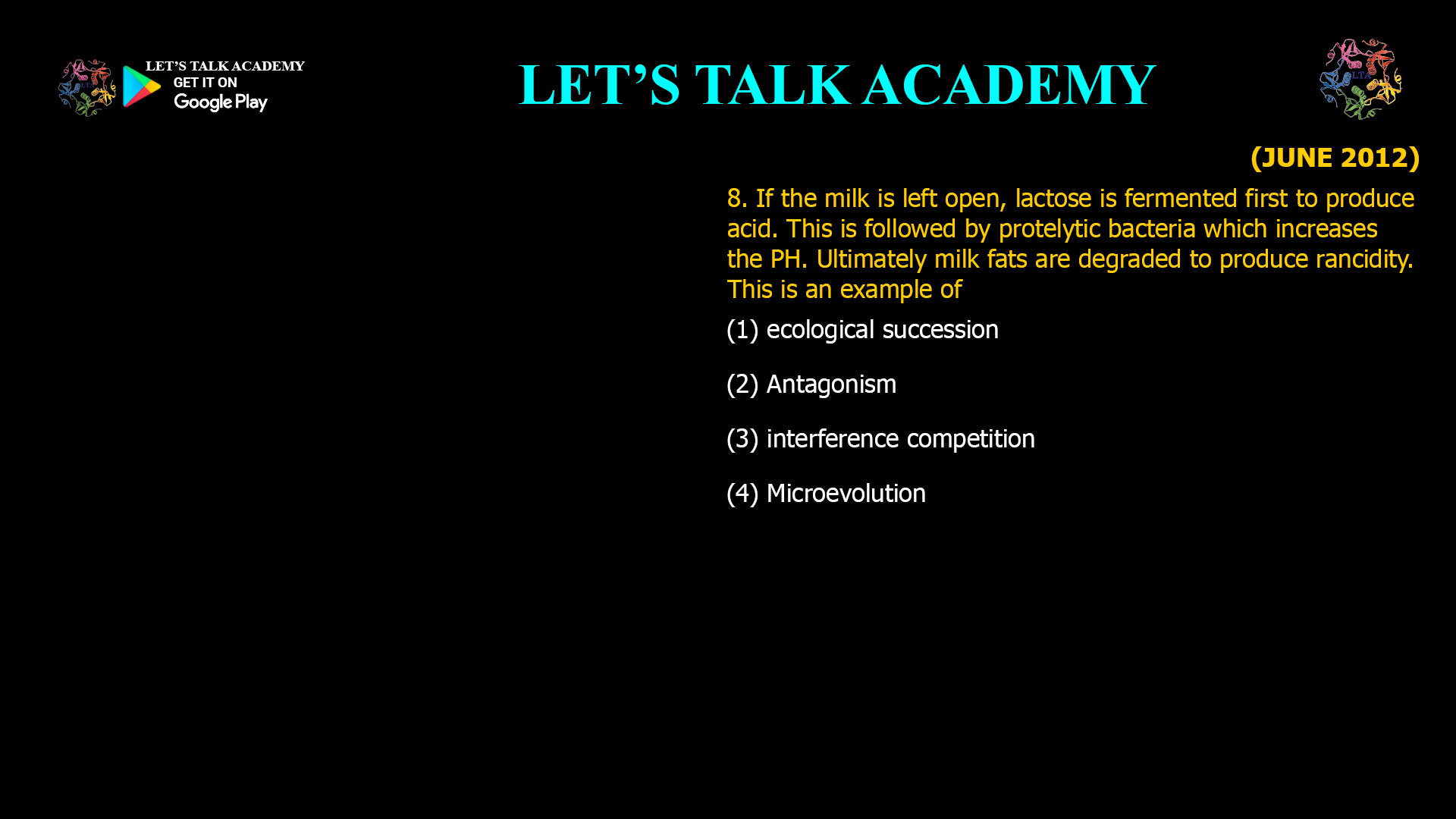
If the milk is left open, lactose is fermented first to produce acid. This is followed by protelytic bacteria which increases the PH. Ultimately milk fats are degraded to produce rancidity. This is an example of (1) ecological succession (2) Antagonism (3) interference competition (4) Microevolution

What Process Explains the Changes in Milk Left Open? – Ecological Succession in Microbial Communities

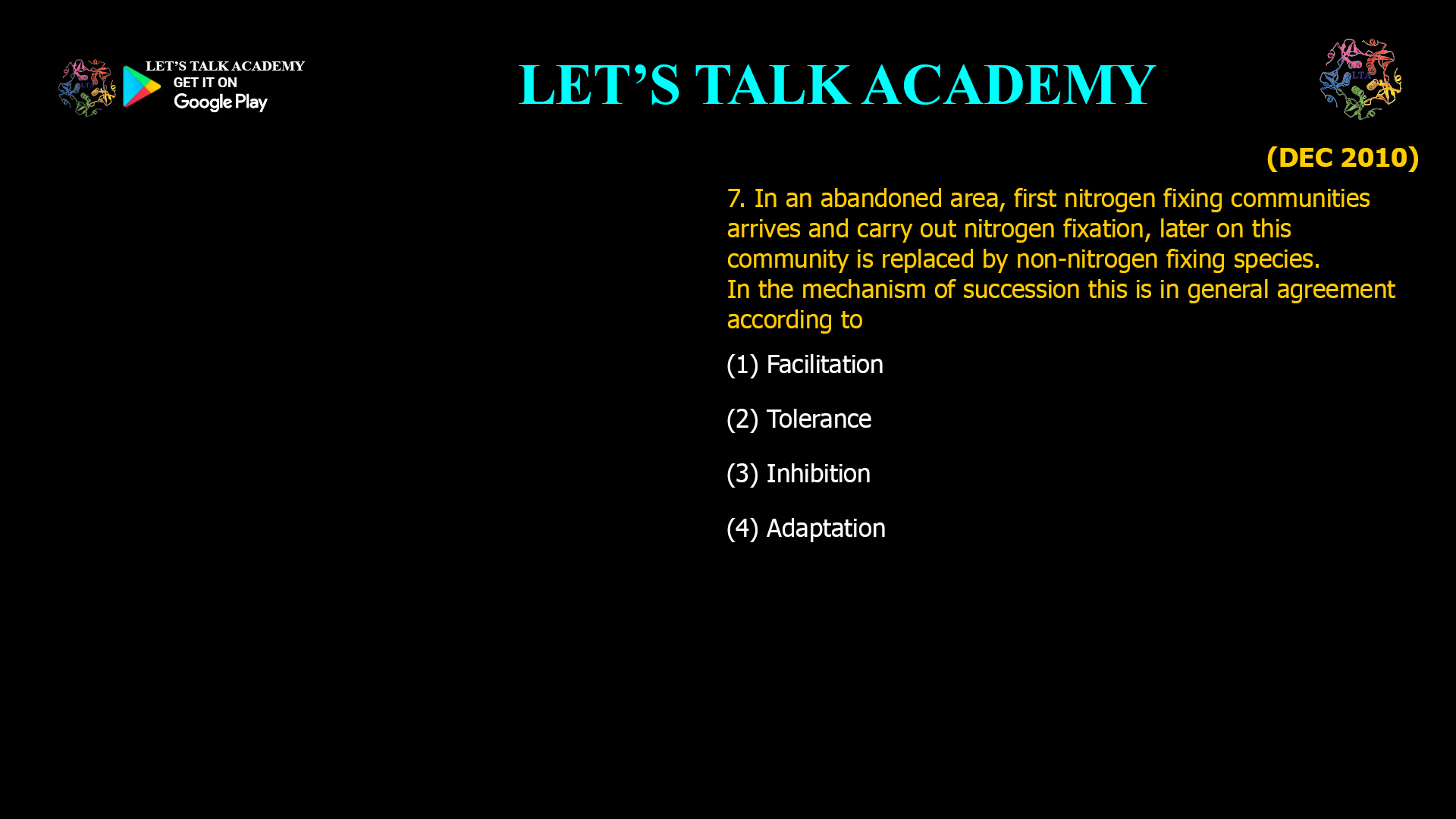
In an abandoned area, first nitrogen fixing communities arrives and carry out nitrogen fixation, later on this community is replaced by non-nitrogen fixing species. In the mechanism of succession this is in general agreement according to (1) Facilitation (2) Tolerance (3) Inhibition                                                  (4) Adaptation

How Do Nitrogen-Fixing Communities Drive Succession in Abandoned Areas? – The Role of Facilitation in Ecosystem Development

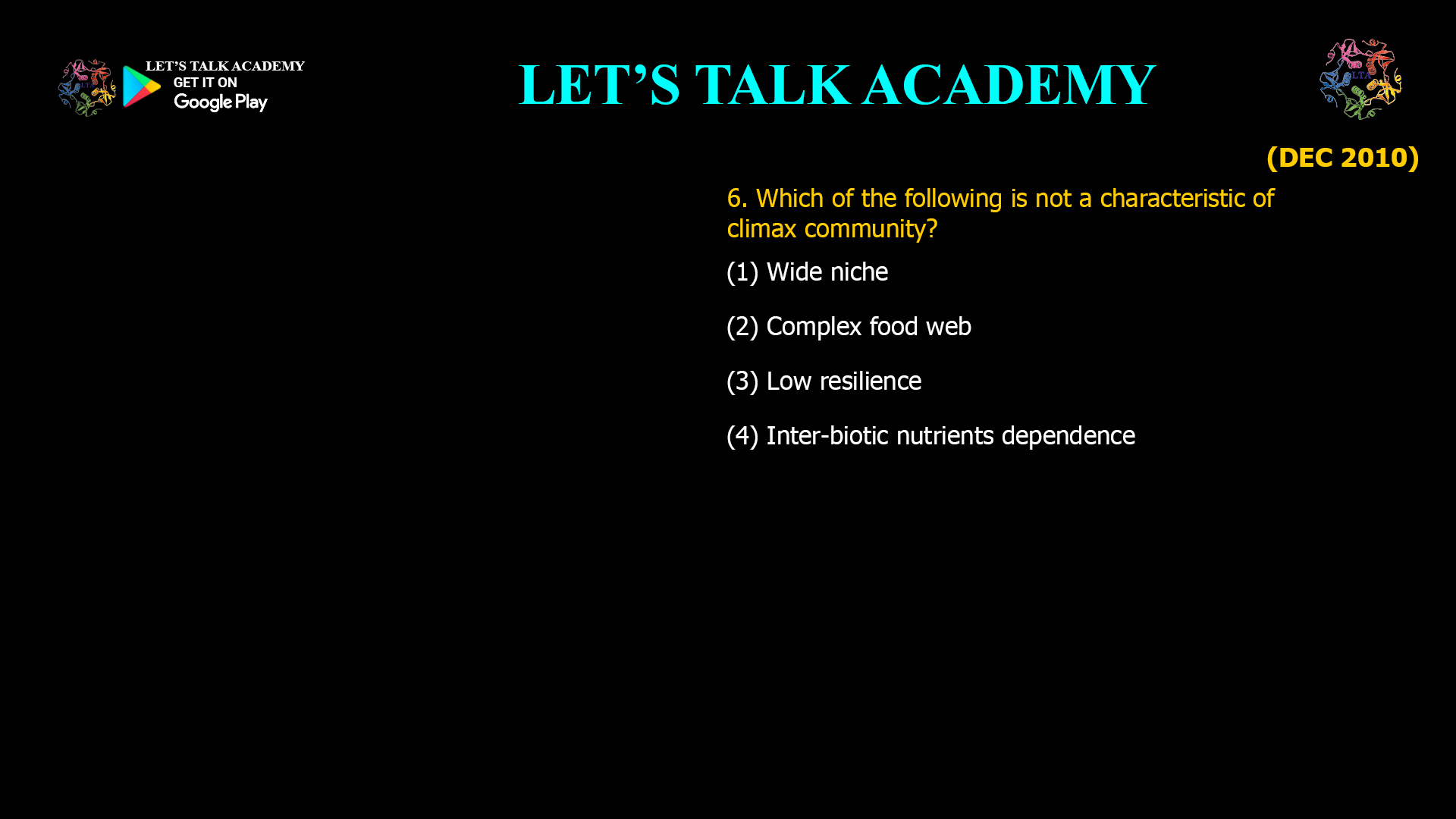
Which of the following is not a characteristic of climax community? (1) Wide niche (2) Complex food web (3) Low resilience (4) Inter-biotic nutrients dependence

What Is NOT a Characteristic of a Climax Community? – Exploring Key Features of Mature Ecosystems

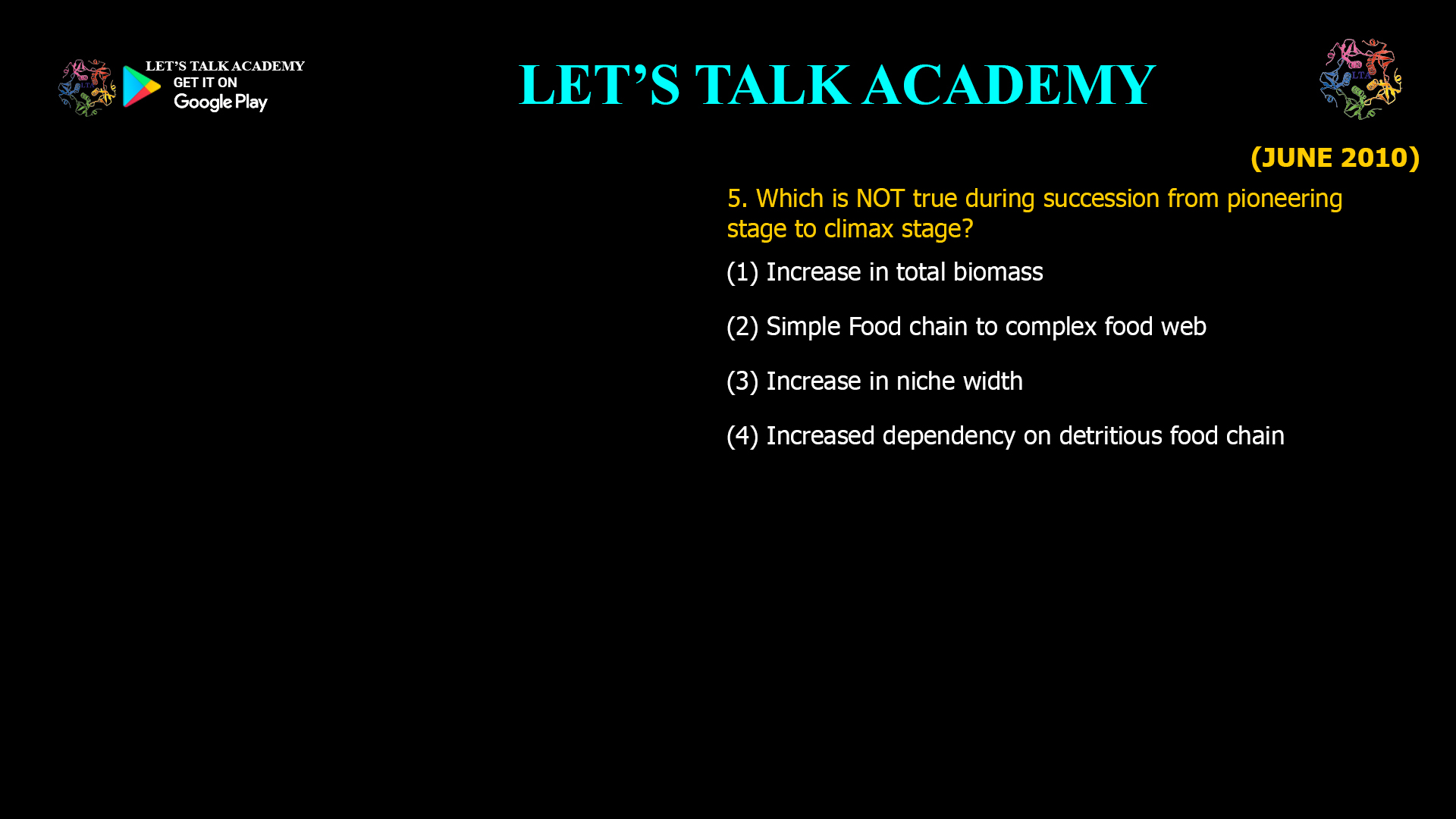
Which is NOT true during succession from pioneering stage to climax stage? (1) Increase in total biomass (2) Simple Food chain to complex food web (3) Increase in niche width (4) Increased dependency on detritious food chain

What Is Not True During Ecological Succession from Pioneer to Climax? – Key Insights into Succession Stages

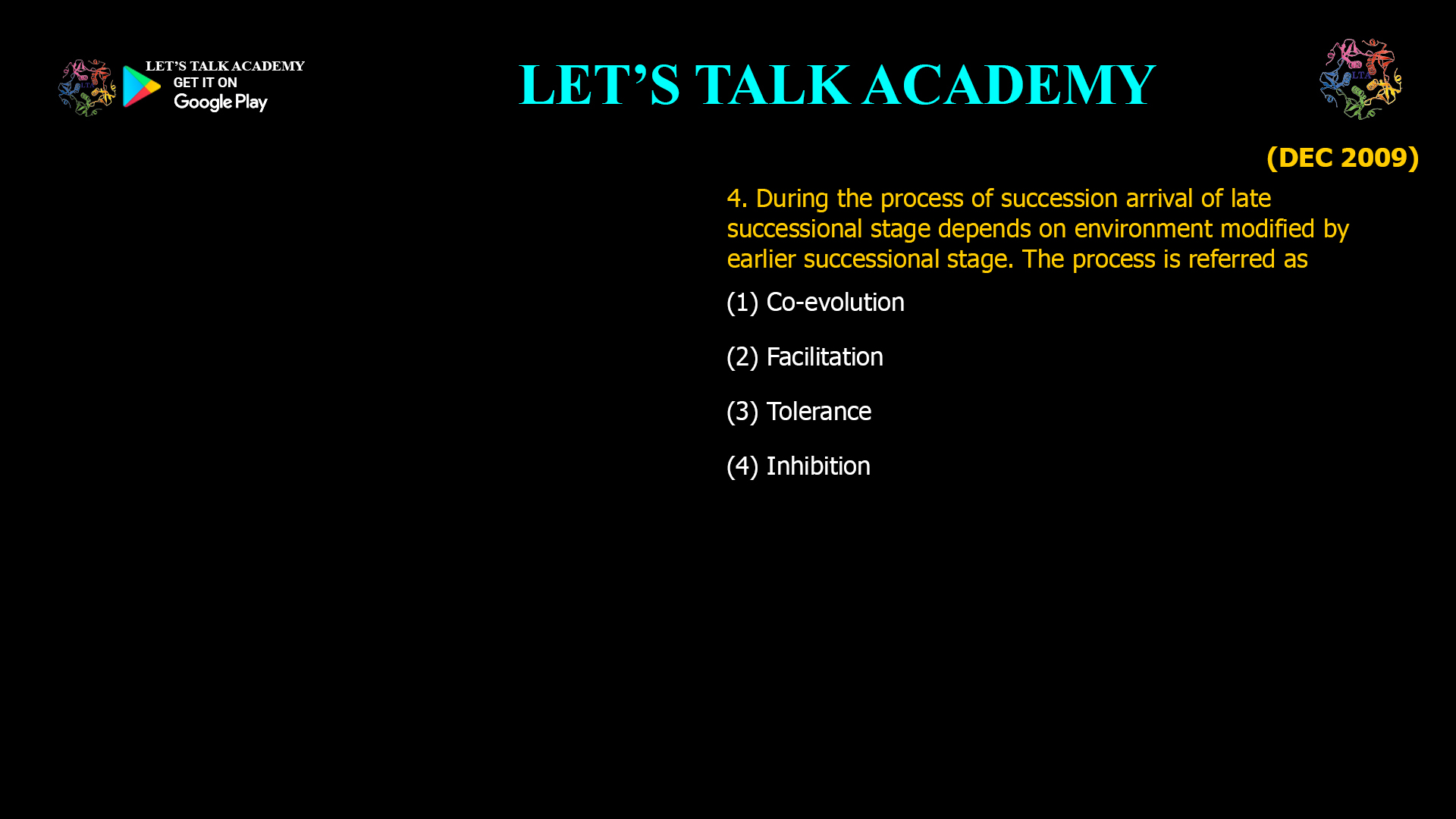
4. During the process of succession arrival of late successional stage depends on environment modified by earlier successional stage. The process is referred as (1) Co-evolution (2) Facilitation (3) Tolerance (4) Inhibition

What Is the Process Where Late Successional Species Arrive Due to Earlier Species? – Understanding Facilitation in Ecological Succession

3. Which of the following is characteristic feature of climax community? (1) Simple food chain (2) High resilience (3) High productivity (4) Narrow niche width

What Is a Characteristic Feature of Climax Communities? – Exploring Key Traits of Mature Ecosystems

2. For climax which statement is INCORRECT? (1) Number of perennial species increases (2) Dependency on detritious food chain increases (3) Vertical stratification of community increases (4) Exploitation competition is more than interference competition

Which Statement About Climax Communities Is Incorrect? – Unraveling the Truth in Ecological Succession

1. During succession the bare rock is first colonized by (1) Algae (2) Bacteria (3)Fungi (4) Lichens

What Organism First Colonizes Bare Rock During Ecological Succession?

Latest Courses