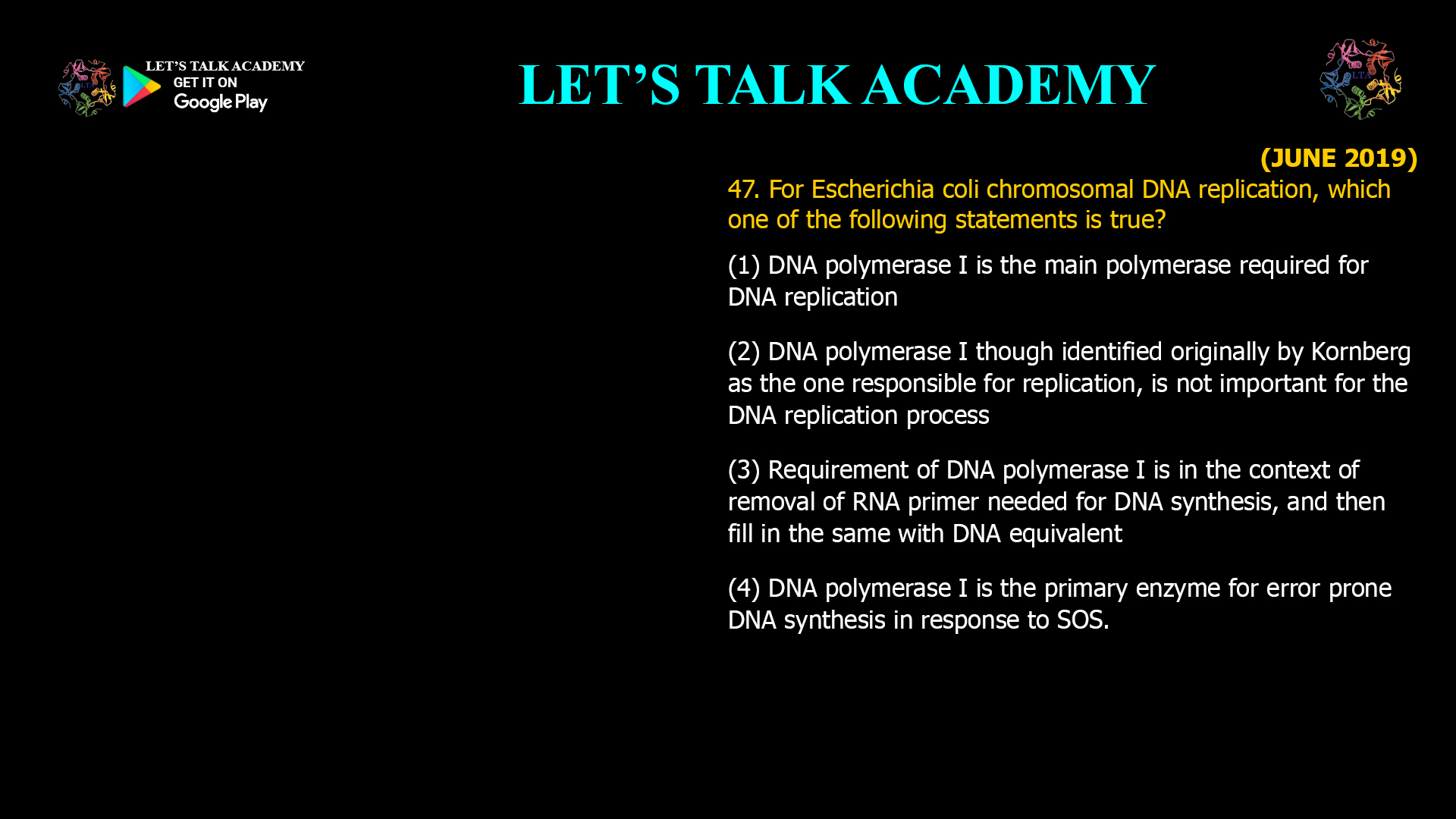
- for Escherichia coli chromosomal DNA replication, which one of the following statements is true?
(1) DNA polymerase I is the main polymerase required for DNA replication
(2) DNA polymerase I though identified originally by Kornberg as the one responsible for replication, is not important for the DNA replication process
(3) Requirement of DNA polymerase I is in the context of removal of RNA primer needed for DNA synthesis, and then fill in the same with DNA equivalent
(4) DNA polymerase I is the primary enzyme for error prone DNA synthesis in response to SOS.
Overview of DNA Polymerases in E. coli
Escherichia coli contains five DNA polymerases (Pol I, II, III, IV, and V), each with specialized roles:
-
DNA polymerase III (Pol III): The primary enzyme responsible for the bulk of chromosomal DNA replication. It is a multi-subunit holoenzyme with high processivity and proofreading ability, synthesizing both leading and lagging strands.
-
DNA polymerase I (Pol I): Functions mainly in processing Okazaki fragments by removing RNA primers and filling in the resulting gaps with DNA. It also participates in DNA repair.
-
DNA polymerases II, IV, and V: Involved in DNA repair and translesion synthesis, with Pol IV and V being error-prone polymerases active during SOS response.
Evaluating the Given Statements
-
DNA polymerase I is the main polymerase required for DNA replication
-
Incorrect. Pol I is important for primer removal and repair but not the main replicative polymerase.
-
-
DNA polymerase I, though identified originally by Kornberg as the one responsible for replication, is not important for the DNA replication process
-
Incorrect. Pol I is essential for removing RNA primers and gap filling, a critical step in lagging strand synthesis.
-
-
Requirement of DNA polymerase I is in the context of removal of RNA primer needed for DNA synthesis, and then fill in the same with DNA equivalent
-
Correct. Pol I’s 5′→3′ exonuclease activity removes RNA primers, and its polymerase activity fills in the gaps with DNA.
-
-
DNA polymerase I is the primary enzyme for error-prone DNA synthesis in response to SOS
-
Incorrect. Error-prone synthesis during SOS is mainly carried out by Pol IV and Pol V, not Pol I.
-
Supporting Evidence
-
The replicative polymerase in E. coli is DNA polymerase III holoenzyme, responsible for synthesizing the majority of DNA during replication.
-
DNA polymerase I plays a specialized role in Okazaki fragment maturation, removing RNA primers and replacing them with DNA.
-
DNA polymerase I also participates in DNA repair but is not the main replicative enzyme.
-
Error-prone DNA synthesis during SOS response is mediated by specialized polymerases (Pol IV and Pol V), not Pol I.
Final Answer
(3) Requirement of DNA polymerase I is in the context of removal of RNA primer needed for DNA synthesis, and then fill in the same with DNA equivalent
Keywords
Escherichia coli DNA replication, DNA polymerase I, DNA polymerase III, Okazaki fragment processing, RNA primer removal, DNA repair, SOS response polymerases, DNA polymerase IV, DNA polymerase V, replicative polymerase
Summary:
In E. coli, DNA polymerase III is the main enzyme responsible for chromosomal DNA replication. DNA polymerase I is crucial for removing RNA primers from Okazaki fragments and filling in the resulting gaps with DNA. The error-prone DNA synthesis during SOS response is carried out by other polymerases, not DNA polymerase I.


25 Comments
Manisha choudhary
July 29, 2025Done sir
Sneha Kumawat
July 30, 2025Dna polymerase 1 is required for removal of RNA primers and feeling is the resulting gaps with DNA during application
Khushi Agarwal
July 29, 2025Answer 3 is correct here
Khushi Agarwal
July 30, 2025Because DNA polymerase I ka main role hai: RNA primer ko remove karke us jagah DNA fill karna – especially during lagging strand synthesis.
Surbhi Rajawat
July 29, 2025Option 3 is correct, given that Pol 1 is essentially required to remove primers in prokaryotic replication
Priti Khandal
July 29, 2025Option 3 is right sir because polymerase 1 rna primer ko remove karta h
Priya Khandal
July 29, 2025Third option is right DNA polymerase RNA Prumerko remove karta hai and dna fill thw dna
anurag giri
July 30, 2025Ans 3 bcoz Pol I’s 5′→3′ exonuclease activity removes RNA primers, and its polymerase activity fills in the gaps with DNA.
Swati Choudhary
July 30, 2025Third answer is right.
Khushi Vaishnav
July 30, 2025Option 3 is correct because
Vanshika Sharma
July 30, 2025Ans 3 is correct
Anisha jakhar
July 30, 2025Option 3 is the right one
shruti sharma
July 30, 2025ANS 3
Soniya Shekhawat
July 31, 2025Option 3 is correct
Santosh Saini
July 31, 20253 option is right ( pol. 1 has 5′ to 3′ exonucleas activity remove RNA primer and also fill the gap with DNA
Aafreen
July 31, 2025Ans-3 DNA polymerase 1 required for the removal of RNA primers and filling in the gaps with DNA
Kajal
July 31, 2025Option 3 is right
Because pol. 1 remove the rna prime and fill the gap
Diksha Chhipa
July 31, 2025Opt 3 is correct because dna pol 1 have less processivity than dna pol 3 and it is not main polymerase.it is used when rna primer remove and gap fill.it also have 5 to 3 prime exonuclease activity .
Dharmpal Swami
August 1, 2025Dna polymerase 1 have 5’to 3’exonuclease activity
Remove Rna primer and gap seal
Varsha Tatla
August 3, 2025Option 3 is the wright one
Deepika sheoran
August 3, 2025Option 3 is correct answer
Polymerase 1 Rna ko remove karta hai.
Deepika sheoran
August 3, 2025Polymerase 1 Rna primer ko remove karta hai.
Deepika sheoran
August 3, 2025Option 3 is correct answer
Because polymerase 1 Rna primer ko remove karta hai.
Aman Choudhary
August 28, 2025Option C is correct
Requirement of DNA polymerase I is in the context of removal of RNA primer needed for DNA synthesis, and then fill in the same with DNA equivalent
Deepika Sheoran
November 7, 2025Polymerase 1 st RNA ko remove karta hai