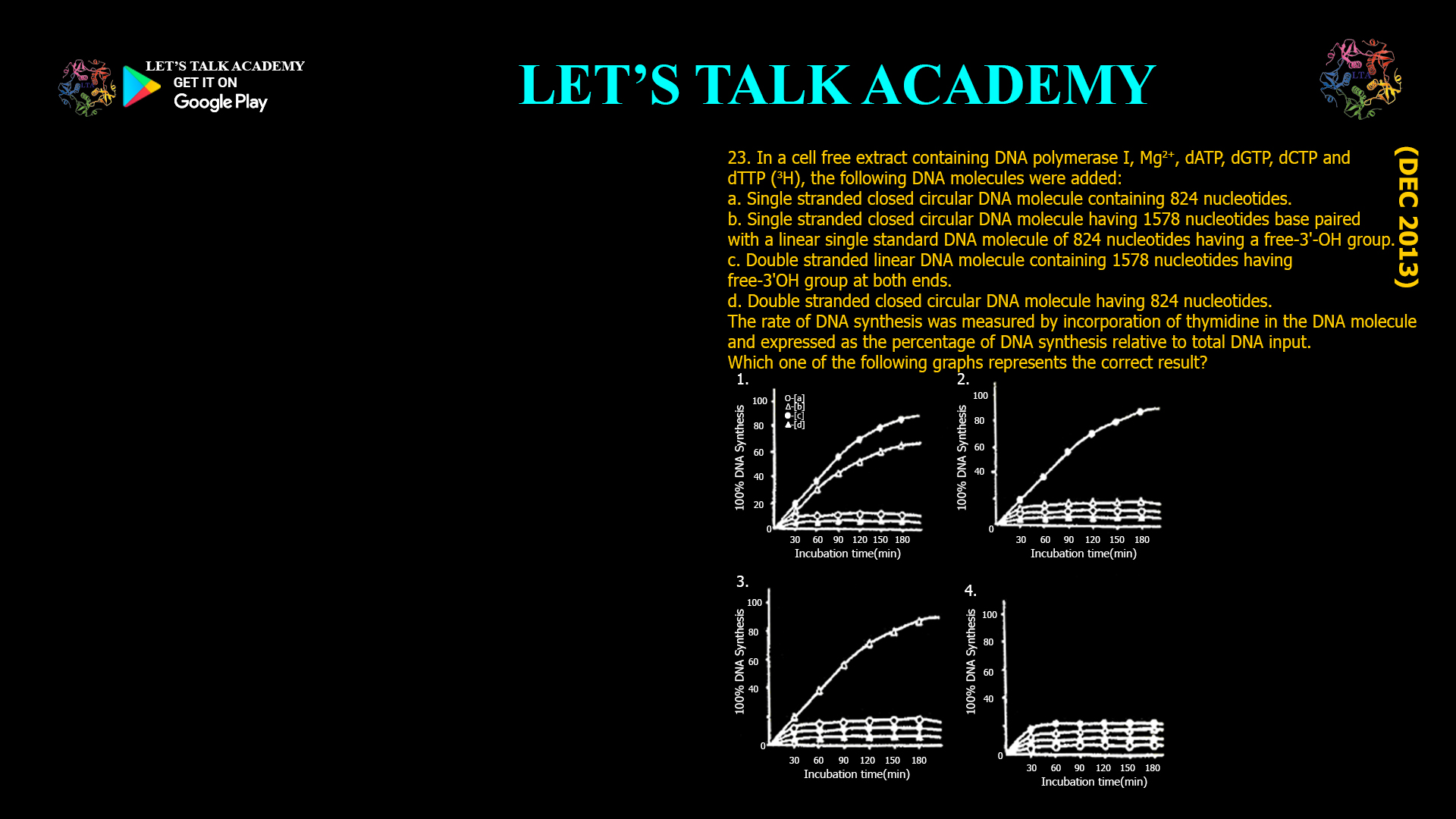
- In a cell free extract containing DNA polymerase I, Mg2+, dATP, dGTP, dCTP and dTTP3H), the following DNA
molecules were added:
- Single stranded closed circular DNA moleculecontaining 824 nucleotides.
- Single stranded closed circular DNA molecule having1578 nucleotides base paired with a linear singlestandard DNA molecule of 824 nucleotides having a
free-3′-OH group.
- Double stranded linear DNA molecule containing 1578 nucleotides having free-3’OH group at both ends.
- Double stranded closed circular DNA molecule having 824 nucleotides.
The rate of DNA synthesis was measured by
incorporation of thymidine in the DNA molecule and expressed as the percentage of DNA synthesis relative to total DNA input. Which one of the following graphs represents the correct result?
Introduction
DNA Polymerase I (Pol I) from E. coli is a multifunctional enzyme involved primarily in processing Okazaki fragments during DNA replication. It has polymerase, 3′→5′ exonuclease (proofreading), and 5′→3′ exonuclease activities. Understanding how Pol I acts on different DNA substrates in vitro helps elucidate its biological function and substrate specificity.
In a cell-free extract containing DNA Polymerase I, Mg^2+, and the four deoxyribonucleotide triphosphates (dATP, dGTP, dCTP, and tritiated dTTP), DNA synthesis can be measured by incorporation of labeled thymidine into DNA molecules. The substrates tested include:
-
(a) Single-stranded closed circular DNA (824 nucleotides)
-
(b) Single-stranded closed circular DNA (1578 nucleotides) hybridized with a linear single-stranded DNA (824 nucleotides) having a free 3′-OH group
-
(c) Double-stranded linear DNA (1578 nucleotides) with free 3′-OH ends
-
(d) Double-stranded closed circular DNA (824 nucleotides)
Expected DNA Synthesis Activity on Each Substrate
-
(a) Single-stranded closed circular DNA (ssDNA, 824 nt)
-
Pol I requires a primer with a free 3′-OH to initiate DNA synthesis.
-
Pure ssDNA without a primer or free 3′-OH end will not support significant DNA synthesis.
-
Therefore, DNA synthesis on this substrate will be very low or negligible.
-
-
(b) Hybrid molecule: ssDNA closed circular (1578 nt) base-paired with linear ssDNA (824 nt) with free 3′-OH
-
The linear strand provides a primer-template junction with a free 3′-OH end.
-
This substrate mimics a primed template and is efficiently extended by Pol I, leading to significant DNA synthesis.
-
This substrate will show the highest DNA synthesis activity relative to others.
-
-
(c) Double-stranded linear DNA (1578 nt) with free 3′-OH ends
-
Pol I can extend from free 3′-OH ends on linear dsDNA.
-
DNA synthesis will occur but may be less efficient compared to a primed ssDNA template due to lack of processivity and potential end effects.
-
Moderate DNA synthesis is expected.
-
-
(d) Double-stranded closed circular DNA (824 nt)
-
Pol I cannot initiate DNA synthesis on fully double-stranded closed circular DNA without a primer or nick.
-
Unless the DNA contains nicks or gaps, DNA synthesis will be minimal or absent.
-
Therefore, low DNA synthesis is expected.
-
Summary of Expected DNA Synthesis Rates (Relative to DNA Input)
| Substrate Description | DNA Synthesis Activity (Relative) |
|---|---|
| (a) Single-stranded closed circular DNA (824 nt) | Very low / negligible |
| (b) ssDNA circular (1578 nt) hybridized with linear ssDNA (824 nt) with free 3′-OH | Highest activity |
| (c) Double-stranded linear DNA (1578 nt) with free 3′-OH ends | Moderate activity |
| (d) Double-stranded closed circular DNA (824 nt) | Very low / negligible |
Explanation
-
DNA Polymerase I requires a primer-template junction with a free 3′-OH group to add nucleotides.
-
Substrate (b) provides an ideal primed template, allowing efficient DNA synthesis.
-
Linear dsDNA with free 3′-OH ends (c) allows extension but may be less efficient due to lack of processivity.
-
Pure ssDNA without primers (a) and closed circular dsDNA without nicks (d) do not provide initiation sites for Pol I, resulting in minimal synthesis.
Conclusion
In a cell-free system with DNA Polymerase I and required dNTPs, the hybrid DNA substrate (b) containing a primed template with a free 3′-OH end will exhibit the highest DNA synthesis. Linear dsDNA with free 3′-OH ends (c) will show moderate synthesis, while single-stranded closed circular DNA (a) and double-stranded closed circular DNA (d) will show little to no DNA synthesis.


12 Comments
Manisha choudhary
July 28, 2025Itna smjh nhi aaya sir
Priya Khandal
July 29, 2025Sir ue nahi aaya
Priti Khandal
July 29, 2025Sir ye samjh nahi aaya
shruti sharma
July 30, 2025read ache se kra h
Aafreen
July 30, 2025May be 1st or 2nd
Pratibha Sethiya
July 30, 2025Option b is only correct
In ( C) , DNA is double stranded and complete – both strands are already base paired,
Mana uske ends par 3′ OH present h but koi bhi primer present nhi h so
no primer — no little starting piece with a free 3′-OH that’s single-stranded and already attached.
So DNA polymerase sirf new nucleotide add krta h but usko Start krne k liye template to chahiye
(B) gives a complementary template (single-stranded DNA with free 3′-OH already paired to a template)
Diksha Chhipa
July 31, 2025DNA pol 1 nd pol 3 both are template dependent and need free 3 prime oh so that new ntd add.In first opt and fourth opt no template available . So no dna synthesis. In third opt 3prime free oh group present but no template available.but in 2 opt free oh is present and template also present so dna synthesis occur
Dipti Sharma
August 1, 2025DNA Polymerase I requires a primer-template junction so c has fast replication while a and d have negligible.
Khushi Vaishnav
August 1, 2025Option b is correct
Mahima Sharma
August 2, 2025❓
Soniya Shekhawat
August 3, 2025In this b has both primer or 3’OH show highly dna synthesis, c has only 3’OH has moderate synthesis, a and d has not primer and 3’OH has negligible synthesis so that information show or correlate to graph 1st so OPTION 1 IS CORRECT because dna pol 1 has required primer and 3’OH for dna synthesis.
Soniya Shekhawat
August 3, 2025In this question b has both primer or 3’OH show highly dna synthesis, c has only 3’OH has moderate synthesis, a and d has not primer and 3’OH has negligible synthesis so that information show or correlate to graph 1st so option 1 is CORRECT because dna pol 1 has required primer and 3’OH for dna synthesis.