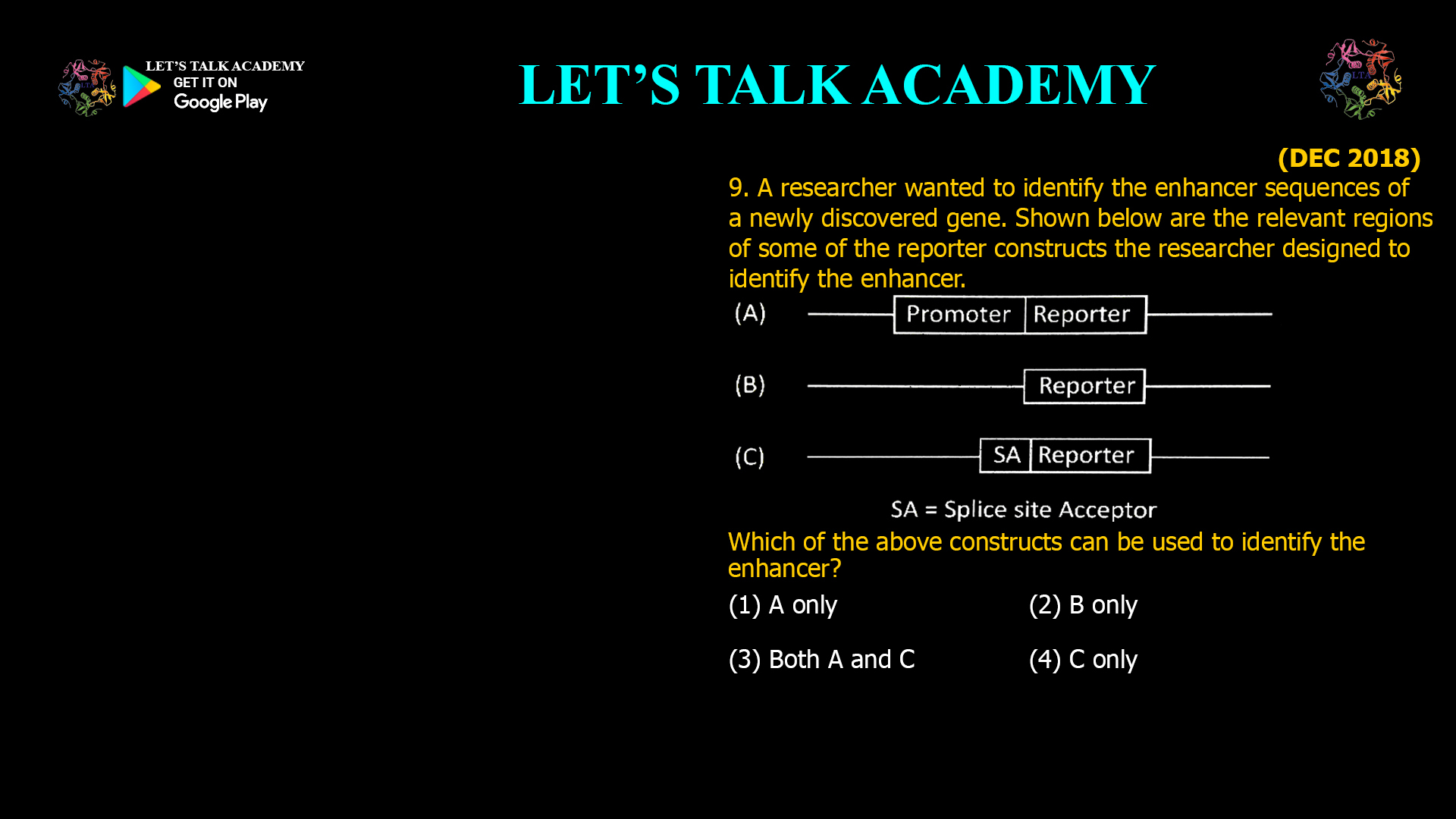
9. A researcher wanted to identify the enhancer sequences of a newly discovered gene. Shown below are the relevant regions of some of the reporter constructs the researcher designed to identify the enhancer.
Which of the above constructs can be used to identify the enhancer?
(1) A only (2) B only
(3) Both A and C (4) C only
Introduction
Enhancers are critical DNA sequences that regulate gene expression by increasing transcription from promoters, often in a tissue-specific or developmental stage-specific manner. Identifying enhancer sequences is fundamental to understanding gene regulation, developmental biology, and disease mechanisms. A common approach to identify enhancers involves using reporter gene assays with specially designed DNA constructs. This article explains why Construct A, which links a candidate enhancer sequence to a minimal promoter and a reporter gene, is the best choice for enhancer identification.
What Are Enhancers?
Enhancers are cis-regulatory DNA elements that can increase the transcriptional output of target genes. They function independently of their orientation and can act over large distances from the promoter. Enhancers bind transcription factors (activators or repressors) and facilitate the assembly of the transcriptional machinery at the promoter.
Principles of Enhancer Identification Using Reporter Constructs
To test whether a DNA sequence functions as an enhancer, researchers clone the candidate sequence into a reporter construct containing:
-
A minimal promoter: A basal promoter that alone drives very low or negligible expression of the reporter gene.
-
A reporter gene: Such as luciferase, GFP, or LacZ, which provides a measurable output reflecting promoter activity.
If the candidate sequence is an enhancer, it will increase reporter gene expression by activating the minimal promoter.
Why Construct A Is Ideal for Enhancer Identification
-
Contains Candidate Enhancer + Minimal Promoter + Reporter Gene:
Construct A includes the putative enhancer sequence placed upstream (or sometimes downstream) of a minimal promoter driving a reporter gene. This setup allows any enhancer activity to be directly measured as an increase in reporter expression. -
Minimal Promoter Ensures Low Baseline Expression:
The minimal promoter alone produces minimal transcription, so any increase in reporter activity can be attributed to the candidate enhancer sequence. -
Direct Functional Assay:
This construct tests the enhancer’s ability to activate transcription in a controlled manner, providing clear evidence of enhancer function.
Why Other Constructs Are Less Suitable
-
Construct B (Minimal Promoter + Reporter Only):
Serves as a negative control to establish baseline reporter activity. It cannot identify enhancers because it lacks candidate sequences. -
Construct C (Full Promoter + Reporter):
Contains the entire promoter region, which may include multiple regulatory elements including enhancers, silencers, or other sequences. It does not isolate the candidate enhancer’s effect, making it unsuitable for specifically identifying enhancer activity.
Modern Techniques and High-Throughput Assays
While traditional reporter assays like Construct A provide direct functional validation, recent advances have introduced massively parallel reporter assays (MPRA) and STARR-seq, which allow simultaneous testing of thousands of candidate enhancer sequences. These high-throughput methods rely on similar principles but scale the process massively, using unique barcodes and sequencing to quantify enhancer activity.
Summary Table
| Construct | Composition | Purpose | Suitability for Enhancer Identification |
|---|---|---|---|
| A | Candidate enhancer + minimal promoter + reporter | Tests enhancer activity directly | Ideal |
| B | Minimal promoter + reporter only | Negative control | Not suitable |
| C | Full promoter + reporter | Tests overall promoter activity | Not suitable for isolating enhancer |
Conclusion
To identify enhancer sequences effectively, the candidate DNA fragment must be tested in a reporter construct containing a minimal promoter and a reporter gene, as in Construct A. This design ensures that any increase in reporter expression is due to enhancer activity of the candidate sequence. Constructs lacking the candidate enhancer or containing full promoters do not provide specific information about enhancer function.
Answer:
The best construct to identify the enhancer is (1) A only.


