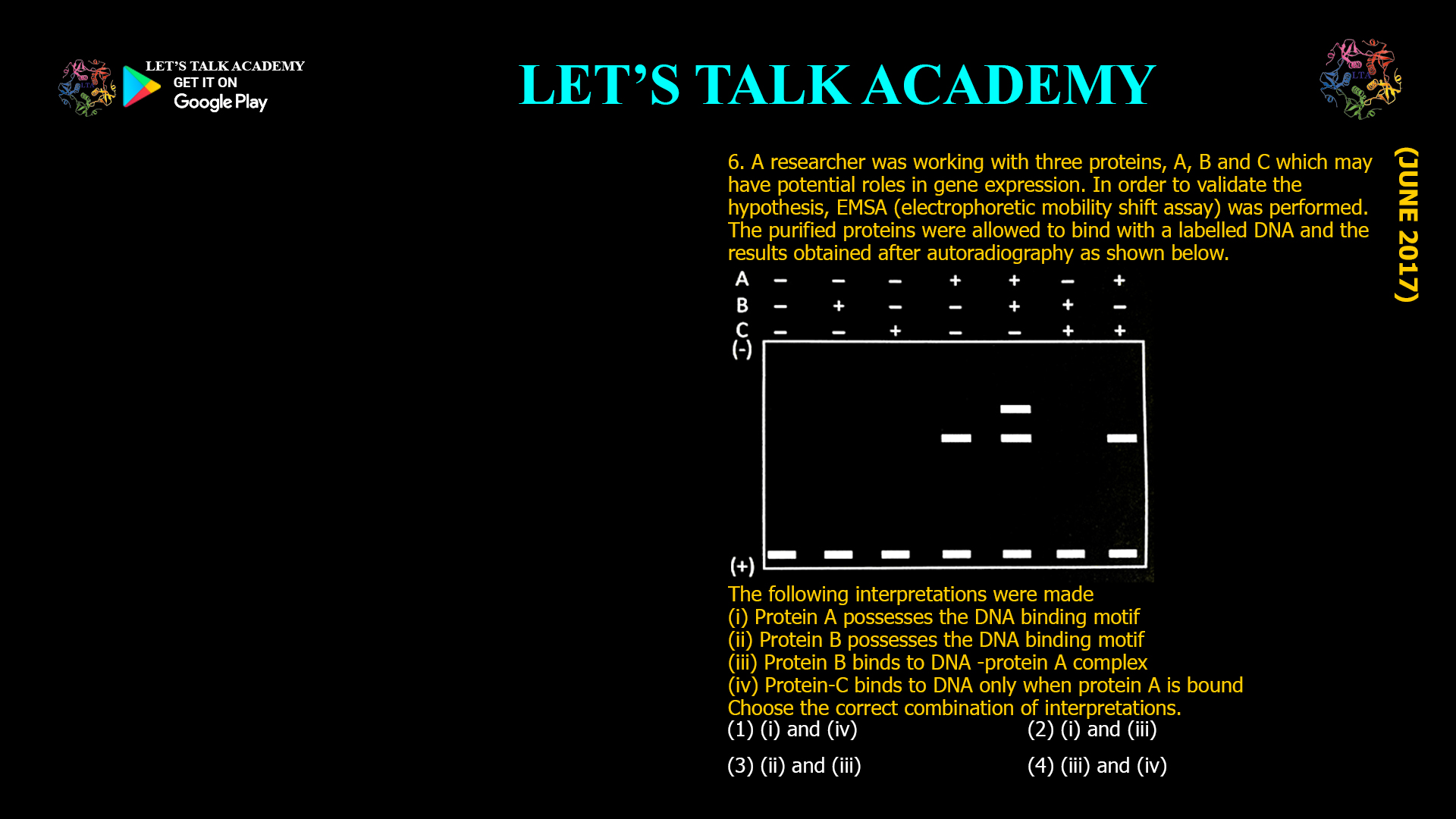
6. A researcher was working with three proteins, A, B and C which may have potential roles in gene expression. In order to validate the hypothesis, EMSA (electrophoretic mobility shift assay) was performed. The purified proteins were allowed to bind with a labelled DNA and the results obtained after autoradiography as shown below.
The following interpretations were made
(i) Protein A possesses the DNA binding motif
(ii) Protein B possesses the DNA binding motif
(iii) Protein B binds to DNA -protein A complex
(iv) Protein-C binds to DNA only when protein A is bound
Choose the correct combination of interpretations.
(1) (i) and (iv) (2) (i) and (iii)
(3) (ii) and (iii) (4) (iii) and (iv)
Introduction
The Electrophoretic Mobility Shift Assay (EMSA) is a powerful and widely used technique to study protein-DNA interactions. It can also provide insights into protein-protein interactions when multiple proteins bind to DNA sequentially or form complexes. Understanding how to interpret EMSA results is crucial for elucidating the roles of proteins in gene expression regulation. This article explains how EMSA data can reveal which proteins bind DNA directly and how proteins interact with each other on DNA.
Basics of EMSA
EMSA relies on the principle that DNA bound to protein migrates more slowly during non-denaturing gel electrophoresis than free DNA. When a protein binds to a labeled DNA fragment, it forms a complex that appears as a shifted band on the gel. Multiple shifted bands can indicate different complexes or multiple proteins binding.
Interpreting the Given EMSA Results
In the experiment, three purified proteins (A, B, and C) were tested for binding to a labeled DNA probe.
Interpretation of Statements:
-
(i) Protein A possesses the DNA binding motif:
If a shifted band appears when protein A is incubated with DNA, it indicates protein A binds DNA directly. -
(ii) Protein B possesses the DNA binding motif:
If protein B alone does not cause a shift but shifts appear when combined with protein A, protein B likely does not bind DNA directly. -
(iii) Protein B binds to DNA-protein A complex:
If a supershift or additional shifted band appears when protein B is added to protein A-DNA complex, it suggests protein B interacts with protein A while bound to DNA. -
(iv) Protein C binds to DNA only when protein A is bound:
Similarly, if protein C alone does not shift DNA but causes a shift when protein A is present, it implies protein C binds DNA indirectly via protein A.
Correct Combination Based on EMSA Principles
-
Protein A alone causes a shift → (i) is true.
-
Protein B alone does not shift DNA, but together with protein A produces a supershift → (iii) is true.
-
Protein C binding depends on protein A presence → (iv) is true.
-
Protein B alone binding (ii) is false if no shift occurs with B alone.
Among the options:
-
(1) (i) and (iv)
-
(2) (i) and (iii)
-
(3) (ii) and (iii)
-
(4) (iii) and (iv)
Since protein A binds DNA directly, and protein B binds to the A-DNA complex, the correct combination is (2) (i) and (iii).
Conclusion
EMSA provides a snapshot of protein-DNA interactions and can reveal complex formation involving multiple proteins. Protein A directly binds DNA, while protein B associates with the DNA-protein A complex. Protein C’s binding pattern can be similarly analyzed. Understanding these interactions is vital for elucidating transcriptional regulation mechanisms.
Answer:
The correct combination of interpretations is (2) (i) and (iii).


2 Comments
Khushi Pareek
August 14, 20251&3
Komal Sharma
August 23, 2025Option 2 is correct