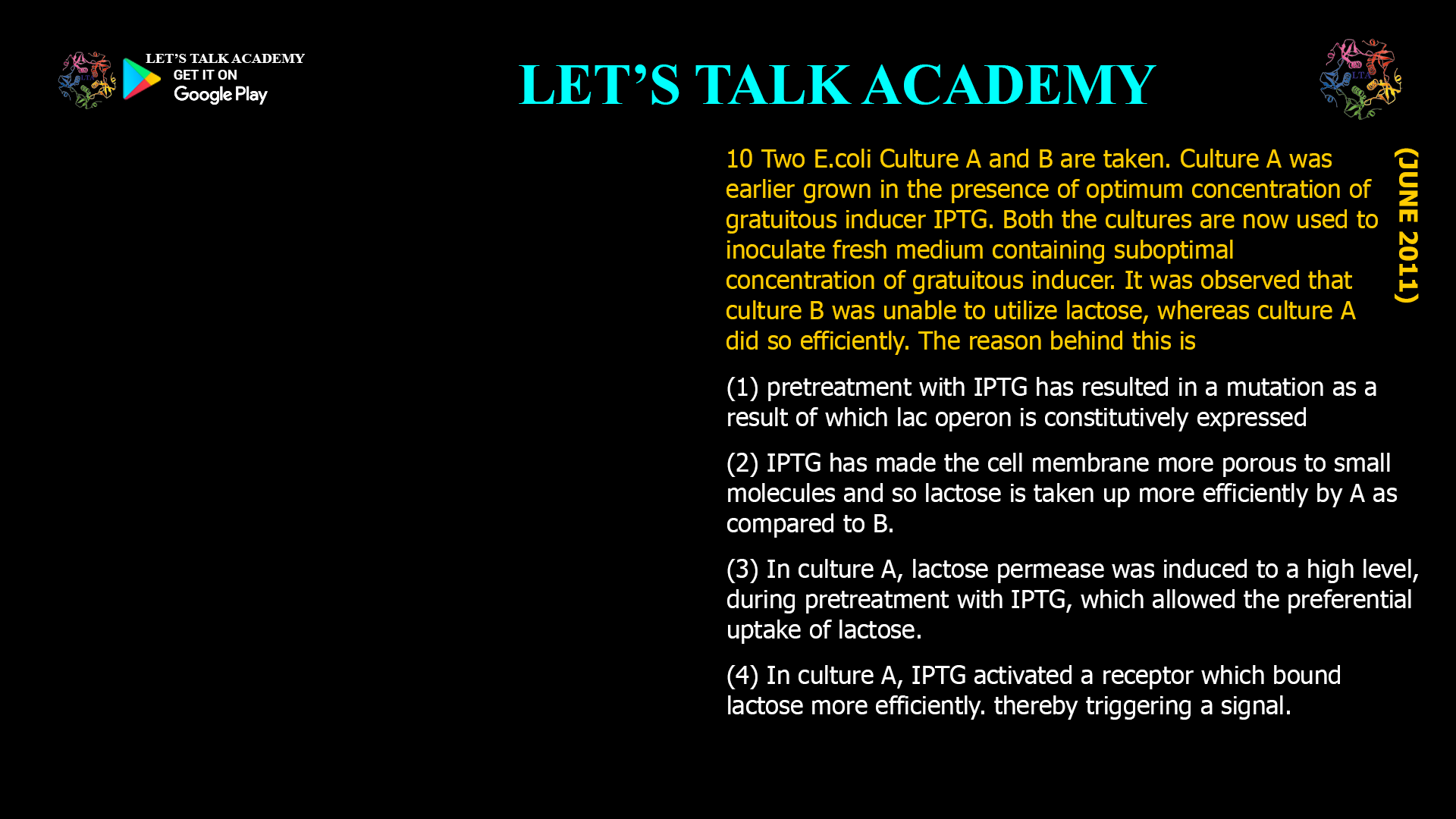
10 Two E.coli Culture A and B are taken. Culture A was earlier grown in the presence of optimum concentration of gratuitous inducer IPTG. Both the cultures are now used to inoculate fresh medium containing suboptimal concentration of gratuitous inducer. It was observed that culture B was unable to utilize lactose, whereas culture A did so efficiently. The reason behind this is
(1) pretreatment With IPTG has resulted in a mutation as a result of which lac operon is constitutively expressed
(2) IPTG has made the cell membrane more porous to small molecules and so lactose taken up more efficiently by A as compared to B.
(3) In culture A, lactose permease was induced to a high level, during pretreatment With IPTG. Which allowed the preferential uptake Of lactose.
(4) in culture A, IPTG activated a receptor which bound lactose more efficiently. thereby triggering a signal.
The lac operon in Escherichia coli is a classic model for understanding gene regulation and metabolic adaptation. When comparing two E. coli cultures—one pretreated with the gratuitous inducer IPTG (Culture A) and the other without such pretreatment (Culture B)—a striking difference in lactose utilization can be observed when both are introduced into a medium with suboptimal IPTG. Culture A utilizes lactose efficiently, while Culture B does not. Understanding the molecular basis behind this observation reveals the importance of operon induction and enzyme availability.
The Role of IPTG in Lac Operon Induction
IPTG (Isopropyl β-D-1-thiogalactopyranoside) is a synthetic, non-metabolizable analog of allolactose, the natural inducer of the lac operon. IPTG binds to the lac repressor, causing it to release from the operator and allowing transcription of the lac operon genes, including those encoding β-galactosidase and lactose permease.
Lactose Permease: The Key to Efficient Lactose Uptake
Lactose permease, encoded by the lacY gene, is a membrane protein responsible for transporting lactose into the bacterial cell. Its expression is induced as part of the lac operon. When E. coli is exposed to high concentrations of IPTG, the lac operon is strongly induced, resulting in high levels of lactose permease and β-galactosidase in the cell.
What Happens in the Experiment?
-
Culture A: Previously grown in optimum IPTG, has high levels of lactose permease already present in the cell membrane.
-
Culture B: No prior IPTG exposure, so baseline levels of lactose permease are low.
When both cultures are transferred to a fresh medium with suboptimal IPTG:
-
Culture A can immediately take up lactose efficiently due to pre-existing permease, quickly inducing the lac operon further and metabolizing lactose.
-
Culture B struggles to import lactose because it lacks sufficient lactose permease, resulting in poor induction of the lac operon and inefficient lactose utilization.
Correct Answer
(3) In culture A, lactose permease was induced to a high level, during pretreatment with IPTG. Which allowed the preferential uptake of lactose.
Why Is This Mechanism Important?
This phenomenon demonstrates the importance of positive feedback in gene regulation. Once lactose permease is present, even at low inducer concentrations, E. coli can efficiently import lactose, further inducing the operon and ensuring rapid metabolic adaptation.
Summary Table: Effect of IPTG Pretreatment on Lactose Utilization
| Culture | IPTG Pretreatment | Lactose Permease Level | Lactose Uptake | Lac Operon Induction | Lactose Utilization |
|---|---|---|---|---|---|
| A | Yes | High | Efficient | Strong | Efficient |
| B | No | Low | Inefficient | Weak | Poor |
Frequently Asked Questions
Q: What is a gratuitous inducer?
A: A molecule like IPTG that induces gene expression but is not metabolized by the cell.
Q: Why doesn’t Culture B utilize lactose efficiently?
A: It lacks sufficient lactose permease for effective lactose uptake at low inducer concentrations.
Q: Is this effect permanent?
A: No, it depends on the presence of induced proteins; over time, without induction, permease levels will decrease.
Conclusion
Pretreatment with IPTG leads to high levels of lactose permease in E. coli, enabling rapid and efficient lactose uptake even when inducer concentrations are suboptimal. This highlights the critical role of transport proteins and operon induction in bacterial metabolic flexibility and adaptation.
Keywords: E. coli, IPTG, lac operon, lactose permease, β-galactosidase, gene regulation, operon induction, lactose utilization, bacterial metabolism, gratuitous inducer, positive feedback, molecular biology.


21 Comments
Suman bhakar
June 12, 2025Easy sir 👍
Anita choudhary
June 14, 2025✅✅
Arushi
June 14, 2025Done sir
Kajal
November 3, 2025The correct answer is (3) In culture A, lactose permease was induced to a high level, during pretreatment with IPTG. Which allowed the preferential uptake of lactose.
Kirti Agarwal
November 4, 2025In culture a lactose Permease was induced to a high level during pre treatment with IP TG which allow the preferential uptake of lactose
Neha Yadav
November 6, 2025In culture A, lactose permease was induced to a high level, during pretreatment with IPTG which allowed the preferential uptake of lactose.
Heena Mahlawat
November 6, 2025Option 3
Roopal Sharma
November 6, 2025Option 3
Sonal Nagar
November 6, 2025Option 3rd
Deepika Sheoran
November 6, 2025Lactose permease was induced high level, during pretreatment with IPTG.
The preferential uptake of lactose.
The critical role of transport proteins and operon induction in bacterial metabolic flexibility and adaptation.
Neeraj Sharma
November 6, 2025Due to pretreatment with IPTG of A it will induce high level of lactose permease due to which intake was more preferable in A than B
Neelam Sharma
November 6, 2025In culture A, lactose permease was induced to a high level, during pretreatment With IPTG. Which allowed the preferential uptake Of lactose.
Dipti Sharma
November 6, 2025Culture B lacks sufficient lactose permease for effective lactose uptake while culture A has high level of permease .
Sonam Saini
November 7, 2025Answer 3 is right
Aman Choudhary
November 7, 2025Option C is correct because IPTG is a gratuitous inducer of lactose operon it copy allo-lactose but not degraded by β-galactosidase
Mansukh Kapoor
November 8, 2025The correct answer is option 3rd
Anisha Beniwal
November 8, 2025In culture A, lactose permease was induced to a high level, during pretreatment with IPTG. Which allowed the preferential uptake of lactose
Anurag Giri
November 9, 2025Option 3
Mohd juber Ali
November 9, 2025Option 3 right bcs IPTG is inducer it inactive RP so RP not able to bind at operatot rate of tc increase and permease con high
Sakshi Kanwar
November 10, 2025In culture A, lactose permease was induced to a high level, during pretreatment with IPTG. Which allowed the preferential uptake of lactose.
Manisha choudhary
November 12, 2025Option 3 is correct answer