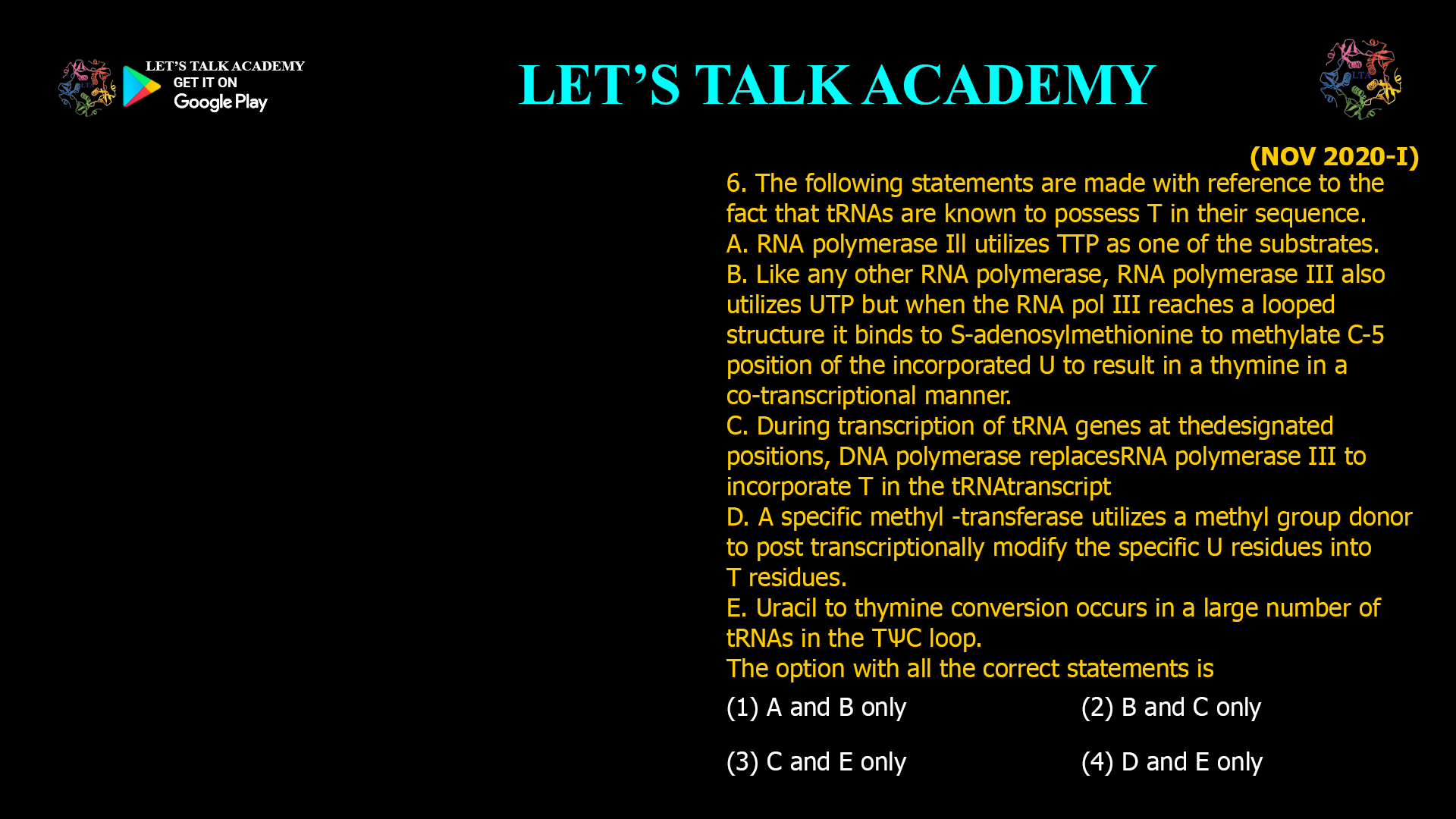
- The following statements are made with reference to the fact that tRNAs are known to possess T in their sequence.
A. RNA polymerase Ill utilizes TTP as one of the substrates.
B. Like any other RNA polymerase, RNA polymerase III also utilizes UTP but when the RNA pol III reaches a looped structure it binds to S-adenosylmethionine to methylate C-5 position of the incorporated U to result in a thymine in a co-transcriptional manner.
C. During transcription of tRNAgenes at thedesignated positions, DNA polymerase replacesRNA polymerase III to incorporate T in the tRNAtranscript
D. A specific methyl –transferase utilizes a methyl group donor to post transcriptionally modify the specific U residues into T residues.
E. Uracil to thymine conversion occurs in a large number of tRNAs in the TѰC loop.
The option with all the correct statements is
(1) A and B only (2) B and C only
(3) C and E only (4) D and E only
Why tRNAs Contain Thymine: Mechanisms and Modifications Explained
Introduction
Transfer RNAs (tRNAs) are unique among RNA molecules because, unlike most RNAs, they contain the base thymine (T) in their sequence, most notably within the TΨC loop. This is surprising since RNA typically contains uracil (U) instead of thymine. Understanding how thymine appears in tRNA is crucial for appreciating the complexity of RNA processing and modification. This article explores the mechanisms behind thymine’s presence in tRNA, evaluates several scientific statements on the topic, and clarifies which explanations are correct according to current molecular biology knowledge.
The Unique Presence of Thymine in tRNA
While DNA contains thymine and RNA contains uracil, tRNA is an exception. In the TΨC loop of tRNA, thymine is commonly found, contributing to the molecule’s stability and function. This thymine does not originate from direct transcription using thymine nucleotides but from chemical modification after the tRNA is synthesized.
Evaluating the Statements
Let’s analyze each statement regarding the origin of thymine in tRNA:
A. RNA polymerase III utilizes TTP as one of the substrates.
-
Incorrect.
RNA polymerase III, like all RNA polymerases, uses ATP, GTP, CTP, and UTP as substrates. Thymidine triphosphate (TTP) is not incorporated directly into RNA during transcription.
B. Like any other RNA polymerase, RNA polymerase III also utilizes UTP but when the RNA pol III reaches a looped structure it binds to S-adenosylmethionine to methylate C-5 position of the incorporated U to result in a thymine in a co-transcriptional manner.
-
Incorrect.
While UTP is used during transcription, RNA polymerase III does not itself methylate uracil to form thymine during transcription. Methylation is a post-transcriptional modification, not a co-transcriptional event mediated by the polymerase.
C. During transcription of tRNA genes at the designated positions, DNA polymerase replaces RNA polymerase III to incorporate T in the tRNA transcript.
-
Incorrect.
DNA polymerase is never involved in RNA synthesis. This statement is not supported by molecular biology principles.
D. A specific methyl-transferase utilizes a methyl group donor to post-transcriptionally modify the specific U residues into T residues.
-
Correct.
This describes the true mechanism. After tRNA is transcribed with uracil at certain positions, a specific methyltransferase enzyme uses a methyl group donor (usually S-adenosylmethionine) to methylate the C-5 position of uracil, converting it into thymine (5-methyluracil). This is a post-transcriptional modification.
E. Uracil to thymine conversion occurs in a large number of tRNAs in the TΨC loop.
-
Correct.
The conversion of uracil to thymine is a well-known modification in the TΨC loop of many tRNAs, contributing to the structural integrity and function of the molecule.
The Correct Combination: D and E Only
Based on the analysis, the correct answer is:
(4) D and E only
The Mechanism: How Thymine Appears in tRNA
-
Transcription:
tRNA genes are transcribed by RNA polymerase III, incorporating uracil (U) at all positions where thymine will eventually appear. -
Post-Transcriptional Modification:
After the tRNA transcript is produced, specific methyltransferase enzymes act on certain uracil residues—especially in the TΨC loop—using S-adenosylmethionine as a methyl group donor. This methylation converts uracil into thymine (5-methyluracil). -
Result:
The mature tRNA contains thymine at designated positions, most notably in the TΨC loop, which is essential for correct tRNA folding and function.
Related Search Keywords Explained
-
tRNA modifications: Chemical changes made to tRNA after transcription, such as methylation.
-
TΨC loop: A conserved loop in tRNA structure containing thymine, pseudouridine, and cytosine.
-
RNA methyltransferase: The enzyme responsible for methylating uracil to produce thymine in tRNA.
-
Post-transcriptional modification: Chemical changes to RNA after it is synthesized, crucial for tRNA function.
Summary Table: Statements and Their Validity
| Statement | Validity | Explanation |
|---|---|---|
| A | No | TTP is not used by RNA polymerase III during transcription. |
| B | No | RNA polymerase III does not methylate uracil during transcription. |
| C | No | DNA polymerase does not participate in RNA synthesis. |
| D | Yes | Methyltransferase converts uracil to thymine post-transcriptionally. |
| E | Yes | This modification occurs in many tRNAs, especially in the TΨC loop. |
Conclusion
The presence of thymine in tRNA is a result of post-transcriptional modification, not direct incorporation during transcription. After tRNA is synthesized with uracil, specific methyltransferases convert select uracil residues—especially in the TΨC loop—into thymine. This process is essential for tRNA stability and function. Therefore, the correct statements are D and E only.
Correct answer:
(4) D and E only


9 Comments
Kirti Agarwal
November 1, 2025Statement D and E is correct
anjani sharma
November 4, 2025The (U) base in the tRNA transcript is modified into (T) (specifically, Ribothymidine) after transcription by an enzyme like TrmA (a methyltransferase) using Sadenosylmethionine (SAM) as the methyl donor.
So answer would be D and E
Sakshi yadav
November 3, 2025Option -4 D and E correct statement
Neha Yadav
November 3, 2025Option 4 -D and E are correct statement
Kajal
November 4, 2025Correct answer is D and E
Dipti Sharma
November 4, 2025D and E are correct bcz post transcriptional thymine provides correct folding to trna and pseudouridine arm of trna convert uracil to thymine.
Heena Mahlawat
November 5, 2025D and E
Roopal Sharma
November 9, 2025D and E
Sakshi Kanwar
December 6, 2025-D and E are correct statement