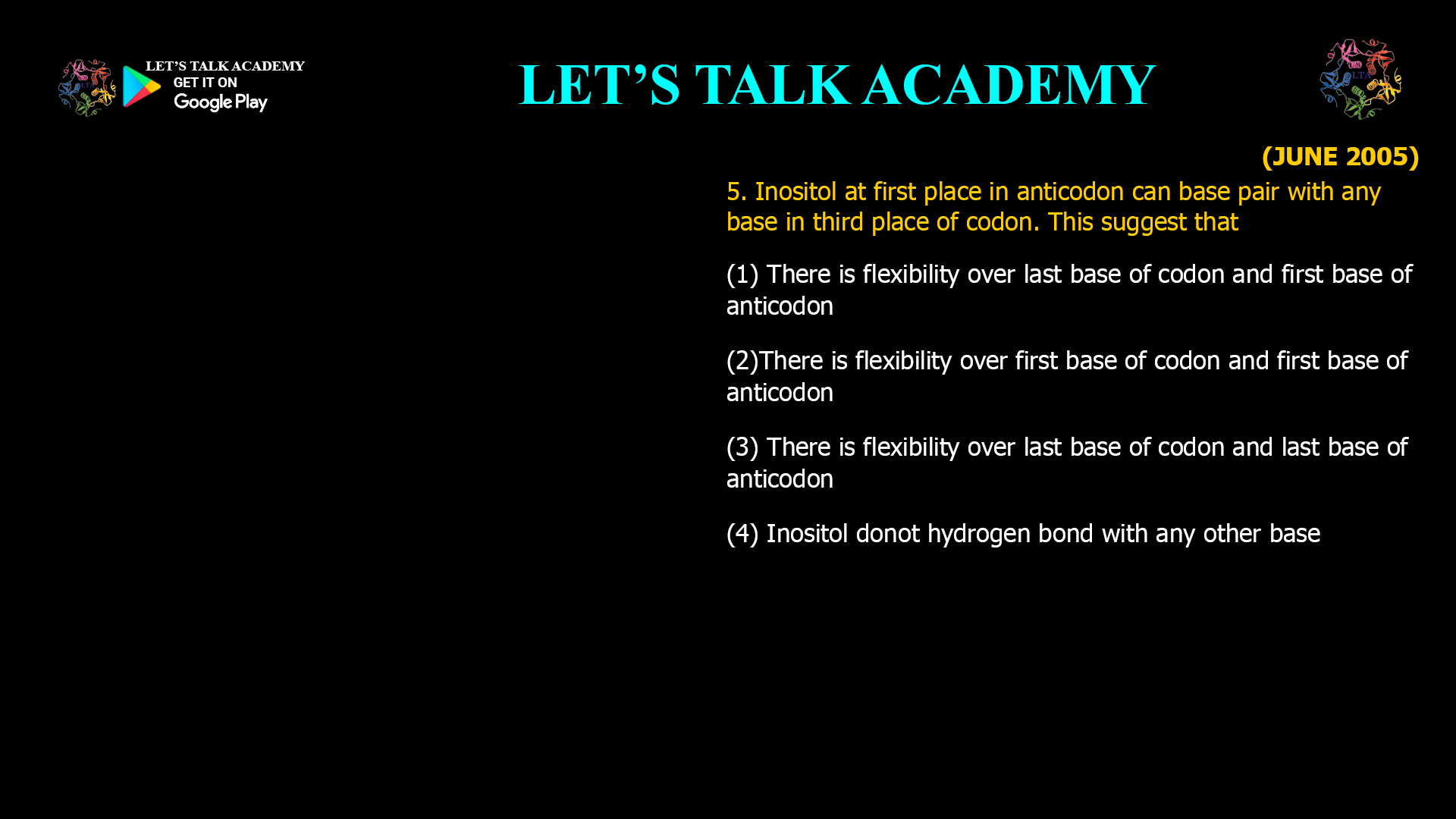
5. Inositol at first place in anticodon can base pair with any base in third place of codon. This suggest that
(1) There is flexibility over last base of codon and first base of anticodon
(2)There is flexibility over first base of codon and first base of anticodon
(3) There is flexibility over last base of codon and last base of anticodon
(4) Inositol donot hydrogen bond with any other base
Inosine in the Anticodon: Flexibility in Codon-Anticodon Pairing Explained
Introduction
The translation of genetic information from mRNA into proteins relies on the precise pairing of codons (on mRNA) and anticodons (on tRNA). However, this process is not as rigid as once believed. The presence of certain modified bases, such as inosine, in tRNA’s anticodon introduces remarkable flexibility at the so-called “wobble position.” This flexibility is crucial for the efficiency and adaptability of protein synthesis. This article explores what it means when inosine is found at the first position of the anticodon and how it affects codon recognition, focusing on the correct interpretation of this molecular phenomenon.
The Wobble Hypothesis: Foundation of Flexibility
Francis Crick’s Wobble Hypothesis explains why the genetic code is degenerate—that is, why multiple codons can code for the same amino acid. According to this hypothesis:
-
The first two bases of the codon form strict Watson-Crick base pairs with the corresponding bases of the anticodon.
-
The third base of the codon (3′ end) and the first base of the anticodon (5′ end) can engage in more flexible, “wobble” pairing.
This flexibility allows one tRNA molecule to recognize multiple codons, reducing the number of tRNAs a cell needs to synthesize all proteins.
Inosine at the Wobble Position
Inosine is a modified nucleotide (derived from adenosine) commonly found at the first position of the anticodon in tRNA (position 34). Its unique chemical structure enables it to base pair with three different nucleotides—adenine (A), uracil (U), or cytosine (C)—at the third position of the codon.
Key Point:
If inosine is present at the first position of the anticodon, it can pair with any base (A, U, or C) at the third position of the codon, greatly expanding the decoding capacity of that tRNA.
Why Does This Flexibility Matter?
-
Genetic Code Degeneracy: The genetic code has 61 codons for amino acids, but cells typically have fewer than 61 tRNAs. Wobble pairing, especially involving inosine, allows a single tRNA to recognize multiple codons, explaining this discrepancy.
-
Efficiency: This reduces the cellular burden of synthesizing a unique tRNA for every codon.
-
Evolutionary Advantage: Flexibility at the wobble position allows organisms to adapt to mutations and codon usage bias without compromising protein synthesis.
Which Statement Is Correct?
Given the question:
Inosine at first place in anticodon can base pair with any base in third place of codon. This suggests that…
Let’s analyze the options:
-
There is flexibility over last base of codon and first base of anticodon
This is correct. The wobble hypothesis specifically describes flexibility between the third base of the codon (the “last” base, 3′ end) and the first base of the anticodon (the “first” base, 5′ end). -
There is flexibility over first base of codon and first base of anticodon
Incorrect. The first base of the codon pairs strictly with the third base of the anticodon. -
There is flexibility over last base of codon and last base of anticodon
Incorrect. The last base of the anticodon pairs with the first base of the codon, but wobble flexibility is not observed here. -
Inosine does not hydrogen bond with any other base
Incorrect. Inosine can hydrogen bond with A, U, or C at the third codon position.
Correct answer:
(1) There is flexibility over last base of codon and first base of anticodon
Related Search Keywords Explained
-
Wobble base pair: Non-standard pairing at the third codon position, often involving inosine, guanine, or uracil.
-
tRNA wobble: The phenomenon where tRNA anticodons can recognize multiple codons due to flexible pairing at the wobble position.
-
Codon-anticodon pairing: The interaction between mRNA codons and tRNA anticodons during translation.
-
Inosine pairing: The ability of inosine to pair with A, U, or C at the third codon position.
Summary Table: Wobble Pairing Rules
| Anticodon Base (1st position, 5′ end) | Codon Base (3rd position, 3′ end) | Pairing Flexibility |
|---|---|---|
| C | G | Strict (Watson-Crick) |
| A | U | Strict (Watson-Crick) |
| U | A or G | Moderate |
| G | U or C | Moderate |
| I (Inosine) | A, U, or C | High (maximum wobble) |
Conclusion
The presence of inosine at the first position of the tRNA anticodon exemplifies the wobble hypothesis, providing essential flexibility in genetic decoding. This flexibility occurs specifically between the last base of the codon and the first base of the anticodon, allowing efficient and accurate translation of the genetic code with fewer tRNA molecules. Understanding this molecular mechanism is key to appreciating the elegance and adaptability of the translation process in all living cells.
Correct answer:
There is flexibility over last base of codon and first base of anticodon


10 Comments
Kirti Agarwal
November 1, 2025Statement 1
Neha Yadav
November 3, 2025There is flexibility over last base of codon and first base of anticodon
Kajal
November 4, 2025Correct answer is There is flexibility over last base of codon and first base of anticodon
Mohd juber Ali
November 4, 2025Wobble hypothesis
(3’ end )last base of codon and first base of anticodon
Deepika Sheoran
November 4, 2025Wobble Hypothesis
Flexibility over last base of codon and first base of Anticodon.
anjani sharma
November 4, 2025There is flexibility over last base of codon and first base of anticodon
Dipti Sharma
November 4, 2025There is flexibility over last base of codon and first base of anticodon.
Heena Mahlawat
November 5, 2025Option 1
Roopal Sharma
November 9, 2025Statement 1 is correct
Sakshi Kanwar
December 6, 2025There is flexibility over last base of codon and first base of anticodon