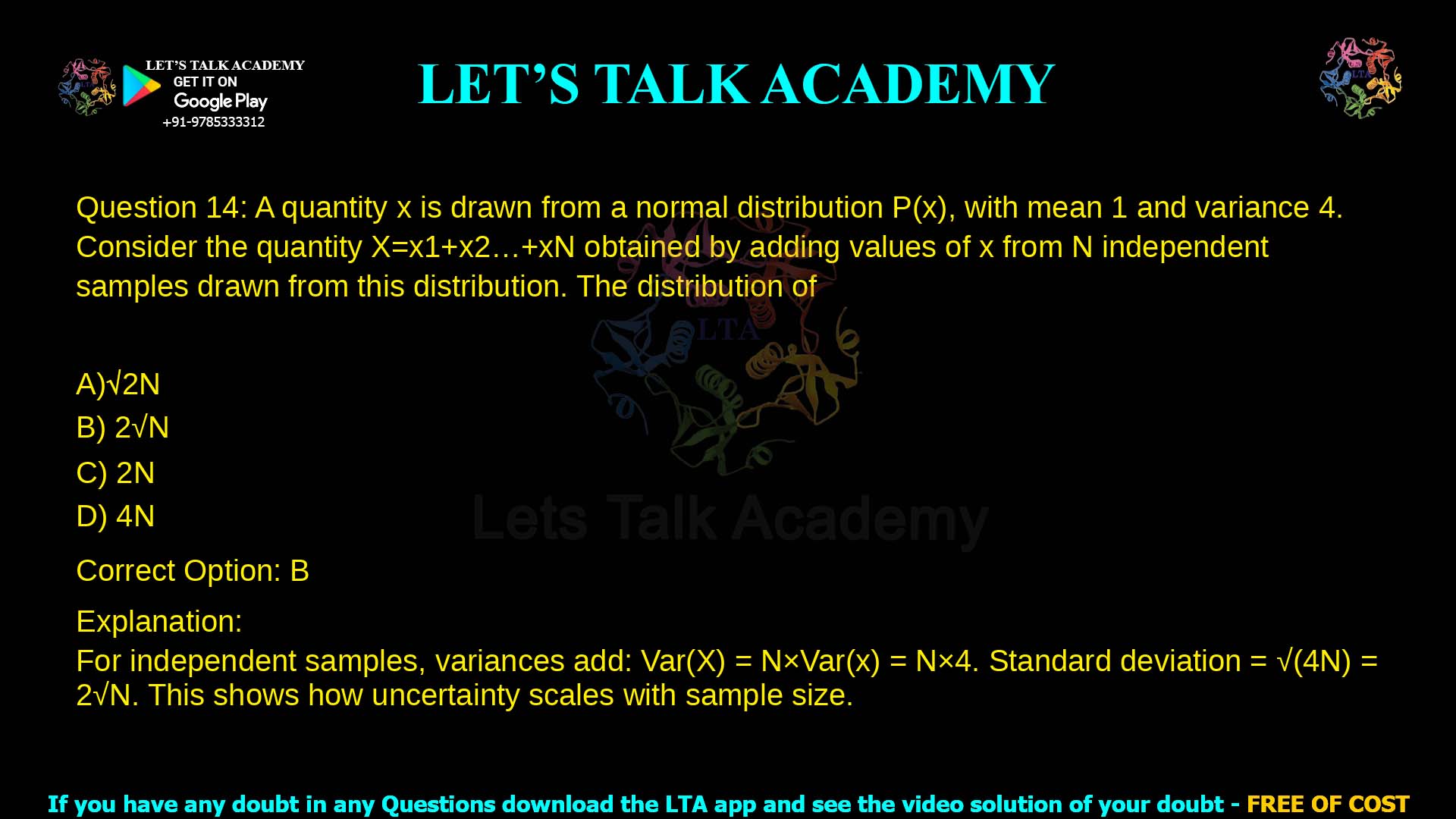
14. A quantity x is drawn from a normal distribution P(x), with mean 1 and variance 4.
Consider the quantity X=x1+x2…+xN obtained by adding values of x from N independent
samples drawn from this distribution. The distribution of X has a standard deviation of
a. 2𝑁
b. 2 𝑁
c. 2𝑁
d. 4𝑁
Question: A quantity x follows a normal distribution with mean 1 and variance 4, so its standard deviation equals 2.
X represents the sum of N independent samples from this distribution. Find the standard deviation of X.
Solution Derivation
Each \( x_i \sim N(1, 4) \), where variance \( \sigma^2 = 4 \) implies \( \sigma = 2 \).
For independent normal variables, the sum
\( X = x_1 + x_2 + \dots + x_N \)
follows \( N(N \times 1, N \times 4) \).
The standard deviation equals:
√(N × 4) = 2√N
This matches option (b).
Option Analysis
- a. 2N: Scales linearly with N, incorrect since variance adds, not standard deviations.
- b. 2√N: Correct; \( \sqrt{N \sigma^2} = \sigma \sqrt{N} = 2\sqrt{N} \).
- c. 2/N: Shrinks with N; applies to sample mean, not the sum.
- d. 4N: Overestimates due to incorrect variance scaling.


