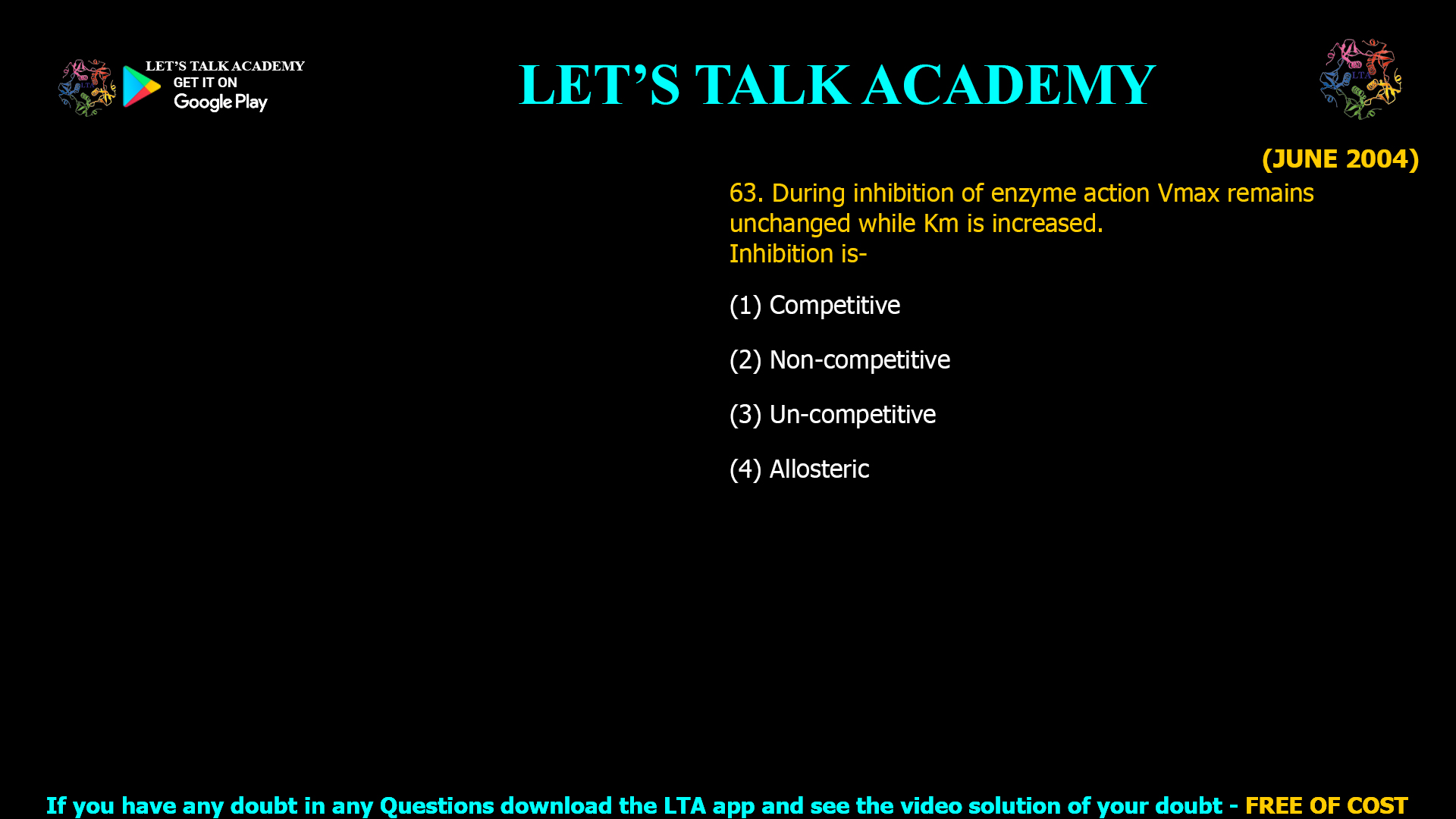
(JUNE 2004)
63. During inhibition of enzyme action Vmax remains unchanged while Km is increased.
Inhibition is-
(1) Competitive (2) Non-competitive
(3) Un-competitive (4) Allosteric
The correct answer is (1) Competitive.
Introduction
Enzyme inhibition is a crucial concept in biochemistry, with different types affecting enzyme kinetics distinctively. Competitive inhibition occurs when an inhibitor competes with the substrate for binding to the enzyme’s active site. This competition affects the substrate affinity and kinetic parameters in a characteristic way: increasing the Michaelis constant (Km) while leaving the maximum reaction velocity (Vmax) unchanged. This guide explains how and why competitive inhibition affects these parameters and distinguishes it from other inhibition types.
Competitive Inhibition Defined
-
In competitive inhibition, the inhibitor resembles the substrate and binds directly to the active site, preventing substrate binding.
-
The inhibitor binding is reversible: increasing substrate concentration can overcome inhibition.
-
This increases the apparent Km because higher substrate levels are required to achieve half-maximal velocity when inhibitors occupy active sites.
Effect on Km and Vmax
-
Km increases: Due to competition, effective substrate affinity appears reduced.
-
Vmax unchanged: If enough substrate is present, it can outcompete the inhibitor to reach the enzyme’s maximum catalytic rate.
Distinguishing Other Inhibition Types
-
Non-competitive inhibition: Inhibitor binds to a different site; lowers Vmax but Km remains constant.
-
Uncompetitive inhibition: Inhibitor binds only to enzyme-substrate complex, lowering both Km and Vmax.
-
Allosteric regulation: Modulators bind at regulatory sites; kinetics may deviate from Michaelis-Menten.
Summary Table
| Inhibition Type | Km Effect | Vmax Effect | Binding Site |
|---|---|---|---|
| Competitive | Increases | Unchanged | Active site |
| Non-competitive | Unchanged | Decreases | Allosteric site |
| Uncompetitive | Decreases | Decreases | ES complex |
| Allosteric | Variable | Variable | Regulatory sites |
Biological and Pharmacological Significance
-
Competitive inhibitors are the basis for many drugs, such as statins and HIV protease inhibitors.
-
Understanding inhibition types guides drug design and therapeutic strategies.
Conclusion
When enzyme inhibition results in increased Km but unchanged Vmax, competitive inhibition is responsible. This reflects inhibitor competition at the enzyme’s active site, reversible by high substrate concentration. This foundational kinetic principle distinguishes competitive from other inhibition types.
This detailed explanation supports students and researchers in correctly interpreting enzyme kinetics to understand inhibitor mechanisms in biochemical systems.


44 Comments
Divyanshi Vaishnav
September 12, 2025In enzyme inhibiton the km is increase and vmax is unchanged because of competitive inhibition it prenset on enzymes active side and reversible by high substrate concentration.
Mahima Sharma
September 18, 2025Competitive inhibition
Kirti Agarwal
September 12, 2025Ccompetitive
Kajal
September 12, 2025Option A is correct as in competative inhibition the value of vmax.remain unchanged.
Khushi Vaishnav
September 12, 2025Competitive inhibition of enzyme action Vmax remains unchanged while Km is increased.
anjani sharma
September 12, 2025Answer a
In competitive inhibition the inhibitor is in Competition with substrate for binding
So the value of km is increased
Bharti yadav
September 13, 2025In competitive inhibition Vmax remain unchanged while km is increased.
yashika
September 13, 2025Competitive
Kanica Sunwalka
September 13, 2025in competitive inhibition ,
inhibitor binds at the active site of enzyme
so , affinity of substrate towards enzyme gets reduced , km increased
Vmax – unchanged
Aakansha sharma Sharma
September 13, 2025The correct answer is (1) Competitive.
Rishita
September 14, 2025Competitive
Pratibha Jain
September 14, 2025correct answer is option (1) Competitive.
Santosh Saini
September 14, 2025In competitive inhibition, Vmax stays same and km increase.
Mohd juber Ali
September 14, 2025Competative inhibition
Affinity (low )
km high
V max calculated at infinite concentration of substarte all enzymes are in the form of ES complex not even a single enzyme is free so Vmax not changed
Aartii sharma
September 14, 2025Compititive
Dharmpal Swami
September 14, 2025Competitive inhibition= km is increase and affinity are decrease
Vmax are not effected
Pooja
September 14, 2025Option A is correct
Khushi Agarwal
September 14, 2025Option A is correct answer During inhibition of enzyme action Vmax remains unchanged while Km is increased.
Inhibition is Competitive corporation
Konika Naval
September 14, 2025Competitive
Pallavi Ghangas
September 14, 2025In competitive inhibition km increases affinity of substrate to bind enzyme decreases and Vmax is same
Palak Sharma
September 14, 2025Competitive inhibition= km increases but
Vmax is not affected.
Sakshi yadav
September 14, 2025Competative inhibition=km inc , affinity dec.,and vmax = not changed
Deepika sheoran
September 14, 2025Competative inhibition= km increases & affinity decrease .but Vmax is not affected.
Ankita Pareek
September 14, 2025Competitive inhibition because in this inhibition km increases as due to competition substrate affinity become low and Vmax unchanged
Priya dhakad
September 14, 2025In competitive inhibition , vmax remains unchanged but km increases.
Sakshi Kanwar
September 14, 2025Competitive inhibition occurs when an inhibitor competes with the substrate for binding to the enzyme’s active site.
Soniya Shekhawat
September 15, 2025Competitive inhibition km increase and vmax unchanged .
Aafreen Khan
September 15, 2025Competitive inhibition because it occurs when an inhibitor competes with the substrate for binding to the enzymes active site and in this inhibition Km increase due to substrate affinity is low and Vmax is unchanged
Vanshika Sharma
September 15, 2025Competitive inhibition bcz it occurs when an inhibitor compets with subs to binds with enzymes active site
Bhawna Choudhary
September 15, 2025Option 1st is correct because in competitive inhibition Vmax remain unchanged while km is increased
Samiksha bajiya
September 15, 2025In copmpitative inhibition inhibitor binds at the active site of enzyme so the affinity of substrate towards enzyme decrease and km increases
Devika
September 16, 2025Competetive
Anjana sharma
September 16, 2025In competitive inhibition value of km increase while value of vmax unchanged
Nilofar Khan
September 16, 2025correct answer is (1) Competitive.
In competitive inhibition km value increase but Vmax remain unchanged.
Payal Gaur
September 16, 20251. Competitive (Vmax unchanged and km is increase) affinity of enzyme substrate complex is decrease.
Tanvi Panwar
September 16, 2025Competitive
Vmax. is calculated at infinite substrate concentration and at infinite substrate concentration all enzymes are in the form of ES , so Vmax. will be unaffected.
Lokesh Kumawat
September 17, 2025Competitive
Priya khandal
September 17, 2025Competitive
Avni
September 17, 2025The correct answer is (1) Competitive.
Divya rani
September 19, 2025In competitive inhibition value of vmax remain same because at infinite concentration of substrate all Enzyme present in The form of ES complex and km increase.
Minal Sethi
September 19, 2025Competitive because at infinite concentration all enzymes are present in ES complex form not a single enzyme is free so Vmax remains same
Muskan Yadav
September 19, 2025When enzyme inhibition results in increased KmKm but unchanged VmaxVmax, competitive inhibition is responsible.
Kajal
September 25, 2025correct answer is (1) Competitive
Sachin kant sharma
September 29, 2025Answer is A