- The ColE1 plasmid has a low to medium copy number. However, pUC18, which is also a ColE1- based plasmid, has a high copy number because:
(1) It has a mutation in RNAI (antisense RNA) and does not carry the rop gene.
(2) It has a mutation in RNAII (primer for replication initiation) and does not carry the rop gene.
(3) It has a mutation in RNAI and the rop gene is overexpressed.
(4) It has a mutation in RNAII and the rop gene is overexpressed.
Background: ColE1 vs pUC18 Plasmid Replication Control
-
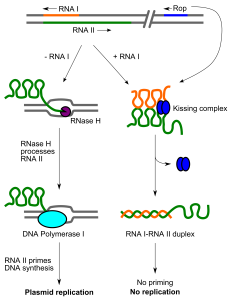
ColE1 plasmid is a low to medium copy number plasmid found in bacteria, regulated by two RNA molecules:
-
RNAI: An antisense RNA that inhibits replication initiation.
-
RNAII: The RNA primer that initiates replication.
-
-
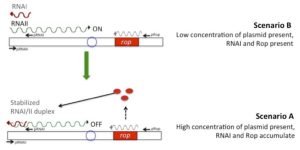
The Rop protein (also called Rom) enhances the interaction between RNAI and RNAII, strengthening negative regulation and maintaining low copy number.
Why pUC18 Has a High Copy Number
Why pUC18 Has a High Copy Number
-
Mutation in RNAII:
pUC18 carries a point mutation in RNAII, which reduces its ability to be inhibited by RNAI. This mutation weakens the negative regulation, allowing more frequent initiation of replication. -
Absence of the rop gene:
pUC18 lacks the rop gene, so the Rop protein is not produced. Without Rop, the RNAI-RNAII interaction is less stable, further loosening replication control. -
Together, these changes increase the frequency of replication initiation, resulting in a significantly higher plasmid copy number compared to the original ColE1 plasmid.
Explanation of Options
| Option | Explanation | Correctness |
|---|---|---|
| (1) It has a mutation in RNAI and does not carry the rop gene | Incorrect. Mutation is in RNAII, not RNAI. | |
| (2) It has a mutation in RNAII and does not carry the rop gene | Correct. This combination explains high copy number in pUC18. | |
| (3) It has a mutation in RNAI and the rop gene is overexpressed | Incorrect. No mutation in RNAI; rop is absent, not overexpressed. | |
| (4) It has a mutation in RNAII and the rop gene is overexpressed | Incorrect. rop gene is absent, not overexpressed. |
Summary Table
| Feature | ColE1 Plasmid | pUC18 Plasmid |
|---|---|---|
| RNAI | Wild type | Wild type |
| RNAII | Wild type | Point mutation reducing inhibition |
| Rop gene (rom) | Present | Absent |
| Copy number | Low to medium | High (200-700 copies per cell) |
Conclusion
The high copy number of pUC18 compared to the ColE1 plasmid is due to a mutation in RNAII, which impairs its inhibition by RNAI, combined with the absence of the rop gene, which normally enhances this inhibition. This dual effect releases stringent control on replication initiation, allowing pUC18 to replicate at a much higher copy number.
Keywords
pUC18, ColE1 plasmid, plasmid copy number, RNAII mutation, RNAI, rop gene, plasmid replication control, antisense RNA, plasmid origin of replication, bacterial plasmids
Final answer:
(2) It has a mutation in RNAII (primer for replication initiation) and does not carry the rop gene


7 Comments
Mohini
July 30, 2025The correct answer is 2.
Santosh Saini
July 30, 2025The correct option is 2
Vijay kumar Meena
July 30, 20252 ✔️
Mahima Sharma
August 3, 2025No idea 💡
Aafreen Khan
August 23, 2025Ans-2 It has a mutation in RNAII and does not carry the rop gene
Komal Sharma
September 30, 2025The high copy number of pUC18 compared to the ColE1 plasmid is due to a mutation in RNAII, which impairs its inhibition by RNAI, combined with the absence of the rop gene, which normally enhances this inhibition. This dual effect releases stringent control on replication initiation, allowing pUC18 to replicate at a much higher copy number.
Rishu
April 9, 20262nd is the correct answer