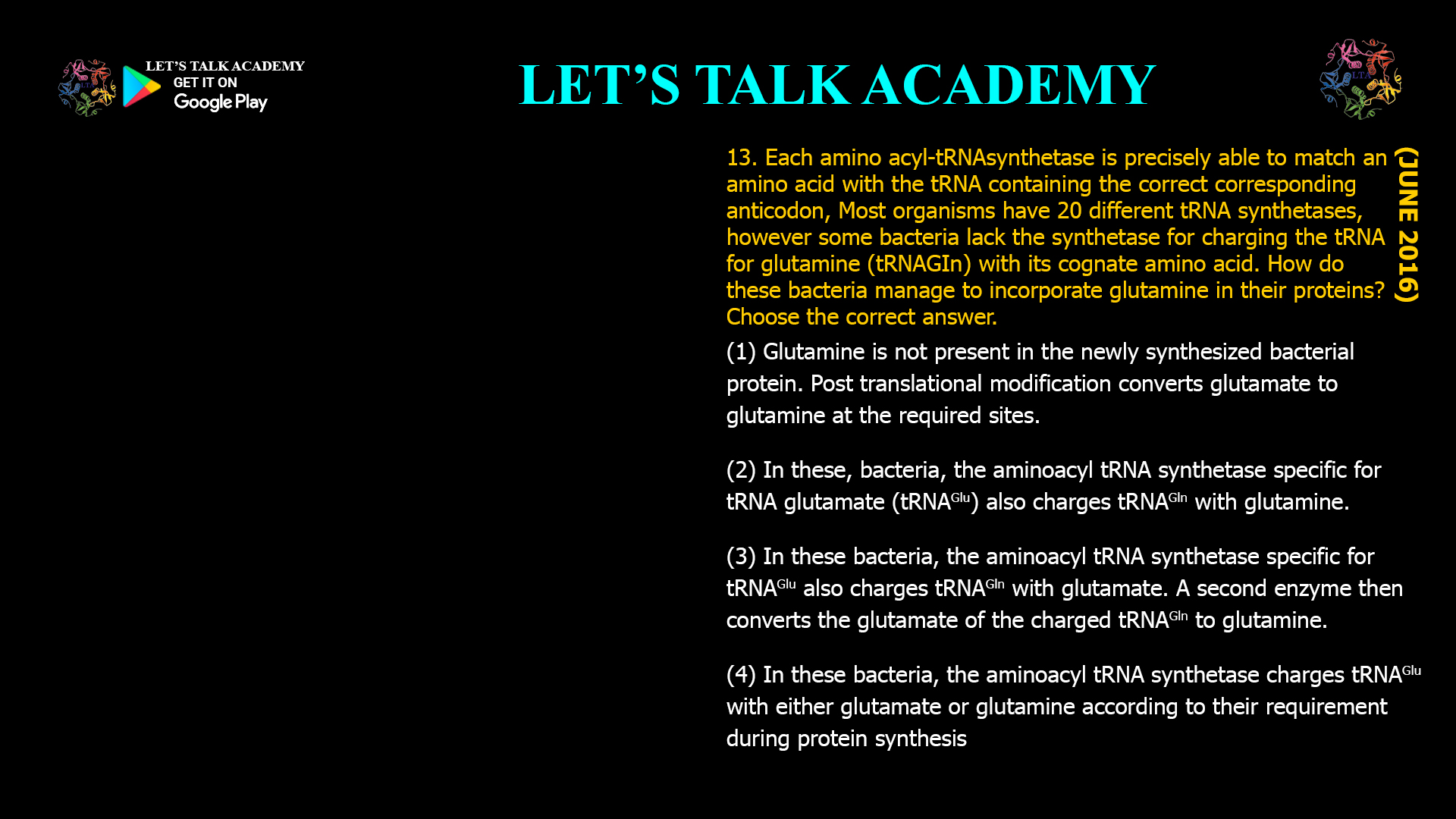
- Each amino acyl-tRNAsynthetase is precisely able to match an amino acid with the tRNA containing the correct corresponding anticodon, Most organisms have 20 different tRNAsynthetases, however some bacteria lack the synthetase for charging the tRNA for glutamine (tRNAGIn) with its cognate amino acid. How do these bacteria manage to incorporate glutamine in their proteins? Choose the correct answer.
(1) Glutamine is not present in the newly synthesized bacterial protein. Post translational modification converts glutamate to glutamine at the required sites.
(2) In these, bacteria, the aminoacyl tRNAsynthetasespecific for tRNA glutamate (tRNAGlu) also charges tRNAGlnwith glutamine.
(3) In these bacteria, the aminoacyl tRNAsynthetase specific for tRNAGlualso charges tRNAGln with glutamate. A second enzyme then converts the glutamate of the charged tRNAGln to glutamine.
(4) In these bacteria, the aminoacyl tRNAsynthetasecharges tRNAGlu with either glutamate or glutamine according to their requirement during protein synthesisHow Some Bacteria Incorporate Glutamine Without a Dedicated Glutaminyl-tRNA Synthetase
Aminoacyl-tRNA synthetases (aaRSs) are essential enzymes that attach specific amino acids to their corresponding tRNAs, ensuring accurate translation of the genetic code. Most organisms have 20 different aaRSs, one for each amino acid. However, some bacteria lack a dedicated glutaminyl-tRNA synthetase (GlnRS) for charging tRNA^Gln with glutamine. This raises the question: how do these bacteria incorporate glutamine into proteins?
The Indirect Pathway for Glutamine Incorporation
-
In bacteria lacking GlnRS, the glutamyl-tRNA synthetase (GluRS) charges tRNA^Gln with glutamate instead of glutamine.
-
This mischarged tRNA^Gln (carrying glutamate) is then modified by a second enzyme called glutamyl-tRNA^Gln amidotransferase, which converts the attached glutamate into glutamine while still bound to the tRNA.
-
This two-step process is known as the indirect pathway of glutaminyl-tRNA formation.
-
The result is a correctly charged tRNA^Gln with glutamine, ready for incorporation into the growing polypeptide chain during translation.
Why Other Options Are Incorrect
-
Option 1: Glutamine is indeed incorporated during translation, not post-translationally modified from glutamate residues.
-
Option 2: GluRS does not directly charge tRNA^Gln with glutamine; it charges it with glutamate.
-
Option 4: The synthetase does not charge tRNA^Glu with glutamine; charging specificity is strict.
Biological Significance
-
This indirect charging mechanism is common in many bacteria and archaea and is an example of evolutionary adaptation to enzyme availability.
-
It ensures that glutamine is incorporated accurately despite the absence of a dedicated GlnRS.
-
The amidotransferase enzyme plays a crucial proofreading role, preventing mistranslation.
Summary Table
Option Description Correctness (1) Glutamine absent in proteins; post-translational modification converts glutamate to glutamine Incorrect (2) GluRS charges tRNA^Gln directly with glutamine Incorrect (3) GluRS charges tRNA^Gln with glutamate; amidotransferase converts glutamate to glutamine Correct (4) GluRS charges tRNA^Glu with glutamate or glutamine Incorrect
Keywords for SEO Optimization
-
Glutaminyl-tRNA synthetase absence
-
Indirect glutamine incorporation pathway
-
Glutamyl-tRNA synthetase and tRNA^Gln
-
Glutamyl-tRNA amidotransferase function
-
Bacterial translation mechanisms
-
Aminoacyl-tRNA synthetase specificity
-
tRNA charging and editing
-
Protein synthesis in bacteria
-
Evolution of aminoacyl-tRNA synthetases
-
Translation fidelity in prokaryotes
Conclusion
In bacteria that lack a dedicated glutaminyl-tRNA synthetase, glutamine incorporation into proteins is achieved through an indirect pathway. The glutamyl-tRNA synthetase charges tRNA^Gln with glutamate, and a specialized amidotransferase enzyme converts the attached glutamate to glutamine. This elegant mechanism ensures accurate protein synthesis despite the absence of GlnRS.
Correct answer: (3) In these bacteria, the aminoacyl tRNAsynthetase specific for tRNAGlu also charges tRNAGln with glutamate. A second enzyme then converts the glutamate of the charged tRNAGln to glutamine.
-


5 Comments
Kirti Agarwal
November 1, 2025Statement 3 is correct
Sakshi yadav
November 3, 2025In these bacteria, the aminoacyl tRNA synthetase specific for tRNA Glu also charges tRNA Gln with glutamate. A second enzyme then converts the glutamate of the charged tRNA Gln to glutamine.
Kajal
November 4, 2025The Correct answer is (3) In these bacteria, the aminoacyl tRNAsynthetase specific for tRNAGlu also charges tRNAGln with glutamate. A second enzyme then converts the glutamate of the charged tRNAGln to glutamine.
Heena Mahlawat
November 5, 2025Option 3
Mohd juber Ali
November 7, 2025Statement 3 is right